





Every Reacher Season Ranked – Which Prime Video Season Is the Best?

Every Reacher Season Ranked – Which Prime Video Season Is the Best?
Finding the best season of Reacher sounds simple until you try to choose between four very different kinds of trouble. This ranking gives you a clear answer, explains what each season does best, and helps you decide which chapter of Prime Video’s action thriller is most worth revisiting.
One season introduces Jack Reacher through a small-town murder mystery. Another reunites him with the people who knew him before he became a drifter. A third sends him undercover, where being the biggest person in the room no longer guarantees that he is in control. The fourth drops him into a dangerous conspiracy that begins with a stranger on a subway.
They all share the same attraction: Alan Ritchson as Lee Child’s formidable former military investigator. Reacher walks into a place, spots the detail everyone else missed, and usually discovers that somebody has made a terrible mistake by underestimating him. It is an enormously satisfying premise. It is also easy for a show built around that premise to become repetitive.
That is why the differences between seasons matter. A great Reacher season needs more than memorable fights. It needs a mystery that keeps moving, supporting characters who can challenge its hero, antagonists who feel worth the effort, and enough humour to stop the violence becoming exhausting. Most of all, it needs to remember that Reacher’s best weapon is not his size. It is the way he thinks.
This is an editorial ranking of the four completed seasons, not a list ordered by review scores or viewing figures. It is largely spoiler-free: you will learn each season’s starting premise and strengths, but not its major reveals or final outcomes. All four seasons are available on Prime Video, and a fifth—based on Lee Child’s Make Me—has been confirmed. Prime Video’s series guide has the current official details.
So, which season earns the top spot? Let’s get into it 👇
Support That Love Podcast
Enjoying the recommendations? You can help support That Love Podcast and keep independent entertainment content like this coming. Donate to That Love Podcast.
If you love this, check out: Top 20 Amazon Prime Video TV Shows to Watch Right Now.
Need something to listen to after your binge? Discover the latest That Love Podcast episodes.
Want to Reach Entertainment Fans?
If you’re a brand, author, publisher, streaming company or creator looking to reach an engaged audience, That Love Podcast offers advertising opportunities across the website, podcast and newsletter. Find out more about advertising with us.
How We Ranked the Four Reacher Seasons
Before the countdown, a quick word about what “best” means here. Reacher is not trying to be the most realistic crime drama on television. Its hero is unusually perceptive, unusually capable in a fight and unusually likely to encounter a conspiracy during what should have been a quiet stop on the road. Judging it solely by plausibility would be like judging a chocolate cake for failing to contain enough vegetables.
That does not mean the writing gets a free pass. The most successful seasons make Reacher’s extraordinary abilities entertaining while still giving him something difficult to solve. They make the clues matter. They allow other characters to bring skills he does not possess. And when a fight arrives, it feels like the result of choices and escalating pressure, not a scene inserted because the episode has gone ten minutes without somebody hitting a wall.
We considered five qualities: the central mystery, the supporting cast, the villains, the action and the season’s rewatch value. We also asked how effectively each adaptation uses its source novel without requiring you to have read it. Prime Video has taken a one-book-per-season approach, drawing on Killing Floor, Bad Luck and Trouble, Persuader and Gone Tomorrow for Seasons 1–4 respectively. Because the books were not adapted in publication order, you do not need to read a dozen novels to understand what is happening onscreen.
One final distinction: the season at No. 4 is still worth watching. This is a ranking of a consistently enjoyable action series, not a warning that the bottom entry should be skipped. If you especially love stories about found family or large-scale conspiracies, your list may look quite different from mine.
4. Reacher Season 2 – The Team-Up That Changes the Formula

Season 2 makes one of the boldest choices the series has attempted: it reminds us that Jack Reacher had a life—and people who mattered to him—before he started travelling alone. Based on Lee Child’s Bad Luck and Trouble, the story begins when members of Reacher’s old Army unit, the 110th Special Investigations, are targeted. A coded message pulls him back toward Frances Neagley and the surviving teammates who can help uncover who is responsible. Prime Video’s Season 2 guide confirms the book and central cast.
That is a strong premise. It gives the danger personal weight immediately, and it lets the show explore a side of Reacher that a stranger in a new town cannot always draw out. Maria Sten’s Neagley is particularly important: she understands his methods, knows when he is withholding something, and does not treat his intimidating reputation as an answer to every question. Serinda Swan’s Karla Dixon and Shaun Sipos’s David O’Donnell add different energies to the reunited team.
There is genuine pleasure in watching capable people work together. Their shared history gives the series a sense of loyalty that the more solitary seasons cannot reproduce. It also reveals something unexpectedly tender about Reacher. He may prefer travelling light, but he has not stopped caring about the people he once trusted with his life.
The trouble is that the team dynamic also changes the show’s balance. Reacher is usually most interesting when he arrives somewhere with little information and has to work out its hidden rules. Here, he begins with a group that already speaks his language. That can make the investigation feel less like an outsider slowly cracking a hostile place and more like a highly effective squad moving through a thriller plot.
The larger scale brings more action and more moving pieces, but not every turn feels as elegant as the simple chain of clues that drives Season 1. At moments, the season seems more interested in letting its characters demonstrate how dangerous they are than in making the audience solve the mystery alongside them. If that is exactly what you want from an action series, you may love it more than this ranking suggests.
Season 2 is still essential viewing, especially before Neagley. It makes Frances more than the clever ally who occasionally turns up to help Reacher. It gives her a history, a professional identity and a relationship with him that can support a story of its own. It is also the season that most clearly argues that Reacher’s chosen family may be the one possession he has never really left behind.
Why fourth, then? Because its best idea—the return of the 110th—occasionally crowds out the loner-detective appeal that makes Reacher distinctive. The team is excellent company. I simply find the show sharper when Reacher has to build trust from scratch.
Best for: Viewers who enjoy ensemble action, old-team reunions and mysteries with personal stakes.Where to watch: Stream Season 2 on Prime Video.
🎧 Need something to listen to after your binge? Discover original romantic audio dramas, comedies and stories from That Love Podcast: Listen to That Love Podcast.
3. Reacher Season 4 – A Darker Mystery That Makes Him Work for Answers
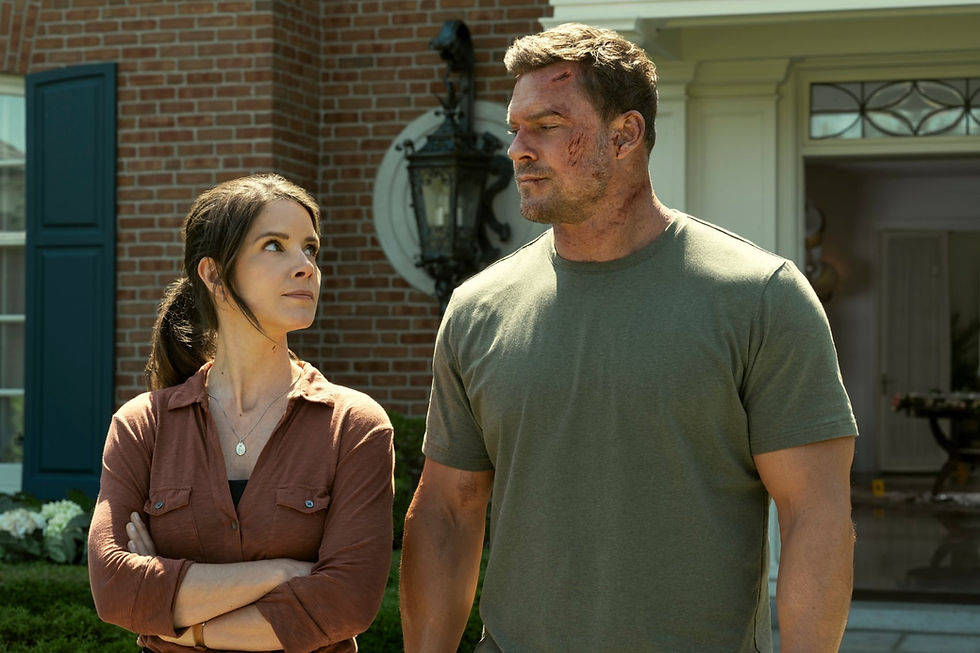
Season 4 begins with a moment that is both ordinary and awful: Reacher notices a distressed stranger on a subway, and the encounter draws him into a much bigger case. Adapted from Gone Tomorrow, the season trades the straightforward appeal of a small-town investigation for a wider, darker conspiracy. Prime Video describes it as a deadly game involving powerful opponents. Its official Season 4 guide confirms the source novel and streaming release.
This is a smart way to test a familiar character. By the fourth season, viewers know Reacher can win most physical confrontations. Suspense has to come from something other than wondering whether he can throw a punch. The Gone Tomorrow premise starts with incomplete information and asks him—and us—to reconsider what appeared obvious at first. The strongest stretches of the season are driven by that uncertainty.
Alan Ritchson has grown increasingly comfortable with the role. He understands that Reacher’s stillness can be as entertaining as his movement. A pause before a question, a flat response to a threat, or a sudden change in where he directs his attention can do more work than another speech explaining how clever he is. Season 4 benefits from a leading performance that trusts the audience to notice those details.
It is also a season with a more complicated critical and audience response than a quick “everyone loved it” claim would suggest. Rotten Tomatoes’ Season 4 page records strong critic approval alongside a more divided audience rating. Scores are snapshots, not verdicts, but the gap reflects a real question: does a darker, more intricate Reacher story deepen the formula, or make it less breezily satisfying?
For me, the answer is somewhere in the middle. I admire the attempt to make the mystery denser and the danger less predictable. The opening hook is excellent, and the season gives Reacher more to do than move from one increasingly large fight to another. Yet its seriousness can sometimes squeeze out the easy rapport and dry humour that make the best episodes such a pleasure. A complex conspiracy also demands careful pacing; if the show spends too long explaining connections, the momentum can briefly sag.
That tension is exactly why Season 4 belongs above Season 2 but below the top two. It is more willing to challenge Reacher’s certainty, and its central puzzle is more interesting to pick apart. It is not always as clean or as emotionally immediate as the seasons above it.
If you prefer an action thriller with more shadows, more moving parts and a sense that even Reacher may not fully understand the game he has entered, this could be your No. 1. If you come to the series for small-town atmosphere and the pleasure of watching him dismantle corruption one clue at a time, you may find it impressive without finding it quite as lovable.
Best for: Viewers who want the most conspiracy-driven Reacher season.
Where to watch: Stream Season 4 on Prime Video.
For another take on Prime Video’s action and crime slate, you’ll also love: Uncover the 6 Best Shows on Amazon Prime Video Right Now.
Why the Ranking Gets Harder From Here
The top two seasons make particularly strong cases for first place because they solve opposite problems. Season 1 has the advantage of discovery. We do not yet know how Reacher operates, and neither do the people around him. Every demonstration of his observational skill or fighting ability feels like a new piece of information.
Season 3 cannot recreate that surprise, so it does something more interesting: it places him in a situation where simply identifying the bad people is not enough. He has to stay close to them. He has to manage what they think they know about him. And he has to reckon with unfinished business from his own past.
That difference comes down to the kind of tension you prefer. Season 1 asks, “What is wrong with this town, and how will Reacher expose it?” Season 3 asks, “How long can he remain inside a dangerous operation before his plan collapses?” Both are excellent engines for a binge-worthy thriller. The final choice depends on whether you value the franchise’s original promise or its best reinvention.
🎧 Taking a break from the screen? Listen to original romance and drama stories from That Love Podcast. Explore the latest episodes.
Advertise With That Love Podcast
Want to put your book, entertainment brand, streaming service, product or business in front of readers who love movies, television, books and pop culture? That Love Podcast offers sponsorship and advertising opportunities across the website, podcast and newsletter. Learn more.
2. Reacher Season 3 – The Undercover Story That Finds a Worthy Threat

I understand why so many viewers would put Season 3 first. Based on Persuader, it sends Reacher into an undercover operation connected to a criminal import business. He becomes involved in an effort to rescue an undercover DEA informant, while a figure from his own past gives the case a more personal edge. Prime Video’s Season 3 cast guide outlines the setup and its principal players.
It is an inspired premise for this particular hero. Reacher usually walks into a situation and makes people nervous by refusing to pretend he is less capable than he is. Undercover work requires the opposite kind of control. He needs to be persuasive without giving too much away, useful without appearing too curious, and ready to act without acting too soon. Watching him operate under those limits is more suspenseful than simply watching people discover that they have picked a fight with the wrong man.
The supporting cast helps give the story texture. Sonya Cassidy’s DEA agent Susan Duffy provides an intelligent, sharp-tongued counterpart who has her own priorities and does not exist simply to admire Reacher. Anthony Michael Hall’s Zachary Beck makes the criminal enterprise feel like a place Reacher must understand from the inside. Brian Tee’s Quinn connects the investigation to Reacher’s past, while Olivier Richters’s Paulie offers something the series has rarely been able to put onscreen: an opponent whose physical presence can make Reacher look almost ordinary.
That last point is easy to turn into a joke, but it matters dramatically. Reacher’s size is normally a shortcut to confidence. Put him near someone who can plausibly meet him blow for blow, and the show has to find other sources of advantage. It brings his tactical intelligence back to the foreground. Strength remains part of the appeal; it stops being the only answer.
Season 3 also understands how to let a case become personal without losing the larger investigation. Reacher’s history informs his decisions, but the show does not need to pause constantly to remind us why he cares. The past presses on the present. The undercover structure creates a useful rhythm of observation, risk and sudden action.
That rhythm is a major improvement over moments in Season 2 when the team can seem to move from one confrontation to the next with the force of a well-equipped action unit. Here, Reacher is often surrounded by people he cannot trust. Even an apparently successful step may leave him more exposed. It is an effective way to restore the feeling that his choices have consequences.
There are imperfections. Like any series built around an almost mythic hero, Reacher can push a confrontation further than strict credibility will comfortably allow. The show also likes a dramatic reveal and sometimes asks the audience to admire a plan after the fact rather than fully participate in working it out. But Season 3’s pace, character dynamics and tension make those tendencies easier to forgive.
Rotten Tomatoes’ Season 3 page reflects its strong critical reception, but the more persuasive case is visible in the story’s design. This season forces Reacher into a role that is recognisably his while making some of his usual habits risky. That is exactly what a third season should do: preserve the pleasure of the character and find a fresh way to put him under pressure.
Why is it second? Because it is an outstanding escalation of a formula that Season 1 establishes with almost effortless clarity. Season 3 might have the more formidable physical threat and the more complicated mission. Season 1 remains the better complete introduction to what this show can be.
Best for: Viewers who want undercover tension, a personal case and an unusually intimidating opponent.Where to watch: Stream Season 3 on Prime Video.
If this season’s combination of investigation and action is your favourite, you’ll also love: 20 Binge-Worthy TV Crime and Detective Dramas of 2026 So Far.
What the Top Two Seasons Understand About Jack Reacher
Before revealing No. 1, it is worth asking why Reacher works when so many television versions of “unstoppable man defeats bad people” become dull. The simple answer is that Reacher is not merely unstoppable. He is a detective.
He pays attention to conversations that others dismiss. He notices how somebody reacts when a name is mentioned. He thinks about distance, timing, motive and the possibility that the obvious explanation is the wrong one. His ability to fight changes what he can do with an answer, but it rarely gives him the answer itself. At its best, the series lets the audience enjoy both halves of that process.
The top two seasons also give him relationships that reveal his limits. He can read a threat quickly, but he is not always as fluent in the expectations of people who care about him. He wants justice, but the people caught in a case may want safety, stability or simply the chance to leave it behind. They are not wrong because their priorities differ from his. That friction prevents him from becoming a machine that exists solely to dispense punishment.
There is a satisfying difference between a character who is always right and one who is worth watching think. The first becomes predictable. The second can still surprise us, even after four seasons. Season 3 proves that by putting Reacher inside a dangerous organisation. Season 1 proves it by putting him in a town where every answer seems to expose another lie.
🎧 Before we reveal our No. 1 pick, you can also discover original romantic audio dramas from That Love Podcast. Listen here.
1. Reacher Season 1 – The Small-Town Mystery That Gets Everything Right

The first season is still the best because it understands the value of a simple question: what happens when Jack Reacher walks into the wrong town?
Adapted from Lee Child’s Killing Floor, Season 1 brings him to Margrave, Georgia, where his arrival is followed by an arrest for a murder he did not commit. From that starting point, a local case opens into something much larger. The location is contained, the stakes become personal, and every new discovery makes the town feel less safe than it appeared when Reacher first arrived.
That structure is enormously effective. Reacher has no established team waiting nearby. He must decide whom to trust, and the audience must make those decisions with him. The mystery has room to breathe because the show is not racing to prove how massive its world can become. Margrave is enough. A diner, a police station, a road out of town and a handful of people with secrets can generate all the suspense the season needs.
Alan Ritchson immediately makes a convincing case for the character. His physical presence is impossible to ignore, but his performance is most enjoyable when Reacher is doing less: listening, calculating or giving somebody one last chance to stop lying. That balance prevents the series from treating him as a walking action sequence. He can be funny without making a joke and intimidating without raising his voice.
The supporting characters are just as important. Roscoe Conklin and Oscar Finlay have reasons to doubt him, help him, disagree with him and develop their own views of the case. Their different approaches create a proper investigative partnership. Reacher may spot the crucial detail, but the show does not suggest that everybody else is foolish simply because he is exceptional.
Margrave itself is the secret ingredient. A convincing crime thriller needs a setting with more than one face. The town has a neat public image and a far less comfortable reality beneath it. As Reacher investigates, the contrast between those versions becomes part of the mystery. Season 1 lets the place shape the story rather than using it as generic scenery for fights.
It also establishes the series’ tone beautifully. The violence is blunt, but the show has a dry sense of humour about Reacher’s size, habits and unwillingness to play along with authority. It understands that the pleasure of this character lies partly in watching powerful people assume he can be managed. The anticipation before they discover otherwise is often as entertaining as the confrontation itself.
Most importantly, the season remembers to make its mystery legible. You can follow Reacher’s reasoning even when he reaches a conclusion before you do. New clues change the shape of the case. Relationships alter what those clues mean. By the time the stakes expand, the story has earned that expansion through investigation rather than announcing that the threat is enormous and expecting us to care.
Season 3 arguably has a tougher opponent for Reacher. Season 4 has a denser conspiracy. Season 2 gives him a larger chosen family. Yet Season 1 brings all of the franchise’s core strengths into the best balance: detective work, action, humour, character and place. It makes the formula look effortless, which is often a sign of how carefully a story has been built.
If you are new to Reacher, start here. If you have seen all four seasons and want to remember why the series became a Prime Video favourite, return to Margrave. It is the season most likely to make you say, “Just one more episode,” until there are no episodes left.
Best for: First-time viewers, mystery fans and anyone who wants the most complete version of the Reacher formula.Where to watch: Stream Season 1 on Prime Video.
The Quick Verdict: Which Reacher Season Should You Watch Tonight?
If you want the best all-round season, choose Season 1. It has the clearest mystery, the most distinctive setting and the strongest balance between Reacher’s intelligence and physicality.
If you want the best undercover thriller, choose Season 3. It gives him less control than usual and an opponent who can make a fight feel genuinely uncertain.
If you want the biggest team story, choose Season 2. Reacher’s reunion with the 110th is the show’s richest look at his military friendships and the loyalty that survives his solitary life.
If you want the darkest conspiracy, choose Season 4. The Gone Tomorrow adaptation asks him to untangle a more intricate situation that begins with a disturbing encounter on public transport.
And if you want to watch the entire franchise in order, do exactly that: Seasons 1–4, followed by Neagley. Prime Video released all eight episodes of the spinoff after the Season 4 finale; its story follows Frances Neagley as a Chicago private investigator.
Prime Video’s Neagley guide has the official premise and cast.
Is Reacher Better as a Mystery or an Action Show?
The question sounds like an either-or choice, but the best seasons make the two sides depend on each other. Reacher’s detective work identifies the people who are responsible. His physical ability allows him to confront them when a conventional investigation might stall. Remove the mystery, and the fights become a series of demonstrations. Remove the action, and the show loses part of the character’s unusual force.
Season 1 finds the cleanest balance. It introduces the rules of the town, allows Reacher to test them, then makes each confrontation feel tied to what he has learned. Season 3 comes close by making undercover work a form of investigation in which exposure can be dangerous. Season 4 leans more heavily into the puzzle. Season 2 places greater emphasis on teamwork and retaliation.
Your favourite season may depend on which side of the formula you value most. Someone who reads Lee Child for the clues and the hard-boiled observations may lean toward Seasons 1 or 4. Someone who comes to Prime Video for high-impact action may favour Seasons 2 or 3. The reason I rank Season 1 first is not that it has the most of everything; it knows exactly how much of each ingredient it needs.
Why Alan Ritchson Holds the Series Together
A season ranking can make it sound as if four different shows are competing, but they have one constant. Ritchson has to make an almost implausibly capable character feel worth following even after the audience knows what he can do.
His answer is restraint. Reacher does not need to announce that he is dangerous every time he enters a room. Other people do that work through their reactions, their misjudgements and, occasionally, their sudden regret. Ritchson gives him a dry, controlled presence that can tip into warmth with the right person. The contrast matters. A hero who is always imposing becomes a single note; a hero who can also listen, care and be quietly amused remains interesting.
Across four seasons, the writing tests that performance in different ways. Season 1 asks him to build relationships with strangers. Season 2 asks him to reopen bonds with people who remember an earlier version of him. Season 3 asks him to conceal his intentions. Season 4 asks him to keep thinking when the shape of a case refuses to stay fixed.
That is one reason the series has enough life in it for a fifth season. The fights may need new choreography and the mysteries new settings, but the deeper dramatic question is flexible: what happens when a man who refuses to belong anywhere discovers another problem he cannot walk away from?
Work With That Love Podcast
If you’re a brand, author, publisher, entertainment company or business looking to connect with an audience that loves movies, television, romance, books and pop culture, we’d love to hear from you. Discover advertising and sponsorship opportunities.
💡 You May Also Love
Conclusion
Reacher has lasted because its basic idea is flexible. Jack can walk into a seemingly quiet town, reunite with old colleagues, infiltrate a dangerous business or follow one troubling encounter into a larger conspiracy. Each season changes the surroundings and tests a different part of his character, while Alan Ritchson makes him unmistakably the same person.
My ranking puts Season 2 fourth, Season 4 third, Season 3 second and Season 1 first. That is not an argument that the team-up is disposable or that the latest season lacks ambition. Season 2 gives Reacher his richest shared history; Season 4 takes the biggest swing at a tangled mystery. Season 3 is a remarkably effective undercover thriller. But Season 1 remains the best complete package, making its town, clues, allies and action feel like parts of one gripping story.
If you are watching for the first time, begin in Margrave and let the seasons surprise you in order. If you are returning, choose according to your mood: mystery, team loyalty, undercover danger or conspiracy. Then tell us what I have got wrong—especially if your No. 1 is not mine.
Support That Love Podcast
If you enjoyed this article and want to support more independent entertainment coverage and original audio storytelling, donate to That Love Podcast.
And if you’re looking for something new to listen to, listen to That Love Podcast.
Frequently Asked Questions
What is the best season of Reacher?
Season 1 is our pick for the best because it combines a tightly structured murder mystery, a memorable small-town setting, engaging supporting characters and a persuasive introduction to Alan Ritchson’s Jack Reacher. Season 3 runs it closest, especially if you prefer undercover suspense and a more intimidating physical threat. The ranking is subjective: viewers who most enjoy Reacher’s old Army team could reasonably place Season 2 much higher.
Which Reacher season should I watch first?
Start with Season 1. Although each season adapts a different Lee Child novel and introduces a largely new central case, the first season teaches you how this version of Reacher thinks, fights and relates to other people. It also gives later appearances by familiar characters more meaning. Watching in release order—Seasons 1, 2, 3 and 4—is the simplest and most rewarding route.
Can I watch Reacher Season 4 without seeing the earlier seasons?
You can follow its central case without having watched every previous episode, because Season 4 adapts a separate novel, Gone Tomorrow. However, starting with Season 1 gives you a much better feel for Reacher’s habits, humour and moral code. If you have time for only a short introduction, watch at least the first season before jumping ahead. You will understand not just what Reacher does, but why the series enjoys watching him do it.
Which books are the Reacher seasons based on?
Season 1 adapts Killing Floor, Season 2 adapts Bad Luck and Trouble, Season 3 adapts Persuader, and Season 4 adapts Gone Tomorrow. Prime Video has announced that Season 5 will draw on Make Me. The show has not followed the books’ publication order, so the television seasons should not be mistaken for a strict chapter-by-chapter adaptation of Reacher’s literary chronology. Prime Video confirms the current and forthcoming adaptations.
Is Reacher Season 3 better than Season 2?
For this ranking, yes. Season 3’s undercover premise places useful limits on Reacher, creates sustained tension and gives him a particularly memorable physical opponent. Season 2 has the emotional advantage of reuniting the 110th Special Investigations team, but its bigger ensemble sometimes makes Reacher’s investigative journey less distinctive. If you prefer teamwork and old friendships to undercover suspense, you may come to the opposite conclusion.
Is Reacher Season 4 the last season?
No. Prime Video has renewed Reacher for Season 5. The next season will be based on Lee Child’s Make Me, which begins with Reacher arriving in a town called Mother’s Rest and joining a private investigator’s search for a missing person. As of this article, Prime Video has not announced a Season 5 premiere date. Treat any specific release window you see elsewhere as a prediction unless the streamer confirms it.
Where can I watch all four seasons of Reacher?
All four completed seasons stream on Prime Video. Availability, subscription terms and purchase options can vary by country, so check your local Prime Video listing before making plans. Season 4’s episodes have finished releasing, meaning you can now watch the complete four-season run without waiting for a weekly instalment. The Neagley spinoff is also available on the service.
Do I need to read the Jack Reacher books before watching the show?
No. Each television season explains its own mystery and introduces the characters you need to know. Reading the books can add pleasure—especially if you enjoy comparing the way Lee Child writes Reacher’s observations with how the series shows them—but it is not homework. If the show makes you curious, start with Killing Floor or choose the novel behind your favourite season.
Is Neagley part of the same universe as Reacher?
Yes. Maria Sten reprises Frances Neagley, a character who has an established history with Reacher through the 110th Special Investigations Unit. The spinoff follows her own investigation as a Chicago private investigator, and Alan Ritchson makes a guest appearance as Reacher. You will get more from their relationship if you have watched Reacher Season 2, but Neagley has its own central story. Prime Video’s guide explains its setup.
What should I watch after finishing Reacher?
Start with Neagley if you want to stay in the same fictional world. If you want another investigator-led crime drama, Bosch is a good choice; for a faster-moving conspiracy thriller, try The Night Agent. Neither is a copy of Reacher. The useful question is what you enjoyed most: the detective work, the solitary hero, the team relationships or the action. Let that decide your next binge.
For official cast, book and release updates, see Prime Video’s Reacher guide.
More Places to Find Great Movies and TV Shows
If you’re looking for your next favourite show or movie, these sites can help you check credits, compare reviews and discover what to watch:
IMDb — Cast, crew and episode information.
Rotten Tomatoes — Critic and audience reviews.
Metacritic — Collected reviews and scores.
Wikipedia — A starting point for background information; check important details against primary sources.
TV Guide — Listings and entertainment coverage.
Entertainment Weekly — Features, interviews and reviews.
Deadline — Film and television industry news.
The Hollywood Reporter — Entertainment reporting and analysis.
Enjoyed What You Read?
Subscribe to That Love Podcast’s newsletter for the latest blogs, entertainment recommendations, updates and exclusive giveaways. If you know someone who loves movies, television, books or pop culture, share this article with them too. Let’s spread the love together!


.jpg)





.jpg)


Comments