





All Agatha Christie Movie and TV Adaptations Ranked from Worst to Best

Choosing an Agatha Christie adaptation should be the easy part of a cosy mystery night. Then you discover that Poirot has had several faces, Miss Marple has crossed generations of television, and famous cases have been remade in sharply different styles. This spoiler-light ranking covers 16 notable screen adaptations, from clever whodunnits to tense limited series, so you can choose what to watch without spending the evening scrolling.
The countdown moves from a less convincing recent experiment at No. 16 to the most satisfying screen mystery at No. 1. It weighs storytelling, cast, tone, clue work, and rewatch value across films, miniseries, and detective series. “All” means a broad selection of defining English-language adaptations—not every episode, foreign-language remake, or Christie story ever filmed. The official catalogue continues to grow, and rankings are always open to debate.
Christie’s appeal is not only the question of who did it. It is the pleasure of watching a room full of people expose themselves through contradictions, misplaced confidence, and carefully guarded motives. The strongest adaptations preserve that social game while giving the screen version its own identity.
This list includes classic Poirot and Marple, newer BBC and Netflix adaptations, theatrical films, and a modern Tommy and Tuppence mystery. Streaming rights shift by country, so check your local service before settling in.
Support That Love Podcast
Enjoying the recommendations? Help support That Love Podcast and keep independent entertainment writing and original audio storytelling coming.
Want to Reach Entertainment Fans?
If you’re a brand, author, publisher, streaming service, entertainment company, or creator looking to reach an engaged audience, That Love Podcast offers advertising across its website, podcast, and newsletter.
How We Ranked These Agatha Christie Adaptations
A Christie adaptation must make its mystery work on screen and make the people caught inside it worth watching. I considered whether the clues remain legible, whether the cast gives suspects distinctive motives, and whether the tone fits the story. I also weighed pacing, production, faithfulness, and rewatch value.
Films and limited series are judged as complete adaptations; long-running detective programmes are assessed as screen interpretations of Christie’s stories. The order is an editorial ranking, not a claim that one version is objectively definitive. New releases are included, but their positions may change as they build a viewing history.
16. Agatha Christie’s Tommy & Tuppence (2026)
This contemporary BritBox adaptation is the newest arrival in the list and an intriguing experiment: Tommy and Tuppence solve mysteries in a modern setting, with Josh Dylan and Antonia Thomas as the amateur detective couple and Imelda Staunton as Aunt Ada. The update brings Christie’s sleuthing duo into a world of phones, online searching, and present-day social habits, while keeping their relationship at the centre.
The modern reset makes Tommy and Tuppence feel approachable, and the six-episode format gives the pair room to develop. Its place here is provisional: the series is too new to judge against Christie adaptations with decades of rewatch history. It is a promising entry point, though long-time readers may prefer the original period setting.
🎧 Need Something to Listen to After Your Binge?
Trade the drawing room for an audio story. That Love Podcast has original romantic audio dramas, comedies, and character-led stories for your next walk or commute.
15. The ABC Murders (2018)

John Malkovich plays a reflective, visibly older Hercule Poirot in this three-part BBC adaptation. A killer signs letters “A.B.C.” and seems to be choosing victims in alphabetical order, pulling Poirot into a case that is personal as well as procedural. The series gives the detective’s past and present a darker frame than the classic ITV version, and Rupert Grint adds an uneasy energy as Inspector Crome.
The handsome production and Malkovich’s thoughtful performance keep the mystery moving, but the relentlessly gloomy reinterpretation weighs down the puzzle. This works better as a character study of an ageing detective than as the definitive ABC case.
14. The Pale Horse (2020)

The BBC’s The Pale Horse takes a short, eerie Christie novel and leans into its atmosphere of superstition. A list of names found in a dead woman’s shoe points Mark Easterbrook toward a village where three women are rumoured to practise witchcraft. Rufus Sewell gives the central character a restless quality, and the adaptation makes the question of whether the deaths are natural, criminal, or supernatural feel genuinely unstable.
Elegant and unsettling, the adaptation turns the novel into a moody standalone mystery. Its changes divide Christie readers, but the atmosphere and an assured cast make it worthwhile for viewers who like their whodunnits touched with the uncanny.
13. Ordeal by Innocence (2018)

Ordeal by Innocence begins after Jack Argyle has been convicted of murdering his adoptive mother, only for new evidence to arrive that could clear him. The family’s old certainty cracks open, and each relative becomes a possible liar, accomplice, or victim of a bad assumption. Bill Nighy, Anna Chancellor, and a strong ensemble give the story the chilly intimacy of a family dinner where nobody wants to pass the salt.
The miniseries changes important details and was reshaped during production, so it is not the cleanest version of Christie’s story. Yet the family’s competing accounts and the question of who can be trusted make it an absorbing, if uneven, watch.
12. Death on the Nile (2022)

Kenneth Branagh’s second Poirot film is a glossy cruise through jealousy, money, and murder. Newlyweds Linnet Ridgeway and Simon Doyle invite a complicated group of friends and acquaintances aboard a Nile steamer, where Hercule Poirot’s holiday becomes an investigation. The setting is lavish, the cast is full of recognisable faces, and the production commits to scale even when the mystery itself is familiar.
Branagh gives Poirot a more personal history, shifting the emphasis from pure deduction to the detective’s emotional life. The result is polished and watchable, though the extra action and backstory sometimes distract from the elegant puzzle.
11. Agatha Christie’s Seven Dials (2026)

Netflix’s three-part Seven Dials introduces Lady Eileen “Bundle” Brent as the curious young sleuth at the centre of a country-house murder. A practical joke goes wrong during a lavish 1920s party, and Bundle is drawn into a larger mystery involving a group known as the Seven Dials. Mia McKenna-Bruce leads the cast, with Helena Bonham Carter and Martin Freeman among the familiar faces.
Brisk, witty, and more adventurous than a classic Poirot case, the series is carried by Bundle’s curiosity and McKenna-Bruce’s lively performance. Its playful tone will appeal to newcomers, even if traditionalists may want more intricate clue work.
10. Crooked House (2017)

Crooked House turns an English country estate into a family-sized labyrinth. Private investigator Charles Hayward returns to a home filled with wealthy relatives after patriarch Aristide Leonides dies, and the family’s polished surfaces quickly begin to crack. Glenn Close, Gillian Anderson, and Christina Hendricks give the ensemble sharp edges, while Max Irons makes Charles a capable guide through the household’s competing stories.
Strong performances and beautiful production design make the Leonides estate feel both inviting and poisonous. The solution is one of Christie’s most startling, and the film earns its place through atmosphere and a memorable ensemble.
9. Murder on the Orient Express (2017)

Kenneth Branagh’s first Poirot outing puts the detective aboard a snowbound train with a passenger list full of secrets. The familiar murder brings together an international ensemble that includes Michelle Pfeiffer, Judi Dench, Daisy Ridley, and Johnny Depp. Branagh also makes a point of centring his own Poirot, with a large moustache and an even larger sense of moral purpose.
The snowbound train is spectacular and the suspects are easy to follow, but Branagh’s action-forward style and expanded backstory make this a more conventional blockbuster than a tightly contained puzzle. A handsome modern introduction to Poirot.
8. The Mirror Crack’d (1980)

Angela Lansbury plays Miss Marple in this star-filled adaptation set around a film production in the English village of St Mary Mead. When a local woman dies after meeting actress Marina Rudd, Marple notices the small reactions and old grievances that the cameras cannot hide. Elizabeth Taylor, Rock Hudson, and Tony Curtis make the Hollywood visit feel like an event in a village that usually prefers its gossip home-grown.
Lansbury’s Miss Marple is the chief pleasure: sharp-eyed, amused, and quietly attuned to the pretences around her. The all-star film is entertaining even when its mystery takes a back seat to the glamorous setting and cast.
7. Miss Marple (1984–1992, Joan Hickson)

Joan Hickson’s Miss Marple adaptations have the patient confidence of stories that know the village will eventually tell on itself. Hickson plays Jane Marple as observant rather than showy: she listens, remembers, and notices how a small social habit resembles something she has seen before. The television films adapt several novels, including The Body in the Library and A Murder Is Announced.
The long-form episodes let suspects and village life unfold at a deliberate pace, while Hickson gives Marple warmth, intelligence, and unobtrusive authority. This is a reassuring choice for viewers who want faithful, classic Christie storytelling.
6. And Then There Were None (2015)

Sarah Phelps’s three-part adaptation sends ten strangers to an isolated island and lets suspicion build as they realise the host is not coming. The cast includes Charles Dance, Aidan Turner, Maeve Dermody, and Miranda Richardson, and the remote setting gives every conversation the feeling of a door closing. The series is unusually faithful to Christie’s original ending, which the author’s official site notes was the first screen adaptation to use.
The three-part structure builds suspicion patiently, and the ensemble makes the island feel increasingly claustrophobic. Its bleak conclusion follows Christie’s novel and distinguishes it from cosy detective stories: this is a tense, morally severe thriller.
🎧 Taking a Break from the Screen?
If you enjoy character-led mysteries, you may also enjoy original audio drama between episodes. Find a new story and listen wherever your day takes you.
5. Agatha Christie’s Poirot (1989–2013)

David Suchet’s Poirot is less a single adaptation than a television home for dozens of Christie mysteries. Across more than two decades, the series moves from brisk early cases to feature-length adaptations of the novels, giving Suchet room to define the detective’s habits, pride, compassion, and “little grey cells.” The period settings make each case feel like a return to a familiar world.
The series is uneven across more than two decades, but Suchet supplies a rare sense of continuity. His fussy comic manner gradually reveals a detective guided by compassion and justice, making this the most complete Poirot viewing experience.
4. Evil Under the Sun (1982)

Peter Ustinov’s Poirot arrives at a sun-drenched island resort, where a glamorous group of guests seem to spend as much time managing their romances as enjoying the beach. When actress Arlena Marshall is murdered, the holiday becomes a puzzle of alibis and resentments. Maggie Smith, Diana Rigg, James Mason, and Roddy McDowall give Guy Hamilton’s film a deliciously theatrical ensemble.
Ustinov’s relaxed, witty Poirot suits this sunlit resort, where romance and vanity obscure a murder. The holiday setting contrasts neatly with the crime, and the ensemble brings the guests’ rivalries to life without sacrificing the puzzle.
3. Death on the Nile (1978)

Ustinov’s first Poirot film, Death on the Nile, brings a group of well-dressed passengers aboard a river steamer as newlywed Linnet Ridgeway is murdered. The Nile scenery gives the movie an expansive, sunlit beauty, while the guest list supplies Christie’s familiar mix of envy, old attachments, money, and carefully rehearsed innocence. The cast includes Bette Davis, Maggie Smith, Mia Farrow, and David Niven.
The patient pacing gives relationships and motives room to settle before Poirot assembles the clues. Ustinov balances humour with authority, and the film’s classic ensemble turns the river voyage into an inviting, richly staged mystery.
🎧 Before Our No. 1 Pick
Before the final reveal, take a screen break with original romantic audio dramas and stories from That Love Podcast.
2. Witness for the Prosecution (1957)

Billy Wilder’s Witness for the Prosecution is a courtroom mystery built around testimony, loyalty, and the danger of deciding too early that you understand someone. Charles Laughton plays barrister Sir Wilfrid Robarts, recovering from illness and eager to return to the case of Leonard Vole, accused of murdering a wealthy widow. Tyrone Power and Marlene Dietrich turn the courtroom into a stage of competing performances.
Laughton’s dry humour gives the courtroom drama warmth without weakening its suspense. Marlene Dietrich adds emotional force, and the final turns reward viewers who have resisted choosing a side too early. It remains one of cinema’s great mystery films.
1. Murder on the Orient Express (1974)
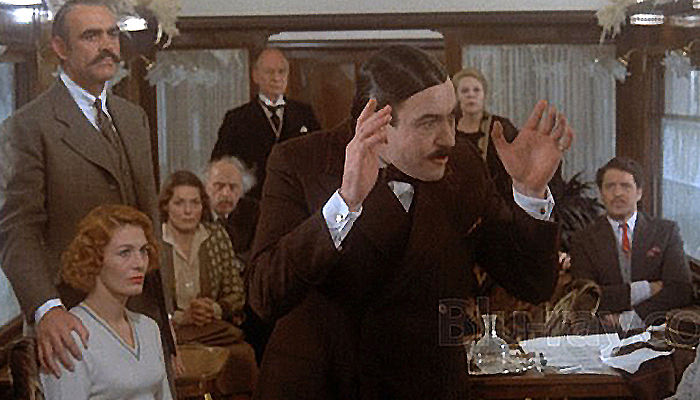
Sidney Lumet’s 1974 Murder on the Orient Express is the gold-standard Poirot movie for this ranking. Albert Finney plays the detective investigating a murder aboard a train stopped by snow, surrounded by passengers whose polished manners conceal sharply different pasts. The cast—Lauren Bacall, Ingrid Bergman, Sean Connery, Anthony Perkins, and John Gielgud among them—turns the train into a collection of brilliant miniature performances.
Lumet lets the train, the glances, and the interviews carry the story. Finney’s exacting Poirot anchors a superb ensemble, and the adaptation makes the famous solution feel both surprising and emotionally earned. It is the most satisfying all-round Christie film here.
Advertise With That Love Podcast
Want to put your book, entertainment brand, streaming service, product, or business in front of readers who love movies, television, books, and pop culture? That Love Podcast offers sponsorship and advertising opportunities across the website, podcast, and newsletter.
How to Choose the Best Agatha Christie Adaptation for You
The best Agatha Christie adaptation depends on what you want from a mystery. Some viewers want a fair-play puzzle, with clues placed in plain sight and a final explanation that makes the whole story click. Others come for period atmosphere, a memorable detective, or the pleasure of watching a familiar case interpreted in a new way. The ranking above weighs those qualities together, but this guide can help you choose a starting point that fits your mood.
If you are new to Christie on screen, begin with a self-contained story rather than a long-running series. A feature film gives you a complete mystery in one sitting, while a short miniseries gives the characters and investigation more room to breathe. Either format lets you see the essentials that make her stories endure: a closed circle of suspects, carefully planted clues, social tensions, and a reveal that changes how earlier scenes look.
For a classic cinema experience, try one of the earlier screen versions near the top of the list. These films have a distinct sense of occasion: polished ensemble casts, carefully composed interiors, and performances that make every suspect seem worth watching. They also show how a director can create suspense through framing and reaction shots, even when the audience is simply listening to a conversation. The result feels theatrical in the best sense, with the mystery unfolding like an elegant stage puzzle.
For a longer Poirot watch, David Suchet’s series offers a satisfying way to follow the Belgian detective across many cases. Its greatest strength is consistency: the central performance stays recognisable while the settings, suspects, and emotional stakes change from story to story. You can watch selected episodes without committing to the entire run, or use the series as a deeper tour through Poirot’s methods, habits, and changing relationships. It is especially rewarding if you enjoy recurring characters alongside a new case each time.
Viewers who prefer a quieter detective may find Joan Hickson’s Miss Marple the most inviting entry point. The adaptation’s village settings can look peaceful, yet the stories repeatedly expose jealousies, old resentments, and carefully maintained reputations. Hickson plays Marple as observant rather than showy; she notices the small details people dismiss and connects them to patterns she has seen before. That approach suits Christie’s interest in how ordinary social behaviour can conceal extraordinary motives.
If you want a modern production, compare the newer television adaptations with the classic films rather than expecting them to feel identical. Recent versions can use faster pacing, sharper visual contrast, and a more contemporary emphasis on character psychology. That can make a familiar story feel newly tense, although brisk editing sometimes gives clues less time to settle. The strongest modern adaptations retain the logic of the mystery while using their visual style to make the world and its people feel immediate.
A film and a television adaptation also reward different kinds of attention. A film must establish its suspects and central question quickly, so strong casting and economical scenes matter enormously. A miniseries can give supporting characters more history and let suspicion shift gradually across episodes. Neither format is automatically more faithful or more satisfying; the right choice depends on whether you want a compact puzzle or a slower immersion in the setting.
When comparing adaptations, look for more than plot accuracy. Consider whether the clues are understandable, whether the suspects have distinct motives, and whether the solution feels earned instead of merely surprising. Then notice what the adaptation adds through performance, production design, music, and pacing. Christie’s plots can survive different interpretations because their foundations are strong, but a memorable screen version makes the investigation feel engaging before the answer is revealed.
Faithful to the Book, Built for the Screen
Faithfulness is one way to compare an adaptation, but it is not a simple measure of quality. A screen version may keep Christie’s central puzzle while changing the order of scenes, trimming supporting roles, or adjusting the setting to suit its format. Those choices can affect the experience without undoing the mystery. What matters most is whether the adaptation preserves the story’s essential logic: the relevant clues are available, the suspects have understandable motives, and the final explanation follows from what the audience has seen.
A feature film has limited time to introduce a household of suspects, so it often depends on crisp character sketches and a strong ensemble. Television can spend longer with a community, revisit a clue from another point of view, and build unease across episodes. A modern retelling may also emphasise a character’s private life more than an older version did. Comparing those choices is part of the fun: the novel provides the foundation, while each adaptation shows what its writers, actors, and director believe deserves the closest attention.
Conclusion: The Best Christie Adaptation Depends on Your Mood
Agatha Christie’s screen legacy works because her mysteries can change shape without losing their essential pleasures: a room full of suspects, a detective who listens closely, and a final detail that makes earlier scenes look different. For a classic film, start with Murder on the Orient Express (1974). For a brilliant courtroom puzzle, pick Witness for the Prosecution. For a longer visit with an iconic sleuth, choose David Suchet’s Poirot; for a darker limited series, And Then There Were None is a gripping weekend watch.
New versions such as Seven Dials and Tommy & Tuppence show that Christie can still be reinterpreted for viewers who did not grow up with the books. The best adaptation for you may be the one whose setting and tone match tonight: sunny and theatrical, quietly cosy, or genuinely tense. Which Christie film or series would you put at No. 1? Tell us what you would move up or down, and support more independent entertainment coverage and original audio stories.
Work With That Love Podcast
If you’re a brand, author, publisher, entertainment company, or business looking to connect with readers who love mysteries and pop culture, we’d love to hear from you.
💡 You May Also Love
Frequently Asked Questions
What is the best Agatha Christie movie adaptation?
This ranking gives the top spot to Sidney Lumet’s Murder on the Orient Express (1974) for its ensemble cast, period atmosphere, and carefully controlled mystery. Witness for the Prosecution and Death on the Nile (1978) are close alternatives, depending on whether you prefer courtroom tension or a classic Poirot case.
Which Agatha Christie TV series should I watch first?
For a long run of self-contained mysteries, start with David Suchet’s Poirot. For a darker limited series, try And Then There Were None (2015). Joan Hickson’s Miss Marple films are a strong choice if you prefer a gentler, village-based mystery.
Is Seven Dials a good Agatha Christie adaptation?
Netflix’s 2026 series is a witty, fast-moving take on The Seven Dials Mystery, led by Mia McKenna-Bruce as Bundle Brent. It is more adventurous in tone than classic Poirot adaptations and works well as a three-episode introduction for new viewers.
Where can I stream Agatha Christie adaptations?
Availability depends on your country and changes over time. Seven Dials is on Netflix, while the new Tommy & Tuppence series is on BritBox in the US; classic films and older series rotate among services, libraries, and digital rental stores.
Which adaptation features David Suchet as Poirot?
Agatha Christie’s Poirot is the ITV series starring David Suchet. It ran from 1989 to 2013 and adapted dozens of Poirot mysteries in both shorter episodes and feature-length television films.
Is the 1974 or 2017 Murder on the Orient Express better?
This list prefers Sidney Lumet’s 1974 film for its restrained pacing and character-focused ensemble. Kenneth Branagh’s 2017 version is more action-oriented and visually expansive, so viewers may enjoy it as a modern reinterpretation.
What is the best Agatha Christie adaptation for a cosy mystery night?
Try a Miss Marple episode with Joan Hickson or a self-contained Poirot case with David Suchet. Both offer a clear mystery, a distinctive detective, and a satisfying period setting without requiring a multi-season commitment.
Is And Then There Were None worth watching?
Yes, especially if you want a tense thriller rather than a cosy detective story. The 2015 BBC miniseries uses Christie’s original ending and gives the isolated-island setup a bleak, suspenseful mood.
Are Agatha Christie movies suitable for family viewing?
Many classic Christie mysteries focus on suspense and deduction rather than graphic violence, but ratings and content vary. Check the age rating and local guidance for each film or series before watching with younger viewers.
What should I watch after Murder on the Orient Express?
For another Poirot film, try Death on the Nile (1978) or Evil Under the Sun. If you want a different style, Witness for the Prosecution shifts the mystery into a courtroom, while Seven Dials offers a newer, brisker series.
More Places to Find Great Movies and TV Shows
To explore Christie’s screen history, start with the official film and television catalogue and the company that manages adaptation rights. IMDb can help with cast and episode details, while Rotten Tomatoes gathers critic and audience reviews. ScreenRant, CBR, Collider, MovieWeb, Slash Film, and Comic Book Movie also publish interviews, reviews, and mystery watchlists.
Use these resources to check credits and current streaming details, then follow the cases and detectives that fit your mood. Release rights can change by territory.
Enjoyed What You Read?
Subscribe to That Love Podcast’s newsletter for new blogs, entertainment recommendations, updates, and exclusive giveaways. Share this ranking with a friend who loves a clever whodunnit, classic films, or British mystery television. Let’s spread the love together!


.jpg)





.jpg)


Comments