





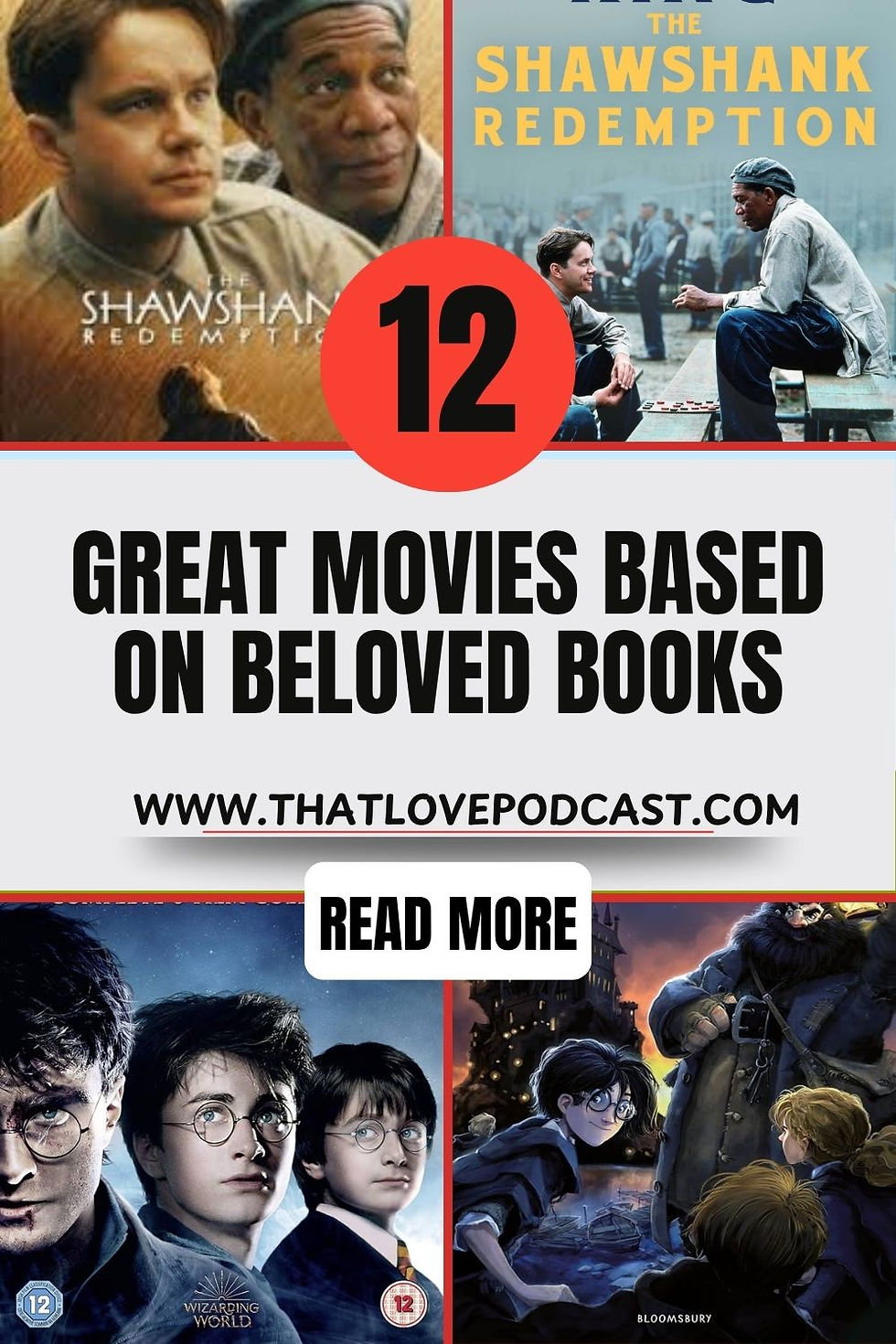
12 Great Movies Based on Beloved Books

Are you tired of watching disappointing movie adaptations that completely ruin the magic of your favorite novels and leave you wishing you had just reread the original story? Finding a film that authentically honors the source material while delivering a breathtaking visual experience can feel like an impossible task for any devoted book lover. By exploring this meticulously curated list of twelve spectacular film adaptations, you will finally discover cinematic masterpieces that perfectly capture the heart, soul, and vivid imagination of the beloved books they are based on. You will save countless hours of scrolling through streaming platforms and instantly build a flawless watch-list guaranteed to satisfy both the avid reader and the hardcore movie buff in you. Let's start and then👇

Read These 6 Related Articles from That Love Podcast:
12. Fight Club (1999) – Based on Fight Club by Chuck Palahniuk

When Chuck Palahniuk released his transgressive, boundary-pushing novel Fight Club in 1996, few people could have predicted that it would be transformed into one of the most culturally significant and heavily debated films of the late 20th century. Director David Fincher took Palahniuk’s gritty, aggressive satire of modern consumerism and toxic masculinity and amplified it through a lens of dark, visceral, and highly stylized cinematography. The film adaptation not only respects the book's narrative structure but practically immortalizes its chaotic energy on the big screen.
The story follows a nameless, severely insomniac narrator (played brilliantly by Edward Norton) whose mundane, IKEA-catalog-driven life is completely upended when he meets the charismatic, soap-making anarchist Tyler Durden (Brad Pitt). Together, they form an underground fight club that serves as a radical, violent outlet for disenfranchised men, which ultimately spirals into a domestic terrorist organization known as Project Mayhem. Fincher’s adaptation is a cinematic marvel, utilizing groundbreaking CGI, subliminal flashes, and a pulsing, industrial soundtrack by the Dust Brothers to put the audience directly inside the narrator's fracturing mind.
What makes Fight Club an extraordinary adaptation is how it elevates the source material. Even Chuck Palahniuk himself famously admitted that Fincher’s film streamlined the plot and improved upon his original ending. The casting of Helena Bonham Carter as the nihilistic, chain-smoking Marla Singer perfectly completed the chaotic trio at the heart of the story. The movie achieved absolute cult status, embedding iconic quotes—most notably, the first two rules of Fight Club—into the global cultural lexicon forever. It stands as a profound, aggressive cinematic triumph that demands multiple rewatches to fully appreciate its layered, satirical brilliance.
Where to Watch & Buy:
[Stream Fight Club on Amazon Prime Video]
[Buy the Fight Club Novel by Chuck Palahniuk on Amazon]
If you love this, check out: About Time Movie Review: A Heartwarming Journey Through Love and Time
11. The Color Purple (1985) – Based on The Color Purple by Alice Walker

Adapting a Pulitzer Prize-winning novel that deals with profound trauma, systemic racism, and deep-seated abuse is an incredibly daunting task, but Steven Spielberg’s 1985 adaptation of Alice Walker’s The Color Purple managed to translate a harrowing, intimate story into a visually rich, emotionally overwhelming cinematic epic. Walker’s original novel is written in an epistolary format—composed entirely of deeply personal letters written by the protagonist, Celie, to God and to her sister Nettie. Translating this internal, deeply introspective format to the screen required an absolute masterclass in visual storytelling and powerhouse acting.
The film introduces us to Celie, a young, impoverished African American girl living in rural Georgia during the early 1900s, who endures horrific abuse at the hands of her father and later her cruel husband, "Mister" (played with terrifying intensity by Danny Glover). Whoopi Goldberg, in her breathtaking film debut, portrays the adult Celie with a quiet, heartbreaking vulnerability that slowly and beautifully transforms into unshakeable resilience and self-love. She is supported by a staggering ensemble cast, including Oprah Winfrey as the fiercely defiant Sofia and Margaret Avery as the glamorous, fiercely independent blues singer Shug Avery.
Spielberg’s directorial vision brings a sweeping, grand, and almost mythic quality to Walker’s intimate narrative. The lush, golden-hour cinematography and the sweeping, emotional musical score by Quincy Jones amplify the emotional stakes of Celie’s arduous journey. While some critics initially argued that the film softened some of the novel’s harsher realities and queer themes for a mainstream Hollywood audience, its monumental cultural impact is undeniable. The Color Purple received an astounding eleven Academy Award nominations and remains a profoundly moving, essential cinematic experience that honors the resilient spirit of Black women in the American South.
Where to Watch & Buy:
[Stream The Color Purple (1985) on Amazon Prime Video]
[Buy The Color Purple Novel by Alice Walker on Amazon]
10. The God of Small Things (Stage & Screen Elements) – Based on The God of Small Things by Arundhati Roy

Arundhati Roy’s The God of Small Things is a literary masterpiece that took the world by storm, winning the prestigious Booker Prize in 1997. Unlike the other entries on this list, this novel has not been transformed into a singular, massive Hollywood blockbuster. However, its brilliant stage and television treatments profoundly demonstrate how this lyrical, heartbreaking story can translate powerfully to screen-style storytelling and theatrical performance, proving that true cinematic magic often begins on the stage or in serialized formats.
The narrative is a breathtaking, non-linear exploration of a wealthy Indian family in the state of Kerala, whose lives are irrevocably shattered by the rigid, suffocating constraints of the caste system, forbidden love, and a tragic childhood death. The story is told through the perspectives of fraternal twins, Estha and Rahel, whose childhood innocence is brutally stripped away by the complex, devastating adult world surrounding them. Roy’s prose is incredibly dense, poetic, and sensory, heavily utilizing unique capitalization and inventive language to capture the worldview of children.
Adapting such a deeply internalized, linguistically unique novel requires an immense amount of creative vision. Various theatrical productions and televised dramatic readings have successfully captured the lush, vibrant, and ultimately tragic atmosphere of Ayemenem. By utilizing vibrant set designs, traditional Indian instrumentation, and highly emotive acting, these adaptations highlight the claustrophobic societal pressures and the devastating beauty of Ammu and Velutha’s forbidden romance. It stands as a powerful reminder that some of the greatest cinematic adaptations are not always massive theatrical releases, but deeply intimate, highly creative translations of beloved, complex literature.
Where to Watch & Buy:
[Buy The God of Small Things Novel by Arundhati Roy on Amazon]
[Explore Indian Cinema Documentaries on Amazon Prime Video]
9. The Hunger Games (2012) – Based on The Hunger Games by Suzanne Collins

When Suzanne Collins published her gripping, dystopian young-adult novel The Hunger Games in 2008, it ignited a massive, global cultural phenomenon. Translating this brutal, politically charged story to the silver screen was a high-stakes endeavor, but director Gary Ross delivered a propulsive, visually striking adaptation in 2012 that successfully launched a multi-billion-dollar franchise. The film perfectly captured the stark, terrifying reality of Panem, balancing the horrific concept of children fighting to the death with profound themes of media manipulation, class warfare, and systemic oppression.
The massive success of the adaptation rests heavily on the brilliant casting of Jennifer Lawrence as the reluctant, fiercely protective heroine, Katniss Everdeen. Lawrence brought an incredible amount of grit, raw emotion, and physical intensity to the role, perfectly embodying the survivalist instincts of a girl from the impoverished District 12. Opposite her, Josh Hutcherson as Peeta Mellark and Woody Harrelson as the cynical, alcoholic mentor Haymitch Abernathy provided exceptional supporting performances that deepened the emotional core of the film.
What makes The Hunger Games a standout adaptation is its aesthetic execution. The film brilliantly contrasts the bleak, ash-covered, poverty-stricken reality of District 12 with the grotesque, neon-drenched, superficial opulence of the Capitol. The shaky, handheld cinematography utilized during the actual arena sequences places the audience directly in the frantic, terrifying mindset of the tributes, adding a visceral sense of realism to the violence. It is an adaptation that respects the intelligence of its young-adult audience, retaining the dark, anti-authoritarian message of the book while delivering a massive, blockbuster cinematic experience. To dive deeper into how dystopian films reflect modern anxieties, check out the analysis at The Hollywood Reporter.
Where to Watch & Buy:
[Stream The Hunger Games on Amazon Prime Video]
[Buy The Hunger Games Trilogy Box Set on Amazon]
You’ll also love: The Dreadful (2026) Movie Review - A Gothic Horror Exploration
8. Atonement (2007) – Based on Atonement by Ian McEwan

Ian McEwan’s 2001 novel Atonement is widely considered a modern literary classic—a devastating, complex narrative exploring the terrifying consequences of a single childhood lie, the horrors of World War II, and the agonizing pursuit of redemption. Director Joe Wright’s 2007 film adaptation is nothing short of a lush, emotionally brutal cinematic triumph that meticulously preserves the novel’s fragmented timelines, shifting perspectives, and haunting, lingering sense of regret.
The story hinges on Briony Tallis, a precocious, imaginative young girl (played phenomenally by a young Saoirse Ronan) who misinterprets an interaction between her older sister Cecilia (Keira Knightley) and Robbie Turner (James McAvoy), the housekeeper's highly educated son. Briony’s subsequent false accusation destroys their lives, sending Robbie to prison and eventually to the front lines of the war, while she spends the rest of her life desperately seeking atonement. Wright’s direction is incredibly stylish, sweeping, and visually intoxicating. The film is famous for Keira Knightley’s iconic, emerald-green silk slip dress, which has gone down in history as one of the greatest costume designs in cinema.
The adaptation is also renowned for its groundbreaking musical score by Dario Marianelli, which brilliantly incorporates the harsh, rhythmic clacking of a typewriter directly into the orchestral music, constantly reminding the audience of Briony’s role as an author and a fabricator of reality. Furthermore, the breathtaking, continuous five-and-a-half-minute tracking shot of the chaotic, devastating evacuation at Dunkirk beach is a monumental achievement in filmmaking. Atonement is a gorgeous, heartbreaking film that captures the profound tragedy and deceptive nature of storytelling found in McEwan’s novel.
Where to Watch & Buy:
[Stream Atonement on Amazon Prime Video]
[Buy Atonement Novel by Ian McEwan on Amazon]
7. The Princess Bride (1987) – Based on The Princess Bride by William Goldman

Adapting a book that is essentially a satire of its own genre is a monumental challenge, but director Rob Reiner and author/screenwriter William Goldman achieved absolute cinematic perfection with the 1987 adaptation of The Princess Bride. Goldman’s novel is a brilliant, meta-fictional fairy tale that blends romance, high-stakes adventure, revenge, and sharp comedy. The film miraculously captures this perfectly matched tone, translating the book’s inherent charm into a witty, timeless, and endlessly quotable family-friendly classic.
The framing device of the film—a grandfather (Peter Falk) reading a beloved book to his sick, skeptical grandson (Fred Savage)—perfectly mirrors Goldman's own literary framing of presenting an "abridged" version of an older, fictional text. From there, the audience is swept into the magical land of Florin, following the beautiful Buttercup (Robin Wright) and her devoted, swashbuckling true love, Westley (Cary Elwes). Along the way, they encounter a legendary cast of characters, including the vengeance-driven swordsman Inigo Montoya (Mandy Patinkin), the massive, gentle giant Fezzik (André the Giant), and the wonderfully arrogant Vizzini (Wallace Shawn).
The Princess Bride succeeds because it never takes itself too seriously, yet it commits fully to the genuine romance and thrilling adventure at its core. The sword fights are impeccably choreographed, the dialogue is razor-sharp and hilarious ("Inconceivable!"), and the chemistry between the cast is absolute magic. It is a rare film that appeals equally to children and adults, capturing the exact, whimsical essence of a storybook come to life. It remains a flawless adaptation that continues to enchant new generations of viewers.
Where to Watch & Buy:
[Stream The Princess Bride on Amazon Prime Video]
[Buy The Princess Bride Book by William Goldman on Amazon]
6. Gone with the Wind (1939) – Based on Gone with the Wind by Margaret Mitchell

Margaret Mitchell’s massive, Pulitzer Prize-winning 1936 novel Gone with the Wind was a literary juggernaut, and its journey to the silver screen resulted in one of the most famous, sweeping historical epics in the entire history of Hollywood. Producer David O. Selznick’s 1939 adaptation turned this monumental Southern novel into a visually grand, incredibly long-lasting, and highly controversial cinematic classic that fundamentally changed the scope of filmmaking.
The story is an exhaustive, dramatic saga set against the violent, transformative backdrop of the American Civil War and the subsequent Reconstruction era. At its center is the fiery, manipulative, and relentlessly determined Scarlett O'Hara (played flawlessly by Vivien Leigh in an Oscar-winning performance). Her tumultuous, passionate, and often toxic relationship with the rogue Rhett Butler (Clark Gable) serves as the emotional anchor of the nearly four-hour-long film. The production value of the movie was unprecedented for its time, featuring groundbreaking Technicolor cinematography, massive, sprawling set pieces, and thousands of extras.
While the film is a masterclass in epic filmmaking and romantic melodrama, its legacy is deeply complicated by its romanticized, highly problematic, and historically inaccurate portrayal of the antebellum South and slavery.
Despite these heavy criticisms, Hattie McDaniel’s performance as Mammy broke massive historical barriers, making her the first African American to ever win an Academy Award. As an adaptation, Gone with the Wind is a titanic achievement in capturing the sheer, overwhelming scale and intense character dynamics of a massive novel, cementing its place as a foundational pillar of American cinema. For an extensive look into classic Hollywood history, explore the archives at the American Film Institute.
Where to Watch & Buy:
[Stream Gone with the Wind on Amazon Prime Video]
[Buy Gone with the Wind Novel on Amazon]

5. The Godfather (1972) – Based on The Godfather by Mario Puzo

When Paramount Pictures acquired the rights to Mario Puzo’s pulpy, highly sensationalized crime novel The Godfather, few anticipated that young director Francis Ford Coppola would transform the material into what is widely regarded as one of the greatest films ever made. Coppola, alongside Puzo who co-wrote the screenplay, stripped away the novel's more superfluous, trashy subplots to focus entirely on the dark, Shakespearian tragedy of the Corleone family. The result is an absolute benchmark for crime-drama adaptations, blending a deeply intimate family saga with brutal power politics and operatic intensity.
The film chronicles the reign of Vito Corleone (Marlon Brando), a powerful, aging mafia patriarch, and the tragic, inevitable corruption of his youngest son, Michael Corleone (Al Pacino). Initially a decorated war hero wanting nothing to do with his family's illegal enterprise, Michael is slowly, methodically pulled into the dark, violent underworld of the mafia to protect his father. Brando’s performance is nothing short of legendary, creating a deeply nuanced, imposing figure who commands absolute respect, while Pacino’s chilling, quiet transformation from an innocent civilian to a cold-blooded, ruthless mob boss is a masterclass in acting.
Coppola’s adaptation is a visual and auditory masterpiece. The haunting, melancholic musical score by Nino Rota, combined with Gordon Willis’s dark, shadowy, sepia-toned cinematography, creates a thick, oppressive atmosphere of dread and loyalty. The film explores profound themes of the American dream, family loyalty, and the corrupting nature of absolute power. The Godfather completely redefined the gangster genre, proving that a film adaptation can vastly elevate its source material into the highest echelon of cinematic high art.
Where to Watch & Buy:
[Stream The Godfather on Amazon Prime Video]
[Buy The Godfather Novel by Mario Puzo on Amazon]
4. To Kill a Mockingbird (1962) – Based on To Kill a Mockingbird by Harper Lee

Harper Lee’s 1960 novel To Kill a Mockingbird is a foundational piece of American literature, dealing with heavy, profound themes of racial injustice, the loss of childhood innocence, and profound moral courage in the racially segregated Deep South. Adapting such a revered, sensitive novel required an immense amount of respect and care, and director Robert Mulligan’s 1962 film is a faithful, incredibly poignant adaptation that does absolute justice to a modern classic.
The film is told through the perspective of young Scout Finch (Mary Badham), whose father, the noble, highly principled lawyer Atticus Finch, is appointed to defend Tom Robinson, a Black man falsely accused of a horrific crime in 1930s Maycomb, Alabama. Gregory Peck’s portrayal of Atticus Finch is widely considered one of the greatest cinematic performances of all time. He brings a quiet, towering, and deeply empathetic dignity to the role, perfectly capturing the essence of a father trying to teach his children the true meaning of empathy and courage in the face of overwhelming prejudice. Peck’s performance is so iconic that it has become the definitive, unshakeable on-screen version of the character.
The decision to shoot the film in stark black-and-white was a brilliant artistic choice, beautifully evoking the nostalgic, hazy atmosphere of a childhood memory while simultaneously emphasizing the stark, brutal moral dualities of the adult world. The haunting, evocative score by Elmer Bernstein further heightens the emotional resonance of the story. To Kill a Mockingbird is a rare adaptation that completely respects the gentle, slow-paced rhythm of the novel while delivering a devastating, powerful message that remains intensely relevant to this day.
Where to Watch & Buy:
[Stream To Kill a Mockingbird on Amazon Prime Video]
[Buy To Kill a Mockingbird Novel by Harper Lee on Amazon]
3. Harry Potter series (2001–2011) – Based on the Harry Potter series by J.K. Rowling

Taking on the monumental task of adapting the most beloved, widely read children’s fantasy series of the modern era was a staggering cinematic gamble. Over the course of ten years and eight massive blockbuster films, the Harry Potter franchise accomplished the seemingly impossible. The films brilliantly capture the whimsical magic, the steadily growing darkness, and the profound emotional arcs of the books, making an entire generation completely fall in love with the cinematic wizarding world.
The absolute greatest achievement of the franchise was its casting. Finding three unknown child actors—Daniel Radcliffe, Emma Watson, and Rupert Grint—to carry a multi-billion-dollar franchise over a decade was a massive risk that paid off flawlessly. Audiences literally watched these actors grow up on screen, perfectly mirroring the maturation and darkening tone of the novels as Harry, Hermione, and Ron evolved from innocent, wide-eyed children into battle-hardened, traumatized young adults leading a war against the terrifying Lord Voldemort (played with terrifying, serpentine grace by Ralph Fiennes).
The franchise also utilized a shifting roster of incredible directors—from Chris Columbus’s warm, magical, and nostalgic early entries, to Alfonso Cuarón’s dark, stylistic turning point in The Prisoner of Azkaban, and finally David Yates’s bleak, emotionally grounded, and war-torn final chapters. The sheer scale of the production design, the iconic, swelling musical themes composed by John Williams, and the inclusion of absolute legends of British cinema (Alan Rickman, Maggie Smith, Gary Oldman, and Richard Harris) created a rich, lived-in world. It is a monumental achievement in long-form cinematic storytelling that successfully translated the dense, sprawling mythology of Rowling's books to the big screen. For a deep dive into the expanding lore, visit Wizarding World.
Where to Watch & Buy:
[Stream the Harry Potter 8-Film Collection on Amazon Prime Video]
[Buy the Harry Potter Complete Book Box Set on Amazon]
2. The Shawshank Redemption (1994) – Based on Rita Hayworth and Shawshank Redemption by Stephen King

It is incredibly rare for a relatively short, non-horror novella to be transformed into what many consider to be one of the greatest, most beloved films in cinematic history. Stephen King’s 1982 novella Rita Hayworth and Shawshank Redemption is a beautiful, understated story about hope, but director Frank Darabont’s 1994 film adaptation is an absolute prison-drama masterpiece that expands and elevates the original text into a profoundly moving, infinitely rewatchable classic.
The narrative follows Andy Dufresne (Tim Robbins), a quiet, intelligent banker who is wrongfully convicted of murder and sentenced to life in the brutal, corrupt Shawshank State Penitentiary. Over the course of several decades, Andy quietly navigates the horrors of prison life, utilizing his financial expertise to aid the corrupt warden while forming a deep, enduring, and beautiful friendship with Ellis Boyd "Red" Redding (Morgan Freeman), the prison's seasoned contraband smuggler. Freeman’s iconic, gravelly voiceover narration provides the emotional, philosophical heartbeat of the film.
Surprisingly, The Shawshank Redemption was actually a massive box office flop upon its initial theatrical release, overshadowed by massive hits like Forrest Gump and Pulp Fiction. However, it found an incredible, passionate audience on home video and television syndication, eventually skyrocketing to the very top of IMDb's top-rated movies list. The film is a masterclass in slow-burn, emotional storytelling, culminating in one of the most satisfying, deeply cathartic, and triumphant endings in cinema history. It proves that a great adaptation does not simply copy the book; it finds the emotional core of the story and amplifies it to soaring, cinematic heights.
Where to Watch & Buy:
[Stream The Shawshank Redemption on Amazon Prime Video]
[Buy Different Seasons by Stephen King on Amazon]
Before we reveal the number one adaptation, check out the latest episodes of That Love Podcast here: https://www.thatlovepodcast.com/episodes
1. The Lord of the Rings trilogy (2001–2003) – Based on The Lord of the Rings by J.R.R. Tolkien

Taking the absolute, undisputed number one spot on our definitive list of the greatest movies based on beloved books is a cinematic achievement that will likely never be replicated. For decades, J.R.R. Tolkien’s massive, sprawling high-fantasy epic The Lord of the Rings was widely considered completely "unfilmable." However, visionary director Peter Jackson took on the monumental, unprecedented task of shooting three massive films simultaneously in New Zealand. The result is a landmark fantasy adaptation that stays remarkably, passionately true to the spirit, heart, and immense scale of Tolkien’s epic while miraculously creating its own distinct, breathtaking visual mythology.
The trilogy—The Fellowship of the Ring, The Two Towers, and The Return of the King—is a staggering masterclass in world-building. Jackson and his incredibly dedicated team at Wētā Workshop utilized revolutionary, groundbreaking CGI (most notably bringing the tragic, motion-captured character of Gollum, played by Andy Serkis, to life), but balanced it perfectly with jaw-dropping practical effects. The use of massive, highly detailed "bigatures," thousands of hand-forged weapons and armor, intricate prosthetics, and sweeping, on-location cinematography made Middle-earth feel incredibly real, lived-in, and tangible.
The casting is universally flawless, featuring Elijah Wood carrying the heavy, emotional burden of Frodo Baggins, Ian McKellen embodying the wise, powerful essence of Gandalf, and Viggo Mortensen capturing the reluctant, rugged nobility of Aragorn. The sweeping, Oscar-winning musical score by Howard Shore elevated the emotional resonance of every battle, every tragic death, and every quiet moment in the Shire. The trilogy swept the Academy Awards, with The Return of the King winning an astonishing eleven Oscars, tying the all-time record. The Lord of the Rings is the absolute gold standard for literary adaptations—it honors the profound themes of friendship, sacrifice, and the enduring battle between good and evil found in Tolkien's texts, delivering a cinematic masterpiece that will be revered for generations.
Where to Watch & Buy:
[Stream The Lord of the Rings Extended Edition Trilogy on Amazon]
[Buy The Lord of the Rings Book Box Set on Amazon]
Conclusion: The Magic of Cinematic Translation
Translating a beloved book from the page to the silver screen is a monumental, incredibly high-stakes artistic endeavor. The 12 spectacular films detailed on this list prove that when visionary directors, brilliant screenwriters, and passionate actors deeply respect the source material, the result can be absolute cinematic magic. Whether it is capturing the sweeping, high-fantasy grandeur of J.R.R. Tolkien's The Lord of the Rings, exploring the dark, psychological depths of Chuck Palahniuk's Fight Club, or honoring the profound, historical courage found in Harper Lee's To Kill a Mockingbird, a great adaptation elevates the original story, providing fans with a new, breathtaking medium to experience their absolute favorite narratives.
The next time you finish reading an incredible novel and find yourself desperately wanting to linger in that fictional world just a little bit longer, queue up one of these legendary adaptations. They offer the perfect, immersive blend of literary depth and visual storytelling. Pop some popcorn, dim the lights, and prepare to fall in love with these timeless stories all over again.
Support our platform and help us keep creating detailed, inspiring content for your entertainment. Donate to That Love Podcast Here: https://www.thatlovepodcast.com/donate
Keep the inspiration flowing! Stream all the latest, captivating episodes of That Love Podcast right here: https://www.thatlovepodcast.com/episodes
💡 You May Also Love
If you loved exploring these incredible book-to-movie adaptations, keep the literary and cinematic momentum going by checking out these amazing deep dives:
Book Review: My Rules by T.L. Swan - A Whimsical Journey of Love and Self-Discovery
Maybe One Day by Catherine Bybee Book Review - A Hopeful Second-Chance Romance
Honeymoon Phase by Amy Daws Book Review: A Friends-to-Lovers Romance That Will Melt Your Heart
Book Review: Heated Rivalry by Rachel Reid - A Sizzling Enemies-to-Lovers Romance
10 FAQs About Movies Based on Books
1. Why do directors often change the endings of books when making a movie?
Directors and screenwriters often alter book endings to better suit the visual medium and pacing of a film. A highly internalized, ambiguous ending that works beautifully in prose might feel deeply unsatisfying or confusing on screen, requiring a more definitive, cinematic resolution (as famously seen in Fight Club).
2. What does it mean when an adaptation is called "unfilmable"?
A book is often deemed "unfilmable" if it contains an incredibly dense, sprawling narrative, features a cast of thousands, relies heavily on the internal thoughts of the protagonist, or requires visual effects that currently do not exist in the film industry (e.g., The Lord of the Rings prior to the 2000s).
3. Did Stephen King like The Shawshank Redemption adaptation?
Yes! While Stephen King has famously disliked some adaptations of his work (most notably Stanley Kubrick's The Shining), he absolutely loved Frank Darabont's adaptation of The Shawshank Redemption, frequently citing it as one of the best adaptations of his writing ever produced.
4. How accurate are the Harry Potter movies to the books?
The Harry Potter films are generally considered highly faithful to the core narrative, emotional arcs, and tone of J.K. Rowling's books. However, due to the massive length of the later novels, the filmmakers had to cut numerous subplots, minor characters, and backstory details to maintain a reasonable theatrical runtime.
5. Why did Peter Jackson shoot The Lord of the Rings movies all at once?
Peter Jackson shot all three films simultaneously in New Zealand to save massive amounts of money on production, ensure the aging and appearance of the massive ensemble cast remained consistent, and fully utilize the enormous sets and props that took years to design and build.
6. Is The Godfather movie better than the original book?
Many critics and fans passionately argue that Francis Ford Coppola's film is vastly superior to Mario Puzo's original novel. Coppola and Puzo worked together to strip away the more sensational, trashy subplots of the book, focusing entirely on the profound, Shakespearean tragedy of the Corleone family.
7. Did the author of The Princess Bride write the movie script?
Yes! William Goldman, the brilliant author of the original 1973 novel The Princess Bride, successfully adapted his own book into the screenplay for the 1987 film, which is a major reason why the movie retains the exact wit, charm, and meta-narrative tone of the source material.
8. Are there any good movie adaptations of poetry or stage plays?
Absolutely. Many incredible films are adapted from stage plays, such as Fences, A Streetcar Named Desire, and Glengarry Glen Ross. These adaptations often focus heavily on intense, claustrophobic dialogue and powerhouse acting performances to carry the cinematic narrative.
9. What is the difference between a direct adaptation and a loose adaptation?
A direct adaptation strives to remain as entirely faithful to the original plot, dialogue, and characters of the book as possible (like To Kill a Mockingbird). A loose adaptation takes the core premise, themes, or characters of a book and heavily reimagines them to tell a new story (like Clueless, which is a loose adaptation of Jane Austen's Emma).
10. How can I find out if my favorite book is becoming a movie?
The best way to track upcoming literary adaptations is to follow major entertainment news outlets like Variety or The Hollywood Reporter, follow the author's official social media accounts, or check comprehensive tracking databases on literary websites.
For more insightful discussions, community reviews, and tracking of your favorite book-to-movie adaptations, explore the massive literary community at Goodreads.
If you're enjoying this blog, check out these other ones:


.jpg)




.jpg)


