






The 20 Best Romantic Comedies of All Time, Ranked

You have scrolled through streaming platforms for hours looking for that perfect rom-com, only to end up rewatching the same three movies you already know by heart.
This definitive ranking spans decades of cinema, breaking down the twenty best romantic comedies of all time, from witty banter and iconic meet-cutes to the kind of undeniable chemistry that keeps these films endlessly rewatchable.
Let's start 👇

💛 Love this kind of content? Help keep it going: Support That Love Podcast
If you love this, check out: The 10 Best Romantic Comedies of the 2010s
📢 Are you a brand, author, publisher, or business looking to reach an audience that loves stories like this one? That Love Podcast partners with sponsors who want to connect with genuine, engaged readers and listeners. If you're interested in advertising with us, we would love to hear from you: Advertise With That Love Podcast
#20 — The Big Sick (2017)

Written by real-life married couple Kumail Nanjiani and Emily V. Gordon and based directly on their own courtship, The Big Sick brings a genuine cultural specificity and emotional honesty to the genre that few rom-coms attempt. Nanjiani plays a fictionalized version of himself, a Pakistani-American comedian navigating his family's expectations around arranged marriage while falling for Emily, whose sudden medical coma forces him to bond with her parents before the two have even fully resolved their relationship.
What makes the film so special is its refusal to soften the real cultural and family tensions at its center, blending genuinely funny stand-up comedy scenes with a surprisingly moving meditation on grief, identity, and the terrifying vulnerability of loving someone whose family barely knows you exist. Holly Hunter and Ray Romano, playing Emily's parents, provide the film's emotional backbone, and the entire project's grounding in true events gives its eventual happy ending a weight that purely fictional rom-coms rarely achieve.
Where to watch: Stream on Amazon Prime Video.
🎙️ Stream a great love story while you scroll through this list — That Love Podcast is live now: thatlovepodcast.com/episodes
#19 — (500) Days of Summer (2009)

Marc Webb's stylized, nonlinear breakup story remains one of the most structurally inventive romantic comedies ever made, following Tom (Joseph Gordon-Levitt) as he looks back across the 500 days of his relationship with Summer (Zooey Deschanel) in a scrambled, non-chronological order that mirrors the way memory actually processes heartbreak. Rather than delivering the genre's typical happily-ever-after, the film explicitly warns audiences in its opening narration that this is not a love story.
The film's most celebrated sequence, splitting the screen into "Expectations" and "Reality" as Tom attends a party hoping for reconciliation, remains one of the most devastatingly precise depictions of romantic disappointment ever committed to film. Deschanel's Summer deliberately subverts the "manic pixie dream girl" archetype the film initially seems to be building, and the film's bittersweet final scene, introducing a new character named Autumn, suggests that heartbreak, while devastating, does not have to be the end of the story.
Where to watch: Stream on Hulu.
#18 — How to Lose a Guy in 10 Days (2003)

Kate Hudson and Matthew McConaughey anchor one of the most purely enjoyable premises in 2000s rom-com history: a magazine writer researching an article on the ways women accidentally sabotage relationships crosses paths with an advertising executive who has bet his colleagues he can make any woman fall in love with him within ten days, neither realizing the other's conflicting, manipulative agenda until it is far too late to simply walk away.
The film's central comedic engine, watching Hudson deliberately commit every relationship red flag imaginable while McConaughey desperately tries to maintain his composure, generates a steady stream of genuinely inspired physical and verbal comedy. Underneath the deception-driven plot, however, the film builds real, undeniable chemistry between its two leads, and by the time both characters' schemes are revealed, audiences are thoroughly invested in whether genuine feelings can survive the collapse of an elaborate lie.
Where to watch: Stream on Paramount+.
You'll also love: The Best Romantic Comedies Streaming on Amazon Prime Right Now
#17 — Moonstruck (1987)
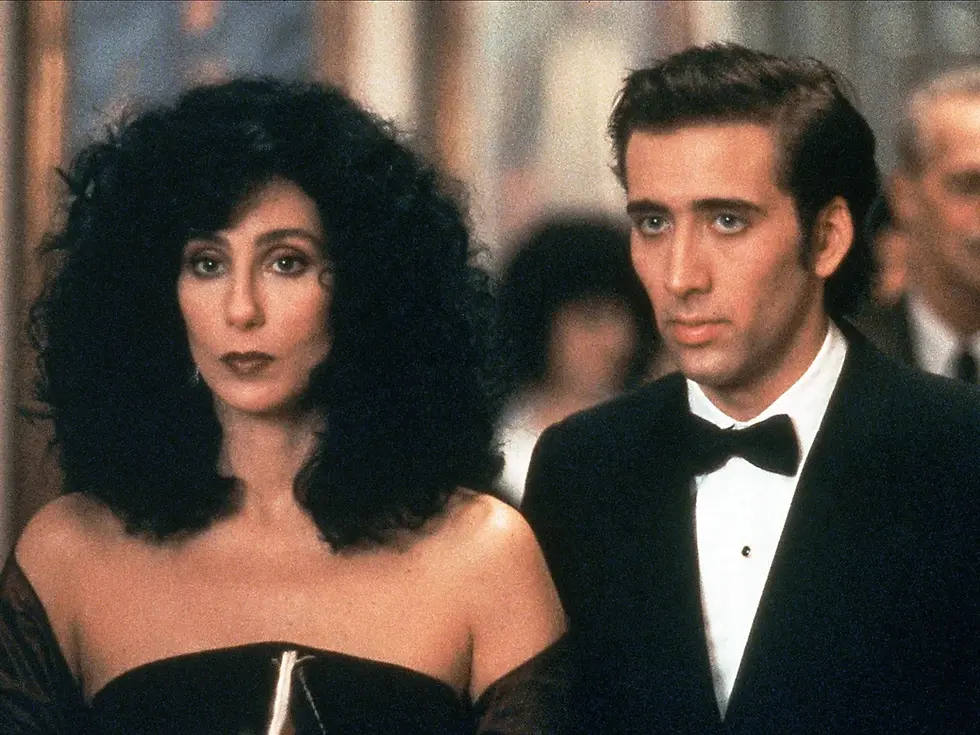
Cher won an Academy Award for her performance as Loretta Castorini, a widowed Brooklyn bookkeeper who agrees to marry a man she does not love out of practical convenience, only to fall unexpectedly and passionately for his estranged, hot-tempered brother Ronny, played by a young Nicolas Cage at his most operatically committed. Set against the vibrant backdrop of Brooklyn's Italian-American community, Moonstruck balances broad, theatrical comedy with genuine warmth and a deep, almost mythic reverence for the irrational power of love.
The film's ensemble of family members, each dealing with their own romantic entanglements and betrayals under the light of a spectacular full moon, gives Moonstruck a rich, layered texture beyond its central couple. Cage's now-legendary "the past and the future is a joke to me now" monologue remains one of the most quotably unhinged declarations of love in rom-com history, and the film's insistence that love is inherently, gloriously irrational has made it a beloved classic for nearly four decades.
Where to watch: Stream on Max.
📢 Loved reading this so far? If you're a brand, author, or business interested in reaching readers who love content just like this, we'd love to connect. Explore sponsorship and partnership opportunities with That Love Podcast: Advertise With That Love Podcast
#16 — Forgetting Sarah Marshall (2008)
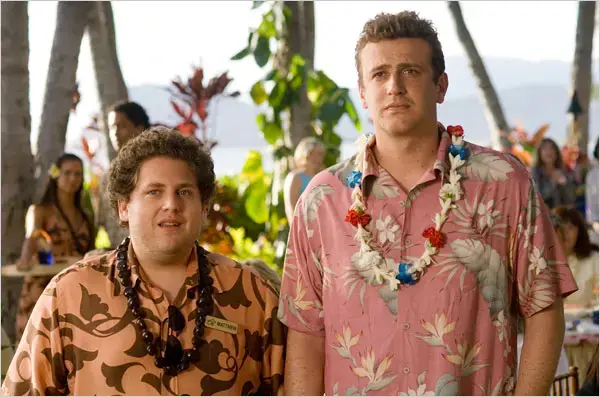
Jason Segel wrote and stars in this Judd Apatow-produced comedy about a composer devastated after being dumped by his television star girlfriend, only to discover she has taken her new boyfriend, a preening rock star played by Russell Brand, to the exact same Hawaiian resort where he retreated to nurse his broken heart. What could have been a simple, cringe-driven premise instead becomes one of the more genuinely vulnerable breakup comedies of its era.
Segel's willingness to depict Peter's grief and humiliation with real, unglamorous honesty — including the now-iconic full-frontal breakup scene at the film's opening — gives the film's eventual comedy real emotional stakes. Mila Kunis's Rachel, the resort employee who slowly helps Peter rebuild his confidence, provides a warm counterbalance to the film's more absurd supporting characters, and the film's setting, drenched in gorgeous Hawaiian scenery, makes heartbreak look almost enviable.
Where to watch: Stream on Netflix.
#15 — My Big Fat Greek Wedding (2002)

An unassuming indie production that became a genuine cultural phenomenon, My Big Fat Greek Wedding remains, adjusted for budget, the most successful romantic comedy ever made, grossing hundreds of millions of dollars worldwide from a tiny five-million-dollar production. Nia Vardalos, who also wrote the screenplay based on her own life, plays Toula, a Greek-American woman who falls for a non-Greek schoolteacher, forcing her enormous, boisterous family to embrace an outsider into their deeply held traditions.
The film's specific cultural detail — from Toula's father's insistence that every word derives from Greek origin to her family's overwhelming, well-meaning chaos at the wedding itself — gives the film a genuine specificity that resonated with audiences far beyond Greek-American communities, tapping into a universal experience of merging two families with wildly different expectations. Its sustained box office success proved that audiences were hungry for stories rooted in authentic cultural experience rather than generic, interchangeable rom-com settings.
Where to watch: Stream on Peacock.
🎙️ Halfway through the countdown — stream That Love Podcast while you keep reading: thatlovepodcast.com/episodes
#14 — Four Weddings and a Funeral (1994)
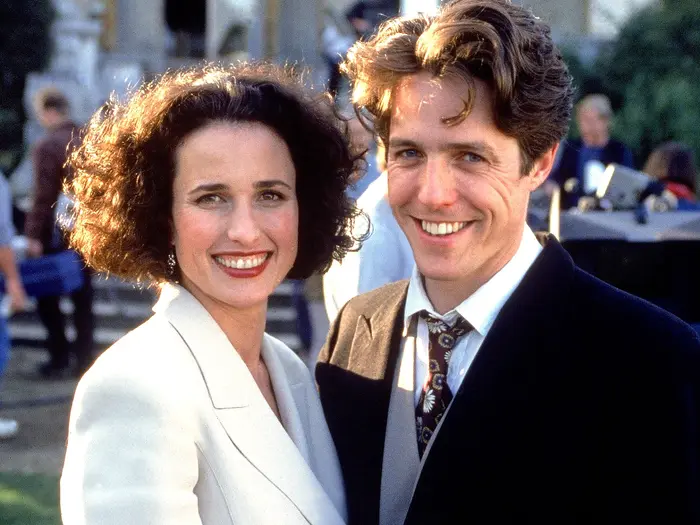
Richard Curtis's breakthrough screenplay turned Hugh Grant into a global superstar overnight, establishing the stammering, self-deprecating English gentleman persona that would define his career for the following decade. Structured around the wedding season of a tight-knit group of British friends, the film follows Charles as he repeatedly encounters Carrie, an American woman he falls for at the first wedding, only to watch her drift in and out of his life across subsequent ceremonies and, eventually, a devastating funeral.
The film's ensemble of British eccentrics, including Kristin Scott Thomas's quietly heartbreaking Fiona and Simon Callow's boisterous Gareth, gives the film a texture and emotional range that extends well beyond its central romance. Its blend of quintessentially British humor, genuine grief following Gareth's sudden death, and a famously understated, rain-soaked final proposal scene cemented Four Weddings and a Funeral as the template for an entire generation of British rom-coms that followed.
Where to watch: Stream on Netflix.
#13 — Clueless (1995)
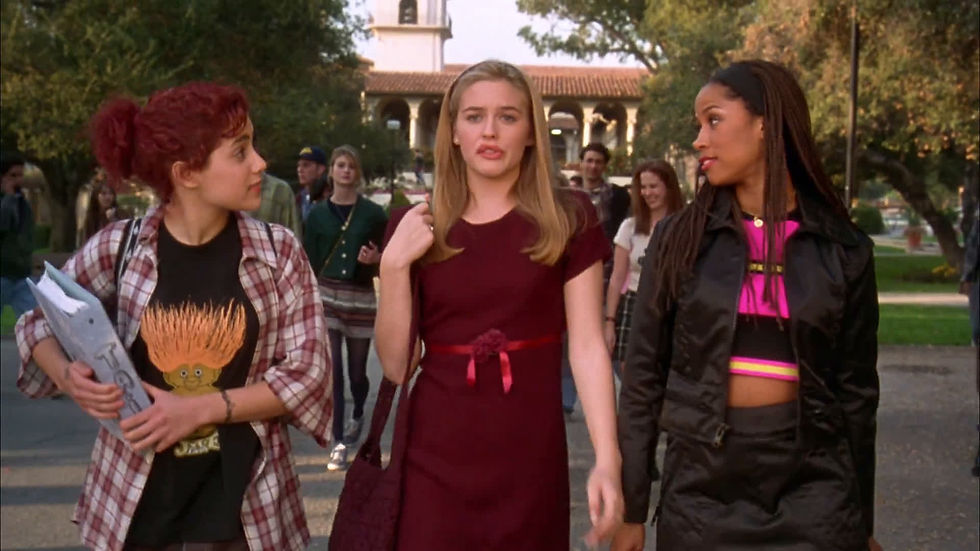
Amy Heckerling's sharp, endlessly quotable update of Jane Austen's Emma transplants the classic novel's matchmaking plot into 1990s Beverly Hills high school culture, following Cher Horowitz, played by Alicia Silverstone, as her attempts to play matchmaker for everyone around her repeatedly backfire in increasingly comedic ways. The film's specific, invented teen slang — "as if," "whatever," and "totally buggin'" among countless others — became genuinely embedded in mainstream American vocabulary well beyond the film's target teenage audience.
Beneath its candy-colored fashion and quick-witted dialogue, Clueless remains a remarkably faithful adaptation of Austen's original themes about class, self-deception, and the gap between how we perceive our own social maturity and how we actually behave. Paul Rudd's Josh, Cher's former stepbrother turned eventual love interest, gives the film's central romance a genuinely sweet, slow-building foundation, and three decades later, Clueless remains one of the most influential and rewatchable teen comedies ever produced.
Where to watch: Stream on Paramount+.
You'll also love: 10 Unforgettable Meet-Cutes in Romantic Comedy History
#12 — Roman Holiday (1953)

Audrey Hepburn won her only competitive Academy Award for her radiant performance as Princess Ann, a young royal who escapes the suffocating formality of a European tour to spend one anonymous, adventure-filled day in Rome with an American journalist, played by Gregory Peck, who initially plans to secretly profit from her story before falling genuinely in love with her instead. William Wyler's black-and-white classic remains one of the most purely romantic films ever made, precisely because of its bittersweet refusal to grant its characters a conventional happy ending.
Hepburn's transformation from sheltered royal to a woman experiencing genuine freedom for the first time, cutting her hair and riding a Vespa through Roman streets, gives the film a joyful sense of liberation that has aged beautifully. The film's final press conference, in which Ann and the journalist silently acknowledge their love while both understanding their duty prevents them from acting on it, remains one of the most quietly devastating and mature endings in the entire genre's history.
Where to watch: Stream on Paramount+.
#11 — My Best Friend's Wedding (1997)

Julia Roberts delivers one of her most subversive performances as Julianne, a food critic who realizes she is in love with her best friend Michael just as he announces his sudden engagement to a wealthy, genuinely kind college student, prompting Julianne to spend the entire film scheming to sabotage the wedding rather than simply confessing her feelings. Director P.J. Hogan's willingness to make his protagonist genuinely, unflatteringly selfish throughout most of the runtime represented a bold departure from the typically sympathetic rom-com heroine archetype.
What makes the film so refreshing, particularly decades later, is its refusal to reward Julianne's manipulative behavior with the conventional romantic prize. Instead, the film allows her to grow through failure, finding comfort and companionship not in romantic victory but in her enduring friendship with her gay best friend George, played by Rupert Everett, whose scene-stealing performance and unwavering loyalty gives the film its true emotional center.
Where to watch: Stream on Netflix.
📢 Enjoying this list? If you represent a brand, author, or business and want to advertise with an audience that genuinely engages with content like this, get in touch: Advertise With That Love Podcast
#10 — Sleepless in Seattle (1993)

Nora Ephron's beautifully nostalgic follow-up to When Harry Met Sally... reunites Tom Hanks and Meg Ryan in entirely separate storylines for most of the film's runtime, connected only through a late-night radio call-in show that broadcasts Hanks's widowed character's grief across the country, catching the attention of Ryan's engaged-but-unfulfilled Annie in Baltimore. The film's structural gamble — keeping its two romantic leads apart until its final moments — represents one of the most successful executions of fate-driven romance in the entire genre.
Ephron's screenplay repeatedly references An Affair to Remember as the platonic ideal of cinematic romance, using the older film as both a running joke and a genuine emotional touchstone for Annie's growing conviction that some connections transcend logic and geography. The film's climactic meeting atop the Empire State Building remains one of the most swoon-worthy payoffs in rom-com history, rewarding over ninety minutes of separation with a single, wordless moment of recognition.
Where to watch: Stream on Hulu.
#9 — Bridget Jones's Diary (2001)

Renée Zellweger transformed herself, both physically and vocally, to play the beloved British everywoman Bridget Jones, whose diary-format narration of her chaotic single life in London struck a genuine cultural nerve upon release. Caught in a love triangle between the seemingly perfect but ultimately caddish Daniel Cleaver, played by Hugh Grant against type, and the stiff, judgmental but ultimately decent Mark Darcy, played by Colin Firth in a deliberate, winking reference to his most famous role, Bridget's journey toward self-acceptance resonated with audiences far beyond its central romantic plot.
The film's willingness to depict Bridget's insecurities, awkward social missteps, and genuine self-deprecation with real affection rather than mockery gave the character a lasting cultural relevance that spawned multiple sequels across more than two decades. Firth and Grant's now-legendary physical fight scene, complete with genuine on-screen destruction, remains one of the most purely entertaining sequences in the entire genre.
Where to watch: Stream on Peacock.
#8 — 10 Things I Hate About You (1999)

Loosely adapting Shakespeare's The Taming of the Shrew into a 1990s Seattle high school setting, 10 Things I Hate About You remains the definitive teen rom-com of its era, anchored by Heath Ledger's star-making performance as the mysterious bad boy Patrick, paid to woo the fiercely independent, deliberately unlikable Kat, played by Julia Stiles, so that her younger sister can finally be allowed to date. The film's insistence on giving Kat genuine feminist convictions, rather than simply softening her into a conventional love interest, gave the film a lasting relevance well beyond typical teen comedy fare.
Ledger's now-iconic marching band serenade of "Can't Take My Eyes Off You," performed to win Kat back after her discovery of the financial arrangement behind their courtship, remains one of the most beloved romantic gestures in the genre's history. The film's whip-smart, endlessly quotable screenplay and its unusually sharp 90s alternative rock soundtrack have only deepened its cult status in the decades since its release.
Where to watch: Stream on Disney+.
🎙️ Before we reach the top seven — stream That Love Podcast for a story just as heartfelt: thatlovepodcast.com/episodes
#7 — The Princess Bride (1987)

Rob Reiner's endlessly quotable fantasy-adventure wraps a timeless, swashbuckling love story inside a framing device involving a grandfather reading the story to his skeptical grandson, allowing the film to simultaneously embrace and gently mock the conventions of classic fairy tale romance. Cary Elwes's Westley and Robin Wright's Buttercup anchor a story built on true love, sword fights, giants, and revenge, all delivered with a self-aware wit that has made the film beloved across multiple generations.
The film's genius lies in its ability to function simultaneously as a genuine, deeply romantic adventure and a knowing comedic deconstruction of the genre's most familiar tropes, with quotable lines like "as you wish" and "my name is Inigo Montoya" becoming permanently embedded in popular culture. Few films manage to be this sincerely romantic while also this consistently, cleverly funny, and The Princess Bride's rewatchability across nearly four decades speaks to just how perfectly it threads that needle.
Where to watch: Stream on Disney+.
#6 — You've Got Mail (1998)

Nora Ephron's second collaboration with Tom Hanks and Meg Ryan reimagines the classic "enemies who don't realize they're secretly in love" premise for the dawn of the internet age, following two bookstore rivals — Ryan's small, beloved independent shop owner and Hanks's corporate mega-chain executive — who despise each other in person while unknowingly falling in love through anonymous email correspondence. The film's specific nostalgia for the earliest, most innocent days of online romance has only deepened with age, capturing a distinct cultural moment with genuine affection.
Ryan and Hanks's easy, practiced chemistry, honed across two prior collaborations, gives the film's dual-identity conceit real emotional stakes, and the film's warm, autumnal New York setting has made it one of the most enduring cozy-weather comfort watches in the entire genre. Its influence remains visible decades later, frequently cited and directly referenced by newer rom-coms attempting to capture its specific blend of wit, warmth, and old-fashioned romantic yearning.
Where to watch: Stream on Max.
#5 — Crazy, Stupid, Love (2011)

An ensemble masterclass featuring Steve Carell, Ryan Gosling, Julianne Moore, and Emma Stone, Crazy, Stupid, Love weaves together multiple overlapping love stories with a structural sophistication rarely attempted in the genre, following a recently separated husband's transformation from hopeless, khaki-clad everyman into a confident bachelor under the tutelage of a slick, womanizing bartender. The film's now-legendary third-act twist, connecting its seemingly separate storylines in a way that recontextualizes everything that came before it, remains one of the most genuinely surprising structural reveals in modern rom-com history.
Gosling's makeover of Carell's Cal provides much of the film's comedic engine, but it is the film's deeper interest in what makes long-term love actually endure, embodied by Carell and Moore's complicated, still-devoted marriage, that gives Crazy, Stupid, Love its genuine emotional richness. Emma Stone and Gosling's chemistry as the film's secondary couple proved so electric that it helped launch their subsequent collaborations, including La La Land.
Where to watch: Stream on Netflix.
#4 — Pretty Woman (1990)

The quintessential 90s fairy tale, Pretty Woman pairs Richard Gere's wealthy, emotionally guarded businessman with Julia Roberts's fiercely independent Hollywood escort, hired initially for a business arrangement that gradually transforms into something neither party anticipated. Roberts's performance made her an instant global superstar, and the film's now-iconic shopping montage, opera scene, and rooftop piano moment have become permanently embedded touchstones of the entire romantic comedy genre.
While the film's premise has drawn ongoing conversation about its treatment of sex work, Roberts's performance gives Vivian genuine agency, wit, and self-possession throughout, refusing to let her be defined purely by her circumstances. The film's Cinderella-adjacent structure, complete with a literal fire escape rescue in its final scene, delivers pure, unapologetic romantic wish-fulfillment with a level of charm and chemistry that has kept it a beloved staple for over three decades.
Where to watch: Stream on Disney+.
📢 Almost at the top of the list — if you're interested in reaching an audience like this one, we'd love to talk: Advertise With That Love Podcast
#3 — Notting Hill (1999)

Richard Curtis's second entry on this list pairs Hugh Grant's unassuming, endearingly self-deprecating London bookstore owner with Julia Roberts's international movie superstar, exploring the genuine logistical and emotional complications of falling in love with someone whose life is permanently, inescapably public. The film's central conceit, imagining what would actually happen if a global celebrity fell for an ordinary person in an ordinary London neighborhood, gives the story a grounded charm that elevates it above simple fantasy.
Grant's now-signature bumbling charm reaches its definitive expression here, and the film's ensemble of Grant's eccentric friends, including Rhys Ifans's unforgettable, scene-stealing Spike, provides consistent comic relief alongside the central romance's more vulnerable moments. The film's famous press conference climax, in which Roberts's character publicly declares herself "just a girl, standing in front of a boy, asking him to love her," remains one of the most quoted and beloved romantic declarations in the genre's history.
Where to watch: Stream on Netflix.
#2 — It Happened One Night (1934)

Frank Capra's Depression-era classic set the template for the entire "enemies-to-lovers road trip" subgenre decades before the term even existed, following a runaway heiress, played by Claudette Colbert, and a cynical newspaper reporter, played by Clark Gable, who agree to travel together across the country, bickering constantly while slowly falling in love along the way. The film swept the "Big Five" categories at the Academy Awards — Best Picture, Director, Actor, Actress, and Screenplay — a feat that would not be repeated for over four decades.
The film's "Walls of Jericho" blanket, hung between the two characters' beds in shared motel rooms as a symbol of propriety, remains one of the most cleverly conceived pieces of visual comedy in classic Hollywood cinema. Colbert and Gable's crackling chemistry, combined with Capra's masterful blend of screwball comedy and genuine social commentary on class and Depression-era hardship, established nearly every convention modern audiences now associate with the romantic comedy genre.
Where to watch: Stream on Tubi.
#1 — When Harry Met Sally... (1989)
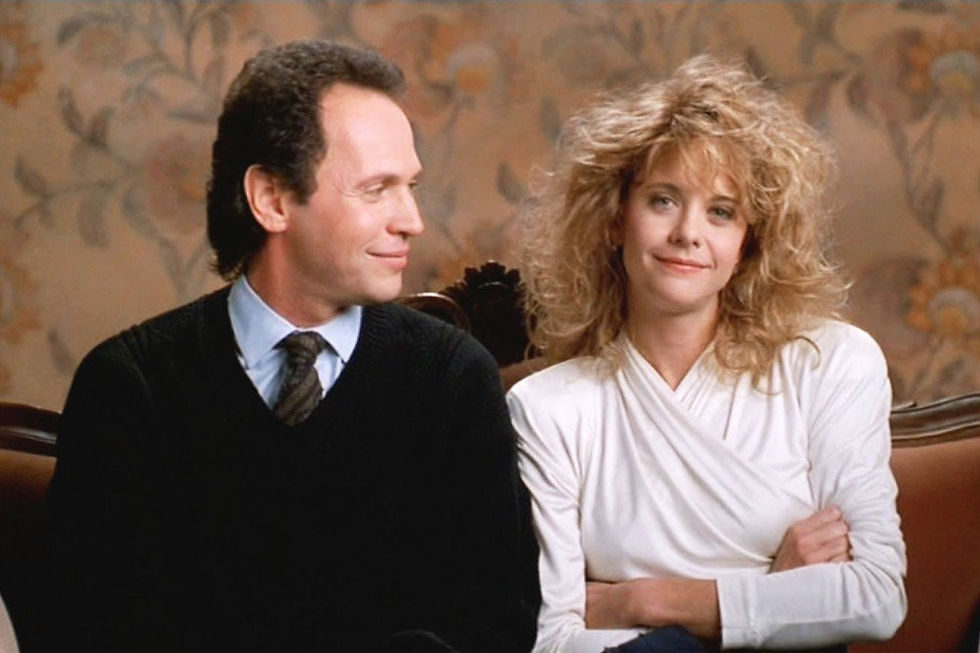
The gold standard against which every other romantic comedy on this list is inevitably measured, When Harry Met Sally... poses one deceptively simple question — can men and women truly just be friends without romantic feelings eventually complicating things — and spends twelve years of the characters' lives thoroughly, hilariously, and movingly answering it. Billy Crystal's Harry and Meg Ryan's Sally develop one of the most naturalistic, believable friendships-turned-romance in cinema history, their chemistry built as much on witty, overlapping dialogue as on any conventional romantic spark.
Nora Ephron's screenplay remains a masterclass in observational comedy about modern relationships, and the film's now-legendary deli scene, in which Ryan's character fakes an orgasm to prove a point about male obliviousness, followed immediately by another customer's famous "I'll have what she's having" line, stands as one of the single most iconic comedic moments in film history. Beyond its humor, the film's genuine, hard-won emotional truths about friendship, timing, and the terrifying vulnerability of loving your best friend have made it the film every subsequent romantic comedy still measures itself against.
Where to watch: Stream on Max.
Shop This Look:
Conclusion
From Claudette Colbert and Clark Gable bickering across a Depression-era road trip to Billy Crystal and Meg Ryan proving that friendship and romance were never as separate as Harry once believed, these twenty films represent nearly a century of the romantic comedy genre's greatest achievements. Whether you gravitate toward the swooning fairy tales of Pretty Woman and Notting Hill or the sharper, more subversive charms of My Best Friend's Wedding and (500) Days of Summer, this list proves the rom-com remains one of cinema's most enduring and beloved forms of storytelling.

💛 Enjoyed this? Support the content that celebrates the stories you love: Donate to That Love Podcast
🎙️ Stream That Love Podcast — stories with just as much heart: thatlovepodcast.com/episodes
💡 You May Also Love
If you're enjoying this blog, check out these other ones:
❓ Frequently Asked Questions
1. What is the greatest romantic comedy of all time? When Harry Met Sally... is widely considered the greatest romantic comedy ever made, praised for Nora Ephron's sharp screenplay, Billy Crystal and Meg Ryan's naturalistic chemistry, and its iconic deli scene, which remains one of the most quoted moments in film history.
2. What is the oldest movie on this list of best romantic comedies? It Happened One Night, released in 1934, is the oldest film on this list, notable for sweeping the "Big Five" categories at the Academy Awards and establishing many of the genre's most enduring conventions.
3. What is the highest-grossing romantic comedy of all time? My Big Fat Greek Wedding remains the highest-grossing romantic comedy relative to its budget, earning hundreds of millions of dollars worldwide from a production budget of just five million dollars.
4. Which romantic comedy on this list is based on a true story? The Big Sick is based directly on the real-life courtship of its writers, Kumail Nanjiani and Emily V. Gordon, including Emily's real medical coma and the couple's cross-cultural relationship challenges.
5. What Shakespeare play inspired 10 Things I Hate About You? 10 Things I Hate About You is loosely adapted from William Shakespeare's The Taming of the Shrew, transplanting the story into a 1990s Seattle high school setting.
6. Which Jane Austen novel inspired Clueless? Clueless is a modern adaptation of Jane Austen's Emma, relocating the story's matchmaking plot to 1990s Beverly Hills high school culture.
7. Who stars in When Harry Met Sally? When Harry Met Sally... stars Billy Crystal as Harry and Meg Ryan as Sally, with a screenplay written by Nora Ephron and direction by Rob Reiner.
8. What is the deli scene in When Harry Met Sally about? In the film's most famous scene, Sally fakes a loud orgasm in a crowded New York deli to prove to Harry that men cannot always tell when a woman is faking, prompting another customer's now-legendary line, "I'll have what she's having."
9. Is Notting Hill based on a true story? No, Notting Hill is a work of fiction written by Richard Curtis, though it draws loosely on the real experience of everyday people navigating relationships with global celebrities in London's Notting Hill neighborhood.
10. Which romantic comedy on this list won the most Academy Awards? It Happened One Night holds the distinction of sweeping all five major Academy Award categories in 1935 (Best Picture, Director, Actor, Actress, and Screenplay), a rare achievement not repeated for over forty years.


.jpg)





.jpg)


Comments