






Voicemails for Isabelle Review: Zoey Deutch and Nick Robinson Deliver Netflix's Best Rom-Com of the Year

Voicemails for Isabelle Review: Zoey Deutch and Nick Robinson Deliver Netflix's Best Rom-Com of the Year
Now streaming on Netflix | Released: June 19, 2026 | TV-14 | 1 hr 58 mins | Rotten Tomatoes: 85%
Introduction
Grief and romantic comedy do not often share screen time. The combination requires an extremely specific kind of tonal balance — too heavy on the grief and the comedy feels cruel, too light on it and the love story feels weightless. Voicemails for Isabelle, written and directed by Leah McKendrick, gets that balance exactly right. It is one of the most emotionally intelligent rom-coms Netflix has produced, a film that makes you laugh out loud in one scene and quietly reach for a tissue in the next — sometimes within the same two minutes.
It also has Zoey Deutch and Nick Robinson, two of the most naturally charming performers currently working in the romantic comedy space, and chemistry so effortless and undeniable that the whole film runs on it like electricity.
Plot Summary
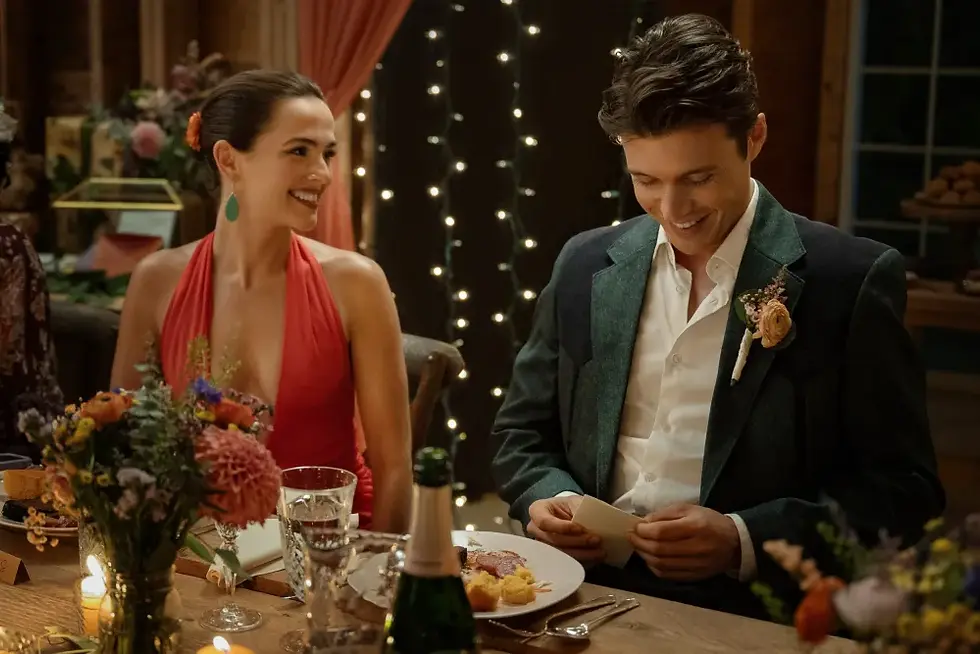
Jill (Zoey Deutch) is an aspiring pastry chef in San Francisco, working under the magnificently tyrannical Chef Bastien (Nick Offerman) and barely holding herself together after the death of her younger sister Isabelle, who spent her life battling cystic fibrosis. Jill and Isabelle had a particular way of staying connected — long, rambling, confessional voicemails that covered everything from bad dates to workplace disasters to the small, daily texture of a life that Isabelle could not always be physically present in.
After Isabelle dies, Jill cannot stop leaving the messages. She leaves them as a way of grieving, as a way of keeping the conversation going, as a way of refusing to accept the absolute silence of loss. What she does not know is that Isabelle's old phone number has been reassigned. That the person now receiving her most private, most vulnerable, most hilarious confessions is Wes (Nick Robinson), an Austin-based real estate agent who picks up the number on a new work phone.
Wes should delete the messages. He knows he should. He listens to one. Then another. Then he starts to fall in love with the woman behind the voice — a woman he has never met, who does not know he exists, who is having the worst year of her life and somehow making it the most fascinating thing he has ever listened to.
When Jill eventually discovers the truth, the film navigates the fallout with surprising honesty and emotional generosity — leading to a New Year's Eve resolution from Wes that is one of the most genuinely romantic gestures in recent Netflix history.
Themes and Storytelling
McKendrick, who drew directly on her own experience of leaving long voicemails for her sister during her college years, brings an intimacy to the film's central conceit that prevents it from feeling gimmicky. The voicemail as a storytelling device is used brilliantly — it is, as McKendrick notes, an inherently messy, unedited, human form of communication. Voicemails cannot be revised. They capture the real voice, the real thoughts, the real person — which is why Wes falls in love through them, and why the audience understands completely that he would.
The film's handling of grief is its most unexpected and most affecting quality. Jill's loss is not resolved or wrapped up neatly. It is present throughout — in the messages, in the moments of unexpected collapse, in the specific way that being a person without the person who knew you best changes your sense of yourself. The grief makes the comedy sharper and the romance more meaningful. A love story that begins in loss has earned its happy ending in a way that most conventional rom-coms do not.
The You've Got Mail comparison is made explicitly in the film — one character calls their meet-cute a "sick reboot" — and the film is confident enough in its own identity to wear the reference as a compliment rather than a challenge.

Characters and Performances
Zoey Deutch is extraordinary. She has always had an exceptional gift for physical comedy — the kind of full-body, completely committed performance that makes every reaction shot as funny as the main action — but in Voicemails for Isabelle she adds a depth and a tenderness to Jill that the role absolutely requires. The range McKendrick describes in her casting notes is exactly what Deutch delivers: from debilitating grief to cackle-inducing comedy to the tentative, terrifying vulnerability of someone allowing herself to be happy again. It is the best performance of her career.
Nick Robinson's performance is quieter but equally essential. Wes is the film's trickiest character — a man whose entire romantic position is built on something that could read as deeply creepy in less careful hands. Robinson plays him with a genuine sensitivity and a very specific brand of quiet bewilderment at his own feelings that makes Wes not just sympathetic but genuinely lovely. The film is right that the wrong actor would have made this impossible to root for. Robinson makes it effortless.
Nick Offerman as Chef Bastien is the film's comedic MVP in the supporting cast — a performance of such magnificent, unhinged pomposity that every scene he appears in generates the biggest laughs in the film. Harry Shum Jr. as Jill's best friend Andy is warm and funny and exactly the kind of best friend these films need. Ciara Bravo as Isabelle — seen entirely in flashback — makes every appearance land with a specific emotional weight that colours the whole film.

Visuals and Style
McKendrick gives the film a warm, slightly golden visual identity that suits its San Francisco and Austin settings beautifully. The Golden Gate Bridge bench — where Wes eventually tracks Jill down in a moment soundtracked by Taylor Swift's "Marjorie" — is one of the year's great cinematic images: the right setting, the right song, the right emotional temperature.
The music throughout is a particular strength. Composers Este Haim and Amanda Yamate — who have previous credits on You Are So Not Invited to My Bat Mitzvah and Do Revenge — use music as emotional punctuation with exactly the right touch. The soundtrack knows when to lead the scene and when to stay out of its way.
Humor and Heart
The film's humor comes primarily from Deutch's voicemails — the specificity, the self-awareness, and the complete lack of filter that makes them both hilarious and deeply revealing. McKendrick has a gift for the comedic digression that turns into the emotional truth: Jill starts a message about her boss and ends up talking about how she would have made Isabelle laugh at the same story. The comedy and the grief are the same thing, which is what makes both of them so affecting.
The romance itself builds beautifully. The slowness of the connection — one-sided for so long, and then suddenly not — gives the payoff the room it needs to genuinely land.
Strengths and Critiques
Strengths: Zoey Deutch's career-best performance. Nick Robinson making an impossible character completely compelling. The grief-meets-comedy tonal balance handled with real sophistication. One of the most emotionally honest rom-com premises in years. Nick Offerman and the dessert nacho food truck subplot. Taylor Swift's "Marjorie" placed with devastating perfection.
Critiques: At nearly two hours, the film runs slightly longer than its premise comfortably supports. The mid-film section around Jill discovering the truth moves through its emotional beats quickly in a way that some audiences may find rushed. The villain-boss subplot feels slightly underdeveloped compared to the richness of everything else.
Legacy and Impact
Voicemails for Isabelle has hit the Netflix Top 10 and is generating the kind of passionate word-of-mouth that the best rom-coms produce. Deadline noted it as proof that chemistry is everything in the genre — and it is. The film's 85% on Rotten Tomatoes places it firmly among the best romantic comedies Netflix has produced. It is already being discussed alongside Set It Up and People We Meet on Vacation in the streaming rom-com canon.
For Leah McKendrick, who wrote and directed the film and also appears in a supporting role, this is a genuine breakthrough — proof that the rom-com has an auteur dimension that is rarely recognised.

Conclusion
Voicemails for Isabelle is everything you want from a summer Netflix rom-com, and then something more. It is funny, it is romantic, it is anchored by two performances of real quality — and it handles grief with a gentleness and an honesty that elevates the whole enterprise from comfort watch to something genuinely moving.
Watch it on a Friday night. Call someone you love afterward.
Stream Voicemails for Isabelle now on Netflix. 💌
FAQs
1. What is Voicemails for Isabelle about? It follows Jill, a grieving aspiring pastry chef who copes with her sister's death by leaving confessional voicemails on her late sister's old number — unaware that the number has been reassigned to Wes, a stranger in Austin who falls in love with her through the messages.
2. Who stars in Voicemails for Isabelle? Zoey Deutch and Nick Robinson lead the cast, supported by Nick Offerman, Ciara Bravo, Lukas Gage, Harry Shum Jr., and director Leah McKendrick in a supporting role.
3. Is Voicemails for Isabelle based on a book? No. It is an original screenplay by Leah McKendrick, inspired loosely by her own experience of leaving voicemails for her sister during her college years.
4. Is Voicemails for Isabelle a good movie? Yes. The film holds an 85% on Rotten Tomatoes and has been praised for Zoey Deutch's performance, its handling of grief, and the chemistry between its leads.
5. When did Voicemails for Isabelle come out on Netflix? The film premiered globally on Netflix on June 19, 2026.
6. What song plays at the end of Voicemails for Isabelle? Taylor Swift's "Marjorie" is used in the film's pivotal reunion scene at the Golden Gate Bridge. The soundtrack was composed by Este Haim and Amanda Yamate.
7. What does Jill do with the food truck in Voicemails for Isabelle? After quitting her job at Chef Bastien's restaurant, Jill uses her late sister Isabelle's college fund to open a dessert nacho food truck called "Jill and Izzy's."
8. Does Voicemails for Isabelle have a happy ending? Yes. On New Year's Eve, Wes leaves Jill a voicemail explaining that he has held on to Isabelle's old phone number so she can continue to use it, and the film moves toward a genuinely earned romantic resolution.
9. Who directed Voicemails for Isabelle? Leah McKendrick, who also wrote the screenplay and appears in a supporting role as Breeda, Wes's friend.
10. How long is Voicemails for Isabelle? 1 hour and 58 minutes.
Meta Description: Voicemails for Isabelle review — now streaming on Netflix. Zoey Deutch and Nick Robinson star in one of 2026's most emotionally intelligent rom-coms, a grief-meets-love story that is funny, heartbreaking, and genuinely beautiful. Read our full review.


.jpg)





.jpg)


