



.jpg)
10 Minimal Christian Easter Decor Ideas


The transition from the stark, reflective season of winter into the blossoming, vibrant days of spring carries a profound spiritual weight for the modern Christian home. As we move through the solemnity of the Lenten season and look toward the triumphant dawn of Resurrection Sunday, our living spaces should reflect this internal shift. For decades, spring decorating has been dominated by commercialized, neon-colored plastics, whimsical bunnies, and cluttered displays that often distract from the true, staggering beauty of the holiday. Today, there is a deep, resonant desire among believers to reclaim the aesthetic of this sacred season. We are seeing a powerful movement toward minimal Christian Easter decor—a design philosophy that marries organic modern aesthetics with deeply rooted faith-based spring decorating.
This approach to Holy Week home accents is not about stripping away joy; rather, it is about stripping away the excess so that the profound message of the gospel can take center stage. By embracing subtle religious Easter decorations, we create environments of peace, reverence, and intentionality. The modern Christian home thrives on authentic materials: raw linen, hand-carved wood, textured stone, and foraged branches. These elements naturally lend themselves to a Lenten decor aesthetic that honors the earth God created while pointing our hearts toward the empty tomb. From minimalist cross decor to elegant Easter styling, these sophisticated design choices allow the narrative of sacrifice and redemption to breathe within our everyday spaces.
If you are seeking to cultivate a Christ-centered Easter that feels both beautifully curated and spiritually rich, this guide will walk you through the intersection of interior design and theology. These ideas will help you craft a home that whispers of grace, offering a sanctuary for your family to pause, reflect, and celebrate the ultimate victory of love over death.
If you appreciate our faith-based lifestyle guides and wish to support our mission of bringing you the best in Christian living and relationship content, please consider donating to our ministry here: https://www.thatlovepodcast.com/donate
Read More from That Love Podcast:
10. The Abstract Wooden Empty Tomb Scene (Organic Modern Resurrection Sets)

Moving away from the brightly painted, literal nativity-style sets of the past, the contemporary Christian interior design world has embraced the abstract wooden empty tomb scene. These organic modern resurrection sets are characterized by their smooth, unvarnished lines, utilizing raw materials like olive wood, walnut, or pale birch. Instead of detailed figurines, these sets rely on geometric shapes—a simple wooden arch, a movable circular stone, and three minimalist crosses—to convey the narrative of Easter morning.
The Spiritual Significance The empty tomb is the absolute climax of the Christian faith; it is the physical manifestation of the promise that death does not have the final word. By stripping away facial features and elaborate clothing from the figures, an abstract set invites the viewer into a space of quiet contemplation. It forces us to focus on the magnitude of the event rather than the minutiae of the depiction. It is a daily, tactile reminder of the "He is Risen" truth that anchors our hope.
How to Style It in Your Home To seamlessly integrate this piece into your Easter Sunday aesthetic, treat it as a sculptural focal point. Clear your entryway console or your living room mantel of everyday clutter. Place the wooden set off-center to adhere to the rule of thirds in design. Ground the set by resting it on a beautifully textured linen runner in a muted tone, such as oatmeal or sage green. You can soften the hard lines of the wood by placing a small, handmade ceramic vase beside it, filled with a single sprig of dried eucalyptus or baby's breath. The goal is to create a moment of visual pause as you walk through your home.
Budget-Friendly & DIY Approach If investing in a hand-carved artisan set is not currently in your budget, you can easily create a beautiful homage using found items. Visit a local craft store to purchase simple wooden blocks, a wooden hoop, and a round wooden disc. Leave them in their natural, unfinished state, or apply a light, natural beeswax polish. Arrange them thoughtfully on a tray.
Call to Action Support independent Christian artisans by purchasing a handcrafted olive wood resurrection set on Etsy to serve as a generational heirloom for your family.
Listen to our latest episodes for more inspiration on faith, family, and intentional living: https://www.thatlovepodcast.com/episodes
9. Subtle "Lamb of God" Line Art & Typography Prints

The transition into spring faith decor offers a wonderful opportunity to refresh the artwork on your walls. One of the most prominent trends in modern Christian home styling is the use of minimalist typography and continuous single-line art. Specifically, artwork featuring the phrase "Behold the Lamb of God" (John 1:29) or simple, elegant sketches of a lamb are replacing more traditional, heavy religious paintings. This style leans heavily into plenty of white space, crisp modern fonts, and muted, neutral color palettes.
The Spiritual Significance The imagery of the lamb is woven throughout the entire biblical narrative, from the Passover lambs in Exodus to the ultimate sacrifice of Jesus Christ in the New Testament. Decorating with the "Lamb of God" motif is a beautiful way to connect the Old Testament prophecies with the New Testament fulfillment during the Lenten season. It is a subtle, elegant reminder of Christ's innocence, His gentleness, and His sacrificial atonement for the sins of the world.
How to Style It in Your Home Look at the existing frames in your living room, hallway, or dining area. Instead of buying entirely new pieces, simply swap out the prints inside your current frames for the spring season. A large, oversized mat with a small, delicate line-drawing of a lamb in the center creates an incredibly high-end, gallery-like feel. For typography, look for prints that feature a single scripture verse typed in a classic serif font on textured, deckled-edge paper. These pieces work beautifully when leaned against a backsplash in a kitchen or placed on open floating shelves alongside trailing pothos plants and stoneware mugs.
Budget-Friendly & DIY Approach The internet is rich with digital downloads from talented Christian creators. You can purchase a digital file for just a few dollars, print it at home on high-quality watercolor paper or cardstock, and frame it yourself. This allows you to change your decor seasonally with almost zero financial strain while maintaining a highly curated look.
Call to Action Download a set of minimalist Easter scripture prints today and spend an afternoon reframing your gallery wall while listening to an acoustic worship playlist.
8. Draped Raw Linen Over Minimalist Crosses

Texture plays a massive role in organic modern interior design. As we curate meaningful Easter traditions within our homes, the juxtaposition of raw, unbleached linen draped over dark, forged iron or natural oak crosses provides a visually arresting and deeply symbolic element. This is not about the glossy, mass-produced decor found in big-box stores; it is about embracing the raw, the tactile, and the historically resonant.
The Spiritual Significance Linen holds a sacred place in the Easter narrative. It was the material used to wrap the broken body of Christ when He was laid in the tomb. On Sunday morning, Peter and John rushed to the sepulcher only to find the linen wrappings lying there, empty and discarded. Draping a piece of rough, raw linen over a simple cross in your home serves as a breathtaking visual representation of the resurrection. The cross is empty, the grave clothes are left behind, and death has been conquered.
How to Style It in Your Home Select a high-quality, free-standing minimalist cross. It could be forged from matte black iron, cast in raw brass, or carved from reclaimed barn wood. Place it on a prominent bookshelf, an entryway table, or as the anchor of a simple Easter centerpiece. Take a small, frayed-edge piece of natural linen—perhaps in a soft stone, ivory, or muted taupe color—and drape it effortlessly over the horizontal beam of the cross. Do not try to make it look perfect or symmetrical; the beauty lies in its organic, slightly rumpled appearance, invoking the wabi-sabi philosophy of finding beauty in the natural and imperfect.
Budget-Friendly & DIY Approach You likely already have the materials for this in your home. A scrap of fabric from a linen napkin, a vintage flour sack towel, or even a piece of muslin can be torn (rather than cut with scissors, to achieve that beautiful frayed edge) and draped over a cross you already own. It costs nothing but completely transforms the tone of the object from an everyday piece of decor into a specific Holy Week home accent.
Call to Action Visit your local fabric store to source a half-yard of 100% raw European flax linen to use throughout your Lenten decor styling.
Related Article: > 7 Ways to Incorporate Scripture into Your Home Decor If you love the idea of using minimal typography prints to celebrate the season, you might be looking for more ways to weave the Word of God into your daily environment. Discover elegant, non-cluttered methods for making scripture a natural part of your home's aesthetic. Read the full article here
7. Foraged Olive Branch and Dogwood Centerpieces

The urge to bring fresh life into our homes during spring is universal. However, faith-based spring decorating elevates this natural impulse by selecting botanicals that hold deep biblical meaning. Moving away from the heavily constructed, artificially dyed floral arrangements, the modern Christian home favors the loose, wild, and foraged look. The stars of the minimalist spring tablescape are the olive branch and the dogwood stem.
The Spiritual Significance The olive branch is universally recognized as a symbol of peace, originating from the dove returning to Noah's ark. More importantly for Easter, Jesus spent His final hours of freedom agonizing in prayer in the Garden of Gethsemane, a grove of olive trees on the Mount of Olives. The dogwood tree carries its own beautiful Christian legend; tradition says the dogwood was the tree used to build the cross, and in its sorrow, God decreed it would never grow large enough to be used for that purpose again. Its four-petaled flowers resemble the shape of a cross, with rust-colored indentations at the edges symbolizing the nail prints.
How to Style It in Your Home To achieve an elegant Easter styling, source a large, oversized vessel. A vintage stoneware crock, a weathered terracotta olive jar, or a textured papier-mâché vase works perfectly. Fill it with tall, sprawling branches of fresh or high-quality faux olive leaves, allowing them to drape naturally and asymmetrically. If dogwood is in bloom in your area, mix in a few branches for a delicate pop of white and subtle pink. Place this arrangement in the center of your dining table or on a large kitchen island. Because the branches are tall and airy, they make a dramatic statement without completely obstructing the view across the table, making them perfect for your Easter Sunday feast.
Budget-Friendly & DIY Approach The most budget-friendly decor is the decor you forage yourself. Take a walk with your family through your neighborhood or local woods (where permitted) and respectfully trim a few budding branches. If you don't have access to olive or dogwood, any budding spring branch—like cherry blossom, pussy willow, or even simple green leafy branches—will bring the vital, resurrecting energy of spring into your home for free. For insights on how nature affects our home's atmosphere, leading interior designers often discuss biophilic design principles on platforms like Architectural Digest.
Call to Action Head to a local florist or farmers market to pick up fresh, leafy branches, and spend a quiet Saturday morning arranging them in your favorite vintage pitcher.
6. Terracotta and Stone Arch Accents (The Rolled Away Stone)

Interior design trends have been heavily influenced by architectural arches in recent years. We see them in doorways, mirrors, and cabinetry. For the Christian decorator looking for subtle religious Easter decorations, introducing arch motifs and circular stone accents into your shelf styling serves as a beautiful, modern nod to the architecture of the garden tomb. Utilizing materials like terracotta, travertine, soapstone, and raw concrete adds an earthy, grounded element to your space.
The Spiritual Significance "Who will roll the stone away from the entrance of the tomb?" This was the anxious question the women asked each other as they walked to the grave on Sunday morning. The stone represents the finality of death, the seemingly immovable barrier between humanity and God. When they arrived to find the stone rolled away, it signified that the barrier had been permanently demolished. Incorporating heavy stone elements and open arches into your decor is a tactile reminder of the immovable obstacles that God effortlessly moves out of our way through the power of the resurrection.
How to Style It in Your Home Look for bookends crafted from travertine marble in the shape of an arch, or small, sculptural concrete spheres to rest atop a stack of vintage Bibles on your coffee table. You can also find beautiful, unglazed terracotta candle holders. Arrange a small vignette on a side table: a stone arch bookend, a small round river stone placed beside it, and a delicate spring flower in a bud vase. This creates an incredibly subtle, deeply meaningful abstract representation of the empty tomb. It is a "quiet" piece of decor that fits perfectly within a minimalist faith aesthetic without screaming "holiday decoration."
Budget-Friendly & DIY Approach You can create the look of high-end stone or terracotta decor using the viral "baking soda paint" trick. Take a cheap glass or plastic arched frame or a round decorative ball from a dollar store. Mix regular acrylic craft paint with a generous spoonful of baking soda until it forms a thick, chalky paste. Paint the objects with a bristle brush to give them a rough, matte, ceramic-like texture that mimics expensive stonework perfectly. For more DIY home projects that elevate your space, you can find excellent tutorials on The Spruce.
Call to Action Try your hand at a baking soda paint DIY this weekend to upcycle an old vase into a beautiful, stone-textured piece for your Lenten display.
Related Article: > The Spiritual Practice of Hospitality Preparing your home for Easter is not just about aesthetics; it is about preparing a space to welcome others. Discover how the early church viewed hospitality as a sacred duty, and learn how to open your minimally decorated home with maximum warmth and love. Read the full article here
5. Naturally Dyed Earth-Tone Eggs

The tradition of decorating eggs is deeply tied to the season, but the bright, artificial dyes of our childhoods often clash with a neutral spring decor palette. The resurgence of traditional, natural egg dyeing techniques is a cornerstone of organic modern Easter styling. By using everyday kitchen ingredients to dye eggs, you achieve stunning, muted earth tones—deep ochres, soft sage greens, dusty blues, and warm terracotta pinks.
The Spiritual Significance The egg has long been a symbol of new life and rebirth, making it a fitting metaphor for the resurrection. But there is added spiritual depth when we use the natural, God-given colors found in the earth to decorate them. Boiling yellow onion skins, red cabbage, turmeric, and coffee grounds to extract their rich pigments is a slow, intentional process. It invites us to slow down, to marvel at the hidden beauty in creation, and to engage in a meditative, Lenten practice of simplicity and mindfulness.
How to Style It in Your Home Once you have achieved your desired palette of naturally dyed eggs, the key to minimalist styling is presentation. Avoid the plastic, brightly colored Easter grass. Instead, nestle your earthy eggs in a hand-carved wooden dough bowl or a rustic ceramic colander on your kitchen island. For a beautiful minimalist spring tablescape, place a single naturally dyed egg in a small, woven nest made of dried grapevine or Spanish moss at the center of each guest's place setting. The matte, slightly speckled finish of naturally dyed eggs looks incredibly sophisticated against crisp white linen napkins and stoneware plates.
Budget-Friendly & DIY Approach This is arguably the most cost-effective decor idea on this list because you are using food scraps you would otherwise throw away.
For rich orange/sienna: Boil the dry outer skins of yellow onions.
For robin's egg blue: Boil chopped red cabbage.
For golden yellow: Simmer water with a few tablespoons of ground turmeric.
For deep brown: Soak the eggs in strong, cold-brewed coffee. Add a tablespoon of white vinegar to your dye baths to help the color adhere to the eggshells, and leave them submerged in the fridge overnight for the deepest hues. If you want to dive deeper into creating faith-based minimalism in your home, embracing these slow, natural processes is a perfect start.
Save your onion skins and coffee grounds this week, and plan a slow, intentional afternoon of natural egg dyeing with your family to prepare for Easter weekend.
Subscribe to our podcast for more insightful discussions on faith, love, and living intentionally: https://www.thatlovepodcast.com/episodes
4. The Grapevine "Crown of Thorns" Wreath

Wreaths are a staple of seasonal decorating, but for the Christian home preparing for Holy Week, a standard spring wreath bursting with pastel faux florals can feel incongruous with the solemnity of Good Friday. Enter the stripped-back, rustic grapevine wreath, purposefully left unadorned to symbolize the Crown of Thorns. This is a profound piece of Lenten decor that brings the weight and reality of Christ's sacrifice to the forefront of your home's exterior or interior.
The Spiritual Significance Before we can celebrate the joy of the empty tomb, we must sit with the agony of the cross. The crown of thorns was woven by Roman soldiers to mock Jesus' kingship, causing immense physical pain and humiliation. Hanging a bare, twisted grapevine wreath in your home during the weeks leading up to Easter is a powerful, sobering visual reminder of the price that was paid for our redemption. It is a declaration that the King of Kings wore a crown of suffering so that we could wear a crown of life.
How to Style It in Your Home The beauty of the "Crown of Thorns" wreath lies in its raw, unpolished state. Do not add bows, flowers, or greenery to it during Lent. Hang a simple, medium-sized grapevine wreath on your front door using a piece of rough jute twine or a strip of black or deep purple velvet ribbon (purple being the liturgical color of Lent, symbolizing mourning and royalty). Alternatively, you can lay the wreath flat in the center of your dining table, placing three thick pillar candles in the center to light during family dinners as you read through your Holy Week devotionals.
On Easter Sunday morning, you can transform the wreath to symbolize the resurrection by weaving fresh sprigs of baby's breath, olive leaves, or white lilies into the thorny vines, visually demonstrating how Christ's suffering bloomed into glorious victory.
Budget-Friendly & DIY Approach Plain grapevine wreaths can be purchased at any local craft store for just a few dollars. If you have wild grapevines, wisteria, or willow branches growing on your property, you can easily harvest them while they are still green and pliable, twisting them into a circular wreath shape yourself. Secure the ends with floral wire and let it dry out.
Purchase or forage a simple grapevine wreath to hang in your home as a visual anchor for your prayers and reflections throughout the solemn days of Holy Week.
Related Article: > Creating a Prayer Room in a Small Space Having visual reminders of Christ's sacrifice, like the grapevine wreath, can deeply enhance your prayer life. If you are looking to cultivate a dedicated space for quiet communion with God, learn how to transform even the smallest corner of your home into a sacred prayer sanctuary. Read the full article here
3. Single Taper Candles in Forged Iron Holders (The Light of the World)

Lighting is perhaps the most crucial element in establishing the mood and atmosphere of a room. For a minimal Christian Easter decor setup, stepping away from bright, artificial overhead lighting in favor of ambient, moody candlelight creates an environment ripe for reflection. Specifically, the use of tall, slender taper candles placed in heavy, forged iron, matte black, or antique brass holders invokes a sense of ancient reverence and wabi-sabi simplicity.
The Spiritual Significance The imagery of light and darkness is central to the Easter narrative. Jesus declared, "I am the light of the world." On Good Friday, darkness fell over the entire land from the sixth to the ninth hour as the Light of the World was temporarily extinguished. The tradition of the Paschal candle, lit on Easter Eve, symbolizes Christ rising from the dead to scatter the darkness of sin. By incorporating simple taper candles into your decor, you are participating in this ancient, beautiful symbolism. Lighting a candle in a quiet room is an act of defiance against the darkness; it is a declaration of hope.
How to Style It in Your Home To achieve an elegant Easter styling, arrange a cluster of candlestick holders of varying heights on a mantle, a sideboard, or as the centerpiece of your dining table. The asymmetry of different heights adds visual interest and prevents the display from looking too rigid. Use high-quality, dripless taper candles in muted, organic colors—think beeswax yellow, ivory, soft taupe, or even a deep, moody charcoal for Good Friday. When hosting an Easter dinner, turn off the overhead lights and allow the warm, flickering glow of the tapers to illuminate the faces of your family and friends. It creates a sacred, intimate atmosphere that elevates a simple meal into a communion of saints.
Budget-Friendly & DIY Approach Thrift stores and antique shops are absolute treasure troves for vintage brass and iron candlestick holders. You can often find heavy, beautiful pieces for pennies. Don't worry if they are tarnished; the patina adds to the rustic Christian decor aesthetic. To remove stubborn wax from thrifted holders, simply place them in the freezer for an hour; the old wax will shrink and pop right out.
Call to Action Dim the lights this evening, light a single taper candle, and spend ten minutes in quiet prayer, reflecting on Christ as the Light of the World.
2. Minimalist Wildflower & Palm Frond Displays
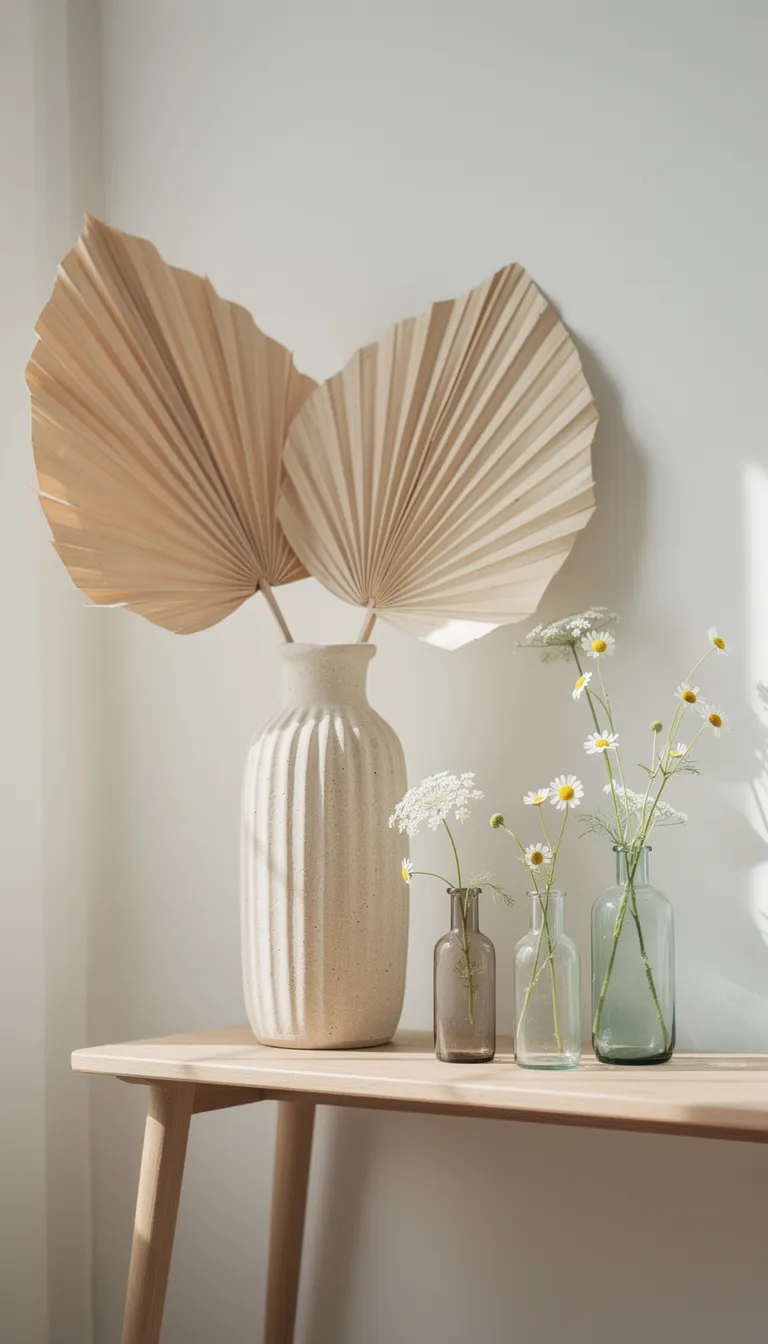
While the olive branch and dogwood focus on the solemnity of the garden and the cross, we must also make room for the joyful, triumphant elements of the Easter story. The entry into Jerusalem on Palm Sunday and the vibrant burst of new life on Resurrection Sunday are perfectly captured through minimalist displays of dried palm fronds and delicate, wispy spring wildflowers. This approach avoids the heavily manicured look of traditional florist bouquets in favor of something that feels freshly gathered from a sun-drenched meadow.
The Spiritual Significance When Jesus rode into Jerusalem on a donkey, the crowds laid palm branches on the road before Him, shouting "Hosanna!" (meaning "Save us now!"). The palm branch has since become a universal Christian symbol of victory, triumph, and peace. Incorporating dried or fresh palm fronds into your spring decor is a direct homage to the beginning of Holy Week. Transitioning from the palms to the delicate, resilient wildflowers on Easter Sunday symbolizes the unexpected, beautiful ways God brings life out of the dark, cold earth after winter. It reminds us that His mercies are new every morning.
How to Style It in Your Home For a modern, coastal-meets-organic vibe, utilize dried sun palms or fan palms. Their architectural, sculptural shape makes a massive impact. Place two or three large dried palm spears in a tall, narrow, textured vase in an entryway or living room corner. Because they are dried, they require zero maintenance and will last for years.
For the wildflower element, embrace the "bud vase" trend. Instead of one massive floral centerpiece, scatter five or six tiny, mismatched glass or ceramic bud vases down the center of your table. Place just one or two delicate stems in each vase—think chamomile daisies, Queen Anne's lace, ranunculus, or sweet peas. This creates a delicate, airy, and whimsical display that celebrates the fragility and beauty of new life.
Budget-Friendly & DIY Approach If you attend a Palm Sunday service, save the palm fronds given out by your church. You can follow tutorials to weave them into traditional palm crosses to hang above your doorways, or simply let them dry out naturally in a vase for a free, deeply meaningful piece of decor. For wildflowers, support a local flower farmer by purchasing a single, inexpensive market bouquet and breaking it apart into your collection of small glass jars and bottles.
Call to Action Gather empty glass bottles (like vintage apothecary bottles or cleaned-out specialty soda bottles) to create your own scattered bud vase centerpiece for your Easter table.
1. The "It Is Finished" Minimalist Mantel Vignette

Topping our list of minimal Christian Easter decor ideas is the curation of a dedicated, breathtaking focal point in your home: The "It Is Finished" mantel vignette. This is where all the elements of organic modern design and deep theological reflection come together to tell the complete story of Holy Week. A vignette is simply a small, curated grouping of objects that tells a story. By dedicating your fireplace mantel (or a prominent entryway console if you don't have a fireplace) to the Easter narrative, you create a visual anchor for your family's celebrations.
The Spiritual Significance "It is finished" (Tetelestai in Greek) were Jesus' final words on the cross. They are words of ultimate victory, signifying that the debt of sin was paid in full and the work of salvation was complete. A mantel vignette dedicated to this truth serves as an altar of remembrance in the heart of your home. It gathers the symbols of suffering, waiting, and resurrection into one cohesive display, guiding your family's hearts through the emotional and spiritual journey of the Triduum (the three days from Good Friday to Easter Sunday). For guidance on how to explain these profound concepts to children in your home, explore our resources on christian parenting at Easter.
How to Style It in Your Home Creating a minimalist vignette requires restraint; every object must have a purpose. Start with a blank slate.
The Anchor: Lean a piece of minimalist scripture art (perhaps the John 1:29 "Lamb of God" print or a simple typography print reading "Tetelestai") against the wall slightly off-center.
The Height: On the opposite side of the art, place a tall, textured vase holding a few sprawling, foraged olive or dogwood branches to draw the eye up.
The Symbol: In the center, place your abstract wooden empty tomb set, or a simple iron cross draped with a scrap of raw linen.
The Light & Texture: Fill in the gaps with two or three forged iron taper candle holders of varying heights. Lay a woven grapevine crown of thorns flat on the mantel surface, perhaps resting a small, smooth terracotta stone beside it to symbolize the rolled-away stone. The result is an asymmetrical, perfectly balanced, richly textured display that captures the essence of a Christ-centered Easter. It is elegant, it is understated, and it is profoundly moving.
Budget-Friendly & DIY Approach You do not need to buy anything new to create a stunning vignette. "Shop" your own home for items that fit the color palette (creams, earthy browns, blacks, muted greens) and the theme. An old, worn family Bible opened to the resurrection story in the Gospel of John can serve as the centerpiece of your display, costing absolutely nothing but holding infinite value. For more insights into the theological depth of the Easter story, platforms like Christianity Today offer excellent essays and devotionals.
Call to Action Clear off your mantel or a prominent shelf today, and spend time intentionally curating a vignette that points your family's gaze toward the finished work of the cross.
Conclusion
As we prepare our homes and our hearts for the celebration of Resurrection Sunday, the shift toward minimal Christian Easter decor offers us a beautiful, necessary exhale. By stripping away the brightly colored plastic excess and the commercialized noise, we make room for the sacred. We allow the profound, earth-shattering reality of the empty tomb to speak for itself.
Incorporating these 10 ideas—from the tactile drape of raw linen and the rustic weight of a grapevine crown to the organic beauty of naturally dyed eggs and foraged branches—transforms our living spaces into genuine sanctuaries. This approach to faith-based spring decorating is not merely an interior design trend; it is a spiritual practice. It is a way of visually declaring that our hope is anchored not in the fleeting things of this world, but in the eternal promise of Christ's resurrection.
This Easter, may your home be a place of quiet reverence. May your minimalist spring tablescapes and curated mantels spark deep, meaningful conversations with your family and guests. And above all, as you look upon the simple crosses, the flickering taper candles, and the subtle reminders of the rolled-away stone, may you be overwhelmed anew by the grace, love, and breathtaking victory of our Savior. He is risen indeed.

If this guide has inspired you to create a more intentional, Christ-centered home this season, please consider supporting the ongoing work of That Love Podcast by making a donation. Your generosity allows us to continue providing rich, faith-based content to believers around the world: https://www.thatlovepodcast.com/donate
Don't miss out on our latest conversations about faith, relationships, and intentional living. Listen to the podcast here: https://www.thatlovepodcast.com/episodes
Explore More from That Love Podcast:
10 FAQs About Minimal Christian Easter Decor
1. What is minimal Christian Easter decor? Minimal Christian Easter decor is an aesthetic approach to holiday decorating that focuses on simplicity, natural materials, and deeply symbolic religious elements. It moves away from commercialized spring decorations (like plastic eggs and neon bunnies) in favor of organic modern design elements that highlight the true meaning of the Lenten and Easter seasons.
2. How can I decorate for Easter without it looking tacky? To avoid a tacky appearance, stick to a cohesive, neutral, and earthy color palette. Use natural materials like wood, stone, linen, and fresh botanicals. Focus on one or two high-quality, meaningful focal points—such as an elegant Easter tablescape or a curated mantel—rather than scattering cheap decorations all over the house.
3. What are some subtle ways to display crosses in my home? For a subtle, organic look, choose crosses made from raw materials like olive wood, reclaimed barn wood, or matte forged iron. Avoid overly ornate or bedazzled crosses. You can display a small, minimalist cross on a stack of coffee table books or incorporate it into a gallery wall with lots of negative white space.
4. How do I naturally dye Easter eggs? You can dye eggs using kitchen staples! Boil the outer skins of yellow onions for a rich sienna/orange, chopped red cabbage for a robin's egg blue, ground turmeric for golden yellow, and strong cold-brewed coffee for deep brown. Adding a splash of white vinegar helps the color set on the eggshells.
5. What is the significance of the dogwood tree for Easter? Christian legend suggests the dogwood tree was used to make the cross on which Jesus was crucified. The legend states that God cursed/blessed the tree so it would never grow large enough to be used for a cross again, and its four-petaled flowers resemble a cross with rust-colored edges symbolizing nail prints.
6. Can I leave minimal Easter decor up all spring? Absolutely! Because this style of decor relies heavily on natural elements like foraged branches, wildflowers, and neutral linens, it easily transitions into general spring decor. You can simply remove specific Holy Week elements (like the crown of thorns or the draped cross) after Easter Sunday while leaving the botanicals in place.
7. Where can I find abstract wooden resurrection sets? Many independent Christian artisans craft beautiful, organic modern resurrection sets. The best places to look are Etsy, local Christian bookstores that feature handmade items, or online boutiques that specialize in faith-based minimalism.
8. What colors represent Lent and Easter in home decor? Traditional liturgical colors are purple for Lent (representing mourning and royalty) and white/gold for Easter (representing purity, joy, and victory). In modern minimalist decor, these translate beautifully into muted mauve, deep plum, soft ivory, raw linen, and warm brass tones.
9. How do I create a "Crown of Thorns" wreath? You can purchase a plain, unadorned grapevine wreath from a craft store, or weave your own using pliable, green wild grapevines or willow branches. The key is to leave it bare and rustic, without adding any floral elements, to accurately symbolize the suffering of Good Friday.
10. What is "wabi-sabi" and how does it relate to Christian decor? Wabi-sabi is a Japanese design philosophy centered on the acceptance of transience and imperfection. In Christian decor, embracing the imperfect, raw, and unpolished elements of nature (like rough stone, frayed linen, or knotted wood) reminds us of our own brokenness and the beauty of God's redemptive grace that meets us in our imperfection.
For more beautiful spring decorating inspiration and ideas to transition your home into the new season, check out Country Living Magazine.


.jpg)


.jpg)








Comments