



10 Best Sitcoms Like Community

Community made a community college feel like a launchpad for almost any kind of story. The Greendale study group could spend one week navigating a paintball action movie, another trapped in a bottle episode, and another confronting the emotional consequences of ordinary friendship. Beneath the genre homages and meta jokes was a dependable ensemble: people who were lonely, defensive or self-involved, but gradually learned how to belong. Finding a follow-up means looking for comedies that share that creative freedom as well as the pleasure of a close, messy group.
This ranking favors series that combine distinct character voices with formal invention, dense jokes or a setting that can keep generating new kinds of conflict. Some are workplace or family sitcoms that build elaborate running gags; others parody familiar genres or turn a high-concept premise into a playground. They do not all have Community’s exact mix of warmth and pop-culture references. A few are considerably darker, and several have tighter story engines. Their common thread is a willingness to make structure part of the joke.
The entries retain your ranking, with #1 saved for the strongest overall recommendation. For each show, we introduce the central cast and setup, explain which Community pleasures it shares, and identify the differences that matter. You can use the ranked order as a guide or jump to the pick that best matches your mood: dense callbacks, absurd group schemes, a genre parody or a character-driven ensemble.
Every title links to a JustWatch UK search page because streaming catalogues change. Check current subscription, rental or purchase listings before you start. If you mainly miss Greendale’s affectionate study group, lean toward the warmer entries. If you want the show to keep surprising you structurally, the higher-ranked formal experimenters are likely to be the best fit.
A note about expectations: Community’s genre episodes are part of a wider run of character stories, not isolated parodies. The best alternatives here likewise have a reason for their comic experiments, whether it is a workplace that invites recurring schemes or a family whose history fuels callbacks. Some entries are more accessible than Community’s most self-referential episodes; others ask you to pay close attention to the construction. That range is intentional. It lets you choose between a quick, easy ensemble binge and a comedy whose jokes become richer when you remember details from earlier seasons.
We also distinguish affectionate satire from comedy that is deliberately abrasive. Community can tease its characters and institutions while still inviting viewers to care about the outcome; not every recommendation has that same balance. The entry notes will help you decide.
Affiliate disclosure: This article contains Amazon affiliate links. If you sign up or make a qualifying purchase through one of these links, That Love Podcast may earn a commission at no additional cost to you. As an Amazon Associate I earn from qualifying purchases.
How we ranked these sitcoms
We judged each show by its ensemble chemistry, willingness to experiment with form or genre, density of comic ideas, and ability to make the characters’ relationships matter. Community is unusually flexible: it can spoof a genre while advancing a story about friendship. Shows that share several of those qualities rank higher, while more specialized workplace or family comedies remain useful recommendations when their particular comic voice is strong.
Pick a style of comic experiment
For layered callbacks and jokes that reward close attention, try the tightly constructed entries. For genre parody, choose a series that changes its storytelling frame or builds a heightened world. For the Greendale group’s sense of accidental family, look for a workplace ensemble with recurring projects and character growth. Several titles are darker than Community, so use the notes below to match tone as well as format.
#10 AP Bio

Story: Disgraced Harvard philosophy scholar Jack Griffin (Glenn Howerton) returns to his Ohio hometown and is forced to teach advanced biology at Whitlock High. Jack has no interest in teaching: he wants to use the school’s resources and his students to get revenge on a rival who took his dream job. His class, including eager-to-please Sarika and observant Stef, quickly learns that their teacher’s schemes are more ambitious than the syllabus. Principal Durbin (Patton Oswalt) tries to keep the school functioning while Jack’s plans repeatedly spill into the hallways and faculty lounge.
Why it works for fans: The setup gives the series a workplace ensemble, a self-centered lead, and a steady supply of elaborate group schemes. Like Community, it finds comic mileage in a school full of oddball personalities and in the gap between official educational purpose and what people actually do there. Jack is a much less redeemable center than Jeff Winger, and the show leans into broad farce more than emotional growth. Its students also receive less sustained development than Greendale’s study group. Still, the class’s plans and the school’s eccentric adults make it a good fit for viewers who enjoy smart characters behaving very badly.
Why it ranks here: It starts the countdown because its misfit school setting is an obvious Community connection, though its character development and thematic range are narrower.
Who should watch it: Watch if you want a cynical school comedy with clever schemes, an antihero teacher and a large, energetic ensemble.
#9 Trial & Error

Story: New York lawyer Josh Segal (Nicholas D’Agosto) arrives in the small Southern town of East Peck to defend poetry professor Larry Henderson (John Lithgow), who has been accused of murdering his wife. Josh’s case team includes eccentric local investigator Dwayne Reed (Steven Boyer) and assistant Anne Flatch (Sherri Shepherd), whose unusual medical conditions and matter-of-fact confidence often become part of the investigation. Each season builds a new case through mockumentary interviews, courthouse theatrics and increasingly absurd evidence, while Josh tries to make a serious legal defense out of a town that treats everything as spectacle.
Why it works for fans: The mockumentary format, self-aware storytelling and ensemble commitment make this a natural recommendation for Community fans who like genre parody. Its legal mystery gives every character a shared project, much as Greendale’s study group can rally around a class, campus crisis or wildly overproduced event. The jokes are often built around procedural conventions, and the cast plays the town’s ridiculousness with straight-faced conviction. It has less emotional continuity than Community and focuses more tightly on a case-of-the-season structure, but its willingness to turn a familiar format inside out is very much in the same comic spirit.
Why it ranks here: It earns this place for its playful formal tricks and group chemistry, while its short run and case-centered storytelling give it less room to build a sprawling world.
Who should watch it: Pick it for a fast, eccentric mystery-comedy that treats courtroom clichés as a playground.
#8 Mythic Quest

Story: At a successful video-game studio, creative director Ian Grimm (Rob McElhenney) and lead engineer Poppy Li (Charlotte Nicdao) try to guide the long-running fantasy game Mythic Quest through expansions, launches and office crises. Ian’s ego and Poppy’s technical ambition make them uneasy collaborators, while producer David Brittlesbee, monetization lead Brad Bakshi and the rest of the staff navigate deadlines, rivalries and the strange demands of a devoted player community. The workplace is the engine, but the show also makes space for standalone stories about relationships, creativity and what people give up to make art.
Why it works for fans: Like Community, Mythic Quest is comfortable shifting its format and tone. It can move from fast workplace banter to an unusually intimate standalone episode, then return to an ensemble plot about an absurdly high-stakes project. The creative team’s arguments echo the balance between Jeff’s showmanship and Annie’s organization, though Mythic Quest is more interested in labor, authorship and the business pressures surrounding creativity. Its gaming-industry details are accessible even if you do not play games, and its best episodes deepen characters rather than merely parodying them. It is more polished and grounded than Greendale’s cartoon logic, which makes the differences part of its appeal.
Why it ranks here: It ranks here for its inventive structure and memorable ensemble, though the gaming studio gives it a more focused workplace identity than Community’s anything-goes campus.
Who should watch it: Choose it if you like workplace comedy that can be silly one week and surprisingly thoughtful the next.
#7 What We Do in the Shadows

Story: A documentary crew follows vampire housemates Nandor, Laszlo, Nadja and energy vampire Colin Robinson as they attempt to live together in Staten Island. Their familiar, Guillermo, handles the practical work and secretly hopes to become a vampire himself. The group’s centuries of supernatural history do not help them with chores, local politics or the latest household disagreement. Neighbors, other creatures of the night and the vampires’ own insecure ambitions keep turning domestic routines into escalating disasters, while the documentary format captures their grand self-image beside their deeply petty behavior.
Why it works for fans: Community fans will recognize a comedy that treats a ridiculous premise with documentary seriousness and lets every member of a dysfunctional group have a sharply defined comic point of view. The characters’ elaborate plans often collapse because nobody can admit what they really want, a familiar kind of ensemble friction. It also shares Community’s appetite for genre parody, though it plays in horror, fantasy and mock-documentary conventions rather than television formats and pop culture at large. Its humor is more improvisational and its continuity looser, but the supernatural setting gives the show an unusually durable source of new conflicts.
Why it ranks here: It lands in the upper half for its original ensemble and sustained commitment to the premise, with a slightly less serialized emotional arc than the shows above it.
Who should watch it: It is a strong choice if you want a workplace-like ensemble of self-absorbed friends and supernatural absurdity.
#6 The Good Place

Story: After her death, Eleanor Shellstrop (Kristen Bell) wakes in an apparently perfect afterlife neighborhood designed by architect Michael (Ted Danson). Eleanor believes she has been sent there by mistake, and she recruits ethics professor Chidi Anagonye (William Jackson Harper) to help her become the kind of person who belongs. Their circle also includes socialite Tahani (Jameela Jamil), silent monk Jianyu—who is actually Jason Mendoza (Manny Jacinto)—and the all-knowing assistant Janet (D’Arcy Carden). As the group investigates the rules of their world, the series keeps changing what its characters think they know.
Why it works for fans: The Good Place resembles Community in the way it turns a stable ensemble into a laboratory for ideas. Ethics, friendship and personal change become the material for jokes and serialized twists, rather than speeches attached to a conventional sitcom. It has the same affection for flawed people who can learn from one another, and Michael’s elaborate plans can feel like a professor’s overdesigned lesson. The Good Place is more tightly plotted and philosophically focused, while Community is more likely to detour into an homage or meta-fictional experiment. That precision makes it a satisfying next watch for viewers who want comedy with an endgame.
Why it ranks here: It ranks sixth because its emotional and intellectual payoff is exceptional, although its carefully controlled story is less loose and genre-hopping than Community.
Who should watch it: Start here if you want an accessible, funny series about friendship, ethics and becoming better through practice.
More sitcoms to explore
#5 Better Off Ted

Story: Ted Crisp (Jay Harrington) is a warm-hearted executive at Veridian Dynamics, a corporation that pursues scientific breakthroughs with little regard for ethics or common sense. He tries to protect his daughter and maintain a decent relationship with coworker Linda Zwordling, even as his boss Veronica Palmer orders increasingly questionable projects. Scientists Phil and Lem are enthusiastic but socially awkward partners in workplace experimentation, and the company’s cheerful advertising slogans rarely match what is happening inside the lab. The series uses Ted’s narration and the company’s absurd policies to expose the distance between corporate language and human consequences.
Why it works for fans: Its satirical workplace is a strong match for Community viewers who enjoy a high-concept joke system that can be reset and recombined every episode. Veridian’s employees are part of an institution that behaves like a classroom run by an authority figure with a bad plan, and the cast’s precise comic rhythms make even a simple office memo feel absurd. Better Off Ted is less serialized and less emotionally expansive than Community, but its sharp writing rewards attention to background jokes and recurring corporate absurdity. It also gives Linda and Veronica distinct ambitions, so the office conflict is not limited to Ted’s perspective.
Why it ranks here: It reaches the top five for its smart premise, disciplined satire and ensemble timing, though it offers fewer long-form character arcs than the higher-ranked picks.
Who should watch it: Try it for brisk, clever corporate satire with a humane lead and a relentless stream of visual and verbal jokes.
#4 Party Down
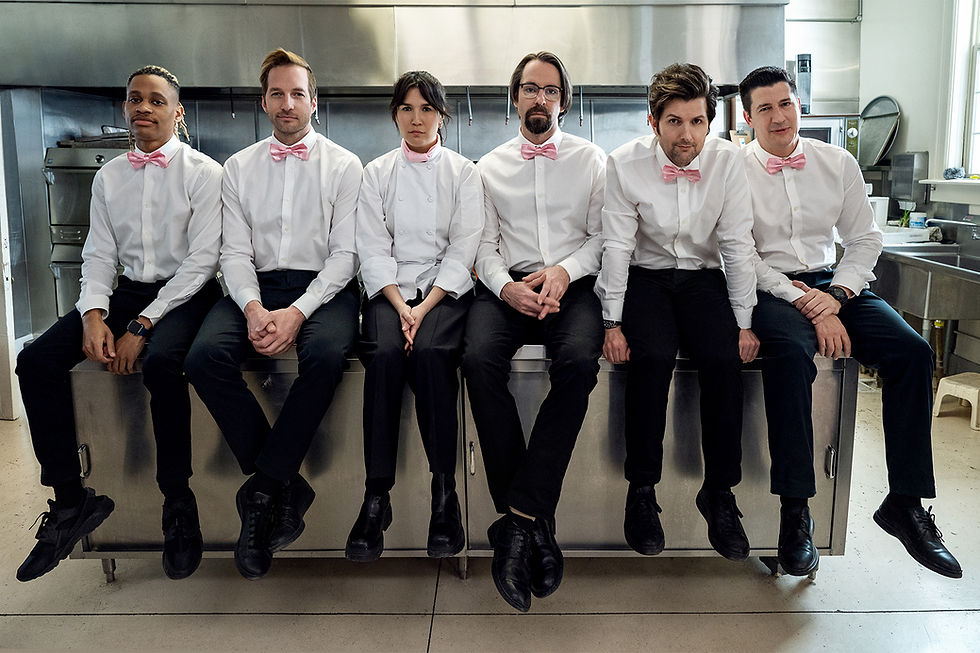
Story: A group of aspiring actors and writers work catering jobs around Los Angeles while waiting for their careers to take off. Henry Pollard (Adam Scott) has largely given up on acting, but his coworkers—including ambitious Casey, romantic dreamer Kyle, aspiring writer Roman and earnest manager Ron—keep imagining that the next audition, party or connection will change everything. Each shift takes the crew to a different event, where wealthy clients’ celebrations become the setting for workplace mishaps and personal disappointments. The pink bow ties and repeated company slogan promise professionalism, while the staff quietly wonders whether this temporary job has become their real life.
Why it works for fans: Party Down has Community’s interest in people who are overqualified, underprepared or simply unsure what they are doing with their lives. Its workplace gives the ensemble a weekly mission and a flexible set, while recurring characters grow through small disappointments rather than tidy sitcom lessons. The comedy is drier and more adult, and the event format is more grounded than Greendale’s genre tributes. Still, both shows understand that a group can be irritating and loyal at the same time. Party Down is especially good at turning an awkward social setting into a revealing character study, with Henry’s resignation counterbalanced by the others’ stubborn hope.
Why it ranks here: It takes fourth place for its excellent ensemble and bittersweet perspective on ambition, with less formal experimentation than the top three.
Who should watch it: Watch if you like workplace comedies about creative people, uncertain futures and coworkers who become an accidental family.
#3 It’s Always Sunny in Philadelphia

Story: At Paddy’s Pub in Philadelphia, friends Mac, Charlie and Dennis run a bar that rarely attracts customers. Dennis’s twin sister Dee joins their schemes, while Frank Reynolds supplies money and a taste for chaos. The Gang’s plans to get rich, prove a point or win a personal argument usually expose their selfishness and make the situation worse. Episodes build from small grievances into elaborate cons, public embarrassments and social disasters, with the characters’ certainty that they are right providing much of the comedy. The series keeps returning to the same people and place, letting their long-running habits become the joke.
Why it works for fans: Community and Sunny both use a close ensemble as an excuse to experiment with genre, structure and absurdly committed premises. Sunny is far more cynical: its characters rarely learn, and the show often makes their worst instincts the point. Community’s study group, by contrast, can surprise itself with moments of generosity. But if the appeal of Greendale is watching a group create its own bizarre rules, Sunny offers a darker version in which the rules are designed to excuse selfish behavior. Its long continuity makes the Gang’s shared history part of the humor, even as each episode can usually be watched on its own.
Why it ranks here: It earns third for its fearless premise and remarkably durable ensemble, though its aggressive misanthropy is a sharp tonal change from Community’s warmth.
Who should watch it: Choose it when you want boundary-pushing, cynical ensemble comedy and characters who are spectacularly bad at self-reflection.
#2 30 Rock

Story: Tina Fey’s Liz Lemon runs the fictional live sketch show TGS with Tracy Jordan, balancing network demands, cast egos and the production calendar. Her volatile star Tracy Jordan (Tracy Morgan) and relentlessly optimistic co-star Jenna Maroney (Jane Krakowski) create daily problems, while executive Jack Donaghy (Alec Baldwin) treats every crisis as a chance to apply his own corporate philosophy. Writers, pages and producers fill out a workplace where a simple creative decision can turn into a media event. Liz’s attempts to keep the show coherent rarely survive the collision of ambition, money and celebrity.
Why it works for fans: 30 Rock is one of the closest matches for Community’s rapid-fire references, formal play and affection for characters who are ridiculous without becoming interchangeable. Both series can make a small plot carry a dense stream of jokes, and both enjoy mocking television while remaining deeply interested in how it gets made. Liz’s writer room has the cooperative chaos of Greendale’s study group, while Jack’s power games echo the campus’s parade of self-important authority figures. 30 Rock is more tightly centered on a production workplace and has a sharper joke-per-minute style; Community is more sentimental and more likely to turn an entire episode into a genre pastiche.
Why it ranks here: It ranks second for its inventive television satire and exceptionally strong character voices, narrowly behind a show with even broader ensemble transformation.
Who should watch it: Put it on if you love dense jokes, behind-the-scenes television stories and characters whose confidence far exceeds their competence.
#1 Arrested Development

Story: When patriarch George Bluth is jailed for financial crimes, his responsible son Michael (Jason Bateman) tries to keep the family business and family itself from collapsing. His relatives—self-involved siblings Gob, Lindsay and Buster, teenage son George Michael, niece Maeby and matriarch Lucille—keep creating new problems while insisting that Michael fix them. Narrator Ron Howard guides viewers through callbacks, cutaway jokes and contradictions that reward close attention. The family’s real-estate company becomes a setting for schemes, rivalries and misunderstandings, but the central conflict is Michael’s repeated attempt to be the only mature person in a household that resists maturity.
Why it works for fans: Arrested Development is the best next stop for Community fans who enjoy layered callbacks, unreliable self-image and stories that make later jokes depend on earlier details. Its characters have distinct comic engines, and their shared history creates a web of running jokes rather than a simple collection of punchlines. Community is more openly affectionate and more willing to let its characters grow; Arrested Development is a sharper family satire whose members often repeat their mistakes. But both shows trust viewers to notice structural tricks and small details. The result is a sitcom that becomes richer on a rewatch, with a formally playful approach that fits this list better than any other.
Why it ranks here: It takes the top spot for combining a tightly connected ensemble, intricate construction and high rewatch value—the qualities that make Community’s most ambitious episodes so rewarding.
Who should watch it: Start here if you want a smart, densely plotted comedy with recurring jokes, family dysfunction and a cast that commits to every absurdity.
Further reading and official show information
Conclusion
A great follow-up does not need to repeat the original show beat for beat. The best recommendations here keep the pleasures that make a sitcom rewatchable—distinct voices, relationships that change, a setting that generates new stories and enough comic invention to make the next episode feel fresh. Start with the title that matches what you miss most, then let its own characters and rhythms take over.
If you found a new favorite from this ranking, support the podcast and browse more episodes for your next watch-list conversation.
More sitcoms to explore
More sitcoms to explore
Frequently asked questions
What sitcom is most like Community?
Arrested Development is a strong match for dense callbacks, formal play and a cast whose relationships generate running jokes. 30 Rock is another close recommendation for fast references and television satire. Community’s specific blend of warmth, pop culture and genre homage is distinctive, but both shows reward attentive viewers.
What should I watch after Community?
Try Arrested Development for intricate callbacks, 30 Rock for rapid-fire television comedy, or The Good Place for a warm ensemble and an ambitious serialized concept. This ranking offers ten directions, from workplace satire to darker group comedy, so you can choose based on which part of Greendale you miss.
Which show has the most meta humor?
30 Rock and Arrested Development are especially rewarding for viewers who notice how the show is made and how earlier jokes return. It’s Always Sunny also plays with recurring structure, though its tone is much harsher. Each uses self-awareness differently, so expect related craft rather than a direct Community imitation.
Which recommendation is closest in tone?
The Good Place may be the closest in emotional balance: its characters are flawed, the jokes are concept-driven, and friendship supports real change. Party Down shares an ensemble focus but is more bittersweet, while Arrested Development is more cynical. Think about whether you want warmth, melancholy or sharper satire.
Are these shows all one-camera sitcoms?
No. The list includes different production styles and storytelling formats, from mockumentary to traditional multi-camera and highly edited single-camera comedy. Community itself often changed its visual language to support a genre homage. That variety is part of the appeal, but it means the pacing and joke delivery will differ.
Which series is best for genre parodies?
Community remains an unusually direct genre parody, but What We Do in the Shadows makes supernatural conventions a regular source of comedy, and Trial & Error turns legal-procedural tropes into a mockumentary mystery. 30 Rock also satirizes television conventions. Choose by whether you want horror, courtroom or media references.
Are any of these shows darker than Community?
Yes. It’s Always Sunny in Philadelphia is much more cynical, and its central characters rarely learn the lessons that Greendale’s study group sometimes does. Party Down is more melancholy about ambition. If you want Community’s warmth, start with The Good Place or Party Down rather than the most abrasive picks.
Do I need to watch these series in order?
For most, release order is best because recurring characters and callbacks accumulate across seasons. Many episodes have self-contained plots, but serialized changes are more satisfying when you know the earlier context. Start with the pilot, then follow the listed seasons in order if the ensemble works for you.
Which show has the best ensemble?
That depends on what you value. Arrested Development has a tightly interlocked family whose flaws fuel complex callbacks; 30 Rock has sharply distinct workplace voices; The Good Place offers some of the clearest character growth. Community fans may enjoy comparing how each ensemble handles conflict and loyalty.
Where can I check UK streaming availability?
The JustWatch UK link beneath each entry searches the current listings for that exact show. Services change their catalogues, and a title may be available by subscription, rental or purchase. Verify the season count and current option through the linked result before planning a binge.