



.jpg)
The Uprising Review – Andrew Garfield Brings Fire to a Gritty but Muddled Medieval Epic

Subtitle: Paul Greengrass’ brutal 1381 revolt drama is powered by urgency, mud and strong performances, even when its storytelling loses the historical thread.
There is something immediately compelling about the way The Uprising looks at medieval England. Paul Greengrass does not present the 1381 Peasants’ Revolt as a handsome, distant chapter from a school textbook, full of polished armour and grand speeches delivered in spotless castles. His England is wet, filthy, hungry and furious. It is a country where ordinary people are crushed under taxes, landlords and a ruling class that barely notices their suffering until the anger arrives at its gates.
That approach gives The Uprising a real charge. Andrew Garfield plays the unnamed Ploughman, a fictional working man pushed toward rebellion as England begins to fracture beneath the rule of the young King Richard II. Alongside real historical figures including radical preacher John Ball and rebel leader Wat Tyler, he becomes part of a movement that refuses to accept its place at the bottom of society. The historical setting is not merely decorative; the film wants the audience to feel the pressure that makes people risk everything.
It is also a surprisingly strange film. Greengrass is one of cinema’s most effective directors of political panic and ground-level chaos, from Bloody Sunday to the Bourne films and United 93. Here, he brings that restless energy to an era of wooden carts, rough fields and brutal public punishment. When The Uprising is focused on class rage, fear and the sudden possibility of collective power, it can feel genuinely alive.
Yet the film has a difficult time deciding exactly what kind of story it wants to be. Is it a sober historical drama about the Peasants’ Revolt? A rough-edged action epic about a reluctant rebel? Or a myth-making story that wants to connect its hero to a much more familiar English legend? That uncertainty becomes increasingly noticeable as the plot develops, and it explains why early reviews have been so split. The film currently holds a mixed critics’ score on Rotten Tomatoes, where praise for its atmosphere and cast sits beside frustration with its uneven narrative choices.

Still, an uneven Paul Greengrass historical epic is often more interesting than a safe one. The Uprising has blood in its veins, a terrific ensemble and a clear sense that the past is not as far away as people like to imagine. Its flaws are frustrating precisely because so much of the film works.
So, is The Uprising worth watching? Let’s get into it 👇
Support That Love Podcast
Enjoying the reviews and recommendations? You can help support That Love Podcast and keep independent entertainment coverage and original storytelling going.
If you enjoy ambitious period stories that use history to examine power and rebellion, explore our guide to the most binge-worthy TV dramas.
Want to Reach Entertainment Fans?
If you're a brand, author, publisher, streaming company, entertainment business, or creator looking to reach an engaged audience, That Love Podcast offers advertising opportunities across the website, podcast, and newsletter.
Find out more: Advertise With That Love Podcast

What Is The Uprising About?
The Uprising is set during the 1381 Peasants’ Revolt, one of the most significant popular uprisings in English history. The country is exhausted by war, unequal taxation and a rigid social order that treats labourers as disposable. As resentment builds, rural workers and townspeople begin to challenge the institutions that have governed every part of their lives.
Andrew Garfield’s Ploughman is the emotional entry point into that turmoil. He is not a king, knight or nobleman; he is a man whose life has been narrowed by poverty and violence. That perspective gives the film an appealingly grounded starting point. Instead of watching history from a throne room, the audience sees it through the eyes of someone who has everything to lose and very little left to protect.
Around him are real historical figures. Jamie Bell plays John Ball, the radical preacher whose message of spiritual and social equality helps give the rebellion a language. Cosmo Jarvis plays Wat Tyler, the formidable leader who helps turn scattered anger into a political force. Stephen Dillane appears as Archbishop Simon Sudbury, while Tom Hollander brings a cold authority to Treasurer Robert Hales.
The film’s official premise positions the revolt as a battle against the tyranny of Richard II’s government, and that is largely what the early sections deliver. It is a story of people discovering that the systems built to keep them powerless are vulnerable after all. Focus Features has framed the film as a historical drama rooted in the revolt, and that basis remains the movie’s strongest asset.
The complication is that The Uprising also begins to flirt with a larger legendary identity for its fictional hero. The marketing and the film’s later storytelling invite a connection to Robin Hood mythology, but not with enough confidence or clarity to make the idea fully land. It is an intriguing impulse, but it leaves the film caught between history and folklore.
You May Also Enjoy
Story and Plot: A Revolution That Loses Some Momentum
Greengrass understands how quickly political instability can turn into motion. The opening stretch of The Uprising is strong because it does not waste time making medieval England seem picturesque. It establishes deprivation, anger and an everyday culture of humiliation, then lets those tensions tighten until they snap. The revolt feels inevitable rather than convenient.
The Ploughman’s journey is built around that growing pressure. Garfield’s character does not begin as a natural leader or warrior, which gives the story a useful human scale. He is pulled toward rebellion by circumstance, grief and an emerging recognition that obedience will not protect him. That is a solid foundation for a historical action drama.
The best plot developments involve the movement itself. John Ball’s rhetoric, Wat Tyler’s strategic presence and the increasingly dangerous march toward London give the movie a larger scope without losing sight of ordinary people. The revolt becomes a collision of beliefs: some characters want reform, some want revenge and some simply want the ruling class to finally feel the fear it has imposed on everyone else.
This is also where Greengrass’ style works best. His films often make institutions feel enormous until one crisis exposes how fragile they really are. In The Uprising, palaces, churches and government offices become places of panic once the people outside stop accepting the rules. The suspense comes less from whether the revolt will happen than from what it will become once it does.
The problem is that the film’s central fictional storyline is less developed than the historical figures around it. The Ploughman is clearly meant to represent an everyman figure, but he can feel more symbolic than specific. The audience understands his anger, but not always the full shape of his inner life beyond it.
That issue becomes more pronounced once the movie begins steering toward its mythic ambitions. The Robin Hood-adjacent material is not necessarily a bad idea; legends are often born out of real social conflict, and the Peasants’ Revolt is fertile ground for that kind of storytelling. But The Uprising does not quite build the bridge between documented history and fictional myth-making. Instead, the shift feels abrupt enough to distract from the historical drama that was already working.
The result is a film with a riveting first half and a more divisive later stretch. The Associated Press noted that the final turn toward a familiar legend risks making the history feel muddled, even while praising the film’s commitment to its harsh medieval setting and its major performances. That is a fair assessment: The Uprising is never boring, but it does not always know where its strongest story is.
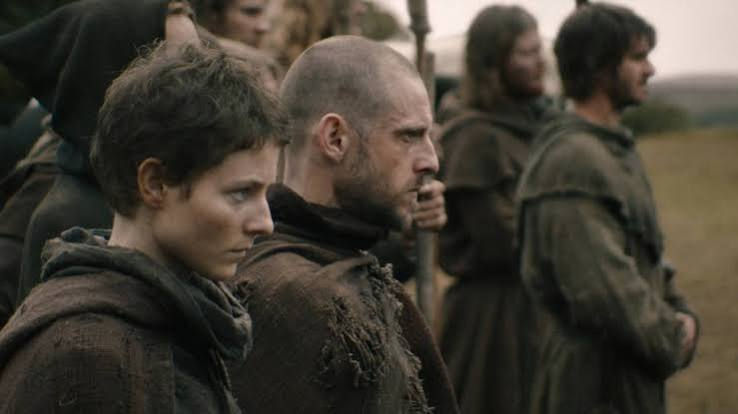
Cast and Performances: Garfield Carries the Weight
Andrew Garfield gives the film its emotional centre. The Ploughman is a role that asks him to be wounded, defiant, frightened and physically exhausted, often in the same scene. Garfield has always been particularly effective at playing men who feel everything intensely, and he uses that quality well here. His performance is raw without becoming showy.
What Garfield does especially well is make the Ploughman’s anger feel earned. This is not a modern action hero who suddenly discovers he has a rebellious streak. He looks like a man who has spent years swallowing injustice because there seemed to be no alternative, then reaches the point where survival and resistance become the same thing.
Jamie Bell is arguably the film’s most electric supporting presence. His John Ball is not a saintly revolutionary delivering tidy speeches for the history books. Bell plays him as a man who understands the power of words and the danger of being heard. He gives the character conviction, volatility and enough spiritual intensity to explain why people would follow him.
Cosmo Jarvis makes Wat Tyler similarly memorable. Jarvis has a rugged physical presence that suits the role, but he also brings a sharpness that stops Tyler from becoming a standard rebel-warrior figure. There is calculation in his performance. He knows the uprising needs force, but he also knows force alone cannot build a future.
Stephen Dillane and Tom Hollander are excellent choices for the ruling class and church establishment. Dillane brings a weary severity to Archbishop Sudbury, while Hollander’s Treasurer Hales is all clipped authority and bureaucratic contempt. Neither actor overplays the villainy; they make the upper echelons of power feel insulated, fearful and utterly convinced of their own legitimacy.
Woody Norman, as the young Richard II, has one of the most difficult jobs in the film. He must play a king who is technically powerful but visibly out of his depth, a child raised to represent certainty while a nation is unraveling around him. Norman gives Richard an unsettling mix of vulnerability and inherited privilege.
🎧 Need something to listen to after watching? That Love Podcast creates original romantic audio dramas, comedies and stories you can listen to anytime.

What Works in The Uprising
The film’s world-building is its greatest triumph. Greengrass and his creative team make 14th-century England feel tactile rather than theatrical. The streets are crowded, the clothes are worn, the walls are damp and the violence is ugly. There is little of the polished fantasy sheen that often turns medieval settings into theme parks.
That visual roughness matters because the movie is about economic pressure. The world has to feel physically hard for the revolt to make sense, and it does. Food is scarce, work is punishing and power is visible in the smallest details of daily life. A tax collector, a church official or an armed guard can alter the course of a family’s existence in seconds.
The political material also has real bite. The film does not pretend that every rebel is noble or every member of the ruling class is cartoonishly evil. It is more interested in the way unequal systems create rage, then act surprised when that rage becomes uncontrollable. The themes feel uncomfortably current without requiring obvious modern dialogue.
Greengrass remains excellent at staging confusion. When crowds gather, the frame becomes unstable and the soundscape grows claustrophobic. The audience is not positioned above the action, calmly surveying a historical battle. It is placed inside the crush, where rumours move faster than facts and a single decision can send hundreds of people running.
The supporting cast makes the political arguments feel personal. Bell and Jarvis, in particular, give the revolt competing energies: Ball represents belief and moral imagination, while Tyler represents action and leadership. Their scenes help the film articulate why rebellion is never a single emotion. It is hope, rage, desperation, ego and solidarity all at once.
The movie’s willingness to show the revolt as frightening is another strength. The Uprising does not reduce ordinary people to flawless heroes simply because they are oppressed. When a crowd gains power, it can seek justice, but it can also become cruel. The film understands that moral complexity, even if it sometimes handles its individual characters less precisely.
Finally, the movie benefits from ambition. Historical dramas are often built around famous monarchs, military victories or royal romances because those stories are easier to sell. The Uprising chooses workers, preachers and rebels. That choice alone gives it a perspective that feels fresher than many big-screen period dramas.
What Doesn’t Work
The biggest weakness is the Ploughman himself. Garfield is fully committed, but the screenplay gives him fewer distinctive qualities than the people surrounding him. The historical figures arrive with ideology, status and clear stakes. The fictional protagonist is meant to make the story accessible, yet he occasionally becomes the least interesting person in it.
The pacing is another issue. At just over two hours, The Uprising has enough room to explore the revolt’s shifting alliances and consequences, but it does not always use that time efficiently. Some scenes create rich atmosphere without pushing the character arcs forward. Others rush through emotional turns that would have benefited from more patience.
The film’s handling of the Robin Hood connection is the most frustrating element. It is not a spoiler to say that The Uprising toys with the idea of turning history into legend, because the film’s promotion has made that conversation unavoidable. The trouble is that the movie never fully commits to either version of itself. It is not quite a historical drama with a subtle folkloric flourish, and it is not quite a bold reinvention of Robin Hood either.
That ambiguity has reportedly been part of the film’s wider conversation, with some coverage questioning how directly the story connects to the famous outlaw myth. The best version of this movie would have either embraced that idea from the beginning or left it as a quiet, haunting possibility. Here, it lands somewhere in the middle.
There is also a risk that the film’s visual intensity begins to feel repetitive. Greengrass’ handheld style has power, especially in scenes of disorder, but the constant movement can flatten the difference between moments of real escalation and scenes that are simply loud. A few more still, intimate sequences would have deepened the emotional impact.
You May Also Enjoy
More Historical Drama Worth Your Time
If you enjoy dark, atmospheric stories shaped by harsh historical realities, read our review of The Dreadful, another recent period film built around danger, poverty and oppressive social structures.
Advertise With That Love Podcast
Want to put your movie, series, book, entertainment brand, product, or business in front of readers who love television, movies, books and pop culture?
That Love Podcast offers advertising and sponsorship opportunities across the website, podcast and newsletter.
Find out more: Advertise With That Love Podcast

Characters and Relationships: The Movement Is the Main Character
The most compelling relationship in The Uprising is between the individual and the crowd. The Ploughman begins as someone shaped by private suffering, but the story steadily asks what happens when personal pain becomes political. He is not simply joining a rebellion; he is becoming part of a force too large for any one person to control.
That makes Garfield’s scenes with Bell and Jarvis particularly important. John Ball offers the Ploughman a way to understand injustice as something larger than bad luck. Wat Tyler offers him a practical route toward change, one built on discipline, risk and the willingness to confront power directly. The film suggests that revolutions need both kinds of figures.
The tension between Ball and Tyler is also one of the movie’s strongest ideas. One is a preacher whose words can inspire people to imagine equality; the other is a leader forced to make immediate, dangerous decisions. They are united by the cause, but they do not represent the same method. That distinction gives the rebellion texture.
On the other side, Richard II and his advisers reveal how power looks when it is scared. The king is young, but the machinery around him is old and entrenched. The nobles and church leaders do not necessarily understand the people rising against them, which makes their responses more reckless. They see disorder, not the decades of exploitation that created it.
The Ploughman’s personal relationships are less sharply drawn. The film gives him emotional wounds and reasons to fight, but it rarely slows down enough to make those connections feel as fully lived-in as the historical conflict. That is why the character can feel like a vehicle for the plot rather than a complete person.
Still, the movie understands something valuable: collective action changes people. The Ploughman is not the same man once he has seen thousands of others refuse obedience. That transformation is the film’s emotional argument, even if it does not always dramatise it as deeply as it could.
Visuals, Music and Atmosphere
The Uprising looks expensive in the right way. Its production design is not interested in making poverty picturesque. There are no glowing castle interiors designed to invite tourism, no spotless costumes and no overly romantic sunsets turning hardship into beauty. The image is brown, grey, smoky and often difficult to look at.
That palette gives the film an oppressive weight. England feels permanently cold, even when the action is happening outdoors in daylight. The environment is another source of conflict: mud slows people down, narrow streets trap them and darkness becomes a weapon. It is a setting designed to make the audience feel how little room there is to breathe.
The violence is similarly blunt. Greengrass does not stage combat as a series of triumphant poses. A fight is messy, noisy and often over before anyone has fully understood what happened. That approach fits the movie’s anti-romantic view of rebellion, even when the action scenes become visually chaotic.
The sound design helps sustain the tension. Crowds, chanting, hooves, wooden doors and distant church bells create a world where danger is often heard before it is seen. The music avoids overwhelming the film’s rough realism, allowing the pressure of the environment to do much of the emotional work.
Themes: Power, Class and the Stories History Chooses to Keep
The central theme of The Uprising is class inequality. The revolt grows because the people at the bottom of society are expected to absorb every cost: taxes, labour, war and punishment. The ruling class treats this structure as natural, while the rebels recognise it as a choice made by people with power.
The film is especially effective when it explores the gap between law and justice. The institutions of England insist that they represent order, but the characters at the centre of the story experience that order as exploitation. The Uprising asks whether a system can still be called lawful when it has abandoned the people it claims to govern.
Religion also plays a major role. John Ball’s message challenges the idea that social hierarchy is divinely ordained. That is dangerous because it turns political resistance into a moral question. If all people are equal before God, then the privileges of kings, nobles and church leaders become much harder to defend.
There is a theme of myth-making running underneath the movie as well. The story is interested in the moment when a person stops being an individual and becomes a symbol. That is potentially fascinating territory, especially in a film set around an uprising remembered through fragmented history, folklore and political argument.
But this is also where the movie’s final choices feel most unresolved. The Uprising wants to ask how legends are born, yet it is more persuasive when it stays with the real human cost of history. Its best scenes remind viewers that before anyone becomes a myth, they are a person trying to survive.
🎧 Need something to listen to after watching? That Love Podcast creates original romantic audio dramas, comedies and stories you can listen to anytime.
Is The Uprising Worth Watching?
Yes, with a few reservations. If you enjoy historical dramas that feel rough, political and physical, The Uprising is worth seeing on the biggest screen available. Greengrass creates a convincingly hostile medieval world, and Andrew Garfield, Jamie Bell and Cosmo Jarvis give the film enough performance power to make its strongest stretches genuinely gripping.
It is especially recommended for viewers who like history films that focus on ordinary people instead of royalty. The 1381 Peasants’ Revolt is a fascinating subject, and the movie gives it a scale and immediacy that many viewers may not expect. It makes the uprising feel like a living event rather than a footnote.
Fans of Robin Hood stories should manage expectations. This is not a conventional swashbuckling adventure, and it is not built around the playful outlaw fantasy associated with most versions of that legend. The tone is much darker, more violent and more interested in social upheaval than romantic heroism.
Those who want a tightly structured historical epic may be more frustrated. The film’s ambition sometimes outpaces its focus, particularly in the later material. But even at its most muddled, The Uprising remains a serious, textured attempt to tell a large story from the mud up.
Where to Watch The Uprising
As of September 2026, The Uprising is playing in cinemas in the United States through Focus Features. Check local theatrical listings and the official Focus Features page for current screening information.
Work With That Love Podcast
That Love Podcast is open to collaborations with entertainment brands, authors, creators and businesses looking to reach engaged readers and listeners.
Final Verdict
The Uprising is a forceful, muddy and frequently impressive historical drama that never quite solves its own identity crisis. Paul Greengrass brings urgency to the 1381 Peasants’ Revolt, making medieval inequality feel raw, physical and alarmingly relevant. The film’s sense of place is superb, and its supporting performances give the historical material genuine weight.
Andrew Garfield delivers a committed central performance, even if the Ploughman is written more as an emblem than a fully developed man. Jamie Bell and Cosmo Jarvis are the standouts, bringing intellectual fire and hard-edged authority to John Ball and Wat Tyler. Their work makes the uprising feel like a movement with competing voices rather than a simple battle between good and evil.
The film’s strongest choice is its perspective. By centring workers and rebels, The Uprising finds drama in the people history often pushes to the margins. Its weakest choice is its uncertain approach to myth, particularly when it edges toward a Robin Hood connection without fully earning the transition.
For all its narrative wobble, this is a bold period film with real texture and conviction. It may not become the definitive screen version of the Peasants’ Revolt, but it is memorable enough to make viewers want to learn more about the real history behind it.
⭐ Review Score: 6.5/10
You May Also Enjoy

Conclusion
The Uprising is not a clean, crowd-pleasing historical blockbuster, and that is partly what makes it worth discussing. It is angry, grimy and deeply suspicious of the people who insist that suffering is simply the natural order of things. Greengrass turns 1381 into a place of sweat, fear and possibility.
The film does not always balance its historical roots with its mythic ambitions, but its best sequences have a ferocious energy. Garfield gives the audience someone to follow, Bell and Jarvis give the rebellion a pulse, and the production design makes the past feel painfully close.
If you are in the mood for a medieval drama with grit rather than glamour, The Uprising is a worthwhile cinema trip. Just go in expecting a turbulent historical epic, not a straightforward Robin Hood origin story.
Support That Love Podcast
Enjoying the reviews and recommendations? You can help support That Love Podcast and keep independent entertainment coverage and original storytelling going.
For more stories, reviews and original audio dramas, listen to That Love Podcast.
FAQs About The Uprising
Is The Uprising based on a true story?
Yes. The film is set during the real 1381 Peasants’ Revolt in England, though Andrew Garfield’s Ploughman is a fictional character created for the film.
Who plays the Ploughman in The Uprising?
Andrew Garfield plays the Ploughman, an unnamed working man who becomes involved in the rebellion.
Who plays Wat Tyler in The Uprising?
Cosmo Jarvis plays Wat Tyler, one of the real-life leaders of the Peasants’ Revolt.
Who plays John Ball in The Uprising?
Jamie Bell plays John Ball, the influential preacher associated with the revolt.
Is The Uprising a Robin Hood movie?
Not exactly. The film has prompted discussion about a possible connection to Robin Hood mythology, but it is primarily a historical drama about the Peasants’ Revolt.
Who directed The Uprising?
Paul Greengrass directed The Uprising.
How long is The Uprising?
The film runs for approximately 128 minutes.
What rating is The Uprising?
The Uprising is rated R in the United States for its violent and intense historical material.
Is The Uprising suitable for children?
No. Its violence, dark themes and mature depiction of medieval conflict make it best suited to adult and older teen viewers.
Where can I watch The Uprising?
As of September 2026, The Uprising is in cinemas. Check local listings and Focus Features for availability.
Further Reading
For more background on the film’s reception and historical approach, read the Associated Press review of The Uprising.
Useful Resources
Join the That Love Podcast Newsletter
Want more movie reviews, TV recommendations, book lists and entertainment news delivered straight to your inbox? Subscribe to the That Love Podcast newsletter for fresh recommendations and original storytelling.


.jpg)







.jpg)


Comments