





Toy Story 3 (2010) Review: The Most Emotionally Devastating Animated Film Ever Made

Updated: Aug 10
Opening Scene
There are films that make you cry. And then there is Toy Story 3 (2010), which does something rarer and more unsettling: it makes you grieve. Not for fictional characters exactly — though you will weep for them too — but for your own childhood, for things you set aside without realising they were irreplaceable, for every version of yourself that time made obsolete before you were ready to let it go. Directed by Lee Unkrich and released on June 18, 2010, this Toy Story 3 review is an attempt to articulate how a sequel to a children's animated film became one of the most emotionally complete works in cinema history. With Tom Hanks and Tim Allen returning alongside a spectacular new cast including Ned Beatty, Michael Keaton, and Bonnie Hunt, the film was a box office phenomenon — earning over $1 billion worldwide — and won the Academy Award for Best Animated Feature. It is available on Disney+, and it will absolutely ruin you in the best possible way.
👉 If you love this, check out: The Films That Helped Us Grieve What We've Left Behind
You Might Like This
Toy Story 3 is where the franchise’s themes about growing up and letting go become almost impossible to ignore. These related articles explore the movies before it, what followed, and why this chapter still hits so hard:
Plot Summary
Seventeen years have passed in the story's internal timeline since Andy first found Woody and Buzz under the Christmas tree. Andy is now 17 and preparing to leave for college, and his toys — who have spent years in the toybox, rarely played with, waiting with increasing anxiety for the moment of connection that no longer comes — face an existential reckoning.
The options are bleak: attic or trash bag. Through a series of mishaps, the toys end up donated to Sunnyside Daycare, which at first seems like a paradise — children who will always play with them, a purpose finally restored — but which quickly reveals itself to be something far more sinister. The daycare is run by a strawberry-scented teddy bear named Lotso (voiced by Ned Beatty with a thick Southern warmth that slowly curdles into menace), who controls the toy community with a velvet fist and an iron heart.
What follows is one part prison-break thriller, one part meditation on mortality, one part love letter to childhood — and it pulls off all three registers with extraordinary confidence. Woody, separated from the group, ends up at the home of a young girl named Bonnie, whose simple, imaginative, joyful play reminds him (and us) of everything Andy's room once was.
The Toy Story 3 plot moves with the assurance of a film that knows exactly where it is going and is not afraid to take you all the way there. The third act — the furnace sequence — is among the most harrowing ten minutes in the history of family cinema. And the ending, which asks every adult in the cinema to cry openly and without shame, delivers on everything the franchise has promised since 1995.
Director's Style & Cinematic Elements
Lee Unkrich, who co-directed Toy Story 2 and served as editor on several of Pixar's landmark films, brings a precise, emotionally confident directorial vision to Toy Story 3. His background in editing is evident throughout: the film is impeccably paced, with a rare instinct for when to push forward and when to linger. The opening montage — Andy's childhood captured in home-video textures, set to a version of "You've Got a Friend in Me" that sounds like memory rather than music — is one of the great opening sequences in cinema. It establishes the film's entire emotional argument in under three minutes.
Visually, the film is a profound leap forward from its predecessors. The animation has a softness and warmth that the earlier films' cleaner rendering could not achieve — skin, fabric, dust motes in afternoon light — and every environment is constructed with the detail of a story being told rather than a world being displayed. Bonnie's bedroom is a riot of loving, handmade specificity. The daycare's surface cheerfulness is coded with a quiet wrongness that deepens as the film progresses.
The score by Randy Newman is his best work in the franchise — more orchestral, more expansive, and more melancholy. The film knows that it is a story about endings, and Newman's music holds that knowledge tenderly throughout.
The daycare sequences have the atmosphere of a noir thriller, and Unkrich leans into this with genuine commitment — low angles, dramatic lighting, shadows used expressively in ways that recall classic Hollywood filmmaking transposed into a bright, plastic world. It is a tonal achievement that few animated films have matched.
Toy Story 3 holds a 98% on Rotten Tomatoes and is detailed in full on IMDb.

Themes & Deeper Meaning
Toy Story 3 is, at its philosophical core, a film about mortality — and about whether it is possible to face the end of things with grace, gratitude, and love intact. It is one of the very few family films that actually goes there: that looks at oblivion, does not flinch, and finds something true to say about it.
The furnace sequence is the film's central statement. As the toys, conveyed toward the incinerator on a moving belt, exchange a last look and reach for each other's hands — choosing to face what is coming together, having given up on escape — the film asks its audience to hold something that most adult dramas would not dare to raise. It is a moment of stunning emotional courage from a studio making entertainment for children, and it lands with a force that suggests that the best children's stories have always known that children can bear the truth.
But the film's deeper theme is not death — it is love expressed through letting go. Andy's arc in the final sequence, as he passes his toys one by one to Bonnie, saying a few words about each with a tenderness that reveals how much they have meant to him even in the years of silence, is the franchise's emotional payoff. It is not a sad ending. It is the most loving ending imaginable — a gift, freely given, from someone who grew up to understand what he had been given.
Lotso's backstory — revealed in a sequence that echoes Jessie's from the second film — provides the film's villain with a genuine emotional foundation. He too was loved and then lost, and the choice he made in response to that loss — to become incapable of love rather than risk loss again — is presented as the film's moral tragedy. He is not evil because he is bad; he is evil because he gave up on good.
👉 For more on films about love, loss, and letting go, see: The Hardest Goodbyes in Cinema History
You Might Like This
Toy Story 3 is where the franchise’s themes about growing up and letting go become almost impossible to ignore. These related articles explore the movies before it, what followed, and why this chapter still hits so hard:
Acting Performances
Tom Hanks delivers his finest work as Woody in Toy Story 3. The performance is notably quieter than in the earlier films — the anxious energy has been replaced with something closer to weary resignation that gradually transforms into genuine peace. The final scene, in which Woody watches Andy drive away from Bonnie's driveway, is not a scene of loss but a scene of complete and full-hearted love — and Hanks communicates that without a single word.
Ned Beatty is a revelation as Lotso. The character is one of the great villain constructions in Pixar's history: warm, insinuating, and genuinely terrifying once the mask slips. Beatty's soft Southern drawl gives Lotso a surface gentleness that makes his cruelty all the more chilling. He is an actor bringing full presence to a role that a less committed performer might have phoned in.
Michael Keaton is an unexpected comic delight as Ken, the vain, fashion-obsessed doll who falls catastrophically in love with Barbie. It is a perfectly timed comic performance that provides the film with some of its funniest moments without ever undercutting the emotional weight of the surrounding story.
Joan Cusack's Jessie continues to evolve as a character — her arc in this film is about overcoming the fear of being abandoned again, and Cusack plays that fear and its gradual resolution with the same emotional intelligence she brought to the second film.
The film's most memorable line belongs to Woody in the closing scene: "So long, partner." Two words. Tom Hanks' voice. Total devastation.
Strengths
The primary strength of Toy Story 3 is that it earns everything it asks of its audience. The emotion is not manufactured. It is not a response to manipulative orchestral swells or cheap callbacks. It is the natural culmination of fifteen years of story, fifteen years of love for these characters, and a third act that knows precisely what it has been given and honours it completely.
The villain is the franchise's best. Lotso works because he is not simply a threat to the protagonists — he is a dark mirror of what any of the toys could have become. His tragedy illuminates the film's central moral argument: that love is always worth the cost of losing it.
The prison-break second act is one of the most entertaining extended sequences in Pixar's history. It is genuinely tense, cleverly constructed, and populated with sharp character comedy that never loses sight of the stakes. The film balances its tonal registers — thriller, comedy, existential meditation — with a poise that is simply extraordinary.
The Bonnie subplot is a lovely grace note — a reminder that the cycle of love between children and their toys does not end; it simply continues in new hands. It reframes the film's ending from loss to legacy, which is precisely the note the franchise needed to hit at this particular moment in the story.

Areas for Improvement
If there is a weakness in Toy Story 3, it is that some of the new daycare characters are not given the depth they might have been, given more screen time. Chunk, Sparks, and the other residents of Sunnyside are essentially background colour — present but not fully rendered. This is perhaps inevitable in an ensemble film with such a wide cast, but a few more minutes with any of them might have made the prison-break sequences feel even more richly populated.
Some viewers have also suggested that the film's near-unbearable emotional weight in the final act makes for a slightly unbalanced overall experience — the tonal shift from adventure comedy to existential grief is steep, and younger children may find the furnace sequence genuinely distressing rather than cathartic. That said, the film resolves this tension with such warmth and grace that most viewers emerge feeling held rather than devastated.
Comparative Analysis
Toy Story 3 belongs in conversation with the great third acts in trilogy cinema. Like Return of the King or The Dark Knight Rises, it carries the obligation of completion — of honouring everything that came before while delivering something that feels genuinely new — and it meets that obligation with extraordinary confidence.
Within the animated genre, it stands as perhaps the most emotionally complete feature ever produced. Pixar's own Up (2009) opens with a sequence of comparable devastation, but Toy Story 3 sustains that register across its full length. Inside Out (2015) is arguably more intellectually sophisticated in its exploration of emotion, but Toy Story 3 hits the body in a way that few films of any kind achieve.
The Oscar it won for Best Animated Feature was the right outcome. In a year that also saw the release of How to Train Your Dragon — another extraordinary film — Toy Story 3 was simply operating at a different level of artistic ambition and achievement.
Its enduring legacy is visible in almost every ambitious animated sequel since: the willingness to age with your audience, to trust that the people who grew up with these characters can bear something honest and difficult about what it means to grow up.
👉 See also: The Best Third Films in a Trilogy – Ranked
Target Audience
Toy Story 3 is rated G in most territories and is appropriate for all ages, though the emotional experience it delivers is very different depending on who you are when you watch it. Children will find an exciting adventure with genuinely scary villains and a deeply satisfying resolution. Adults who grew up with the first two films — and who may be watching at the precise moment in their lives when they are leaving home, or watching their own children grow — will experience it as something far more personal.
It is worth being aware that the furnace sequence may genuinely frighten young children, and the overall emotional weight of the film's final act can be overwhelming for sensitive viewers of any age. But this is not a film to protect yourself from. It is a film to let in.
Parents watching with children should perhaps have tissues available and be prepared for their children to ask why they are crying at a cartoon about toys. The answer — "because it's about love, and love sometimes hurts" — is actually an excellent conversation to have.
Personal Impact
Watching Toy Story 3 as an adult — particularly as someone who was a child when the original was released — is not simply watching a film. It is a confrontation with the passage of time. The film knows this about you. It knows exactly who you were and how much of that you have set aside without quite meaning to. And it meets that knowledge with extraordinary tenderness.
The ending is not sad. This is important. The ending is the most luminous and generous thing the franchise ever does — a reframing of loss as love freely given, of ending as transformation rather than extinction. Andy saying goodbye is not a scene of grief; it is a scene of a young man choosing, consciously and fully, to give the things he loves to someone who will love them as he once did.
You will cry. You will not mind.
You Might Like This
Toy Story 3 is where the franchise’s themes about growing up and letting go become almost impossible to ignore. These related articles explore the movies before it, what followed, and why this chapter still hits so hard:
Conclusion
Toy Story 3 (2010) is not just the best film in the Toy Story franchise. It is one of the great films of the 21st century — a work of animation that transcends its genre, its medium, and its audience's age to say something true and aching and ultimately hopeful about what it means to love, and to grow, and to let go.
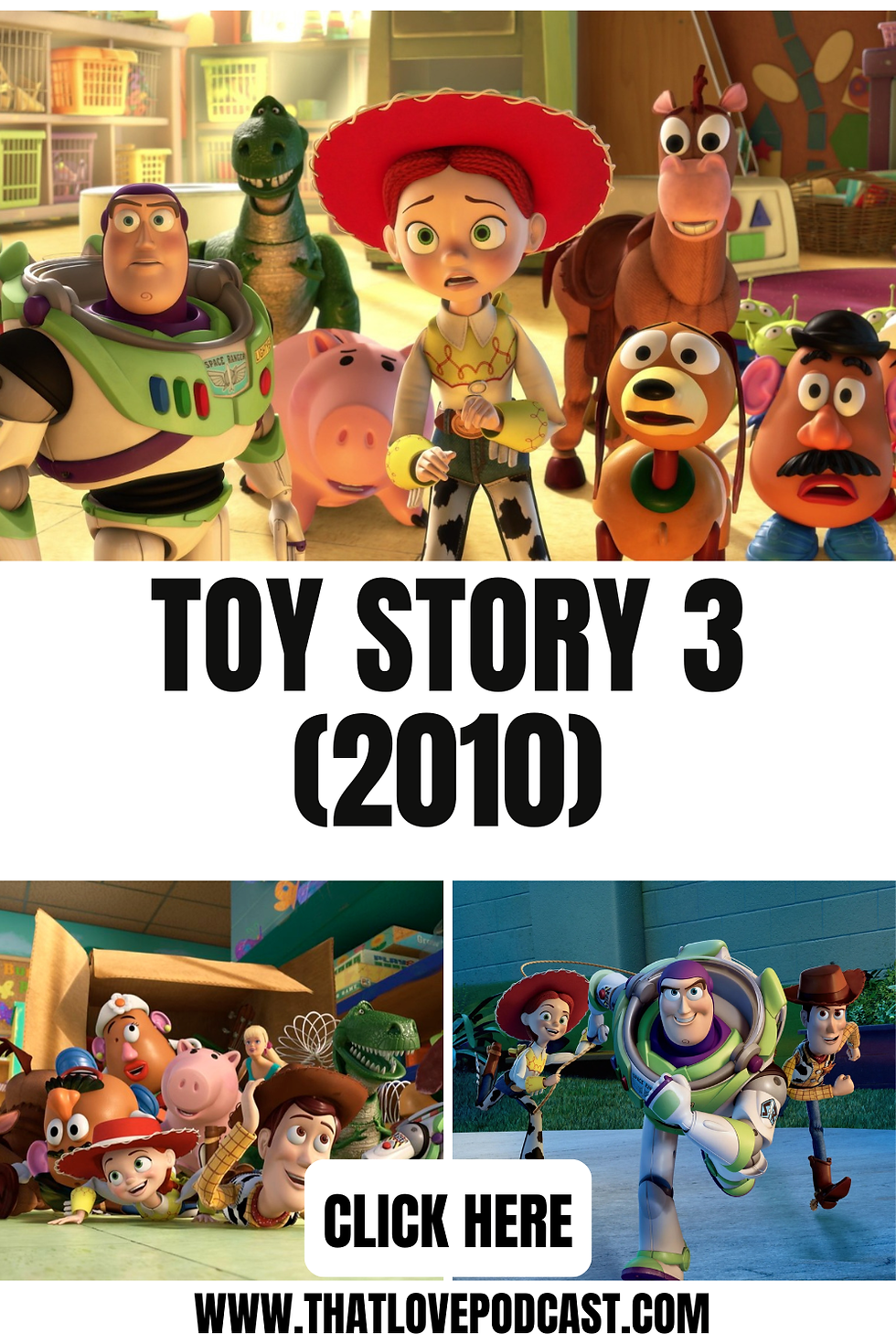
Watch it tonight on Disney+. Watch it with the people you love. Give yourself permission to feel everything it asks you to feel.
Where to watch: Disney+
"So long, partner." — Woody
💖 If you enjoyed this, consider donating: https://www.thatlovepodcast.com/thewriter
You Might Like This
Toy Story 3 is where the franchise’s themes about growing up and letting go become almost impossible to ignore. These related articles explore the movies before it, what followed, and why this chapter still hits so hard:
FAQs
1. Is Toy Story 3 worth watching? Without reservation. Toy Story 3 is one of the highest-rated animated films in history, winning the Academy Award for Best Animated Feature and holding a 98% score on Rotten Tomatoes. It is a near-perfect film for audiences of all ages.
2. Where can I watch Toy Story 3? Toy Story 3 is available to stream on Disney+, as well as for digital purchase or rental on Amazon Prime Video, Apple TV, Vudu, and other platforms.
3. Does Toy Story 3 have a sad ending? The ending is emotionally intense and has caused tears in countless viewers, but it is ultimately a warm, hopeful, and deeply satisfying conclusion. Most viewers describe it as bittersweet rather than sad.
4. Is Toy Story 3 appropriate for young children? The film is rated G, but the furnace sequence may genuinely frighten very young children. Most children aged 5 and up will handle it well, particularly with a parent nearby to reassure them.
5. What happens to Woody at the end of Toy Story 3? Woody, along with Buzz and the other toys, is given by Andy to a young girl named Bonnie as he leaves for college. It is a deeply moving scene that serves as the emotional climax of the first three films.
6. Who is Lotso in Toy Story 3? Lotso (full name Lots-o'-Huggin' Bear) is the film's villain — a strawberry-scented teddy bear who runs Sunnyside Daycare. He is voiced by Ned Beatty and is one of the most complex and compelling antagonists in Pixar's history.
7. Did Toy Story 3 win any Oscars? Yes — Toy Story 3 won the Academy Award for Best Animated Feature and Best Original Song ("We Belong Together" by Randy Newman) at the 83rd Academy Awards.
8. How much did Toy Story 3 make at the box office? Toy Story 3 earned approximately $1.07 billion worldwide, making it the highest-grossing animated film of 2010 and one of the most successful Pixar films ever released.
9. Is Toy Story 3 the best in the franchise? Many critics and viewers consider Toy Story 3 the finest entry in the series, though the entire franchise is exceptional. Its emotional depth and narrative completeness as a conclusion to the Andy trilogy make it a strong candidate for the title.
10. Will there be a Toy Story 5? Pixar has confirmed that Toy Story 5 is in development. No release date had been confirmed at the time of writing, but the franchise shows no signs of losing its emotional power.
About the Director
Lee Unkrich was born on August 8, 1967, in Chagrin Falls, Ohio. He joined Pixar in 1994 and served as editor or co-editor on several landmark productions including Toy Story, A Bug's Life, and Monsters, Inc. before co-directing Toy Story 2. As sole director of Toy Story 3 and Coco (2017), Unkrich established himself as one of the most emotionally intelligent directors in Pixar's history. Both films won the Academy Award for Best Animated Feature. His visual approach emphasises expressive character animation, confident pacing, and a profound willingness to engage with difficult emotions honestly.
💖 If you'd like to support That Love Podcast, donate here: https://www.thatlovepodcast.com/donate




.jpg)



.jpg)


