



.jpg)
The Paper Season 2 Review – Peacock’s Office Spinoff Finds Its Own Funny Voice

Subtitle: Domhnall Gleeson’s chaotic editor and the Toledo Truth Teller staff return for a sharper, warmer and more confident second season.
The first season of The Paper had an impossible task: exist in the shadow of The Office without simply becoming The Office with different desks. The premise was immediately familiar—the same documentary crew that filmed Dunder Mifflin moves on to a struggling Midwestern newspaper—but the show’s best decision was refusing to make its new workplace a carbon copy of Scranton.
By Season 2, that decision has paid off. The Paper is still a mockumentary workplace comedy, still full of awkward pauses, doomed meetings and employees who should not be trusted with basic professional responsibility. But it is more comfortable with its own characters now. The Toledo Truth Teller is no longer simply “the newspaper version of Dunder Mifflin.” It is a distinct workplace, full of passionate underachievers, ambitious oddballs and people trying to save a dying local institution without entirely understanding what journalism requires.
Domhnall Gleeson’s Ned Sampson remains at the centre of the chaos. As the eager Editor-in-Chief, Ned is exactly the kind of person who believes enthusiasm can solve an industry-wide crisis. He loves the idea of a newspaper, the civic responsibility of a newspaper and the romantic image of heroic reporting. Whether he can actually run a newspaper is a different question.
Season 2 begins with the Truth Teller staff enjoying the afterglow of an Ohio Journalism Awards win. For Ned, this is not simply a morale boost. It is evidence that the paper is ready for bigger things. That confidence leads him toward a local private club, a potential journalistic crusade and a series of decisions that threaten to create as many problems as they solve.

The new season is quicker, more confident and more character-driven than the first. It understands that the best workplace comedies do not just make fun of the jobs people do; they reveal why people keep returning to those jobs even when the workplace is absurd. The Truth Teller staff may be incompetent in strange ways, but they also care.
About stories, about one another and, occasionally, about the community they are supposed to serve.
Early reviews have been largely positive. Rotten Tomatoes’ first-reviews roundup praised the show as a funny comedy increasingly capable of standing on its own rather than living as a permanent Office comparison piece. That is the key achievement of this season.
So, is The Paper Season 2 worth watching? Let’s get into it 👇
Support That Love Podcast
Enjoying the reviews and recommendations? You can help support That Love Podcast and keep independent entertainment coverage and original storytelling going.
For more brilliant recent series to add to your watchlist, read our ranking of the most binge-worthy TV dramas.
Want to Reach Entertainment Fans?
If you're a brand, author, publisher, streaming company, entertainment business, or creator looking to reach an engaged audience, That Love Podcast offers advertising opportunities across the website, podcast, and newsletter.
Find out more: Advertise With That Love Podcast

What Is The Paper Season 2 About?
The Paper is a workplace mockumentary co-created by Greg Daniels and Michael Koman. The series follows the documentary crew from The Office as they turn their cameras on the Toledo Truth Teller, a historic but struggling Ohio newspaper trying to survive in an era when local journalism is increasingly undervalued.
Season 2 picks up after the staff’s unexpected success at the Ohio Journalism Awards. The team has momentum, confidence and the dangerous belief that it might actually know what it is doing. Ned Sampson sees an opportunity to push the paper toward more serious investigative reporting, beginning with a local private club that may have more secrets than the Truth Teller is prepared to handle.
The official Peacock Season 2 guide confirms that the season also develops the growing romantic tension between Ned and reporter Mare Pritti. While Ned tries to pursue a major story, the rest of the newsroom is pulled into storm chasing, strange assignments, personal rivalries and the everyday disorder that makes the Truth Teller feel like home.
Domhnall Gleeson returns as Ned, joined by Sabrina Impacciatore as the gloriously self-involved Esmeralda Grand, Chelsea Frei as Mare, Oscar Nuñez as Oscar Martinez, Melvin Gregg, Gbemisola Ikumelo, Tim Key, Ramona Young, Eric Rahill, Duane Shepard Sr. and Alex Edelman.
The central idea remains smart. Local newspapers are filled with stories that matter, yet they are also workplaces. That means deadlines collide with break-room gossip, ethical questions collide with office politics and a potentially major investigation can be derailed by a printer malfunction or someone’s terrible social-media plan.
Story and Plot: The Truth Teller Finally Has a Real Story
The biggest improvement in Season 2 is the stronger sense of forward movement. Season 1 spent a lot of time introducing the newsroom and proving that its characters could exist outside the orbit of The Office. Season 2 trusts that groundwork. It gives Ned and his staff a larger story to pursue while allowing the comedy to grow out of their increasingly questionable choices.
Ned’s interest in investigating a private club gives the season a useful narrative spine. It is not a dark prestige-TV conspiracy, and the show wisely avoids pretending that it is. Instead, the potential story becomes a reason for the staff to try harder, mess up more spectacularly and confront the gap between their idealistic view of journalism and the awkward reality of doing it.
The series is strongest when it balances that bigger plot with smaller newsroom disasters. A good mockumentary comedy needs episodes that feel self-contained while still allowing relationships to evolve. The Paper does this better in Season 2. Some episodes are built around field assignments, some around office conflict and some around the slow collapse of Ned’s best intentions.
The show also makes better use of the local-news setting. The Truth Teller is not a glamorous media institution. It is a paper fighting for relevance, which makes every potential scoop feel bigger. A story that might be a small item at a major publication becomes a defining moment here. That scale gives the comedy real stakes without making it overly serious.
The Ned-and-Mare storyline is handled with more confidence this season. Their attraction is not treated as a huge melodramatic twist. It develops through glances, awkward conversations and the kind of professional tension that workplace comedies have always used well. The writing understands that a slow-burn romance works best when the characters are not fully sure they want it.
There are still moments when the season leans too heavily on mockumentary habits audiences know well: the look to camera, the poorly timed confession, the employee who says something outrageous with total confidence. But the show has become better at making those choices feel character-specific rather than inherited from The Office.
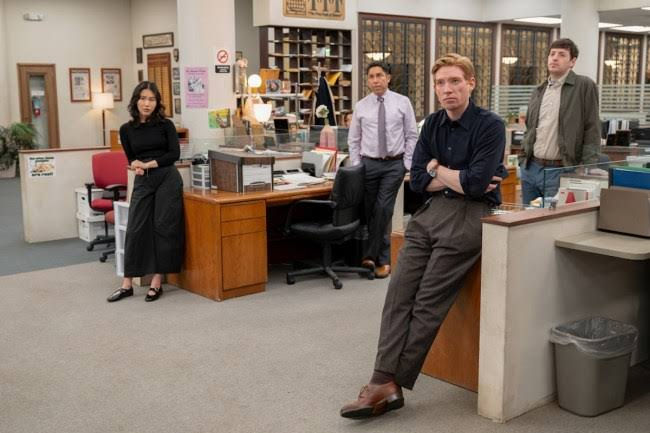
Cast and Performances: Domhnall Gleeson Leads a Stronger Ensemble
Domhnall Gleeson is the season’s steady comic centre. Ned could easily become exhausting—a relentlessly optimistic editor who thinks every small win proves he is destined for greatness—but Gleeson gives him enough insecurity to keep him human. Ned wants to be admired, but he also wants to do something meaningful. The collision between those desires creates much of the show’s comedy.
Gleeson is especially good at portraying professional enthusiasm as a form of self-destruction. Ned is always one bad idea away from a disaster, but he never sees it coming. He walks into meetings with the confidence of someone unveiling a Pulitzer-winning plan and leaves them with a far more complicated problem than he started with.
Chelsea Frei continues to be a key part of the show’s appeal as Mare Pritti. She gives Mare enough intelligence and patience to make her a natural contrast to Ned, but she is not simply the sensible person in the room. Mare has her own ambitions and frustrations, and Frei lets the character’s dry humour cut through the newsroom noise.
Sabrina Impacciatore is still the season’s wild card. Esmeralda Grand has the kind of enormous personality that could easily overwhelm every scene, but Impacciatore knows exactly how far to push it. Esmeralda is vain, dramatic and deeply convinced of her own importance, yet the performance is never one-note. Every so often, the show allows viewers to glimpse the insecurity underneath the spectacle.
Oscar Nuñez’s return as Oscar Martinez is an obvious pleasure for The Office fans, but the show mostly avoids using him as a nostalgia machine. Oscar is more valuable here as a dry, experienced observer of workplace absurdity. Nuñez knows how to make a reaction shot feel like a punchline, and Season 2 uses that skill well.
The broader ensemble is more settled this time around. Melvin Gregg, Gbemisola Ikumelo, Tim Key, Ramona Young, Eric Rahill, Duane Shepard Sr. and Alex Edelman have clearer rhythms with one another. Not every character receives an equally memorable storyline, but the newsroom increasingly feels like a real workplace with its own internal hierarchy and weird rituals.
🎧 Need something to listen to after watching? That Love Podcast creates original romantic audio dramas, comedies and stories you can listen to anytime.

What Works in The Paper Season 2
The show’s greatest strength is that it has stopped trying to earn permission to exist. Season 1 understandably had to deal with comparisons to The Office. Season 2 is more relaxed. It knows the connection is part of the premise, but it no longer treats that connection as the entire point.
The newsroom setting is genuinely rich comic territory. Newspapers are full of competing priorities: public service, commercial pressure, personality clashes and impossible deadlines. The Truth Teller’s staff wants to produce meaningful journalism, but it also has to survive its own management decisions. That contradiction creates stories that feel specific to this show.
Ned is a more interesting lead than he initially appears. His idealism is funny because it is impractical, but it is also sincere. The season does not mock him for caring about local journalism. It mocks him for believing that caring is enough. That distinction gives the character more depth than a typical bumbling boss.
The romance between Ned and Mare works because it does not dominate the season. It is present as an undercurrent, adding tension and warmth without hijacking the workplace story. Their connection feels earned through shared frustration and professional respect rather than a sudden plot twist.
Esmeralda remains a comic weapon. Sabrina Impacciatore gives the show an unpredictable energy that keeps the ensemble from becoming too grounded. Whenever the season risks settling into a familiar sitcom rhythm, Esmeralda can enter a scene and turn it sideways.
The humour is also sharper. The second season has a better sense of when to let a joke breathe and when to move on. The mockumentary format can become overused, but The Paper increasingly uses the camera crew as a way to reveal private delusion rather than merely invite characters to explain the joke.
Finally, the show has real affection for local journalism. It does not romanticise the industry’s financial problems, but it understands why a small paper still matters. The Truth Teller may be chaotic, but it is one of the few places where these characters feel useful.

What Doesn’t Work
The biggest issue is that The Paper cannot completely escape The Office comparisons. The mockumentary style, the documentary crew and Oscar Martinez’s presence invite viewers to look for echoes of Scranton. Some episodes are strong enough to make those comparisons fade; others lean into familiar rhythms too heavily.
A few characters remain underdeveloped. The ensemble is large, and the season does not always have enough room to give everyone a meaningful arc. Certain staff members are excellent in individual jokes but still feel more like workplace types than complete people.
The investigative storyline is also a little uneven. It gives the season purpose, but the show occasionally seems unsure whether it wants to satirise serious journalism or make a classic workplace-comedy plot. It is usually funnier when it stays close to the characters’ incompetence than when it reaches for broader institutional commentary.
Some viewers may also find Ned’s optimism tiring in larger doses. Gleeson makes the character likable, but the writing sometimes pushes his enthusiasm into repetitive territory. The best episodes are the ones that let him learn something—or at least pretend to learn something—before the next mistake.
The show’s warmth can occasionally soften the comedy. The Office often let characters be deeply unpleasant, while The Paper is more interested in making the newsroom feel like a found family. That is not a bad thing, but it can make the series less brutal and less unpredictable.
The RogerEbert.com review suggested that the series occasionally starts to run out of ideas in its second season. There are moments where that is true, particularly when an episode leans on format rather than character. But the stronger episodes show that the Truth Teller still has plenty of stories left to print.
More Workplace and TV Comedy Recommendations
For another recent series built around pressure, secrets and characters trying to hold their lives together, read our I Will Find You review.
Advertise With That Love Podcast
Want to put your movie, series, book, entertainment brand, product, or business in front of readers who love television, movies, books and pop culture?
That Love Podcast offers advertising and sponsorship opportunities across the website, podcast and newsletter.
Find out more: Advertise With That Love Podcast
Characters and Relationships: The Newsroom Starts to Feel Like a Family
The most important relationship in Season 2 is still Ned’s connection with the entire Truth Teller staff. He is their boss, but not in the traditional sitcom sense. He is not powerful enough to be intimidating and not competent enough to be fully reliable. What he offers instead is enthusiasm, belief and a strange talent for making everyone else’s workday more difficult.
Mare’s relationship with Ned adds a welcome emotional layer. She sees both his best and worst qualities. She knows he can be frustrating, self-important and oblivious, but she also sees how hard he tries. The show wisely keeps their dynamic complicated rather than making it an easy will-they-or-won’t-they story.
Esmeralda’s search for a place within the newsroom is another effective thread. She wants attention and status, but she also wants to belong. Season 2 gives her a little more emotional texture without making her less funny. That is a difficult balance, and Impacciatore handles it beautifully.
Oscar’s presence creates a useful link to the wider mockumentary universe, but his role is more than a callback. He understands workplace bureaucracy and professional disappointment better than almost anyone around him. His reactions provide a reality check when the rest of the staff begins treating chaos as normal.
The Truth Teller’s staff works because the characters are not simply friends. They are coworkers first. They irritate one another, compete for attention, avoid responsibility and occasionally make each other’s jobs impossible. But when the paper is threatened, there is a growing sense that they want it to survive.
Visuals, Tone and the Mockumentary Style
The show’s visual approach remains intentionally ordinary. Fluorescent lights, cluttered desks, half-functional technology and cramped meeting spaces make the Truth Teller feel like a workplace that has existed for decades and survived mostly through stubbornness.
That grounded look is important because the comedy depends on contrast. The characters often behave as if they are working at a grand media institution, while the camera reveals the far less glamorous reality. The mockumentary format makes that gap visible in every awkward glance and poorly timed interview.
Season 2 has a stronger visual identity than the first. The newsroom feels more lived-in, and the outdoor assignments give the show a little more range. Storm chasing, community events and field reporting allow the comedy to move outside the office without losing its workplace focus.
The show’s tone is warmer than The Office, but that suits its local-newspaper setting. This is not a company full of people selling a product nobody needs. It is a struggling institution trying to convince itself that its work still matters. The affection is part of the joke.
Themes: Local Journalism, Ambition and the Need to Matter
The Paper Season 2 is quietly interested in why local journalism still matters. The Truth Teller is underfunded, understaffed and frequently ridiculous, but it is still one of the few places where local stories can be pursued with any seriousness.
Ned’s ambitions reflect that. He wants a major investigation because he believes the paper can matter again. His mistake is assuming that desire automatically gives him the skill to make it happen. The season finds humour in that gap, but it also respects the idealism behind it.
The show also explores professional identity. Many of these characters do not have conventional paths to success. They are working at a struggling newspaper in an unstable industry, yet they still want to be good at what they do. That insecurity makes the comedy relatable.
Ambition is another major theme. Ned wants recognition, Mare wants more control over her professional life and Esmeralda wants to be seen as important. The season does not judge them for wanting more. It simply shows how messy ambition becomes when everyone wants different things at the same time.
The broader message is optimistic: institutions may be struggling, but people can still find purpose inside them. That is not a revolutionary idea, but it gives The Paper a warmth many workplace comedies lack.
🎧 Need something to listen to after watching? That Love Podcast creates original romantic audio dramas, comedies and stories you can listen to anytime.
Is The Paper Season 2 Worth Watching?
Yes. If you enjoyed Season 1, the second season is an easy recommendation. It is funnier, more assured and more comfortable with its own world. The show still carries the DNA of The Office, but it increasingly feels like a genuine sibling rather than a copy.
New viewers can probably start here, but Season 1 is worth watching first. The new season benefits from knowing the staff’s original dynamics and understanding why the Ohio Journalism Awards matter so much to Ned and the paper.
The season is especially recommended for viewers who enjoy workplace comedies with a little heart. It is less mean-spirited than The Office, less polished than Abbott Elementary and more chaotic than Parks and Recreation. Its best quality is that it knows exactly what kind of underdog institution the Truth Teller is.
Where to Watch The Paper Season 2
All episodes of The Paper Season 2 are streaming exclusively on Peacock in the United States as of September 2026. The series is also available through selected international partners, including Sky and NOW in the UK.
Work With That Love Podcast
That Love Podcast is open to collaborations with entertainment brands, authors, creators and businesses looking to reach engaged readers and listeners.

Final Verdict
The Paper Season 2 is a meaningful step forward. It is not trying to be The Office again, and that is exactly why it works. The show has found confidence in its own setting, its own ensemble and its own version of workplace chaos.
Domhnall Gleeson is a terrific lead, giving Ned enough optimism to be funny and enough insecurity to be relatable. Chelsea Frei and Sabrina Impacciatore provide the strongest supporting work, while Oscar Nuñez makes his return feel useful rather than purely nostalgic.
The season has a few familiar mockumentary habits and some uneven storylines, but its better episodes prove that the Toledo Truth Teller is worth revisiting. There is life in this newspaper yet.
⭐ Review Score: 7.5/10
You May Also Enjoy
Conclusion
The Paper Season 2 succeeds because it treats its characters and setting as more than a nostalgia exercise. The Truth Teller may share DNA with Dunder Mifflin, but it has its own pressures, ambitions and strange workplace culture.
The season’s comedy lands best when it lets the staff be passionate, awkward and wildly underprepared for the jobs they are trying to do. It is a show about people attempting to make something meaningful in an industry that often tells them they do not matter.
That balance of silliness and sincerity makes The Paper a very easy binge. The newsroom is chaotic, the editor is overconfident and the stories are rarely straightforward—but that is exactly why the series has found its voice.
Support That Love Podcast
Enjoying the reviews and recommendations? You can help support That Love Podcast and keep independent entertainment coverage and original storytelling going.
For more stories, reviews and original audio dramas, listen to That Love Podcast.
FAQs About The Paper Season 2
Is The Paper Season 2 connected to The Office?
Yes. The series follows the same documentary crew that filmed Dunder Mifflin in The Office, but it centres on a new workplace and mostly new characters.
What is The Paper Season 2 about?
Season 2 follows the Toledo Truth Teller staff after their Ohio Journalism Awards win as Editor-in-Chief Ned Sampson pursues a major local investigation.
Who stars in The Paper Season 2?
The cast includes Domhnall Gleeson, Sabrina Impacciatore, Chelsea Frei, Oscar Nuñez, Melvin Gregg, Gbemisola Ikumelo, Tim Key, Ramona Young and Eric Rahill.
Is Oscar Martinez in The Paper Season 2?
Yes. Oscar Nuñez returns as Oscar Martinez.
Who created The Paper?
The Paper was co-created by Greg Daniels and Michael Koman.
How many episodes are in The Paper Season 2?
Season 2 consists of 10 episodes.
Is The Paper Season 2 funny?
Yes. The season has received positive responses for its workplace humour, ensemble chemistry and stronger confidence as its own series.
Do I need to watch Season 1 before Season 2?
It is recommended. Season 2 is accessible, but Season 1 establishes the characters and newsroom dynamics.
Where can I stream The Paper Season 2?
The full second season is streaming on Peacock in the United States.
Will there be a Season 3 of The Paper?
Peacock has not yet officially announced a third season. The show’s future will likely depend on audience response and Peacock’s renewal plans.
Further Reading
For cast details, guest stars and Season 2 character updates, visit Peacock’s official guide to The Paper Season 2.
Useful Resources
Join the That Love Podcast Newsletter
Want more movie reviews, TV recommendations, book lists and entertainment news delivered straight to your inbox? Subscribe to the That Love Podcast newsletter for fresh recommendations and original storytelling.


.jpg)






.jpg)


Comments