






The Bear Season 5 (2026) TV Review: A Perfect Final Service That Earns Every Tear

There are shows that go out quietly, and there are shows that go out the way they arrived — loud, stressful, beautiful, and completely on their own terms. The Bear Season 5 is emphatically the latter.
Christopher Storer's FX series about food, family, grief, and the daily insanity of the restaurant kitchen premiered its fifth and final season on June 25, 2026 — all eight episodes dropping simultaneously on Hulu and Disney+, with a weekly broadcast on FX for viewers who prefer to savour it slowly. It is the show's most focused, most deliberately stripped-back season, and it is being received by critics as a return to the form that made the show one of the defining television events of this decade.
The Rotten Tomatoes score at debut? 100%. Metacritic: 81, a "must-watch" designation. IndieWire gave it a B-plus. RogerEbert.com called it "all signs point to success." The Daily Beast said simply: "This inimitable gem goes out on top." These are not the reviews of a show coasting to a comfortable conclusion — they are the reviews of a show that remembered exactly what made it extraordinary, went back to those fundamentals, and delivered them at full intensity one final time.
The primary keyword must appear here: this is the most essential television of summer 2026 — and The Bear Season 5 review that everyone will be writing for the next week is the one that confirms what the first two seasons promised and the subsequent two sometimes forgot: this show is, has always been, and will remain one of the finest pieces of television ever made.

💖 If this guide helps you decide what to watch, consider supporting us here: https://www.thatlovepodcast.com/donate
Related Reading from That Love Podcast
If you love great TV, you'll enjoy these:
Plot Summary: One Day, One Service, Everything on the Line
The Bear Season 5 picks up the morning after the events of the Season 4 finale, when Carmy Berzatto (Jeremy Allen White) announced he was quitting the food industry and leaving the restaurant to Sydney, Richie, and Natalie. The season's formal structure is elegantly confined: its eight episodes play out across a single day — one final, catastrophic, ultimately redemptive dinner service, the kind of all-or-nothing day that the restaurant business can always produce and that this restaurant has been building toward for four years.
The stakes are stacked with the specific, overlapping cruelty the show has always loved. Uncle Jimmy (Oliver Platt) has run out of money and patience — he is eyeing a sale of the building, and his timeline has collapsed. The reservation system has crashed. A catastrophic Chicago rainstorm has flooded the basement, burst pipes, destroyed inventory, and is battering the city as the service approaches. Sydney and Richie are operating without their anchor. Carmy is still present but is a ghost in his own kitchen — neither fully here nor fully gone, attempting to transfer ownership of a place that still feels like part of him.
And yet, through all of this, Storer's writing insists on the same thing it has always insisted on: these people love each other. The restaurant is a pressure cooker, the day is a disaster, the future is uncertain — but these people, this specific group of people who found each other in a Chicago kitchen, will face it together or not at all.
"Ultimately, they learn that what makes a restaurant 'perfect' might not be the food, but the people." That is the official synopsis. It is also the thesis of the entire five-season arc, delivered in a single sentence.
Director's Style and Cinematic Vision: Storer Goes Back to Basics
Christopher Storer returns as showrunner and directs six of the season's seven episodes screened for critics (the finale was withheld). His approach to the final season is a deliberate, pointed course correction after what many critics and viewers identified as the overextended middle seasons of the show's run.
Gone are the long, meandering subplots that drifted far from the restaurant. Gone are the extended flashback episodes and the sometimes self-indulgent emotional montages. What remains is the tightest, most kitchen-focused season since Season 1 — a concentrated version of the show's best qualities, with nothing that doesn't serve the story of this final day.
The visual language of Season 5 is more expressionistic than previous seasons. The rain-drenched Chicago exteriors are digitally augmented to create a near-dystopian atmosphere — reviewers have compared the look to Blade Runner, to Uncut Gems, to a pressure cooker rather than a city. The restaurant interiors are stylised, with careful expressionistic silhouetting in doorways and pervasive lens flares that create an artificial but emotionally accurate version of the chaos being depicted. Storer is clearly making aesthetic choices that foreground the subjective experience of a day like this — the way crisis can feel both hyperreal and slightly unreal simultaneously.
The score is a significant departure from the show's previous use of needle drops. Composer Christian Lundberg, with Hans Zimmer producing, provides a propulsive, electronic soundtrack that Vulture's Nicholas Quah described as "leaning toward cheesy sports-movie propulsion, complete with echoes of the Alan Parsons Project's Chicago Bulls anthem." IndieWire's Ben Travers called it a score that "instills a sense of urgency in the viewer to match that of the kitchen crew." Both are right, and both are actually complimenting the same thing: a score designed to make the final service feel like the most important sporting event of the year — because for these characters, it is.
You'll also love: What to Watch | That Love Podcast
Themes and Deeper Meaning: What the Kitchen Was Always About
The Bear has always been, underneath the food and the yelling and the kitchen chaos, a show about trauma, family, and the way people build communities to compensate for the families that couldn't hold them.
Season 5 strips this theme to its most essential expression. With Carmy preparing to leave, the question the season asks is deceptively simple: what does it mean when the thing you built around your grief finally has to exist without you? The restaurant was, in many ways, Carmy's monument to his brother Mikey. Every dish, every refinement, every impossible standard was partly a way of not having to stop grieving. Now, in handing it over to Sydney, he is being asked to do something genuinely difficult: let the monument live without him. Let it belong to other people. Let it become something beyond what he needed it to be.
Richie's arc in Season 5 carries the show's most direct engagement with loyalty and legacy. Haunted by memories of Mikey — particularly from the surprise prequel episode "Gary," released May 5, 2026 — Richie is the character who most acutely feels the gap between what the restaurant was supposed to be and what it has become. His journey through the season is, in essence, the question of whether grief and love can be separated — whether you can honour what someone was without being trapped by it.
Sydney's arc is the season's most professionally satisfying and its most emotionally complex simultaneously. She is finally getting what she wanted — the kitchen, the leadership, the chance to prove what she can do without Carmy's shadow over it. The season is aware of the cost of getting what you want, and Ayo Edebiri plays every dimension of that awareness.

Acting Performances: A Cast Saying Goodbye at the Top of Their Game
The performances across Season 5 represent the cast at the very top of their game — and given what this cast has delivered across five years, that is an extraordinary statement.
Ayo Edebiri's Sydney is the season's central achievement. RogerEbert.com's Clint Worthington specifically praised her ability to "sell the pressure of getting the responsibility she had waited for the whole show to receive," and the observation is precisely right. Edebiri has been building toward this performance for four seasons — the brilliant, patient, overlooked chef who always knew she was capable of more and always waited for the right moment. Season 5 gives her the moment, and she meets it with a quality of focused, contained authority that feels completely earned.
"Yes, Chef." — Sydney Adamu, accepting the kitchen. This moment, however it lands in the final season, will be remembered.
Ebon Moss-Bachrach as Richie is the show's emotional core and its comedic engine simultaneously — a combination that should be impossible and that he makes look completely effortless. The season gives Richie's grief new context and new expression, and Moss-Bachrach brings his characteristic quality of po-faced sincerity to every Chicagoan pep talk and every moment of quiet devastation.
Jeremy Allen White is present throughout as Carmy — a ghost, as Variety's Alison Herman noted, "in his own kitchen" — and his performance captures something genuinely difficult: the specific quality of someone who has decided to leave but cannot quite make themselves go. White plays the ambivalence not as weakness but as love — he lingers because the place and the people matter to him, and every scene carries the weight of an imminent goodbye he is not ready to say.
Oliver Platt as Uncle Jimmy provides the season's sharpest comedy, with his creative cursing ("fuck my life to death") and his genuine, often-ignored care for the restaurant and its people giving the character more depth than he has had since Season 1.
Strengths: When The Bear Season 5 Is Completely, Perfectly Itself
The most consistent and most significant strength of Season 5 is its focus. IndieWire's characterisation — "a Bear jus," as Radio Times put it, "distilled Bear, concentrated Bear" — captures precisely what works so well about this season: it has removed everything that isn't essential and left only what is.
The single-day structure is a masterstroke. It returns the show to the ticking-clock urgency of Season 1's best episodes — most memorably the iconic "Review" episode — and extends that structure across an entire season without feeling repetitive, because what fills the time is not manufactured crisis but genuine character revelation. This is the most time the show has ever spent simply being with these people, and being with them turns out to be its greatest pleasure.
The comedy is better in Season 5 than it has been since Season 2. Vulture noted that "even the comedy lands better, allowed more room to breathe beneath all the yelling," and the observation is accurate. The Fak brothers (Matty Matheson and Ricky Staffieri) provide physical comedy that is sometimes literally structural — the sequence of Faks falling through the ceiling during the flooding is exactly the kind of controlled chaos at which the show has always excelled.
The episode runtimes are lean. Five of the first seven episodes run under thirty minutes. None cross the hour mark until the penultimate episode, which Storer and Nicole Kohut wrote together and which several critics, including Hollywood Reporter's Daniel Fienberg, described as functioning like a complete, perfect series finale in itself — a 52-minute episode of "breathlessly taut" storytelling that delivers the emotional payoffs the entire season has been building toward.

Areas for Improvement: The Honest Assessment
Even a season earning 100% on Rotten Tomatoes is not without its honest critics, and Season 5 has a few genuine weaknesses worth acknowledging.
Variety's Alison Herman, one of the more rigorous reviewers of the season, notes that the show "can't fully shake off two full seasons of subpar storytelling" and that its issues with ensemble balance remain "at least partially in place." The Uncle Jimmy subplot — involving Platt, Brian Koppelman, and Elsie Fisher driving around Chicago in search of a new revenue stream — works well as comedy but introduces a structural problem: the subplot's resolution relies on characters remaining ignorant of information they should reasonably have, which is the kind of plot mechanics the show's best seasons avoid.
The digital rain and heavily stylised visual choices also divide critics. Hollywood Reporter's Daniel Fienberg finds that the "heavily stylized interiors" make the restaurant "feel like an evocative soundstage and not like a working eatery" — a loss of the gritty, documentary-close authenticity that made Seasons 1 and 2 feel genuinely immediate.
Time's Judy Berman, the season's most persistent measured dissenter, notes that the show's "reluctance to drop the pretense that it is a comedy" creates tonal inconsistencies — specifically in the deployment of the Fak brothers against the more seriously dramatic character work happening around them.
These are real criticisms, and they keep Season 5 from being the unambiguous masterpiece of the show's first season. What they do not do is undermine the final season's considerable achievement.
Comparative Analysis: Where Season 5 Sits in the Bear's Own Legacy
The Bear's five-season arc is one of the more interesting quality trajectories in recent television. Season 1 earned 100% on Rotten Tomatoes and changed what people expected from prestige streaming drama. Season 2 earned 99% and delivered the iconic "Fishes" episode. Seasons 3 and 4 earned 89% and 84% respectively — still strong by any industry standard, but significantly lower than the show's opening achievements, and accompanied by a notable shift in critical and audience mood.
Season 5's return to 100% is not simply a nostalgia score — it reflects a genuine creative course correction. Christopher Storer has listened to what wasn't working, removed it, and returned to the show's core strengths with clarity and confidence.
The closest analogues in television history — shows that struggled in their middle seasons and delivered strong final chapters — include Breaking Bad (whose final season was considered its best), and The Americans (which delivered its quietest and most devastating season as a finale). The Bear's Season 5 invites comparison to both: it is not as explosively dramatic as Breaking Bad's conclusion, but it shares The Americans' quality of stripping away excess to find the emotional truth underneath.
Compare and explore similar viewing:
Target Audience: Who This Season Is For
The Bear Season 5 is for anyone who has followed the show from Season 1 and wants a conclusion that honours what the series was when it was at its best. New viewers who have not seen previous seasons should not start here — the emotional payoffs of Season 5 are entirely dependent on four years of investment in these characters, and without that investment the season's quieter moments will not carry the weight they are designed to.
For lapsed viewers who dropped off after Seasons 3 or 4 — the people Alison Herman describes as "those who've stuck with The Bear through its low point — and anecdotally, I know many one-time fans who have not" — Season 5 is an excellent reason to return. It is a reminder of what the show could always be.
The season carries a TV-MA rating. Content warnings: intense kitchen pressure sequences, grief and trauma, language.
Personal Impact: What Stays
What stays after watching The Bear Season 5 is the specific quality of watching people who love each other more than they know how to say do the thing they do together for the last time.
Richie saying "I'm not giving up. We're going to keep operating" against the backdrop of a flooding kitchen is the show at its most recognisably human — the stubborn, not-entirely-rational refusal to let go of something that has cost everything and given back more than it took.
Sydney taking the kitchen is the show's answer to every question it has spent five seasons asking.
And Carmy — still there, still unable to fully go, still learning what it means to let the people around him be enough without him — is the show telling us what it was always about: not the food, not the Michelin star, not the perfection of the service. The people. Always the people.
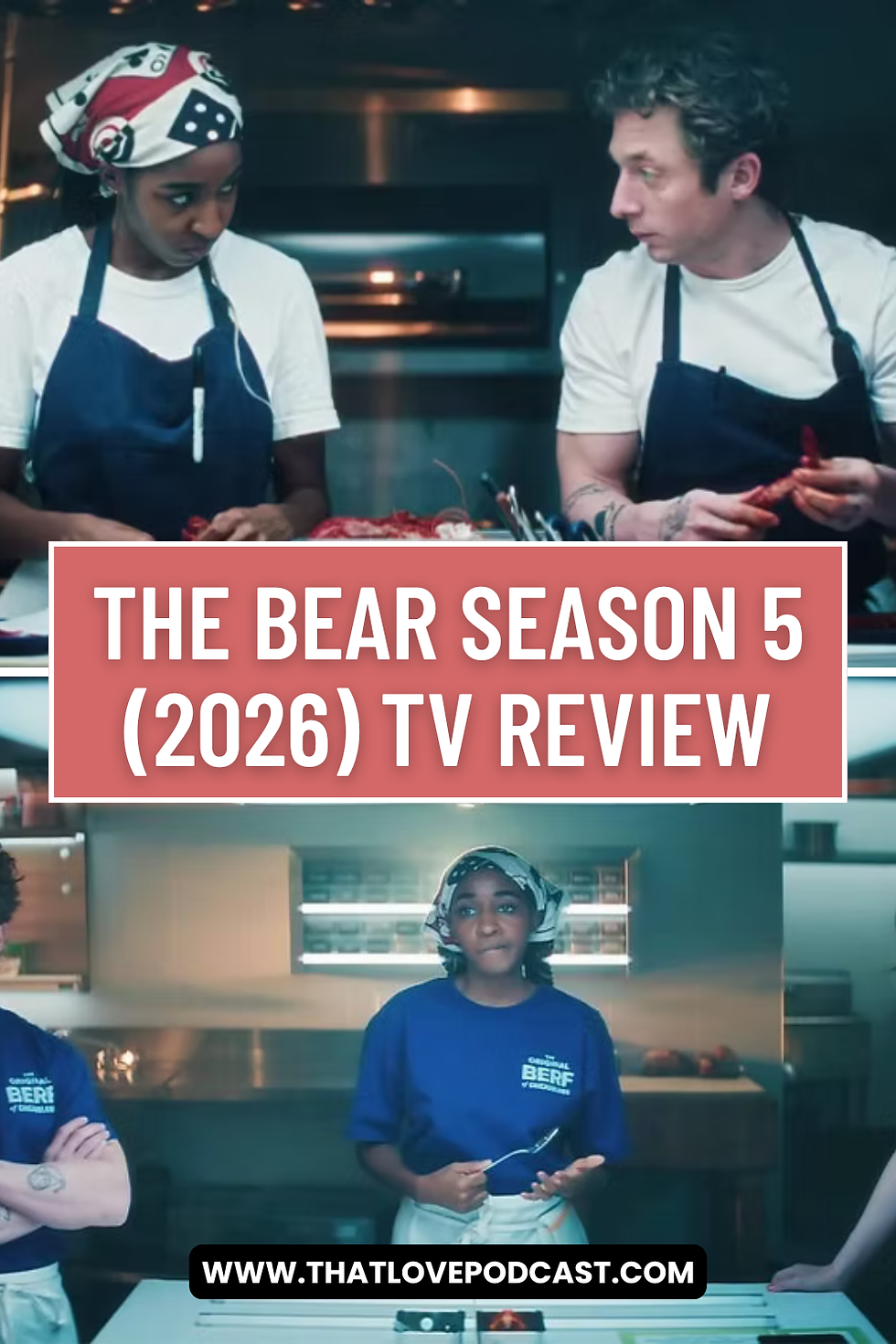
Conclusion: The Final Service
The Bear Season 5 is a near-perfect ending to a show that lost its way in the middle and found it again, beautifully and completely, in time for the curtain call. Christopher Storer goes back to basics, trusts his extraordinary cast, and delivers the most focused, most emotionally honest season the show has produced since its debut.
This is not a finale that will be perfect for everyone. The stylised visuals may feel too artificial for viewers who loved the raw authenticity of early seasons. The ensemble remains slightly unbalanced. The comedy occasionally clashes with the drama.
But none of this undermines what Season 5 achieves in its best moments — which are, by any critical standard, some of the best television of 2026. The Bear goes out on its own terms, with the people who built it standing in a flooded kitchen, determined to serve one last perfect meal.
Yes, Chef. One last time.
Stream The Bear Season 5 now on Hulu and Disney+. All eight episodes available from June 25, 2026. Also airing weekly on FX through August 6.
💖 If you enjoyed this review, please support That Love Podcast: https://www.thatlovepodcast.com/donate
Related Articles from That Love Podcast
Frequently Asked Questions — The Bear Season 5
Is The Bear Season 5 the last season? Yes. Season 5, which premiered June 25, 2026, is confirmed as the final season of The Bear. Creator Christopher Storer returns as showrunner and director for the majority of episodes, bringing the story of Carmy Berzatto and The Bear restaurant to its conclusion. The show was renewed for a fifth season in July 2025, and confirmed as ending with Season 5 following Jamie Lee Curtis's inadvertent announcement and subsequent official confirmation.
Do I need to watch The Bear Seasons 1–4 before Season 5? Yes — Season 5 begins the morning after the Season 4 finale and carries forward emotional arcs that have been building for four years. First-time viewers will not receive the full impact of Season 5's character moments without that context. The surprise prequel episode "Gary" (released May 5, 2026) is also recommended viewing before Season 5.
Where can I watch The Bear Season 5? All eight episodes of The Bear Season 5 are available to stream on Hulu and Hulu on Disney+ from June 25, 2026. The first two episodes also air on FX on June 25, followed by one new episode weekly on FX through August 6. Internationally, The Bear is available on Disney+.
Is The Bear Season 5 good? Yes — very. Season 5 debuted at 100% on Rotten Tomatoes (from early reviews) and 81 on Metacritic ("must-watch"), with critics widely praising it as a return to form after the more divisive Seasons 3 and 4. The consensus is that Season 5 goes back to basics, focusing on the restaurant and the characters with the tight, intense energy that defined the show's first two seasons.
What is The Bear Season 5 about? Season 5 picks up the morning after Carmy quit the food industry, leaving the restaurant to Sydney, Richie, and Natalie. Set across a single catastrophic day — with flooding, financial crisis, a crashed reservation system, and the weight of a final dinner service — the season asks what makes a restaurant "perfect" and arrives at the answer the entire show has been building toward: not the food, but the people.
How many episodes are in The Bear Season 5? Season 5 has eight episodes — returning to the same episode count as Season 1, two fewer than the standard ten episodes of Seasons 2–4. The reduced count was a deliberate creative decision, and reviewers note that the leaner season is significantly better paced than the middle seasons.
Who wrote and directed The Bear Season 5? Christopher Storer returns as showrunner and writer for Season 5, and directed six of the seven episodes screened for critics (the finale was withheld from advance viewing). The score for the final season was composed by Christian Lundberg and produced by Hans Zimmer — a notable departure from the show's previous use of rock and pop needle drops.
What happened to Carmy at the end of The Bear Season 4? At the end of Season 4, Carmy announced he was quitting the food industry and leaving The Bear restaurant to Sydney, Richie, and Natalie. This decision — which came without warning to his colleagues — creates the central crisis of Season 5.
Is "Gary" the prequel episode required viewing before Season 5? Yes. "Gary" — released without advance marketing on May 5, 2026 — is a flashback episode following Richie and Carmy's late brother Mikey on a work trip to Gary, Indiana, set several years before the events of the main series. It provides essential context for Richie's emotional arc in Season 5 and ends on a cliffhanger that Season 5 addresses directly (though reviewers note it turns out to be a red herring).
Will there be a Bear Season 6? No. Season 5 is confirmed as the final season of The Bear. Creator Christopher Storer has always described the show as having a defined arc, and the final season concludes the story of Carmy Berzatto and The Bear restaurant definitively.
About the Director: Christopher Storer
Christopher Storer created The Bear in 2022 and has served as showrunner, writer, and frequent director across all five seasons. Prior to The Bear, he was a writer and producer on Ramy. His approach to The Bear — kitchen-vérité filmmaking, overlapping dialogue, single-location intensity, and a formal willingness to experiment with episode structure — has been enormously influential on the prestige television landscape of the 2020s. Season 5, which he directed in its majority, represents the clearest and most focused expression of his visual and narrative instincts.


.jpg)





.jpg)


