


8 Free Knitting Patterns for Cozy Fall Sweaters

8 Free Knitting Patterns for Cozy Fall Sweaters
There is a very specific moment every year when I suddenly become convinced I need a new sweater. The temperature drops slightly, the evenings get darker, and somebody somewhere posts a photograph involving a cup of coffee, orange leaves, and an enormous knitted jumper. Within minutes, I am mentally redesigning my entire autumn wardrobe.
The good news is that you do not have to spend a fortune buying new sweaters every fall. If you enjoy knitting—or you are looking for a project that will take you through those cooler autumn evenings—making your own gives you far more control over the colour, fit, texture, and yarn. It also gives you the deeply satisfying ability to tell somebody, “I made it,” when they ask where your sweater came from.
Finding a genuinely free sweater knitting pattern can be the annoying part. Search for free knitting patterns online and you will sometimes find a beautiful photograph, click through three different pages, and eventually discover that the actual instructions cost money. There is nothing wrong with designers charging for their work, obviously, but it is slightly frustrating when you specifically searched for something free.
For this list, I wanted patterns where you can actually access the knitting instructions without purchasing the pattern itself. I have therefore concentrated on free sweater patterns from DROPS Design, whose online pattern library includes detailed written instructions, measurements, diagrams where required, yarn information, and supporting knitting tutorials. You can buy the suggested yarn if you want, but access to the patterns themselves is free.
I also wanted these sweaters to genuinely feel like fall rather than simply being eight random jumpers that happen to contain yarn. There are warm textures, raglan silhouettes, cables, moss stitch, colourwork, oversized shapes, soft alpaca blends, autumnal names, and the sort of cosy designs that look completely at home with jeans, boots, long skirts, and an unreasonable number of hot drinks.
The patterns also cover different skill levels. Some are relatively straightforward if you already know basic sweater construction, while others introduce cables, colourwork, lace, or more decorative yokes. I will explain what makes each sweater interesting, the construction used, the suggested yarn, what skills you should feel comfortable with, and what I would watch out for before casting on.
One important thing before we begin: free pattern does not mean free sweater. You will still need yarn, needles, and any other supplies listed in the pattern, and the cost can vary depending on the fibre you choose and the size you make. However, starting with a free pattern can make a larger knitting project considerably more affordable.
So pick your favourite autumn colour, make some room in the yarn basket, and try not to begin all eight sweaters simultaneously. I know that last part may be asking too much.
Let’s start 👇

Before You Choose a Free Fall Sweater Pattern
A beautiful sweater photograph can make it extremely tempting to immediately order yarn and start knitting. Before doing that, I would always open the complete pattern and read through it from beginning to end. You do not need to understand every line yet, but you should have a reasonable idea of how the sweater is constructed and which techniques are involved.
Pay particular attention to the size chart and finished measurements. Knitting patterns do not necessarily correspond with the size you normally buy in a clothing shop, and two sweaters labelled medium can have very different finished measurements. Look at your own measurements and then consider how much ease you want in the finished garment.
Ease simply refers to the difference between your body measurement and the finished sweater measurement. A fitted sweater may have very little positive ease, while an oversized sweater can intentionally be considerably larger than your actual bust measurement. Choosing the correct size based on measurements rather than assumptions can save you from spending several weeks knitting something that fits completely differently from what you imagined.
You should also check the gauge before buying substitute yarn. Gauge tells you how many stitches and rows should fit within a specified measurement, and matching it is particularly important when knitting garments. Even a seemingly small difference can become several centimetres once multiplied across the entire body of a sweater.
8. Foggy Autumn Sweater

Pattern: Foggy Autumn / DROPS 236-34Sizes: S–XXXLConstruction: Top down with raglan shapingSuggested yarn: DROPS AirBest for: Confident beginners to intermediate knittersFall factor: Soft, simple and wonderfully wearable
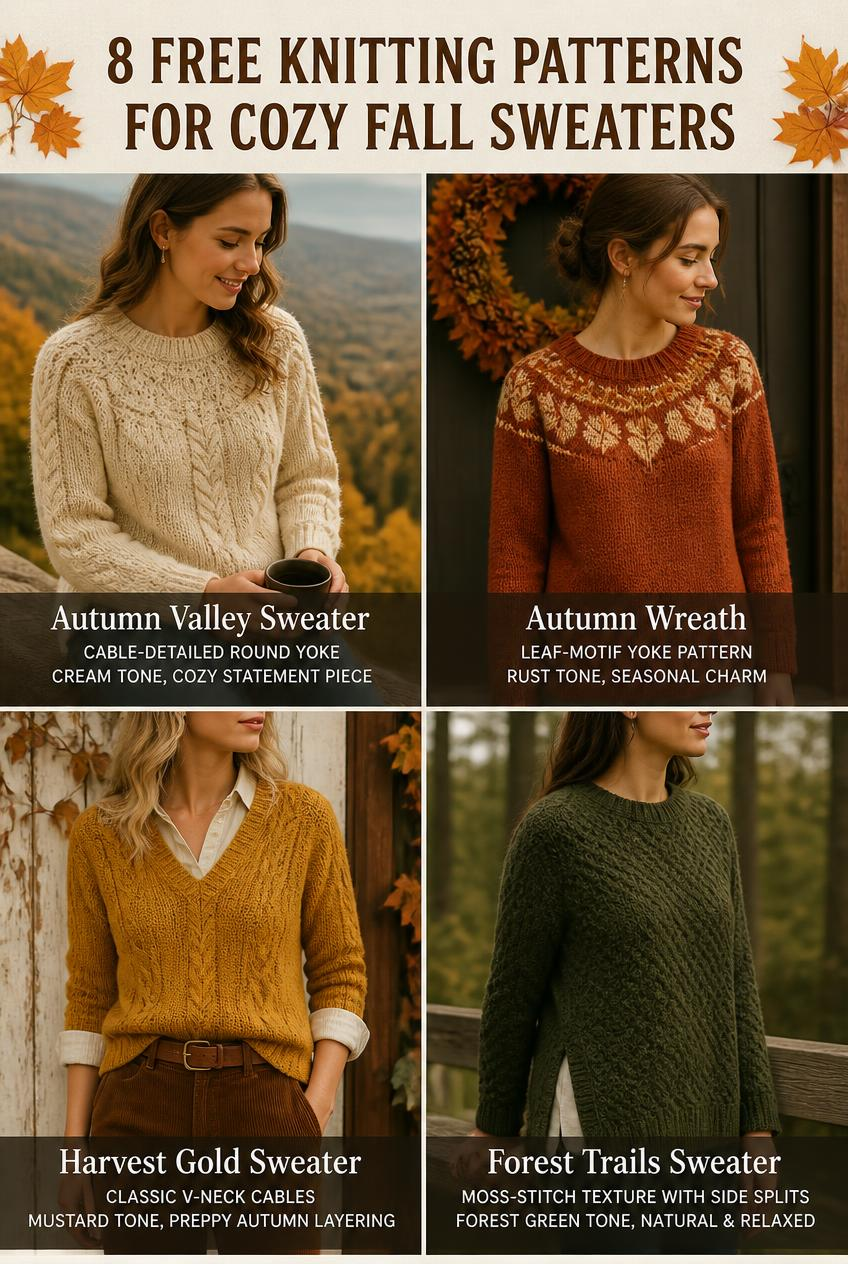
If your perfect autumn sweater is simple, relaxed, and easy to wear with almost everything, Foggy Autumn is where I would start. The design is worked from the top down with raglan shaping, giving you that wonderfully classic sweater silhouette without covering the entire garment in complicated decoration. It is the sort of sweater that could quickly become something you reach for several times a week.
The original pattern uses DROPS Air, a light and fluffy yarn made with alpaca, polyamide, and wool. That combination helps create the soft, slightly airy appearance that makes this sweater look particularly comfortable rather than heavy. If you prefer substituting yarn, concentrate on matching the required gauge and overall characteristics rather than simply choosing another yarn because the ball looks roughly the same thickness.
Working from the top down has a significant advantage when knitting your own clothes. Depending on the construction and where you are in the pattern, you can often get a better sense of the length and fit while the sweater is still being made. That makes adjustments feel considerably less terrifying than discovering a fit problem only after every piece has been sewn together.
The pattern uses raglan shaping, which means increases help create the upper body and sleeve sections. If you have made a basic top-down sweater before, the overall logic should feel familiar. If this is your first raglan sweater, stitch markers can become your best friends because they help you keep track of the different sections and increase points.
Why I Like It for Fall
This is the sweater I would choose if you want something practical rather than extremely decorative. Imagine it in fog grey, oatmeal, camel, rust, chocolate, forest green, burgundy, or cream with straight-leg jeans and boots. It has enough softness and shape to feel special while still functioning as an everyday autumn sweater.
The simplicity also gives you room to make the sweater your own through colour. A neutral version feels timeless, while a burnt orange or deep berry version immediately pushes the design further into autumn territory. Sometimes a simple sweater in exactly the right yarn is far more useful than the most complicated thing you could possibly knit.
Knitting Tip
Do not skip your gauge swatch simply because the design looks relaxed. Loose-fitting sweaters still rely on the correct gauge to produce the intended proportions, and soft airy yarns can change after washing. Knit your swatch, treat it the same way you intend to treat the finished sweater, then measure it again.
7. Autumn Days Jumper

Pattern: Autumn Days Jumper / DROPS 217-22Sizes: S–XXXLConstruction: Top down with a round yokeSuggested yarn: DROPS Kid-SilkMain details: Textured yoke and garter-stitch body and sleevesBest for: Intermediate knitters
There is something very autumnal about a sweater that combines a decorative neckline with a comparatively simple body. Autumn Days does exactly that, using a textured round yoke before moving into garter stitch across the body and sleeves. That contrast makes the upper section feel special without requiring complicated texture across every centimetre of the sweater.
The pattern is knitted from the top down, which again gives you some useful flexibility when thinking about garment length. Instead of knitting separate front, back, and sleeve pieces before discovering whether they actually want to cooperate with each other, the sweater grows outward from the neckline. I particularly like that construction for projects where the yoke is the visual centrepiece.
DROPS recommends Kid-Silk, which contains mohair and silk and creates an entirely different fabric from a traditional smooth wool sweater. The resulting look is lightweight, soft, fluffy, and almost cloud-like rather than thick and dense. That makes this an especially attractive early-autumn sweater when you want warmth without immediately dressing for the middle of January.
Mohair-style yarn can, however, require a little patience. The fluffy fibres make individual stitches harder to see than they would be in a smooth wool, and unravelling mistakes can be more challenging because the fibres grip one another. If you have never worked with this type of yarn, make a generous swatch before committing to the whole sweater.
Why I Like It for Fall
The shape feels feminine and romantic without becoming overly delicate. I can imagine this beautifully in muted beige, dusty pink, warm brown, soft grey, deep berry, sage, or another slightly subdued autumn shade. Pair it with a long skirt or simple trousers and you have exactly the sort of soft seasonal outfit I start wanting the moment September arrives.
I also like that the garter-stitch body gives the yarn plenty of opportunity to provide the texture. Not every sweater needs cables running in seventeen different directions to feel handmade and interesting. Sometimes the fibre itself does enough work.
Knitting Tip
When working with fluffy yarn, count stitches regularly instead of waiting until something visibly looks wrong. The halo can disguise small mistakes much more effectively than smooth yarn does. Keeping track as you go is considerably easier than trying to investigate a mysterious missing stitch twenty rows later.
6. Last Days of Autumn

Pattern: Last Days of Autumn / DROPS 197-2Sizes: S–XXXLConstruction: Top down with raglan shapingSuggested yarn: DROPS AlpacaMain detail: False English rib with rolled edgeBest for: Intermediate knitters
Last Days of Autumn immediately stands out because of its texture. The sweater uses false English rib, creating those strong vertical lines that make knitted fabric look wonderfully soft and substantial. It is exactly the sort of texture that makes you want to reach through the photograph and touch the sweater.
English-rib-inspired fabrics tend to create excellent depth and elasticity. They can also use yarn differently from ordinary stockinette, which is another reason to follow the pattern's yarn quantities carefully. A textured sweater is not the project where I would casually buy what looks like enough yarn and hope optimism takes care of the rest.
The design is worked top down with raglan shaping and includes a rolled edge that keeps the finished look relaxed. I like that combination because the sweater feels intentional without looking too formal. There is a slightly effortless quality to it, even though we both know quite a lot of knitting actually went into producing that effortlessness.
Alpaca also feels extremely appropriate for a cosy fall sweater. It offers warmth while creating a softer drape than some traditional wool garments. If you have sensitive skin or plan to substitute fibres, swatching against your skin rather than simply between your fingers can help you determine whether you will genuinely enjoy wearing the finished sweater.
Why I Like It for Fall
Texture is one of the easiest ways to make a simple autumn outfit more interesting. You could knit this in a warm camel or oatmeal shade and wear it with dark denim repeatedly without the outfit feeling boring. Burgundy, charcoal, warm olive, or chocolate brown would also emphasise the ribbed structure beautifully.
This is also one of those sweaters that could transition easily from fall into winter. Wear it by itself during the milder weeks and add a coat once temperatures really start dropping. A handmade sweater that survives more than one tiny seasonal window always feels like a better investment of knitting time.
Knitting Tip
Pay attention to your tension when working ribbed textures. If your tension varies dramatically, the vertical columns can make those differences more obvious than plain stockinette would. Relax your hands, work at a comfortable pace, and periodically place the fabric flat to check how evenly the texture is developing.
5. Forest Trails Sweater

Pattern: Forest Trails Sweater / DROPS 244-4Sizes: S–XXXLConstruction: Top down with raglan shapingSuggested yarn: Multiple strands of DROPS Kid-SilkMain details: Moss stitch, double neck and side splitsBest for: Intermediate knitters
Forest Trails has one of my favourite textures on this list because it uses moss stitch. Moss stitch alternates knit and purl stitches to create a beautifully textured surface that looks much more complicated than the basic techniques involved. It gives a sweater depth without requiring traditional cables or elaborate colourwork.
The sweater is worked top down with raglan shaping and includes a double neck and splits at the sides. Those details help give the finished garment a slightly more contemporary oversized feel. I particularly like side splits on relaxed sweaters because they allow the fabric to sit more naturally around the hips rather than pulling everything into one solid rectangle.
The original design works with multiple strands of Kid-Silk held together. Holding several yarn strands simultaneously can initially sound like some advanced knitting ritual, but you are essentially treating the group of strands as though they were one yarn. The most important thing is making sure you catch all the strands when creating each stitch.
Working several strands together also allows you to create interesting colour effects if you understand how the yarns interact. You could use identical shades for a clean solid colour or potentially combine compatible tones for greater depth, provided you still achieve the required gauge. Swatching becomes especially important before experimenting because several seemingly small changes can alter the fabric significantly.
Why I Like It for Fall
Forest Trails already sounds like somebody designed it specifically for a weekend involving woodland walks and coffee afterwards. The textured surface and higher neckline make it feel cosy without relying on decorative motifs. It would look beautiful in forest green, obviously, but cream, rust, chocolate, oatmeal, deep plum, or charcoal would work equally well.
The moss stitch is also brilliant when you want the handmade quality of a sweater to remain visible. Light catches all those tiny raised areas differently, creating natural depth across the fabric. It is understated rather than plain, which is a combination I tend to love in autumn clothes.
Knitting Tip
If you are holding multiple strands together, keep the yarn balls organised before they turn themselves into a small domestic crisis. Place them where each strand can feed relatively freely and occasionally untwist the yarns before the problem becomes enormous. Yarn has a remarkable ability to create knots while apparently sitting completely still.
4. Harvest Gold Sweater

Pattern: Harvest Gold / DROPS 207-7Sizes: S–XXXLConstruction: V-neck sweater with cable detailsSuggested yarn: DROPS SkyMain details: V-neck and cablesBest for: Intermediate knitters comfortable with cables
Harvest Gold is for anyone who sees autumn and immediately starts thinking about cable-knit sweaters. There is something timeless about cables, particularly once they are paired with a classic V-neck shape. They instantly make a sweater feel cosy, traditional, and considerably more impressive than the individual technique often turns out to be.
Cable knitting works by changing the order in which stitches are worked. Some stitches are temporarily held while others are knitted, creating the visual effect of the fabric crossing over itself. The first cable can feel slightly alarming because several stitches are temporarily not on your main needle, but after a few repeats the process normally becomes much more logical.
I particularly like the V-neck here because it makes the sweater easier to layer. Put a simple shirt underneath for a slightly preppy autumn look or wear the sweater on its own when the weather is milder. It gives you a different silhouette from all the round-neck and high-neck options that dominate colder-weather knitting.
The suggested DROPS Sky is an alpaca-based blend designed to feel light while still providing warmth. A cable pattern benefits from yarn that gives the stitches enough definition for the crossings to remain visible. If you substitute another yarn, I would avoid anything so extremely fuzzy that all your carefully knitted cables
disappear into a cloud.
Why I Like It for Fall
This design has that slightly academic autumn feeling I always associate with libraries, old buildings, boots, and pretending I have my life extraordinarily organised. Knit it in mustard or warm gold and the autumn connection becomes obvious, but darker colours could completely change the personality. Deep green, burgundy, cream, navy, or brown would make it extremely wearable.
Cable sweaters also photograph beautifully because the raised stitches create natural highlights and shadows. That matters less while you are actually wearing it, obviously, but it is a nice bonus when you have spent weeks making something yourself. If I had successfully knitted all those cables, I would be showing people whether they asked or not.
Knitting Tip
Use a row counter and place markers around cable sections where the pattern allows it. Most cable disasters begin with somebody thinking they will definitely remember which pattern row they are on. Then somebody rings the doorbell and suddenly row six has disappeared from human memory.
3. Autumn Wreath

Pattern: Autumn Wreath / DROPS 228-1Sizes: S–XXXLConstruction: Top down with a round yokeSuggested yarn: DROPS NepalMain detail: Decorative leaf pattern around the yokeBest for: Intermediate knitters
Now we are getting unapologetically autumnal. Autumn Wreath uses a leaf-inspired pattern around the round yoke, immediately giving the sweater a seasonal connection without covering the entire garment in literal pumpkins. It feels decorative and interesting while remaining sophisticated enough to wear year after year.
The jumper is knitted from the top down with a circular yoke. Instead of visible raglan lines dividing the sleeves and body, increases are distributed around the yoke to gradually create enough circumference for the shoulders and upper body. This produces that beautifully rounded shape that works particularly well when the decorative pattern itself travels around the neckline.
The suggested DROPS Nepal combines wool and alpaca, giving you both warmth and a soft handmade appearance. That feels particularly appropriate for a sweater designed around an autumn leaf motif. The yarn also has enough structure to allow the decorative yoke to remain readable rather than disappearing into overly fuzzy fibres.
You will want to pay close attention to the diagram or written pattern for the yoke. Decorative motifs become much easier when you divide the work mentally into repeats rather than thinking about the entire round at once. Stitch markers between repeats can help you spot an error before it travels around half the sweater.
Why I Like It for Fall
This might be the most obviously seasonal sweater on the list without becoming novelty clothing. The leaf pattern gives you a direct connection to autumn, but the overall silhouette remains timeless. That balance means you could happily wear it from early autumn right through winter.
Colour could completely transform it too. Warm rust would make the leaves feel strongly seasonal, while cream creates a quieter traditional sweater and olive gives the entire design a woodland quality. Burgundy, mustard, camel, dark brown, or muted orange would also suit the pattern beautifully.
Knitting Tip
Check your stitch count after completing each major section of the yoke. Patterned yokes rely on increases and decorative repeats remaining aligned, so finding a mistake early can save a tremendous amount of unravelling. Five minutes spent counting is less painful than removing several complete rounds.
2. Autumn Reflections Sweater

Pattern: Autumn Reflections Sweater / DROPS 244-24Sizes: S–XXXLConstruction: Top down with a round yokeSuggested yarn: DROPS NepalMain details: Multicoloured yoke and double neckBest for: Intermediate knitters comfortable with colourwork
Autumn Reflections is the pattern I would choose when one colour simply is not enough. The sweater features a multicoloured pattern around the round yoke, giving you that traditional colourwork appearance that immediately makes a hand-knitted sweater feel special. The original palette uses wonderfully earthy shades that already feel completely at home in autumn.
Colourwork involves knitting with multiple colours to create a repeated motif. Depending on the technique, unused yarn travels behind the stitches while another colour is worked, creating what are often called floats. Keeping those floats relaxed is essential because pulling them too tightly can make the patterned section pucker.
The sweater is worked from the top down in DROPS Nepal and includes a double neck for extra structure and warmth. The round-yoke construction gives the colourwork plenty of uninterrupted space to travel around the shoulders. Once the decorative portion is complete, the comparatively simple body allows the yoke to remain the main attraction.
Choosing colours is half the fun here. You need enough contrast for the design to remain visible, but the shades should still feel harmonious when viewed together. If you are unsure whether two colours have enough contrast, photograph the yarn in black and white and see whether the shades still look distinct.
Why I Like It for Fall
This is basically autumn translated into knitting. Beige, forest green, walnut, and grey-green-style tones create exactly the earthy colour combination I associate with the season. You could stay close to the original feeling or create your own palette using rust, mustard, cream, burgundy, brown, and olive.
I also love that colourwork makes a sweater feel highly personal. Two people can use the same pattern and produce completely different garments simply by changing the colour combination. It is one of the easiest ways to make a free knitting pattern feel like your own project rather than an exact reproduction of the sample.
Knitting Tip
Do not pull your colourwork floats tightly across the back of the fabric. Spread the recently knitted stitches along the right-hand needle before carrying the next colour behind them. That little habit gives the float enough length to sit comfortably when the sweater is worn.
1. Autumn Valley Sweater

Pattern: Autumn Valley Sweater / DROPS 262-15Sizes: XS–XXXLConstruction: Top down with a round yokeSuggested yarn: DROPS Nepal or DROPS Big MerinoMain detail: Cable pattern around the yokeBest for: Intermediate knitters looking for a statement autumn sweater
Autumn Valley takes the number-one spot because it combines almost everything I want from a cosy fall sweater. It has a warm round-yoke silhouette, beautiful cable texture, substantial yarn, and enough visual detail to feel genuinely special without becoming unwearable. This is the sort of sweater I would happily build an entire autumn outfit around.
The piece is worked from the top down with a circular yoke and cable detailing. That construction creates a lovely transition between the neckline and the body while allowing the decorative stitches to become the centrepiece. You get plenty of visual interest around the shoulders without needing to work complicated cables across the entire torso.
The pattern suggests either DROPS Nepal or DROPS Big Merino, giving you some flexibility in the fibre and finished feel while still following the specified pattern requirements. Whichever option you choose, gauge needs to come first. Cables can draw knitted fabric inward, meaning you cannot accurately predict the finished dimensions based solely on how ordinary stockinette behaves.
This is not the sweater I would make as my first-ever knitting project. If you already understand knitting and purling, increases, knitting in the round, garment gauge, and basic cable techniques, however, it offers a satisfying next challenge. The skills are manageable when approached section by section instead of looking at the entire sweater as one intimidating object.
Why I Like It for Fall
It looks cosy before you even put it on. The cable details bring depth to the shoulders while the body remains wearable enough for everyday outfits. Knit it in cream and it becomes a timeless cable sweater; choose warm caramel, forest green, rust, burgundy, or chocolate and it becomes pure autumn.
I also think this is the project most likely to produce that wonderful moment where somebody assumes you bought the sweater. There is enough detail to look beautifully finished while still clearly having the warmth and texture associated with hand knitting. That feels like a pretty satisfying reward after working your way through an entire garment.
Knitting Tip
Learn the cable repeat on a small practice swatch before starting the sweater. Working several repeats using inexpensive yarn can help you understand where stitches cross and how your tension responds. Once you recognise the rhythm, following the cable section of the actual sweater becomes considerably less stressful.
Which Free Fall Sweater Pattern Should You Choose?
If you want the simplest-looking everyday sweater, I would start with Foggy Autumn. The straightforward raglan construction and clean appearance make it an excellent choice when you want the yarn and silhouette to do most of the work. It is also easy to imagine in almost any autumn colour.
If texture matters more to you, Last Days of Autumn and Forest Trails are particularly appealing. False English rib creates pronounced vertical texture, while moss stitch gives you a smaller, beautifully detailed surface. Both make neutral yarn colours look much more interesting without depending on multiple shades.
Cable lovers should look closely at Harvest Gold and Autumn Valley. Harvest Gold gives you a classic V-neck cable sweater, while Autumn Valley concentrates its cable interest around a round yoke. They create very different silhouettes while still delivering that traditional cosy-knitting feeling.
If you want the sweater itself to celebrate fall, choose Autumn Wreath or Autumn Reflections. One uses a leaf-inspired yoke while the other gives you multicoloured patterning in earthy seasonal shades. Either would make a beautiful statement project for the colder months.
What Yarn Is Best for a Cozy Fall Sweater?
Wool remains one of the classic sweater fibres for good reason. It provides warmth, elasticity, and excellent stitch definition, making it particularly useful for structured garments and cable patterns. Different breeds and preparations can feel dramatically different against the skin, so “wool” describes a much wider range of experiences than many new knitters realise.
Alpaca can add softness, warmth, and beautiful drape. Several patterns on this list use yarns containing alpaca, either on its own or blended with other fibres. Alpaca behaves differently from traditional wool, though, so replacing one fibre with another purely based on yarn thickness is not always ideal.
Mohair and silk blends create a much lighter, fluffier effect. They can turn an ordinary stitch pattern into something soft and almost hazy, which works beautifully for romantic autumn sweaters. The trade-off is that fuzzy fibres can make stitches harder to see and mistakes more difficult to unravel.
Acrylic and other synthetic or blended alternatives can also be useful, particularly when budget and easy washing matter. You do not have to use the exact yarn shown in every free knitting pattern, but your substitute needs to produce the required gauge and a suitable fabric. Think about fibre behaviour, yardage, weight, drape, warmth, and care requirements before substituting.
How to Choose Autumn Colours for Your Sweater
Burnt orange is probably the colour everybody immediately associates with fall, but your options go far beyond pumpkin shades. Forest green, burgundy, mustard, camel, caramel, chocolate brown, cream, oatmeal, rust, olive, charcoal, plum, and warm beige all work beautifully. These colours feel seasonal while remaining wearable throughout much of the colder year.
Neutral colours are particularly good when you are spending weeks knitting a sweater. Oatmeal, cream, camel, grey, and brown can easily become wardrobe staples because they work with so many outfits. Texture also shows beautifully on lighter neutrals because shadows naturally emphasise cables and stitch patterns.
Darker shades create a completely different mood. Forest green, deep burgundy, chocolate, navy, or charcoal can make a sweater feel richer and slightly more dramatic. Just remember that very dark yarn can make individual stitches more difficult to see while you are working, particularly at night.
Colourwork gives you even more freedom. Pick one dominant neutral and add two or three seasonal accent colours rather than trying to incorporate every shade visible in an autumn forest. A limited palette often creates a much more polished finished garment.
How Much Does It Cost to Knit a Sweater?
The pattern may be free, but yarn is where most of your project cost will come from. Sweater quantities vary dramatically depending on size, yarn weight, fibre, garment length, sleeve length, stitch pattern, and how much ease the design includes. Always use the quantities listed for your specific size as the starting point.
Premium natural fibres can make a sweater considerably more expensive than acrylic or affordable blends. However, yarn frequently goes on sale, and some brands provide lower-cost wool and alpaca blends specifically intended for garments. If your budget matters, calculate the complete yarn cost before becoming emotionally attached to a pattern.
Do not automatically buy the cheapest substitute you can find either. You may spend dozens of hours making the sweater, which means using a fibre that feels unpleasant against your skin can become a particularly disappointing way to save money. Affordability matters, but so does making something you will genuinely wear.
Buying enough yarn from the same dye lot is another useful precaution. Small colour variations between dye lots may become visible when you add new yarn halfway through a garment. Planning the entire quantity before beginning reduces the likelihood of an unexpected colour change across your stomach.
8 Things to Check Before Starting a Free Sweater Pattern
First, check the skill level realistically. You do not need to know every technique already, but a pattern containing one or two unfamiliar skills is very different from one where almost every instruction is new. Choose something that stretches your ability without making every knitting session feel like an examination.
Second, study the size measurements. Measure yourself instead of relying on the clothing size you usually purchase. Then compare your measurements with the finished garment dimensions and decide how much ease you want.
Third, make a gauge swatch. Yes, I know everybody would rather immediately start the sweater, but a swatch is considerably quicker than knitting an entire garment twice. Wash and dry the swatch as you plan to treat the finished sweater before measuring.
Fourth, calculate the complete amount of yarn you need. Check the pattern requirements for your chosen size, then make sure you understand whether the project uses one strand or several strands held together. The difference can dramatically change how much yarn you need to purchase.
Fifth, make sure you have the correct needles and cables before beginning. Top-down sweaters often require circular needles in different lengths as the circumference changes. Sleeves may also need shorter circular needles, double-pointed needles, or the magic-loop technique depending on your preference.
Sixth, read through any charts before reaching them. Understanding the symbols before you have hundreds of live stitches waiting on your needles makes the process much calmer. Print the chart or keep a way of marking completed rows if that helps you maintain your place.
Seventh, keep notes throughout the project. Record modifications, sleeve lengths, repeated sections, needle changes, and anything else you may need to reproduce later. This becomes especially important when two sleeves are supposed to look as though they belong to the same sweater.
Finally, give yourself time. Sweater knitting is not a race, and there is absolutely no benefit in turning a relaxing autumn hobby into another source of pressure. Thirty enjoyable minutes of knitting still moves the project forward.
Frequently Asked Questions About Free Fall Sweater Knitting Patterns
Are these sweater knitting patterns really free?
Yes. The eight patterns included here are available through DROPS Design's free online pattern library, where the knitting instructions can be accessed without purchasing the individual pattern. You may still need to buy yarn, needles, and other supplies required to physically make the sweater.
Always use the official pattern link included with each entry rather than downloading instructions from an unknown third-party website. The official pages are also more useful because they include supporting information, diagrams, tutorials, corrections, and pattern-specific details. That makes troubleshooting considerably easier.
What is the easiest fall sweater on this list?
Foggy Autumn would be one of my first choices if you want a comparatively straightforward-looking sweater. It uses a top-down raglan construction and avoids the more decorative colourwork and cable sections found in some of the other designs. You should still be comfortable with basic garment knitting and always read the complete instructions before starting.
Autumn Days may also appeal to knitters who enjoy a decorative yoke but prefer a comparatively simple garter-stitch body. The fluffy yarn introduces its own challenge, however, because stitches can be harder to see. “Easy” therefore depends partly on which knitting techniques you personally find comfortable.
Can a beginner knit one of these sweaters?
A confident beginner who already understands knitting, purling, gauge, increases, decreases, and basic pattern reading may be able to tackle some of them. I would not recommend making one of the more complicated colourwork or cable designs as your very first knitting project. Completing a hat, cowl, scarf, or other smaller project beforehand gives you useful practice.
Do not assume you need years of knitting experience before attempting clothes either. Garment knitting becomes much more approachable once you understand the construction process. Choose a manageable pattern, work slowly, and learn new techniques as they appear.
What does top-down sweater knitting mean?
Top-down simply means the sweater begins around the neckline or upper garment and grows downward. The yoke or shoulders are formed first, after which stitches are usually separated for the body and sleeves. This method is popular because it can make adjusting garment length easier.
The alternative is bottom-up construction, where you begin at the lower edge and work upward. Other sweaters are knitted as separate flat pieces before being seamed together. None of these methods is universally better; different knitters simply develop preferences.
What is a raglan sweater?
A raglan sweater uses diagonal shaping from the underarm toward the neckline rather than a traditional set-in sleeve seam. In top-down knitting, strategically placed increases usually create the expanding body and sleeve sections. The resulting diagonal lines can become an attractive part of the design.
Raglan patterns can be helpful when learning seamless sweater construction because the increase points provide obvious landmarks. Stitch markers make those points easier to identify as you work. Once you understand the basic structure, many raglan sweaters begin feeling surprisingly logical.
What is a round-yoke sweater?
A round-yoke sweater distributes shaping around the upper body rather than concentrating it along raglan lines. The yoke forms a continuous circular area around the neckline and shoulders. That space makes round yokes particularly suitable for colourwork, lace, cables, and decorative motifs.
Autumn Wreath, Autumn Reflections, and Autumn Valley demonstrate several ways designers can use that area creatively. One emphasises leaves, another colour, and another cables. The basic construction supports completely different visual styles.
Can I substitute another yarn?
Usually, yes, but yarn substitution requires more than selecting something labelled with a similar yarn weight. You need to consider gauge, fibre content, yardage, structure, elasticity, drape, warmth, and how the finished fabric behaves after washing. A successful substitute should create the kind of fabric the pattern needs.
Always swatch before committing to the entire sweater. If you cannot achieve gauge while producing a fabric you actually like, that yarn may not be a good substitute. It is much better to discover that after one small square than after completing half a body.
What if I cannot match the pattern gauge?
Try changing your needle size. If you have too many stitches within the required measurement, larger needles may help loosen the gauge; if you have too few, smaller needles may help tighten it. Make another swatch after every significant change rather than assuming the adjustment worked.
Gauge can also change after washing. That is why an untreated swatch only tells you part of the story. Measure before and after washing so you understand how the finished sweater is likely to behave.
How long does knitting a fall sweater take?
There is no universal answer because knitting speed, sweater size, yarn weight, stitch complexity, and available free time all vary dramatically. A simple chunky sweater may progress relatively quickly, while detailed cables or colourwork can require substantially more concentration. Someone knitting every evening will obviously finish sooner than somebody knitting once a week.
I would treat a sweater as a multi-week project rather than trying to calculate exactly how many days it should take. Enjoy watching the garment develop rather than constantly measuring your progress against somebody else's. Knitting is considerably more relaxing when you remove imaginary deadlines.
Which sweater is best if I want a traditional autumn look?
Autumn Valley, Autumn Wreath, and Autumn Reflections would be my top choices. Autumn Valley offers classic cable texture, Autumn Wreath introduces a seasonal leaf-inspired yoke, and Autumn Reflections uses earthy colourwork. All three feel particularly suited to colder weather.
Your yarn colours can strengthen that effect even further. Rust, mustard, forest green, brown, oatmeal, cream, and burgundy immediately create an autumn palette. Choose colours you will still enjoy wearing once the leaves have disappeared.
Final Thoughts
A free knitting pattern is one of my favourite ways to start a larger project because it removes one little barrier between inspiration and actually casting on. You can read through the instructions, study the construction, check the yarn requirements, and decide whether the sweater genuinely suits your skill level before committing money to the materials. That feels particularly useful with a project as substantial as a sweater.
The eight patterns here also prove that “free” does not have to mean basic. You can choose colourwork, cables, textured stitches, decorative yokes, fuzzy fibres, high necklines, V-necks, raglan shaping, or wonderfully simple everyday silhouettes. There is enough variety to make several completely different autumn wardrobes from the same free pattern library.
If you are relatively new to sweater knitting, start with the design that feels least intimidating rather than automatically choosing the most complicated photograph. Completing a simpler sweater can teach you an enormous amount about gauge, sizing, sleeves, shaping, and garment construction. Your next project can always add another technique.
If you are already comfortable making garments, this is your excuse to try something different. Make your first colourwork yoke, practise a new cable, experiment with several strands of yarn, or finally knit that rich rust-coloured autumn sweater you keep imagining. The best projects usually teach you something while still producing an item you genuinely want at the end.
I am particularly tempted by Autumn Valley because apparently I have decided my life will become dramatically more organised the moment I own a handmade cable sweater. I realise there is absolutely no evidence supporting this theory. I am choosing to believe it anyway.
Whichever pattern you choose, swatch first, check your measurements, buy enough yarn, and allow yourself to enjoy the process. Autumn does not last forever, but a beautiful sweater you made yourself can return every year.
Happy knitting.