





15 Cozy Fall Knitting Projects to Make This Autumn

15 Cozy Fall Knitting Projects to Make This Autumn
There is something about autumn that makes me want to start making things. The moment the evenings get darker, the first few leaves turn orange, and I realise I can finally wear a jumper without immediately regretting it, knitting suddenly feels like exactly the right hobby. Give me a comfortable chair, a warm drink, some ridiculously soft yarn, and a project I can slowly work through while watching television, and I am very happy.
Fall is also one of the best seasons for knitting because you can actually use almost everything you make. You are not spending three weeks creating something beautiful only to put it in a drawer and forget about it until next year. Scarves, hats, blankets, cardigans, socks, pumpkins, and cosy home accessories can become part of everyday autumn life almost immediately.
The difficult part is deciding what to knit first. I have discovered that looking at yarn can be slightly dangerous because I begin with the perfectly reasonable intention of buying enough for one scarf and somehow end up mentally redecorating an entire house around knitted pumpkins. Apparently, self-control disappears the moment chunky yarn enters the conversation.
That is why I have put together 15 cozy fall knitting projects that range from wonderfully simple weekend makes to larger projects you can enjoy throughout the season. There are ideas here for beginners who are still getting comfortable with their needles, as well as projects that allow more confident knitters to experiment with cables, texture, shaping, colourwork, and different yarn weights.
You do not need to make everything on this list either. Pick one project that genuinely excites you, choose colours you will enjoy looking at for the next few weeks, and allow yourself to take your time with it. Knitting is supposed to be relaxing, not another deadline quietly judging you from the corner of the room.
So grab your favourite yarn, find those knitting needles you were absolutely certain you put somewhere sensible, and make yourself comfortable. These cozy autumn knitting ideas are all about creating warm, beautiful things that make the colder months feel just a little more inviting.
Let’s start 👇
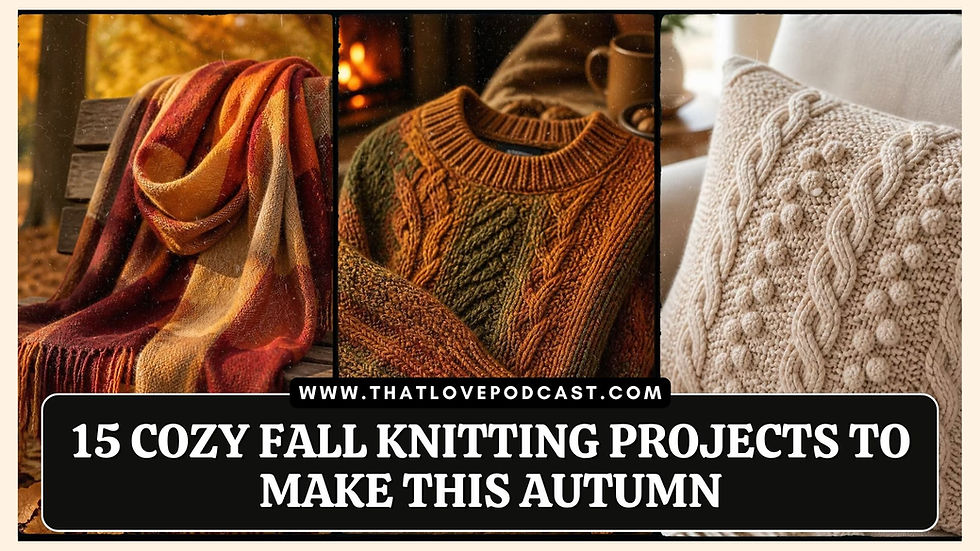
Before You Start: Choosing Yarn for Fall Knitting Projects
Before jumping into the projects, it is worth spending a little time thinking about yarn. Colour gets most of the attention because standing in front of shelves filled with rust, mustard, burgundy, forest green, oatmeal, and chocolate brown yarn is basically autumn heaven. However, fibre, yarn weight, texture, and how you plan to use the finished piece matter just as much.
Wool is an obvious choice for autumn knitting because it provides warmth while creating that wonderfully traditional knitted look. Merino can feel particularly soft against the skin, which makes it useful for scarves, cowls, hats, and sweaters. If wool irritates your skin, acrylic, cotton blends, alpaca blends, and other alternatives give you plenty of options without sacrificing the cosy appearance.
Yarn weight will also dramatically change a project. Chunky and super chunky yarn can turn a simple scarf or pumpkin into a satisfyingly quick project, while DK and worsted-weight yarns are useful when you want more definition or a lighter finished piece. Always check the recommended yarn weight and gauge when following an existing pattern, especially for garments where a small difference can completely change the fit.
I would also think about where your finished project is going to live. A decorative pumpkin does not need to survive the same treatment as a scarf you will wear three times a week, while a blanket needs yarn that feels comfortable and can cope with regular use. Choosing yarn for the life the finished piece will actually have can save you a lot of disappointment later.
15. Knitted Autumn Mug Cozy

If you want a small fall knitting project that gives you almost immediate satisfaction, start with a mug cozy. It is essentially a tiny knitted rectangle designed to wrap around your favourite mug, which means beginners can practise basic stitches without committing themselves to six feet of scarf. You can finish one relatively quickly and use leftover yarn from previous projects rather than buying an entirely new ball.
The simplest version can be worked entirely in garter stitch, which is created by knitting every row. Once you feel more confident, try seed stitch, ribbing, small cables, or another textured stitch to give the cozy more personality. Rust, burnt orange, mustard yellow, oatmeal, dark green, and burgundy are particularly lovely colours if you want that classic autumn appearance.
Measure around your mug before you begin instead of relying completely on a standard measurement. Leave space around the handle and decide whether you want your cozy to close with a button, loop, tie, or simply stretch around the cup. Remember that knitted fabric stretches, so you usually want a comfortable fit rather than something hanging loosely around the mug.
This is also a brilliant project for experimenting without worrying too much about mistakes. Try a stitch you have never used, practise changing colours, or add a small decorative border once you have finished. If your first attempt is slightly wonky, congratulations—you have created a handmade mug cozy with character, which sounds considerably better.
Knitting tip: Make a small swatch before trying a new textured stitch. It lets you see how the yarn behaves without discovering halfway through your finished cozy that the pattern looks completely different from what you imagined.
14. Chunky Knit Headband
A chunky knitted headband is another easy autumn knitting project that beginners can tackle without feeling overwhelmed. It keeps your ears warm on chilly mornings but does not require the shaping that comes with making a full hat. Better still, you can usually create one using a relatively small amount of yarn.
Rib stitch works beautifully because it creates a stretchy fabric that sits comfortably around the head. Seed stitch can give you a thicker, textured appearance, while a simple garter-stitch headband is perfect when you are still learning. If you want the popular twisted-front appearance, knit a rectangle and use a clever fold when seaming the ends together.
Measure the wearer's head and remember that the knitted fabric needs a little negative ease so the headband stays in place. A headband that measures exactly the same as the head circumference may become too loose once the fabric stretches. Make a gauge swatch and test the stretch before deciding on your final length.
For autumn, I love the idea of deep forest green, cream, warm caramel, berry red, or pumpkin orange. You could make several in different colours and suddenly have a handmade accessory for almost every autumn outfit. It is also the sort of quick knitted gift that looks considerably more impressive than the amount of stress required to make it.
Knitting tip: When joining the two ends, take your time with the seam. A beautifully knitted headband can lose some of its polished appearance if the join becomes bulky or uneven.
13. Knitted Fall Leaf Garland
Not every autumn knitting project needs to be something you wear. A knitted leaf garland can bring a lovely handmade touch to a mantel, bookshelf, staircase, doorway, or autumn table display. It is also a fantastic excuse to finally use all those tiny pieces of leftover yarn that are apparently too precious to throw away.
Create individual leaves in several fall colours, then attach them to knitted cord, crochet chain, ribbon, or twine. Deep red, burnt orange, mustard, olive, brown, cream, and muted gold work beautifully together. You do not need every leaf to be identical either, because slight differences can make the finished garland look more natural.
Small leaves are useful projects for learning basic increases and decreases because those techniques create the characteristic pointed shape. If you are a beginner, choose a simple leaf pattern before attempting heavily textured or lace versions. Once you understand the construction, you can experiment with different sizes and stitch patterns.
Blocking makes a surprisingly big difference here. Small knitted shapes can curl or look slightly uneven when they first come off the needles, but gentle blocking helps them settle into their intended shape. Suddenly, those questionable little knitted blobs start looking like actual autumn leaves, which is always reassuring.
Knitting tip: Weave in the ends as you finish each leaf. Leaving twenty or thirty tiny leaves until the end turns an enjoyable project into an evening devoted entirely to regretting your previous decisions.
12. Cozy Knitted Cushion Cover

A knitted cushion cover is one of my favourite ways to bring autumn into a room without buying completely new decor. Put a chunky cream, brown, rust, or forest-green cushion on a sofa and suddenly everything feels warmer. It is basically the home-decor equivalent of putting on a cardigan.
Beginners can make two simple knitted squares or rectangles and seam them together around a cushion insert. More experienced knitters can experiment with cables, basketweave, moss stitch, bobbles, colourwork, or panels combining several textures. Because a cushion is relatively small compared with a blanket, it is an excellent place to practise decorative stitches.
Measure your cushion insert carefully before casting on and knit a gauge swatch before calculating the number of stitches you need. You generally want the finished cover to fit snugly rather than hanging loosely around the insert. Check your measurements as you knit because textured stitches can behave differently from plain stockinette.
Think practically about the back as well. You could seam the entire cover and remove the filling when washing, but an envelope-style opening or buttons can make life easier. A removable cover may take a little extra planning, but future you will be extremely grateful when somebody inevitably spills something on it.
Knitting tip: If you are using cables or another stitch that pulls the fabric inward, measure your gauge in that exact stitch pattern. Stockinette gauge will not necessarily tell you how wide your finished cable panel will be.
11. Fingerless Gloves
Fingerless gloves feel made for autumn. They provide enough warmth for chilly mornings without making your hands completely useless when you need to use your phone, carry a coffee, turn a page, or find your keys. They are practical, relatively quick to knit, and make excellent handmade gifts.
Beginners can choose versions knitted flat and seamed along the side, leaving a gap for the thumb. If you are comfortable knitting in the round, circular or double-pointed needle patterns can produce a seamless finish. Ribbing is particularly useful around the wrist because it stretches comfortably while helping the gloves stay in place.
Pay close attention to hand measurements because even simple fingerless gloves benefit from a good fit. Measure around the widest part of the hand and check the intended finished circumference of your pattern. If you are making them as a surprise gift, a stretchy ribbed design gives you a little more flexibility.
This is another lovely project for autumn colours, but you do not have to stay traditional. A neutral oatmeal pair will work with almost anything, while plum, navy, sage, mustard, or burgundy can add colour without becoming difficult to wear. Once you have made one successful pair, you may find yourself producing them for everyone you know.
Knitting tip: Make notes while knitting the first glove. Recording the number of rows, decreases, and any adjustments makes it much easier to create a second glove that actually resembles its partner.
10. Knitted Pumpkins
I could hardly write about cozy fall knitting projects without including knitted pumpkins. They are everywhere for a reason: they are adorable, endlessly customisable, relatively quick to make, and can be brought out every autumn. Unlike real pumpkins, they also have the considerable advantage of not eventually turning into something frightening at the back of your kitchen.
Many beginner-friendly pumpkins are created by knitting a rectangle, joining the sides, gathering the bottom, stuffing the shape, and gathering the top. Yarn can then be wrapped around the pumpkin to create those distinctive sections. Add a knitted, crocheted, felt, wooden, or natural-looking stem and you suddenly have something that looks much more complicated than it actually was.
Experiment with yarn weight to create pumpkins in different sizes and textures. Chunky yarn produces soft statement pumpkins, while thinner yarn works beautifully for smaller decorations that can be grouped together in bowls or table displays. Cream, sage, rust, mustard, brown, muted orange, and dusty pink can create a sophisticated autumn palette if bright orange is not really your thing.
Stuffing matters more than you might expect. Too little filling can leave the pumpkin looking deflated, while too much can make it difficult to shape the sections properly. Add stuffing gradually and spend a little time manipulating the shape before closing everything permanently.
Knitting tip: Make several sizes rather than repeating exactly the same pumpkin. Groups of three or five in different heights, colours, and textures usually create a more interesting autumn display.
9. Oversized Fall Scarf

Sometimes the obvious knitting projects are obvious because they are genuinely good. A big knitted scarf is useful, comfortable, beginner-friendly, and gives you plenty of opportunities to practise your stitches. It also becomes one of those projects you can work on almost automatically once you settle into the rhythm.
If you are completely new to knitting, there is nothing wrong with making an entire scarf in garter stitch. Choose beautiful yarn and let the colour and texture do the work for you. If you want something slightly more interesting, try ribbing, seed stitch, broken rib, basketweave, or a simple repeating cable.
The biggest beginner mistake with scarves is often choosing something far too ambitious and then getting bored halfway through. A six-foot scarf containing an elaborate stitch pattern may look wonderful in photographs, but it becomes less charming when you realise you have repeated the same complicated sequence approximately four million times. Choose a pattern that you genuinely enjoy knitting rather than simply selecting the most impressive finished photograph.
Width is another consideration. A very wide scarf feels luxurious but requires considerably more yarn and knitting time, while a narrower scarf can be easier to wrap and layer under a coat. Decide how you actually like wearing scarves before choosing your dimensions.
Knitting tip: Slip the first stitch of each row if your pattern allows it. This can create a cleaner edge and make a simple scarf look noticeably more polished.
8. Cozy Autumn Beanie
A knitted beanie is one of those projects that feels like an important knitting milestone. You begin with yarn and needles, do a surprising amount of counting, occasionally wonder why you started, and eventually create something you can genuinely wear on your head. There is something wonderfully satisfying about that.
Ribbed beanies are excellent for autumn because they are stretchy, warm, and relatively forgiving when it comes to fit. You can create a fitted version, a folded-brim hat, or a slightly slouchier style depending on your preference. Chunkier yarn makes the project quicker, while lighter yarn can produce a softer and less bulky hat.
If this is your first hat, do not be intimidated by knitting in the round. Circular needles eliminate the need for a side seam and can make the project surprisingly relaxing once you get used to them. The most important thing when joining your stitches is making sure the cast-on edge has not twisted.
The crown is where you will usually begin decreasing stitches to shape the top. Place markers between decrease sections and count carefully so everything remains symmetrical. If you lose your place, stop and work out where you are rather than confidently continuing for another twelve rows and hoping mathematics somehow fixes itself.
Knitting tip: Try the hat on before you begin the crown decreases whenever the construction allows it. Adjusting the body length before shaping is considerably easier than deciding afterwards that your perfectly finished hat is strangely short.

7. Pumpkin Spice Tea Cozy
A tea cozy might sound wonderfully old-fashioned, but that is exactly why I like it for autumn. There is something very comforting about putting a pot of tea on the table wrapped in something you made yourself. Add a pumpkin-inspired shape or autumn colours and the entire thing becomes almost aggressively cosy.
Beginners should look for tea cozy patterns using straightforward ribbing, stocking stitch, or simple shaping. More experienced knitters can try cables, leaves, colourwork, textured pumpkins, or decorative tops. You could even create a neutral everyday version and a more playful pumpkin design specifically for autumn.
Measure the teapot you intend to use because they vary considerably in size and shape. You need to account for the handle, spout, lid, and widest part of the pot rather than assuming every teapot follows some secret universal measurement. A cozy that fits properly will insulate the pot while still being easy to put on and remove.
Choose a yarn suitable for something that may encounter heat, steam, and the occasional splash of tea.
Always follow the care information for your chosen fibre and keep decorative elements safely away from direct heat. Practical does not have to mean boring, but practical should probably still mean practical.
Knitting tip: Test the fit before completing every seam. It is much easier to make small adjustments while parts of the cozy are still open.
6. Chunky Knit Blanket

This is where our cozy fall knitting projects start getting serious. A chunky knitted blanket takes more yarn and commitment than a mug cozy, but the reward is considerably bigger. There are few things better than spending autumn under a blanket you made yourself.
Beginners can create beautiful blankets using simple garter stitch, seed stitch, or repetitive rib patterns. You do not need complicated cables or elaborate colourwork for a blanket to look expensive and inviting. Thick yarn already provides plenty of visual texture, so sometimes simplicity is exactly what works.
Before buying yarn, calculate how much you will realistically need for the finished dimensions. Blankets consume yarn at an impressive rate, and discovering halfway through that your exact dye lot has disappeared from existence is not an experience I recommend. Buying enough at the beginning also makes it easier to keep the colour consistent.
A smaller lap blanket is a sensible first project if a full bed-sized blanket sounds overwhelming. You still get something practical and cosy without committing yourself to knitting until approximately next spring. Once you know you enjoy larger projects, you can move on to throws and full-size blankets.
Knitting tip: Use stitch markers to divide wide rows into manageable sections. If you are supposed to have 140 stitches, checking groups of 20 is much easier than repeatedly counting the entire row.
5. Cable Knit Cowl
A cowl gives you all the warmth of a scarf without the loose ends, which makes it particularly useful on windy autumn days. It is also a wonderful project if you want to learn cables because you can practise the technique on something smaller than a full sweater. Once you understand how cables are formed, they are far less mysterious than they initially appear.
Cable knitting involves working stitches in a different order to create that twisted, raised appearance. A cable needle temporarily holds stitches while others are worked, allowing the fabric to cross over itself visually. The technique looks complicated, but many basic cable patterns repeat the same movements again and again.
Choose a yarn with good stitch definition so your cables remain visible. Extremely fuzzy yarn can be beautiful, but it may hide the details you spent all that time creating. Wool and smooth wool blends are popular choices because the structure of the stitches can remain wonderfully clear.
Pay attention to your tension around the cable crossings. Some knitters pull those stitches too tightly, while others leave them loose because they are concentrating on the cable needle. Try to keep your movements relaxed and consistent, and your tension should improve naturally with practice.
Knitting tip: Use a row counter or keep written notes beside you. Cable patterns often depend on repeating a crossing every specific number of rows, and guessing whether you are on row six or eight is rarely a successful strategy.
4. Cozy Knit Socks
Hand-knitted socks have a reputation for being intimidating, but they are also one of the most satisfying autumn knitting projects you can learn. They are small enough to carry around, practical enough to use constantly, and available in patterns ranging from extremely simple to beautifully elaborate. Once people become sock knitters, they often seem to become very enthusiastic sock knitters.
If you are making your first pair, choose a straightforward pattern rather than immediately attempting complicated lace or colourwork. Learning the basic architecture of a sock—cuff, leg, heel, gusset, foot, and toe—is enough of an adventure the first time. Once that construction makes sense, decorative patterns become much easier to tackle.
Sock yarn is designed to handle the particular demands of something that will spend its life rubbing against feet and shoes. Many sock yarns contain wool blended with a reinforcing fibre for durability, although other options are available. Whatever you choose, check that the yarn is appropriate for socks rather than selecting something purely because it feels wonderful in your hand.
Fit is particularly important. Measure foot circumference and length, check your gauge, and follow the pattern's sizing instructions rather than simply choosing the size you normally buy in a shop. Knitted socks usually need some negative ease so they fit snugly rather than sliding around.
Knitting tip: Consider knitting the second sock relatively soon after the first. Leaving six months between them increases the possibility that you will forget every adjustment you made and accidentally create siblings rather than twins.
3. Autumn Cable Knit Cushion

We have already talked about simple cushion covers, but a statement cable-knit cushion deserves its own place near the top of this list. Thick cables instantly give a room that cozy cottage feeling associated with autumn. Put one next to a soft blanket and suddenly your sofa looks ready for an entire season of books, films, and avoiding terrible weather.
This is a brilliant intermediate knitting project because you get to practise cables without worrying about garment shaping. The cushion provides a predictable rectangular canvas, allowing you to concentrate on the pattern itself. Try one large central cable, several smaller braided cables, or panels separated by reverse stockinette stitches.
Neutral colours work particularly well when texture is the main attraction. Cream, oatmeal, taupe, camel, grey, chocolate, and soft brown allow the shadows created by the cables to become part of the design. Stronger autumn colours such as rust or deep green can look equally beautiful if you want the cushion to become more of a statement piece.
Block the knitted panels before assembling your cover because cables can pull and distort the fabric. Blocking allows everything to settle and makes accurate seaming easier. Take your time matching the corners and edges because good finishing can transform a handmade cushion into something that looks genuinely professional.
Knitting tip: Put a lifeline through your stitches before beginning a complicated new cable section. If something goes wrong several rows later, you have a safe point to return to without unravelling half your project.
2. Oversized Autumn Cardigan
An oversized cardigan is the project I picture when somebody says “cozy fall knitting.” It is warm, practical, easy to layer, and basically gives you permission to walk around wearing something that feels suspiciously similar to a blanket. Pair it with jeans, leggings, boots, or a simple dress and you have an autumn staple you can wear repeatedly.
If this is your first knitted garment, look for a cardigan pattern specifically described as beginner-friendly. Simple drop-shoulder constructions can be less intimidating because the garment is often created from relatively straightforward shapes. Raglan and seamless constructions are also worth exploring once you become more comfortable with garment knitting.
Gauge becomes absolutely essential here. Being slightly wrong on a mug cozy is annoying; being slightly wrong across the entire circumference of a cardigan can turn your carefully planned medium into something designed for you and three close friends. Knit a proper swatch, wash and block it as you intend to treat the finished garment, then measure again.
Think carefully about size and ease before starting. “Oversized” does not simply mean choosing a random larger size, because good patterns intentionally build ease into the finished measurements. Compare the pattern's finished bust measurement with your own body measurement and decide how much additional room you actually want.
Knitting tip: Try the garment on during construction whenever possible. Checking sleeve length, body length, and overall fit while you can still make adjustments is much easier than discovering problems after weaving in every final end.
1. The Perfect Cozy Fall Sweater

If I could choose only one autumn knitting project from this entire list, it would have to be a sweater. There is something special about making a garment from the beginning and eventually being able to say, “Yes, I actually made this.” A handmade sweater can become one of those pieces you look forward to wearing every year when the temperature finally drops.
For your first sweater, simplicity is your friend. A basic raglan, drop-shoulder, or straightforward top-down pullover can teach you an enormous amount without overwhelming you with complicated stitch patterns. You can always make the second sweater covered in cables, colourwork, bobbles, lace, or whatever ambitious idea Pinterest convinces you is absolutely essential.
Choose yarn based on how you want the sweater to feel and behave, not simply how the skein feels in the shop. Consider warmth, weight, drape, softness, washing instructions, durability, and whether the fibre feels comfortable directly against your skin. Remember that a sweater requires a significant amount of yarn, so calculate your quantity carefully and buy a little extra if your pattern recommends it.
Then comes the gauge swatch, which I know is the part everyone wants to skip. Please do not. A few millimetres of difference across a small number of stitches can become several inches of difference across an entire sweater, making gauge one of the most important parts of successful garment knitting.
Once you begin, resist the urge to race through it. Check measurements as you go, try the sweater on when construction allows, and stop occasionally to look at how the fabric is developing. The goal is not simply to finish a sweater; it is to finish a sweater that you actually want to wear.
Colour is where you can really embrace autumn. Think warm oatmeal, chocolate brown, cinnamon, burnt orange, burgundy, forest green, muted mustard, deep navy, charcoal, or soft cream. A beautifully textured neutral can become a wardrobe staple, while a rich autumn shade makes the sweater itself the centre of an outfit.
Knitting tip: Wash and block your gauge swatch before measuring it. Some yarns change significantly after washing, and you want to discover that before knitting an entire sweater rather than after.
How to Choose the Right Fall Knitting Project for Your Skill Level
Looking at fifteen ideas at once can make you want to cast on approximately eleven projects immediately. I understand the temptation, but your future collection of half-finished knitting may be less enthusiastic. Choosing one project that matches your current skill level usually gives you a much better chance of actually finishing it.
Complete beginners should start with projects involving mostly rectangular pieces and basic stitches. Mug cozies, scarves, simple headbands, basic cushion covers, and straightforward blankets allow you to practise casting on, knitting, purling, maintaining tension, binding off, and fixing small mistakes. Those basic skills are the foundation of almost everything else you will eventually make.
Once those techniques feel comfortable, move into projects requiring shaping or knitting in the round. Hats, fingerless gloves, cowls, pumpkins, and simple socks can introduce increases, decreases, circular needles, double-pointed needles, and more structured construction. You do not need to master every technique before moving forward; learning one new skill within an otherwise manageable project is often the easiest approach.
Sweaters and cardigans can come next, although confident beginners absolutely can attempt simple garments earlier. Look for patterns with clear instructions, straightforward construction, plenty of sizing information, and techniques you already partly understand. A first sweater should feel exciting rather than like you have accidentally enrolled in an advanced mathematics course.

How to Create the Perfect Autumn Knitting Colour Palette
One of the easiest ways to make any knitting project feel appropriate for fall is through colour. Traditional autumn palettes draw inspiration from changing leaves, woodland landscapes, pumpkins, spices, and darker evenings. Think burnt orange, rust, mustard, ochre, olive, burgundy, brown, caramel, cream, taupe, and forest green.
You do not have to use every autumn colour at once. In fact, choosing two or three complementary shades can create a more sophisticated result than throwing the entire seasonal palette into one project. Cream with rust, oatmeal with forest green, mustard with chocolate brown, or burgundy with dusty pink can all look beautiful.
Neutral colours are particularly useful for larger projects such as sweaters and cardigans because they are easy to wear repeatedly. Smaller accessories give you more freedom to experiment with stronger colours that might not normally appear in your wardrobe. A mustard hat or burnt-orange scarf can bring autumn colour to a simple neutral coat without becoming overwhelming.
Before committing to colourwork, place your yarns next to each other in natural light. Colours that looked completely different under bright shop lighting can sometimes have surprisingly similar values at home. If your pattern depends on strong contrast, take a quick black-and-white photograph of the yarns to see whether they remain visually distinct.
7 Fall Knitting Tips That Will Make Your Projects Better
The first thing I would recommend is keeping notes. Write down your yarn, needle size, gauge, size, modifications, and anything unusual you do during the project. You may believe you will remember why you randomly added two stitches on a Tuesday evening three months ago, but I promise your brain has other plans.
Secondly, learn how to recognise your stitches rather than relying entirely on counting. Understanding what knit stitches, purl stitches, increases, decreases, and mistakes look like makes knitting much less intimidating.
Eventually, you start reading the fabric almost like a map and can identify problems before they travel too far.
Third, do not be afraid of undoing your work. Frogging can feel painful when you have spent hours knitting, but sometimes going backwards is the quickest route to a finished project you genuinely love. Twenty minutes of fixing something now is preferable to spending the next five years staring angrily at the mistake every time you wear the sweater.
Fourth, use stitch markers generously. They are useful for marking pattern repeats, sides, decreases, increases, sleeves, and important construction points. Anything that reduces the amount of counting I have to do repeatedly gets my full support.
Fifth, block your finished knitting. Blocking can even out stitches, help pieces reach their intended dimensions, open lace patterns, relax cables, and give garments a more polished appearance. Always use a blocking method suitable for your yarn fibre rather than assuming every knitted item wants exactly the same treatment.
Sixth, buy enough yarn before beginning a large project. Dye lots can vary, and colours can disappear or become difficult to find later. Having an extra ball left at the end is considerably less stressful than needing another fifty metres when the yarn has apparently vanished from civilisation.
Finally, choose projects you genuinely want. Knitting requires time, and that time feels much more enjoyable when you are excited about the thing slowly appearing on your needles. Trends can provide inspiration, but your favourite project will probably be the one that fits your own home, wardrobe, skill level, and personality.
What Should a Beginner Knit First for Fall?
If you have never knitted before, I would begin with a headband, mug cozy, or small scarf rather than a sweater. These projects give you enough repetition to practise basic stitches without creating an enormous commitment. You can make mistakes, learn how your tension works, and still end up with something useful.
A scarf is probably the traditional answer, but scarves can become surprisingly long projects. If you know you lose interest when something becomes repetitive, a headband or mug cozy may give you the satisfaction of finishing something much sooner. Completing that first project can provide the confidence you need to tackle something larger.
Your second or third project can introduce one new technique. Try ribbing, seed stitch, simple decreases, or knitting in the round rather than attempting five unfamiliar techniques simultaneously. Gradual progression keeps knitting enjoyable while still allowing your skills to grow.
Most importantly, do not compare your first project with somebody else's hundredth. Handmade knitting does not need to be absolutely perfect to be useful or beautiful. Every slightly uneven row is teaching your hands something that becomes easier the next time.
Frequently Asked Questions About Fall Knitting Projects
What are the easiest fall knitting projects for beginners?
Scarves, mug cozies, simple headbands, cushion covers, and basic blankets are excellent beginner fall knitting projects. They can be created largely from basic stitches and usually require very little complicated shaping. Once you feel confident, hats, cowls, pumpkins, and fingerless gloves are natural next steps.
Choose something small if you want a quick first success. Finishing a manageable project can be far more motivating than spending months struggling through an oversized blanket. You can always make bigger and more complicated projects once the fundamentals feel natural.
What can I knit quickly for autumn?
Headbands, mug cozies, pumpkins, cowls, fingerless gloves, and chunky hats can all make satisfying quick autumn knitting projects. Using thicker yarn and larger needles generally helps projects grow faster, although your exact knitting speed will obviously vary. Small decorative projects are particularly useful when you want something you can finish over a weekend.
Quick knits are also ideal for handmade gifts. You can create several variations using different yarn colours without learning a completely new construction each time. Once you know the pattern, every additional version usually becomes easier.
What colours are best for fall knitting?
Rust, burnt orange, mustard, forest green, olive, burgundy, cream, oatmeal, caramel, chocolate brown, and muted gold all create beautiful autumn knitting palettes. You can use them individually or combine several shades for colourwork and striped projects. Neutral colours are particularly versatile for sweaters, cardigans, scarves, and blankets.
However, there are no actual rules saying autumn knitting must be brown and orange. Deep blues, dusty pinks, purple, charcoal, and muted jewel tones can feel equally seasonal. Choose colours that make you excited to pick up the project.
Is chunky yarn good for beginners?
Chunky yarn can be excellent for beginners because the individual stitches are easier to see and projects often grow relatively quickly. That immediate progress can be encouraging when you are still learning how knitting works. Scarves, hats, cowls, blankets, pumpkins, and headbands can all work particularly well in thicker yarns.
Very large needles can feel awkward at first, so bigger is not automatically easier. Experiment until you find a yarn and needle combination that feels comfortable in your hands. Comfort matters when you are repeating the same movements hundreds or thousands of times.
Can beginners knit a sweater?
Yes, beginners can knit sweaters, particularly when using patterns specifically designed for newer knitters. Look for straightforward construction, simple stitch patterns, clear sizing information, and detailed instructions. A basic top-down raglan or drop-shoulder sweater can be a realistic early garment project.
I would still recommend completing at least one or two smaller projects first. Understanding tension, basic stitches, increasing, decreasing, and how to correct simple mistakes will make the sweater considerably less stressful. You want your first garment to feel like an exciting challenge rather than an impossible one.
How much yarn do I need for an autumn knitting project?
The amount depends entirely on the yarn weight, gauge, size, stitch pattern, and project. A mug cozy may require only leftover yarn, while a large blanket or oversized sweater can require many balls or skeins. Always check the yardage or metre requirements of the specific pattern you plan to follow.
For garments, make sure you are checking the yarn requirements for your chosen size rather than the sample size shown in photographs. Buying a little extra can also be sensible when you are close to the recommended amount. Running out during the final sleeve is not the dramatic ending anyone wants from their autumn knitting experience.
What is the best yarn for cozy autumn knitting?
Wool and wool blends are popular because they provide warmth, elasticity, and beautiful stitch definition, while merino can offer additional softness for items worn close to the skin. Acrylic and blended yarns can provide affordable, easy-care alternatives, and cotton blends may suit people who prefer lighter fibres. The best choice depends on the project and the person using it.
Always consider washing instructions as well. A decorative pumpkin and an everyday child's cardigan have very different practical requirements. The prettiest yarn in the shop is not necessarily the best yarn for every project.
What should I knit with leftover autumn yarn?
Small pumpkins, leaves, mug cozies, headbands, striped accessories, ornaments, patchwork squares, and decorative garlands are excellent ways to use leftover yarn. Tiny projects allow you to combine several colours without needing enough of one shade to create an entire garment. Keep similar yarn weights together to make planning easier.
You can also save leftovers from several projects throughout the year and eventually create a memory blanket. Each section can remind you of something else you knitted. It turns scraps that might otherwise be forgotten into something genuinely meaningful.
How do I stop my knitting from looking uneven?
Uneven knitting is usually related to tension, and tension generally improves through practice. Try to hold the yarn consistently and avoid consciously pulling every stitch extremely tight. Your hands gradually develop a natural rhythm as you knit more frequently.
Blocking can also improve the appearance of slightly uneven stitches once a project is complete. It will not magically repair every problem, but it can help the fabric relax and settle. Do not judge your knitting too harshly while it is still sitting scrunched up on the needles.
When should I start knitting for fall?
You can start whenever you like, but beginning in late summer gives you time to finish larger projects before the coldest weather arrives. Sweaters, cardigans, blankets, and multiple handmade gifts naturally require more time than hats or pumpkins. Starting early means you can knit at a comfortable pace instead of turning your relaxing hobby into a race against the weather.
Smaller fall projects can be started throughout the season. A chunky headband, pumpkin, cowl, or mug cozy can provide that autumn feeling without requiring weeks of work. There is no official knitting calendar waiting to disqualify you for starting a scarf in November.
Final Thoughts: Make This Autumn a Little Cozier
There is a reason knitting feels so right during autumn. The season naturally encourages us to slow down a little, spend more time indoors, pull out our favourite blankets, and rediscover hobbies that make an ordinary evening feel comforting. Knitting fits perfectly into that rhythm because the process can be just as enjoyable as the finished project.
You certainly do not need to make all fifteen projects on this list. Start with the one that made you immediately think, “I want that,” and build from there. Maybe that means three tiny knitted pumpkins for your bookshelf, a huge scarf you can disappear into, or finally attempting the handmade sweater you have been thinking about for months.
If you are new to knitting, allow yourself to be new at it. Your tension might change, your first seam might not be perfect, and there is an excellent chance you will occasionally stare at your needles wondering how you somehow have two more stitches than you started with. That is all part of learning, and every finished project makes the next one a little easier.
For experienced knitters, autumn is a wonderful excuse to experiment with something different. Try a cable you have always admired, choose a colour you would normally avoid, learn a new construction method, or finally use the beautiful yarn that has been sitting in your stash waiting for a project worthy of it. Yarn deserves its moment too.
The best fall knitting projects are ultimately the ones that make the season more enjoyable. They give your hands something relaxing to do, add warmth to your home or wardrobe, and leave you with something tangible at the end of all those quiet hours. That combination is difficult to beat.
Now I just have one problem.
I have convinced myself I need fifteen new knitting projects.
Happy knitting, and have a wonderfully cozy autumn.


.jpg)



.jpg)


