

Every Hunger Games Movie Ranked from Best to Worst

You have watched the entire Hunger Games franchise more than once, but you have never actually settled the debate over which film deserves the top spot.
This complete ranking breaks down every single Hunger Games movie released so far, from the weakest entry to the undisputed best, using critical reception, box office performance, and genuine storytelling craft as the measuring stick.
Let's start 👇

💛 Love this kind of content? Help keep it going: Support That Love Podcast
If you love this, check out: Book Review: Mockingjay by Suzanne Collins - The Explosive Finale of a Dystopian Epic
📢 Are you a brand, author, publisher, or business looking to reach an audience that loves stories like this one? That Love Podcast partners with sponsors who want to connect with genuine, engaged readers and listeners. If you're interested in advertising with us, we would love to hear from you: Advertise With That Love Podcast
#6 — The Hunger Games: Mockingjay Part 2 (2015)

The finale of the original tetralogy stands as the franchise's weakest entry, largely a consequence of Lionsgate's decision to split Suzanne Collins's shortest and most contested novel into two separate films. Directed by Francis Lawrence, Mockingjay Part 2 struggles with pacing throughout its first half, spending a significant amount of time on tactical planning sequences and the "pod" trap systems within the Capitol that, while visually inventive, lack the tension and emotional stakes that defined the franchise's earlier arena sequences.
The film's continued focus on the Peeta-Katniss-Gale love triangle during the war's climax often feels disconnected from the larger political stakes of the rebellion, a criticism that has followed the franchise since the earlier Mockingjay installment. Peeta's ongoing recovery from his Capitol-induced hijacking provides some of the film's most compelling material, as Josh Hutcherson navigates the character's fragile, halting return to himself with genuine nuance, but the film sometimes struggles to balance this intimate psychological journey against the broader demands of a war narrative.
Still, the film delivers a genuinely powerful final act. The deaths of Finnick Odair and Primrose Everdeen land with real emotional weight, and Katniss's ultimate decision to execute President Coin rather than President Snow remains one of the more thematically bold choices in modern YA cinema, refusing the franchise's audience the easy catharsis of a straightforward villain's defeat. The film's quiet, melancholic epilogue — depicting Katniss and Peeta's slow, complicated healing years later — provides a genuinely moving conclusion to the saga, even if the road to get there occasionally drags.
Where to watch: Stream on Peacock.
🎙️ Stream a great love story while you scroll through this ranking — That Love Podcast is live now: thatlovepodcast.com/episodes
#5 — The Hunger Games: Mockingjay Part 1 (2014)

Ranking slightly above its sequel, Mockingjay Part 1 benefits from its genuinely interesting shift in structure — this is the first film in the franchise where the titular Games do not actually take place on screen, instead focusing on propaganda warfare and the psychological toll of rebellion on both individuals and entire districts. Julianne Moore's introduction as President Coin, the calculating and outwardly righteous leader of the District 13 rebellion, adds real intrigue to the film's political dimension, while Philip Seymour Hoffman's Plutarch Heavensbee continues to provide some of the trilogy's sharpest commentary on the manufactured nature of wartime narrative.
The film's depiction of District 13 — an underground, militarized society operating with strict schedules and rigid conformity — provides a fascinating dark mirror to the Capitol's excess, suggesting that even those fighting for freedom can replicate authoritarian structures when given power. Katniss's role as the reluctant, camera-shy face of the rebellion, forced to perform propaganda "propos" under Plutarch's direction, gives Jennifer Lawrence rich material to explore the character's growing exhaustion with being used as a symbol rather than treated as a person.
However, the decision to split the novel into two films means Mockingjay Part 1 often feels like an extended first act patiently waiting for its true payoff. Major character decisions and emotional beats are stretched thin across a runtime that could have been more efficiently compressed, and the film's cliffhanger ending — Peeta's rescue mission resulting in his psychological hijacking — sets up compelling stakes for the sequel without delivering much of a satisfying conclusion in its own right.
Where to watch: Stream on Peacock.

#4 — The Hunger Games: The Ballad of Songbirds & Snakes (2023)

The franchise's first prequel took a significant creative risk by centering an entirely new cast around a young Coriolanus Snow decades before he becomes the trilogy's central villain, and the gamble paid off with a surprisingly rich, character-driven story that has since been reevaluated as one of the series' stronger entries. Directed once again by Francis Lawrence, the film traces Snow's journey from an impoverished, desperate student at the Capitol's elite academy to the calculated, morally compromised young man whose choices during the 10th Hunger Games set him on the path toward the tyrant audiences meet decades later.
Tom Blyth delivers a genuinely compelling performance as young Snow, capturing both the character's charisma and the slow, incremental corruption of his moral compass with real psychological nuance. Rachel Zegler's Lucy Gray Baird brings a haunting, musical quality to the film that sets it apart tonally from every previous Hunger Games entry, though her frequent musical numbers occasionally slow the film's momentum during its middle act. Viola Davis's deliciously sinister Dr. Volumnia Gaul provides one of the franchise's most memorable new antagonists, bringing a scientific coldness to the Capitol's cruelty that expands the mythology of how the Games themselves were designed and refined over decades.
Critics were largely won over by the film's ambition and craft, with the film currently holding scores around 84% from critics and 81% from audiences on Rotten Tomatoes — a notably strong reception for a franchise many assumed had already told its complete story. The film's willingness to explore uncomfortable moral territory, including Snow's genuine capacity for both love and cruelty, has led many fans to reconsider it as a genuine highlight of the broader Panem saga rather than a mere cash-grab prequel.
Where to watch: Stream on Peacock.
You'll also love: 12 Best Hunger Games Characters of All Time, Ranked
📢 Loved reading this so far? If you're a brand, author, or business interested in reaching readers who love content just like this, we'd love to connect. Explore sponsorship and partnership opportunities with That Love Podcast: Advertise With That Love Podcast
#3 — The Hunger Games (2012)

The film that started it all remains one of the most beloved entries in the franchise for very good reason. Director Gary Ross brought a grounded, almost documentary-style intensity to Katniss's journey from the reaping through the arena, treating Suzanne Collins's source material with a seriousness that many YA adaptations of the era conspicuously lacked. The film's handheld cinematography during the early District 12 sequences, while occasionally criticized as overly shaky, effectively conveys the chaotic desperation of life under Capitol rule, and the film's staging of the reaping ceremony remains one of the franchise's most quietly devastating sequences.
Jennifer Lawrence's star-making performance anchored the entire saga from its very first scene, immediately establishing Katniss as a protagonist whose survival instincts and protective fury toward her sister Prim would define the character across four subsequent films. Woody Harrelson's introduction as Haymitch and Stanley Tucci's gleefully theatrical Caesar Flickerman rounded out a supporting cast that gave the franchise its essential foundation, while Donald Sutherland's brief but chilling appearances as President Snow established the underlying menace that would only deepen across subsequent installments.
What continues to set the original film apart from its more polished sequels is its raw, unpolished tension. The cornucopia bloodbath sequence, the constant threat of the arena's engineered dangers, and Katniss's genuine uncertainty about her own survival chances give the film an urgency that later entries, however accomplished, never quite recapture. Without this film's foundational success — nearly $700 million worldwide against a modest $78 million budget — none of the subsequent franchise exists, and it remains a genuinely essential piece of 2010s blockbuster filmmaking.
Where to watch: Stream on Peacock.
#2 — The Hunger Games: Catching Fire (2013)
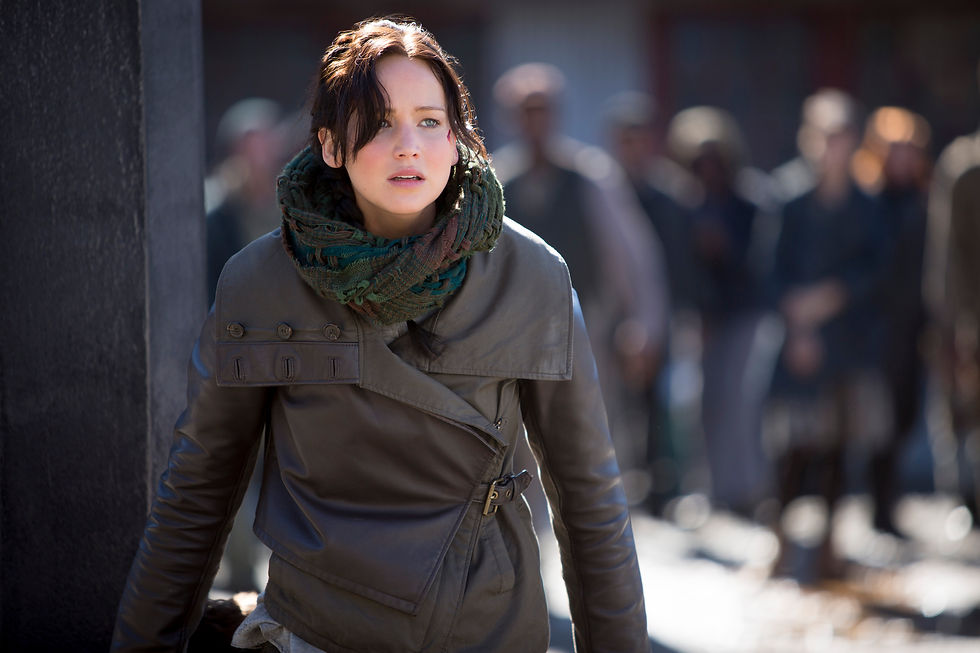
Widely regarded by critics and fans alike as the series' finest achievement, Catching Fire improved on its predecessor in nearly every measurable way. Director Francis Lawrence took over the franchise following Gary Ross's departure and delivered a film that expanded Panem's political stakes considerably while never losing sight of its characters' emotional realities, striking a near-perfect balance between spectacle and substance that the rest of the franchise would continue to chase.
The film's introduction of the Quarter Quell arc — forcing previous victors back into the arena as a twisted, symbolic punishment following the districts' growing unrest — provided a genuinely inspired narrative device, allowing the franchise to introduce a wealth of beloved new characters including Finnick Odair, Johanna Mason, Beetee, and Mags, all while raising the stakes considerably beyond the original film's more contained scope. Sam Claflin's Finnick, Jena Malone's Johanna, and Jeffrey Wright's Beetee all made immediate, lasting impressions in their debut appearances, providing the ensemble depth that the franchise had been missing.
The film holds an impressive 90% from critics and 89% from audiences on Rotten Tomatoes, and its nearly $700 million worldwide box office against a $78 million budget confirmed the franchise's staying power beyond a single successful debut. Beyond its technical and narrative achievements, Catching Fire also deepened the trilogy's political commentary considerably, exploring how the Capitol's response to growing rebellion — increased surveillance, brutal public punishment, and calculated propaganda — mirrors real-world authoritarian tactics with a sophistication rarely attempted in mainstream YA adaptations. The film's ending, with Katniss learning of District 12's destruction and the wider rebellion's existence, remains one of the most gripping cliffhangers in modern blockbuster cinema.
Where to watch: Stream on Peacock.
🎙️ Before we reveal the top spot — stream That Love Podcast for a story just as heartfelt: thatlovepodcast.com/episodes
#1 — Coming November 2026: The Hunger Games: Sunrise on the Reaping

While not yet released at the time of this ranking, anticipation for The Hunger Games: Sunrise on the Reaping has reached a fever pitch following the publication of Suzanne Collins's novel of the same name in early 2025. Directed once again by Francis Lawrence — the filmmaker behind the franchise's two most critically and commercially successful entries, Catching Fire and The Ballad of Songbirds & Snakes — the film stars Joseph Zada as a young Haymitch Abernathy and Whitney Peak as Lenore Dove, chronicling the tragic, previously unexplored story of the Second Quarter Quell that shaped Haymitch into the bitter, brilliant mentor audiences met in the original trilogy.
Collins's source novel has been praised by early readers as one of the darkest and most emotionally devastating entries in the entire Panem saga, exploring themes of Capitol propaganda manipulation, forced spectacle, and the specific personal losses that transformed a hopeful young man into the perpetually drunk, deeply guarded mentor audiences first encountered in The Hunger Games. Given that the story reveals Haymitch as the sole surviving tribute of his Quarter Quell, the film promises some of the franchise's most emotionally difficult material to date, likely rivaling or surpassing the devastating losses depicted throughout the Mockingjay films.
Given Francis Lawrence's proven track record with the franchise's most acclaimed installments, the richness of the source material, and the built-in emotional weight of finally understanding Haymitch's full backstory, Sunrise on the Reaping arrives with the strongest advance expectations of any Hunger Games film to date. Set to release on November 20, 2026, it has genuine potential to surpass even Catching Fire as the series' definitive achievement, and pre-release buzz across social media platforms suggests it may become the most-watched opening weekend in the franchise's history.
Where to watch: In theaters November 20, 2026.
Conclusion
From the raw intensity of the original film to the political sophistication of Catching Fire, the surprisingly rich prequel storytelling of Songbirds & Snakes, and now the highly anticipated arrival of Sunrise on the Reaping, the Hunger Games franchise has proven remarkably durable across more than a decade of storytelling. Whichever entry you consider the best, this ranking confirms one undeniable truth: Panem's story remains one of the most consistently compelling franchises in modern YA cinema, with no signs of slowing down.
💛 Enjoyed this? Support the content that celebrates the stories you love: Donate to That Love Podcast

🎙️ Stream That Love Podcast — stories with just as much heart: thatlovepodcast.com/episodes
💡 You May Also Love
If you're enjoying this blog, check out these other ones:
❓ Frequently Asked Questions
1. What is the best Hunger Games movie? The Hunger Games: Catching Fire is widely considered the best film in the franchise to date, holding a 90% critics score on Rotten Tomatoes and praised for expanding the series' political depth while introducing beloved characters like Finnick Odair, Johanna Mason, and Beetee.
2. What is the worst Hunger Games movie? The Hunger Games: Mockingjay Part 2 is generally considered the weakest entry, largely due to pacing issues stemming from the decision to split the final novel into two films, though it still delivers a powerful and emotionally resonant final act.
3. When does The Hunger Games: Sunrise on the Reaping release? Sunrise on the Reaping is set to release in theaters on November 20, 2026.
4. Who directed The Hunger Games: Sunrise on the Reaping? Francis Lawrence, who also directed Catching Fire, both Mockingjay films, and The Ballad of Songbirds & Snakes, returns to direct Sunrise on the Reaping.
5. Who stars in Sunrise on the Reaping? Joseph Zada stars as a young Haymitch Abernathy, with Whitney Peak playing Lenore Dove.
6. Is The Ballad of Songbirds & Snakes a prequel or sequel? The Ballad of Songbirds & Snakes is a prequel, set decades before the original Hunger Games trilogy, focusing on a young Coriolanus Snow during the 10th Hunger Games.
7. Why was Mockingjay split into two films? Following a trend set by other YA franchises at the time, Lionsgate split Suzanne Collins's final novel, Mockingjay, into two films to maximize box office potential, a decision many critics feel weakened both films' pacing compared to the tighter structure of the earlier installments.
8. What is the highest-grossing Hunger Games movie? The Hunger Games: Catching Fire remains one of the highest-grossing entries in the franchise, earning nearly $700 million worldwide against a $78 million budget, a figure the original film also nearly matched.
9. In what order should I watch the Hunger Games movies? Most fans recommend watching in release order: The Hunger Games, Catching Fire, Mockingjay Part 1, Mockingjay Part 2, The Ballad of Songbirds & Snakes, and eventually Sunrise on the Reaping, though some prefer watching the prequels first for chronological context on Snow and Haymitch's backstories.
10. Will there be more Hunger Games movies after Sunrise on the Reaping? As of now, Sunrise on the Reaping is the next confirmed installment, though given the franchise's continued success and Suzanne Collins's ongoing interest in expanding the Panem universe, further films remain a strong possibility according to industry analysts.