





10 Best Detective Movies Based on Crime Books

10 Best Detective Movies Based on Crime Books
You love crime fiction. You love detective films. And you are trying to find the ones that actually started on the page — the adaptations where a genuinely great book became a genuinely great film.
There are hundreds of crime movies claiming to be the best. But the ones that endure — the ones still being discussed, rewatched, and ranked decades after release — are almost always the ones rooted in exceptional source material. When a great crime novelist builds a world on the page and a great filmmaker brings it to the screen, the result is something that neither medium could achieve alone.
This ranking covers the ten best detective movies adapted from acclaimed crime, mystery, and thriller books — from the 1941 noir that defined an entire genre to the 2011 Swedish thriller that became a global phenomenon. Every film has been evaluated on three criteria: the quality of the adaptation, the strength of the detective or investigative central character, and the lasting cultural impact the film has had.
You will get the full picture: the source novel, the central plot, what makes the film exceptional, why it earns its place in the ranking, and where to watch it right now.
Whether you have read all the books or none of them, this list will give you ten extraordinary films and ten even more extraordinary reasons to go back to the source material after the credits roll.
Let's get into it. 👇

💛 Love great content? Support That Love Podcast: https://www.thatlovepodcast.com/donate
If you love this, check out: 10 Binge-Worthy TV Crime and Detective Dramas of 2026 So Far
Related Articles From That Love Podcast
Six reads to save alongside this ranking:
Why Book-to-Film Detective Adaptations Produce the Greatest Crime Cinema
Before getting into the rankings, it is worth understanding why the best crime films so consistently come from literary source material — because that context makes the individual achievements more impressive.
Detective fiction has a longer and richer tradition than detective cinema. Dashiell Hammett, Raymond Chandler, Agatha Christie, Dennis Lehane, Stieg Larsson — these writers spent decades developing the investigative protagonist, the procedural mechanics of crime plotting, and the specific atmospheric texture of their fictional worlds before any filmmaker had the chance to interpret them. When a great director encounters that depth of preparation, the results are almost always more complex and more enduring than wholly original screenplays could achieve.
The other factor is character. The great literary detectives — Sam Spade, Philip Marlowe, Hercule Poirot, Clarice Starling — are among the most fully realised characters in twentieth-century fiction. Their specific psychology, their particular relationship to the crimes they investigate, and the specific moral frameworks they bring to their work have been developed across hundreds of pages before a single scene is written. That depth is what gives the film adaptations their weight.
The ten films on this list represent the finest examples of this exchange between page and screen — detective stories that were already exceptional and became, in their film incarnations, genuinely essential cinema.
Keywords: best detective movies based on books, detective films adapted from novels, crime book adaptations, The Maltese Falcon 1941, The Silence of the Lambs, The Girl with the Dragon Tattoo film, L.A. Confidential film, Zodiac 2007 David Fincher, Shutter Island film, Mystic River Clint Eastwood, Murder on the Orient Express 1974, In the Heat of the Night, The Big Sleep 1946, noir detective films, best crime film adaptations
10. The Big Sleep (1946) — Raymond Chandler's Philip Marlowe on the Silver Screen

Based on: The Big Sleep (1939) by Raymond Chandler Director: Howard Hawks Starring: Humphrey Bogart, Lauren Bacall Where to Watch: Amazon Prime Video
The Story: Detective Philip Marlowe is hired by the wealthy General Sternwood to deal with a blackmailer threatening his younger daughter Carmen. What begins as a relatively simple assignment escalates through a labyrinthine series of murders, double-crosses, and romantic entanglements that even Marlowe — and reportedly even Chandler himself — could not entirely map. Humphrey Bogart plays Marlowe with a world-weary, sardonic authority that has defined the archetype of the private eye in popular culture for eighty years.
Why This Film Is Extraordinary: The Big Sleep is the film that most completely captures what Raymond Chandler was doing in his fiction — the argument that the detective story is not really about the crime but about the detective's encounter with a corrupt world and the specific quality of intelligence and moral stubbornness he brings to navigating it. The plot famously makes almost no logical sense; there is a murder at the center of the film whose perpetrator was never definitively established even among the production team. And yet the film is completely, magnificently involving from beginning to end.
Bogart and Bacall's chemistry — which was entirely real, as they fell in love during the production — gives the film an erotic charge that transcends the genre conventions of 1940s Hollywood. Every scene between Marlowe and Vivian Sternwood (Bacall) crackles with a specific tension that the story's official romantic plot provides no logical reason for and that the performers generate entirely from their own presence.
Raymond Chandler's specific gift — the aphoristic, rhythmic prose that sees corruption in every surface of Los Angeles — is translated into Hawks's visual language with remarkable fidelity. The film's dialogue carries enough of Chandler's original voice to feel genuinely literary while being completely, kinetically cinematic.
The Big Sleep sits at tenth on this list not because of any failure of quality — it is one of the great American films — but because the adaptations above it achieve a more complete translation of their source material's specific ambitions. The Big Sleep is the film the detective genre built itself on. Everything above it stands on its foundations.
The Book: Chandler's original 1939 novel introduced Philip Marlowe to the world and established the template for the literary private eye that every subsequent crime novelist has been in dialogue with. Reading it alongside or after the film reveals depths — the specific texture of 1930s Los Angeles, the particular social portrait Chandler was drawing — that the film's production code restrictions prevented it from fully exploring.
🎧 Love great storytelling? Listen to That Love Podcast — original audio drama every week: https://www.thatlovepodcast.com/episodes
9. In the Heat of the Night (1967) — Civil Rights America Through a Crime Lens

Based on: In the Heat of the Night (1965) by John Ball Director: Norman Jewison Starring: Sidney Poitier, Rod Steiger Academy Awards: 5 Oscars including Best Picture and Best Actor (Rod Steiger) Where to Watch: Amazon Prime Video
The Story: Virgil Tibbs (Sidney Poitier) is a Black homicide detective from Philadelphia who finds himself stranded at a train station in Sparta, Mississippi, in the immediate aftermath of a local murder. Police Chief Bill Gillespie (Rod Steiger) — initially convinced that Tibbs himself must be the killer simply because of his race — is forced to accept Tibbs's help when the victim turns out to be a prominent industrialist whose murder demands immediate resolution. What follows is one of the most honest and one of the most genuinely moving crime films ever made.
Why This Film Is Extraordinary: In the Heat of the Night operates simultaneously as detective procedural and as one of the finest pieces of American cinema about race and prejudice ever produced. The film does not soften the ugliness of the Mississippi setting — the hostility Tibbs faces is immediate, constant, and at times physically dangerous — and Poitier plays it with a controlled, dignified fury that remains one of the great performances in American film history. The specific line "They call me Mister Tibbs" — Tibbs's response to Gillespie using his first name without permission — entered the cultural vocabulary permanently for very good reason.
The evolution of Gillespie across the film — from a man whose prejudice is automatic and unexamined to someone who has been forced, through professional necessity and then through something more genuine, to actually see who Virgil Tibbs is — is one of the most carefully observed character transformations in 1960s Hollywood. Rod Steiger won the Academy Award for his portrayal with complete justification.
John Ball's source novel, published in 1965 at the height of the Civil Rights Movement, brought exactly this kind of moral urgency to the detective fiction genre — using the structure of the mystery to explore the specific injustices of the American South with a directness and a seriousness that the genre had rarely attempted before.
The Book: Ball's original novel is leaner, faster, and in some respects more bitter than the film's Academy Award-friendly ending — a darker text that makes Tibbs an even more isolated figure than Poitier's performance suggests.
8. Murder on the Orient Express (1974) — Agatha Christie's Finest Hour on Screen

Based on: Murder on the Orient Express (1934) by Agatha Christie Director: Sidney Lumet Starring: Albert Finney, Lauren Bacall, Ingrid Bergman, Sean Connery, Michael York Academy Awards: 1 Oscar (Best Supporting Actress, Ingrid Bergman) Where to Watch: Amazon Prime Video
The Story: The Orient Express is snowbound in Yugoslavia. A passenger has been found stabbed multiple times in his locked compartment. Belgian detective Hercule Poirot (Albert Finney), who happens to be on board, is asked to investigate. Every one of the train's passengers is a suspect. Every one of them has an alibi. And the solution, when it arrives, is one of the greatest final-act revelations in mystery fiction history.
Why This Film Is Extraordinary: Sidney Lumet's 1974 adaptation is the finest Agatha Christie film adaptation ever made — a statement that requires acknowledging the competition (which includes multiple Poirot series episodes and several feature films) and then standing by it completely. The combination of Lumet's specific directorial intelligence — his ability to create genuine psychological tension within extraordinarily confined spaces, demonstrated previously in 12 Angry Men — and the extraordinary all-star ensemble he assembled makes this a genuinely exceptional piece of cinema rather than simply a very well-produced mystery.
Albert Finney's Poirot is polarising for fans of the books who prefer their detective more precise and less flamboyant, but the performance is completely committed and generates genuine authority in the scenes that matter most. The final act — Poirot's extended explanation of his solution to the assembled suspects — is one of the finest set pieces in the mystery genre on film, a masterclass in sustained suspense delivered entirely through dialogue and performance.
The ensemble is, by any reasonable measure, one of the finest ever assembled for a single film: Lauren Bacall, Ingrid Bergman, Sean Connery, Michael York, Vanessa Redgrave, John Gielgud, Anthony Perkins, and more, each with their specific function in the plot and each creating a fully inhabited character in limited screen time.
Agatha Christie reportedly approved of this adaptation more than any other, calling it "the best film of her work she had seen." That endorsement from the source is worth noting.
The Book: Christie's 1934 novel is one of the great masterpieces of the classic whodunit form — a perfect closed-circle mystery whose solution remains one of the most audacious in the genre's history.
You'll also love: It's Not TV, It's HBO: The 10 Greatest Drama Shows of All Time, Ranked
7. Zodiac (2007) — The Investigation That Consumed Everyone

Based on: Zodiac (1986) by Robert Graysmith Director: David Fincher Starring: Jake Gyllenhaal, Robert Downey Jr., Mark Ruffalo Where to Watch: Amazon Prime Video
The Story: In late 1960s and early 1970s San Francisco, a serial killer begins sending coded messages to the press, signing them "The Zodiac." Political cartoonist Robert Graysmith (Jake Gyllenhaal), San Francisco Chronicle crime reporter Paul Avery (Robert Downey Jr.), and homicide inspector Dave Toschi (Mark Ruffalo) each become obsessively, life-alteringly consumed by the case — across years, across careers, across marriages that cannot compete with the gravitational pull of an unsolved crime.
Why This Film Is Extraordinary: Zodiac is the finest film David Fincher has ever made, which is a claim that requires engaging with a filmography that includes Se7en, Fight Club, and The Social Network, and then standing by it. What makes Zodiac exceptional — and what distinguishes it from nearly every other serial killer film — is its complete refusal to provide the satisfactions the genre conventionally delivers. The Zodiac Killer was never definitively caught. The case remains unsolved. And Fincher makes a film that is entirely honest about that — a procedural about the specific devastation that an unsolvable crime inflicts on everyone who tries to solve it.
The film spans two decades of screen time — following the investigation from its peak intensity in 1969 through its cold-case years into the 1980s — and creates a genuinely harrowing portrait of obsession: the specific way that a case can become the organizing principle of a person's life, crowding out everything else, without ever providing the resolution that would justify the sacrifice.
Jake Gyllenhaal's Graysmith is one of the great obsessed amateur detective figures in film — a man whose fundamental unsuitedness to the world he enters (he is a cartoonist, not a detective) makes him both the story's most vulnerable figure and, ultimately, its most relentlessly committed.
Based on Graysmith's own account of his involvement in the case, Zodiac is the rarest thing in crime cinema: a detective story that is completely, absolutely honest about what it feels like when the case remains open.
The Book: Graysmith's original 1986 book is more explicitly a solution document — the author believes he identified the Zodiac — while the film is more epistemologically honest about the limits of that identification. Both are essential.

6. Mystic River (2003) — Dennis Lehane's Boston in Its Most Devastating Form

Based on: Mystic River (2001) by Dennis Lehane Director: Clint Eastwood Starring: Sean Penn, Tim Robbins, Kevin Bacon, Laurence Fishburne Academy Awards: 2 Oscars (Best Actor Sean Penn, Best Supporting Actor Tim Robbins) Where to Watch: Netflix
The Story: Three boys grow up in Boston's East End. One of them is abducted and abused, and the experience marks all three forever in different ways. Twenty years later, Jimmy Markum (Sean Penn) is a small-time criminal turned neighbourhood patriarch. Dave Boyle (Tim Robbins) has never recovered from what was done to him. Sean Devine (Kevin Bacon) is a homicide detective. When Jimmy's daughter is murdered, Sean is assigned to the investigation — and the shadows of their shared childhood begin to determine everything.
Why This Film Is Extraordinary: Mystic River is the most purely devastating film on this list — a crime drama that uses the detective investigation as the scaffolding for a story about trauma, about masculinity, about the specific and terrible way that violence committed against a child can echo across decades and destroy everyone it touches. Sean Penn won the Academy Award for his portrayal of Jimmy Markum with complete justification: it is a performance of almost unbearable intensity that never tips into self-consciousness, anchored by a genuine understanding of grief and fury that makes every scene feel genuinely dangerous.
Tim Robbins's Dave Boyle is the film's most complex and most heartbreaking figure — a man so visibly marked by what happened to him that the film's central dramatic question acquires an agonising moral dimension. Kevin Bacon's quiet, withdrawn detective provides the film's most controlled performance: the man who knows the truth about everything except the thing that matters most.
Clint Eastwood directs with a restraint and an emotional intelligence that represents some of his finest work. The Boston setting — the specific working-class neighbourhoods, the river of the title that becomes the film's dominant visual metaphor — is captured with the same love and specificity that Dennis Lehane brought to it in his novels.
Dennis Lehane is the finest crime novelist of his generation, and Mystic River is his masterpiece. The film is a worthy companion to it.
The Book: Lehane's 2001 novel is one of the great American crime novels — richer, more interior, and even more agonisingly constructed than the film. If the film moves you, the book will destroy you.
🎧 More great stories await at That Love Podcast: https://www.thatlovepodcast.com/episodes
You Might Like This
Keep exploring brilliant mysteries, unforgettable investigators, and compelling crime stories with these closely related features:
5. Shutter Island (2010) — Dennis Lehane's Psychological Masterpiece

Based on: Shutter Island (2003) by Dennis Lehane Director: Martin Scorsese Starring: Leonardo DiCaprio, Mark Ruffalo, Ben Kingsley, Michelle Williams Where to Watch: Netflix
The Story: U.S. Marshal Teddy Daniels (Leonardo DiCaprio) and his new partner Chuck Aule (Mark Ruffalo) arrive at Ashecliffe Hospital — a psychiatric facility on a remote island — to investigate the disappearance of a patient. The facility is for the criminally insane. A hurricane is coming. And nothing about the island, the patients, the doctors, or even Teddy's own memories is what it initially appears to be.
Why This Film Is Extraordinary: Shutter Island is one of the most formally inventive detective films ever made — a film that uses the conventions of the genre with such complete mastery that it can subvert them without the audience realising it is being subverted until the moment of revelation. Martin Scorsese, whose crime filmography is among the finest in cinema history, brings to Dennis Lehane's psychological puzzle an atmospheric control and a visual dread that make the island itself feel like a character — oppressive, Gothic, labyrinthine in ways that mirror the labyrinth inside the protagonist's mind.
Leonardo DiCaprio's performance is one of his most committed and most technically complex — a character whose surface competence as an investigator is in constant, barely visible tension with a psychological reality that the film is simultaneously concealing and revealing through its visual language. DiCaprio makes Teddy Daniels's specific quality of damaged determination completely convincing across the film's full runtime, which is essential for the revelation to work.
The film's final act — and specifically its final scene — is one of the most discussed and most genuinely debated in recent cinema. The question it leaves open is not ambiguity for its own sake but a genuine ethical question about the nature of reality and the specific mercy of choosing illusion over unbearable truth.
Two Dennis Lehane adaptations in the top five of this list is not coincidence. Lehane is simply the finest crime novelist currently working, and both Mystic River and Shutter Island demonstrate that his specific understanding of trauma, identity, and the uses of investigation as emotional metaphor translates to cinema with exceptional fidelity.
The Book: Lehane's 2003 novel is tightly, brilliantly constructed — the specific pleasures of discovering how meticulously the deception has been planted are even richer on a reread after watching the film.
4. L.A. Confidential (1997) — The Greatest American Crime Film of the 1990s
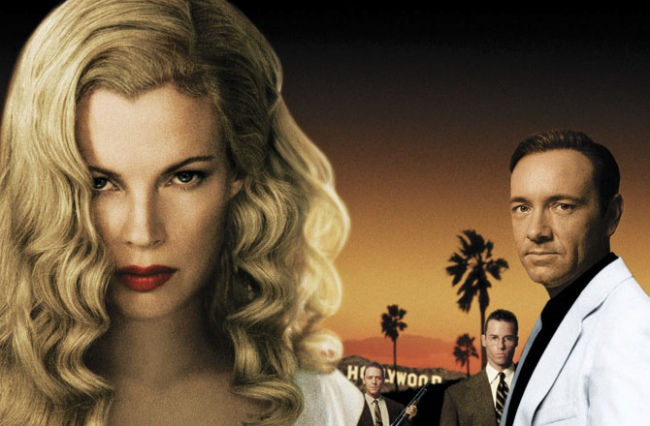
Based on: L.A. Confidential (1990) by James Ellroy Director: Curtis Hanson Starring: Russell Crowe, Guy Pearce, Kevin Spacey, Kim Basinger, James Cromwell Academy Awards: 2 Oscars (Best Supporting Actress Kim Basinger, Best Adapted Screenplay) Where to Watch: Amazon Prime Video
The Story: Los Angeles, 1953. Three LAPD detectives — brutal, impulsive Bud White (Russell Crowe), ambitious, morally flexible Ed Exley (Guy Pearce), and celebrity-obsessed, compromised Jack Vincennes (Kevin Spacey) — are investigating from their different positions when a massacre at a coffee shop called the Nite Owl pulls all three into the center of a conspiracy that reaches to the highest levels of the Los Angeles police department and the city's criminal power structure.
Why This Film Is Extraordinary: L.A. Confidential is the most formally ambitious crime film adaptation on this list — a film that takes James Ellroy's 500-page novel of staggering complexity and distills it into a tightly plotted, brilliantly performed, visually gorgeous two-hour thriller that loses almost nothing essential in the compression.
Curtis Hanson and co-writer Brian Helgeland's adapted screenplay — which won the Academy Award — is one of the great pieces of genre screenwriting, finding the emotional and narrative core of Ellroy's deliberately difficult, stylistically extreme source material and building a film around it that is simultaneously accessible and genuinely complex. The choice of three detective protagonists rather than one is the screenplay's masterstroke: each character represents a different way of being complicit in a corrupt system, and the collision of all three approaches is what generates the film's central moral tension.
Russell Crowe and Guy Pearce arrived as genuine stars from this film — both giving performances that demonstrated a range and an authority that their prior careers had not quite announced. Kim Basinger won her Oscar for a supporting role that is genuinely understated and genuinely excellent. Kevin Spacey's Jack Vincennes is the most morally complex character in the film, a detective who has spent so long performing for the cameras that he has forgotten why he became a detective in the first place.
James Ellroy's novels are notoriously difficult to adapt — their specific style, the density of their plotting, and the darkness of their moral vision have defeated many previous attempts. L.A. Confidential solved the adaptation problem so completely that it remains one of the greatest crime films ever made.
The Book: Ellroy's original is a longer, darker, more stylistically extreme experience — essential reading for anyone who wants the full architecture of the story the film necessarily simplified.
You'll also love: 9 Must-Read Sci-Fi and Fantasy Books Releasing in June 2026
3. The Girl with the Dragon Tattoo (2011) — Stieg Larsson's Sweden on David Fincher's Screen

Based on: The Girl with the Dragon Tattoo (2005) by Stieg Larsson Director: David Fincher Starring: Daniel Craig, Rooney Mara Where to Watch: Netflix / Amazon Prime Video
The Story: Disgraced journalist Mikael Blomkvist (Daniel Craig) is hired by a wealthy Swedish industrialist to investigate the forty-year-old disappearance of his niece from a sealed island during a family reunion. Assisting him — initially at a distance, then in direct collaboration — is Lisbeth Salander (Rooney Mara), a fiercely independent, brilliantly talented computer hacker with her own complicated history of institutional violence. Their investigation, which begins as a cold case inquiry, uncovers something considerably darker and more immediate than a simple disappearance.
Why This Film Is Extraordinary: David Fincher's English-language adaptation of Stieg Larsson's global phenomenon is the finest version of this story ever put on screen — a film that honours the source material's specific moral seriousness, its rage at institutional violence against women, and its complex, unconventional central character while demonstrating the specific visual and atmospheric intelligence that makes Fincher one of the finest directors working in crime cinema.
Rooney Mara's Lisbeth Salander is a performance of complete transformation — physical, psychological, and emotional — that earned her an Academy Award nomination with complete justification and created one of the most indelible characters in modern cinema. Lisbeth is not simply a damaged woman who has learned to survive. She is a specific kind of genius: someone whose processing of the world is fundamentally different from the people around her, whose capacity for violence is entirely proportionate to the violence that has been committed against her, and whose alliance with Blomkvist is built on mutual recognition rather than mutual warmth. The specific quality of the Lisbeth-Mikael working relationship — professional respect becoming genuine partnership in a way that has its own specific intimacy without reducing either character — is handled with extraordinary precision.
The Swedish winter landscape, captured by cinematographer Jeff Cronenweth, gives the film a visual bleakness that mirrors the investigation's moral content. The Trent Reznor and Atticus Ross score is one of the finest original film scores of the decade. And the opening title sequence — one of cinema's great recent credit sequences — announces the film's aesthetic with a confidence that immediately tells you what kind of experience you are in for.
Stieg Larsson completed three novels in the Millennium series before his death in 2004, and all three have been adapted. This first film is the best.
The Book: Larsson's original — originally published in Swedish as Men Who Hate Women — is a longer, more procedurally patient experience than either film adaptation, with a richer portrait of Swedish media and financial culture. Essential reading.
2. The Silence of the Lambs (1991) — The Film That Redefined the Crime Thriller

Based on: The Silence of the Lambs (1988) by Thomas Harris Director: Jonathan Demme Starring: Jodie Foster, Anthony Hopkins Academy Awards: 5 Oscars — Best Picture, Best Director, Best Actress (Jodie Foster), Best Actor (Anthony Hopkins), Best Adapted Screenplay Where to Watch: Amazon Prime Video
The Story: Clarice Starling (Jodie Foster) is a young FBI trainee assigned by her superior Jack Crawford (Scott Glenn) to interview the incarcerated Dr. Hannibal Lecter (Anthony Hopkins) — a former forensic psychiatrist and notorious cannibalistic serial killer — in the hope that his specific understanding of a criminal mind can help catch an active serial killer known as Buffalo Bill, who is skinning his female victims. The film follows Clarice as she navigates this extraordinary professional challenge while carrying her own psychological history into every encounter with Lecter.
Why This Film Is Extraordinary: The Silence of the Lambs is one of the three or four greatest American films of the 1990s and the most psychologically sophisticated crime thriller ever made. It is the only horror or thriller film to win the Academy Award's top five categories simultaneously — a sweep that reflects a completely deserved critical consensus about a film operating at a level of formal and emotional mastery that the genre had never quite achieved before.
What makes the film exceptional — and what distinguishes it from every subsequent attempt to replicate it — is the specific quality of the relationship between Clarice and Lecter. It is not simply a cat-and-mouse dynamic. It is something considerably more complex and considerably more disturbing: a psychic transaction between two genuinely intelligent, genuinely complicated people in which Lecter's information comes at the price of his penetrating analysis of Clarice's most private history. Every scene they share is loaded with a power dynamic that shifts from moment to moment — Lecter behind glass, theoretically contained, exercising more actual power over Clarice than almost anyone in her professional life.
Jodie Foster's Clarice is the great detective protagonist of American cinema: a woman who is simultaneously competent and vulnerable, confident and frightened, professional and deeply personally invested in the case she is pursuing. Her specific performance — the specific quality of Clarice's intelligence and the specific quality of her emotional openness, which Lecter identifies and uses and is also moved by — is the film's essential achievement.
Anthony Hopkins's Lecter appears in only sixteen minutes of screen time and has been voted the greatest screen villain in cinema history in numerous polls. The performance achieves maximum impact through maximum economy: every word Lecter says is chosen with a precision that mirrors the character's intelligence, and Hopkins's specific physical stillness — the way Lecter never rushes, never wastes a gesture — creates a presence that is genuinely, permanently disturbing.
Thomas Harris's source novel is excellent. Jonathan Demme's film is a masterpiece.
The Book: Harris's 1988 novel provides more of Clarice's FBI training world and more of the procedural investigation — a richer context for the film's extraordinary central scenes.
1. The Maltese Falcon (1941) — The Film That Invented the Detective Movie

Based on: The Maltese Falcon (1930) by Dashiell Hammett Director: John Huston Starring: Humphrey Bogart, Mary Astor, Peter Lorre, Sydney Greenstreet Academy Award Nominations: 3 (Best Picture, Best Supporting Actor, Best Adapted Screenplay) Where to Watch: Amazon Prime Video
The Story: Sam Spade (Humphrey Bogart) is a private detective in San Francisco whose partner is murdered after they take on a case for a mysterious woman named Brigid O'Shaughnessy (Mary Astor). The investigation leads Spade into a web of competing criminals — the sinister Joel Cairo (Peter Lorre), the enormous, cultured Kaspar Gutman (Sydney Greenstreet) — all of whom are hunting for the same thing: a jewel-encrusted statuette of a black bird known as the Maltese Falcon. Spade navigates this world with a specific combination of sardonic intelligence, physical toughness, and moral code that has defined the literary and cinematic detective ever since.
Why This Film Is the Greatest of All: The Maltese Falcon is number one on this list because it is the foundational text of the detective film — the movie that created the visual and moral vocabulary of the genre so completely that everything produced in the eight decades since has been in explicit or implicit dialogue with it. Sam Spade is the archetype. The San Francisco fog is the archetype. The femme fatale who cannot quite be trusted is the archetype. The private eye whose moral code is personal rather than institutional — who will not be corrupted and will not be bought but will also not be entirely honest about every method he employs — is the archetype. Hammett invented all of it. Huston filmed it perfectly.
John Huston's directorial debut is one of cinema's greatest first films: a work of complete formal confidence from a director who had never directed before, demonstrating an understanding of framing, casting, pacing, and atmosphere that most filmmakers take decades to develop. Every casting choice is exact — Bogart, whose career this film transformed from contract player to genuine star, brings exactly the physical authority and the specific sardonic intelligence that Sam Spade requires. Mary Astor's Brigid O'Shaughnessy is the great femme fatale of American cinema: beautiful, manipulative, genuinely dangerous, and still capable of generating a complex sympathy that makes Spade's final choice about her feel like a genuine moral act rather than a simple genre convention.
Peter Lorre and Sydney Greenstreet create two of the most memorable supporting villain performances in film history — Lorre's nervous, fussy Joel Cairo and Greenstreet's magnificent, expansive Gutman generating between them a world of criminal culture that makes every scene they inhabit feel inhabited rather than performed.
The film's final lines — Spade's description of the falcon as "the stuff that dreams are made of," drawn from Shakespeare's The Tempest — are the most quoted in detective cinema history. They are also, in context, one of cinema's great expressions of sardonic disillusionment: the end of every case, every hope, every dream that crime fiction promises its heroes and denies them.
Dashiell Hammett's original novel, published in 1930, created Sam Spade and established the hard-boiled detective as a literary figure. John Huston's 1941 film made him immortal. There is no detective movie before this one and no detective movie after it that does not acknowledge it as the original and the standard.
The Book: Hammett's 1930 novel is leaner, darker, and in some respects more morally complex than the film — essential reading for anyone who wants the full Sam Spade, before the production code softened some of the harder edges of Hammett's vision.
Conclusion: Your Complete Detective Film Adaptation Watching List
Ten films. Eighty years of detective cinema. From Dashiell Hammett's 1930 San Francisco fog all the way to Stieg Larsson's frozen Swedish winter and Dennis Lehane's Boston trauma. The films on this list are not simply the best detective movies based on books — they are, in several cases, the best crime films ever made, and the reason for their excellence begins on the page.

Start with The Maltese Falcon — because nothing that follows in the genre makes complete sense without it. Add The Silence of the Lambs immediately after, because it is the greatest psychological crime thriller ever made. Work your way through L.A. Confidential, Zodiac, and the two extraordinary Dennis Lehane adaptations. Then complete the list with Christie's Orient Express for pure pleasure and The Big Sleep for history.
Every film on this list has a book that preceded it and in every case enriched it. Every book is available on Amazon. Read them alongside or after the films — and discover that the best crime fiction produces the best crime cinema, every single time.
💛 Loved this ranking? Support That Love Podcast: https://www.thatlovepodcast.com/donate
🎧 For original storytelling and audio drama: https://www.thatlovepodcast.com/episodes
You Might Like This
Keep exploring brilliant mysteries, unforgettable investigators, and compelling crime stories with these closely related features:
10 FAQs About the Best Detective Movies Based on Crime Books
1. What is the best detective movie based on a crime book? The Maltese Falcon (1941), directed by John Huston and adapted from Dashiell Hammett's 1930 novel, is the unanimous critical choice — the film that invented the detective movie genre and remains the standard against which everything that followed is measured. The Silence of the Lambs (1991) is the strongest competitor and a genuinely valid argument for the top position.
2. How many Academy Awards did The Silence of the Lambs win? The Silence of the Lambs won five Academy Awards — Best Picture, Best Director (Jonathan Demme), Best Actress (Jodie Foster), Best Actor (Anthony Hopkins), and Best Adapted Screenplay. It is one of only three films in history to win all five major Oscar categories and the only genre thriller or horror film to achieve this distinction.
3. Is The Girl with the Dragon Tattoo (2011) better than the Swedish original? The 2009 Swedish adaptation, directed by Niels Arden Oplev, is an excellent and faithful film, but David Fincher's 2011 English-language version is generally considered the superior cinematic achievement — with Rooney Mara's Lisbeth Salander widely regarded as the finest screen incarnation of the character. Both are worth watching, though the Fincher version is the recommended starting point.
4. Which Dennis Lehane novel makes the better film — Mystic River or Shutter Island? Both are exceptional films from exceptional directors. Mystic River (Clint Eastwood, 2003) is the more emotionally devastating and the more emotionally realistic. Shutter Island (Martin Scorsese, 2010) is the more formally inventive and the more psychologically complex. Mystic River is the better film; Shutter Island is the more intellectually extraordinary one.
5. Is Zodiac (2007) based on a true story? Yes. Zodiac is adapted from Robert Graysmith's non-fiction book about his own involvement in the investigation of the real Zodiac Killer, who murdered at least five people in Northern California in the late 1960s and early 1970s and was never definitively identified. The film is historically accurate in its recreation of the investigation and its honest acknowledgment that the case was never officially solved.
6. Where can I watch The Maltese Falcon in the UK? The Maltese Falcon (1941) is available to stream on Amazon Prime Video and to rent or purchase digitally on YouTube Movies, Apple TV, and other major digital platforms. The film is in the public domain in some territories, meaning it is also available for free on several streaming services and video platforms.
7. What is the best Agatha Christie film adaptation? Murder on the Orient Express (1974), directed by Sidney Lumet with Albert Finney as Hercule Poirot, is the critical consensus choice — preferred over multiple later adaptations including Kenneth Branagh's 2017 version. Agatha Christie herself reportedly approved of it more than any other adaptation of her work.
8. Which of these films are suitable for younger viewers? Murder on the Orient Express (1974) and In the Heat of the Night (1967) are the most broadly suitable for family or younger teenage viewing. The Big Sleep is a classic film with period-appropriate content. Zodiac, L.A. Confidential, and The Girl with the Dragon Tattoo contain significant violence and adult content. The Silence of the Lambs contains disturbing psychological and violent content and is for adults only.
9. Are there audio descriptions or subtitles available for these classic films? Most major streaming platforms including Amazon Prime Video and Netflix now provide accessibility features including audio descriptions and closed captions for classic film catalogue titles. Check individual platform listings for specific accessibility availability.
10. Which crime book should I read first if I want to explore the literary source material? The Maltese Falcon by Dashiell Hammett is the most historically significant starting point — the novel that essentially invented the hard-boiled detective fiction genre. The Silence of the Lambs by Thomas Harris is the most immediately gripping and the most accessible for contemporary readers. The Girl with the Dragon Tattoo by Stieg Larsson is the most globally relevant and the most recent of the major sources on this list.
External Resources for More Crime Film Coverage:
Crime Reads — Best Crime Film Adaptations — Expert analysis of the finest crime novel-to-film adaptations from the dedicated crime fiction publishing platform.
Rotten Tomatoes — Classic Crime Films — Aggregated critic and audience scores for all major crime and detective film adaptations.
IMDb — Best Crime Thriller Films — Community ratings and full cast and crew information for every crime film discussed in this ranking.
Meta Description: 10 best detective movies based on crime books — from The Big Sleep to The Maltese Falcon. The definitive film adaptation ranking at That Love Podcast.
URL Slug: best-detective-movies-based-on-crime-books


.jpg)





.jpg)


