


12 Greatest Sci-Fi TV Characters Of All Time, Ranked

12 Greatest Sci-Fi TV Characters Of All Time, Ranked
Meta Description: The 12 greatest sci-fi TV characters of all time, ranked and explained in full — from Spock to Eleven — plus where to stream every series.
You've spent years falling in love with sci-fi worlds, but it's rarely the technology or the alien landscapes that actually stick with you — it's the characters. The best sci-fi television has always used impossible settings to tell deeply human stories, and the characters who carry those stories become some of the most beloved figures in all of television, genre or otherwise.
This list ranks the 12 greatest sci-fi TV characters ever created, from stoic logicians to reluctant heroes, with the full context behind why each one earned their place in television history.
Let's start 👇
💖 If you love deep dives like this one, support That Love Podcast here.
If you love this, check out: 12 Most Terrifying Villains In Sci-Fi TV, Ranked
Are you a brand, author, or publisher looking to reach passionate sci-fi fans? That Love Podcast welcomes advertisers and sponsors who want to connect with an engaged, deeply loyal audience of genre television fans. Advertise with us here.

12. Data (Star Trek: The Next Generation)

Data's entire arc across Star Trek: The Next Generation is built around one of science fiction's most enduring questions: what does it actually mean to be human? As an android crew member constantly striving to understand emotion, humor, and connection despite lacking the biological hardware for any of it, Data becomes one of the genre's most quietly moving characters, his sincerity making even his most literal misunderstandings genuinely touching rather than purely comedic.
Brent Spiner's performance threads an impossibly difficult needle, playing a character who is simultaneously stiff and deeply expressive, mechanical and profoundly sympathetic. Data's friendships with the rest of the Enterprise crew, particularly his bond with Geordi La Forge, give the show some of its warmest character material, and his ongoing quest for humanity became one of Star Trek's most philosophically rich long-term storylines.
What elevates Data above a simple "robot learns to feel" trope is how the show consistently takes his perspective seriously rather than treating his lack of emotion as a flaw to be fixed. He's never framed as broken; he's framed as different, and that distinction gives his character decades of staying power that few other android characters in television history have matched.
Data's legacy also extends into how later shows approach artificial characters more broadly, encouraging writers to treat questions of consciousness and identity with genuine philosophical weight rather than as a simple source of fish-out-of-water comedy.
🎧 Missed an episode of That Love Podcast? Catch up on every episode here.
11. Sarah Connor (Terminator: The Sarah Connor Chronicles)

Sarah Connor's television incarnation, played by Lena Headey, took a character already established in film and gave her a level of psychological depth the movies never had room for. Forced to raise a son she knows is destined to lead humanity's resistance against machines, Sarah exists in a state of near-constant trauma, and the show never shies away from showing the toll that takes on her.
What makes Sarah such an enduring character is her refusal to be softened into a conventional protective mother figure. She's paranoid, hardened, and frequently makes choices that put her at odds with the people around her, but the show consistently frames those choices as the rational response to living with knowledge no person should have to carry. Her relationship with her son John is defined by love expressed through vigilance and fear rather than warmth, which gives their scenes together a specific, aching tension.
Sarah Connor also stands as one of television's most influential action heroines, paving the way for a generation of complicated, morally gray female protagonists in genre television. Her willingness to be unlikeable in service of survival remains genuinely rare, even decades after the character's introduction.
Sarah's portrayal also opened space for later genre television to depict motherhood itself as a source of genuine danger and moral complexity, rather than a purely stabilizing, softening force on a story's tone.
10. Rick Sanchez (Rick and Morty)

Rick Sanchez shouldn't work as a beloved character. He's cruel, nihilistic, frequently abusive to the people who love him most, and consistently willing to sacrifice anyone around him to protect his own interests. And yet Rick and Morty has built an entire animated sci-fi empire around him, largely because the show never lets audiences forget the genuine tragedy underneath his chaos.
Voiced with manic, slurred brilliance, Rick's genius-level intellect is inseparable from his profound isolation — a man capable of traveling to infinite universes who still can't maintain a single healthy relationship in any of them. The show uses his relationship with his grandson Morty as its emotional anchor, letting moments of real vulnerability slip through Rick's nihilistic bravado just often enough to keep the character sympathetic despite his worst behavior.
Rick's popularity also speaks to something bigger about modern sci-fi storytelling's willingness to embrace genuinely difficult protagonists. He's not meant to be admired uncritically, and the show is often explicit about the damage he causes, which makes him one of the more thematically ambitious characters on this list.
Rick's design also reflects a broader shift in how modern animated sci-fi handles protagonists, favoring flawed, genuinely dangerous characters over the more traditionally heroic figures that once dominated the genre's animated corner.
9. Fox Mulder (The X-Files)

Fox Mulder's relentless belief in the unexplained, driven by the childhood trauma of his sister's mysterious disappearance, made him one of television's most compelling obsessives. David Duchovny's performance balances genuine conviction with just enough self-aware humor to keep Mulder from tipping into pure melodrama, and his partnership with Dana Scully remains one of the defining dynamics in television history.
What makes Mulder so enduring is how the show treats his belief system with real complexity. He's not simply proven right at every turn; his obsession costs him relationships, credibility, and at points his own sanity, and The X-Files is unusually willing to sit with the genuine cost of his single-minded pursuit of the truth. That willingness to complicate its own protagonist gives Mulder a depth that purely triumphant conspiracy-hunter characters typically lack.
Mulder's cultural footprint extends well beyond the show itself, shaping decades of paranormal-investigation television that followed in its wake. Few sci-fi characters have had as lasting an influence on how television approaches conspiracy and the unexplained.
His dynamic with Scully also set a lasting template for the skeptic-and-believer pairing that countless later procedurals and genre shows have borrowed from, cementing Mulder's place as one of the genre's most imitated protagonists.
8. Seven of Nine (Star Trek: Voyager)

Introduced as a former Borg drone forcibly reintegrated into humanity, Seven of Nine gave Star Trek: Voyager one of its richest character arcs. Jeri Ryan's performance captures the specific difficulty of relearning individuality after a lifetime of enforced collective identity, and the show uses her perspective to interrogate human customs and emotions with a genuinely fresh, critical eye.
Seven's journey isn't a simple redemption arc; it's a slow, often painful negotiation between who she was forced to become under the Collective and who she might choose to be on her own terms. Her prickly relationships with the rest of the Voyager crew evolve believably over several seasons, and her scientific brilliance never comes at the expense of her emotional complexity.
The character's popularity has only grown in the years since Voyager ended, cemented further by her prominent return in Star Trek: Picard, which speaks to how thoroughly Seven's arc resonated with audiences well beyond her original series. Few Star Trek characters have aged as gracefully in cultural memory.
Her arc also holds up as one of the more thoughtful explorations of trauma recovery in genre television, treating her ongoing struggle with individuality not as a problem to be permanently solved but as an evolving part of who she continues to become.
You'll also love: 10 Shows to Watch If You Love The Pitt on HBO Max
7. Kara "Starbuck" Thrace (Battlestar Galactica)
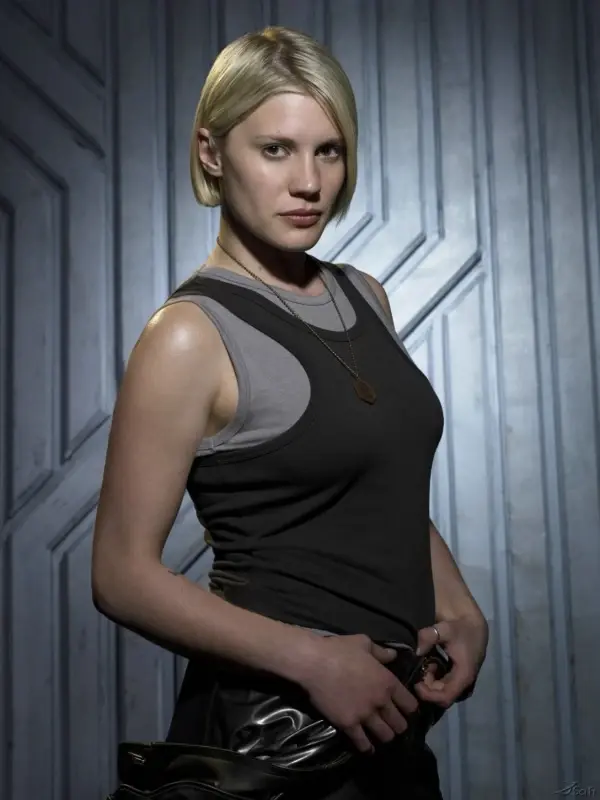
Starbuck redefined what a military sci-fi protagonist could look like on television. Reckless, self-destructive, brilliant in the cockpit and chaotic everywhere else, Kara Thrace is a character defined by contradiction, and Katee Sackhoff's performance leans fully into that mess rather than smoothing it over for easier likability.
What makes Starbuck so compelling is how honestly Battlestar Galactica treats her trauma. Her difficult upbringing, her guilt over past failures, and her complicated relationships with nearly everyone in her orbit are never resolved neatly, and the show consistently lets her make choices that alienate the audience as much as they alienate her crewmates. That refusal to sand down her rough edges is exactly what makes her feel real.
Starbuck's eventual, deeply mysterious arc toward the series' end remains one of the most debated character journeys in sci-fi television history, a testament to how much emotional investment the show managed to build around her across four seasons.
Even years after Battlestar Galactica ended, Starbuck remains a frequent reference point in conversations about how television can build a female action lead without stripping away the flaws and contradictions that make a character feel genuinely human.

6. Din Djarin (The Mandalorian)

Din Djarin proved that a masked, largely silent protagonist could still carry an entire television franchise through sheer physical performance and quiet emotional restraint. Pedro Pascal's work as the Mandalorian relies on posture, small gestures, and vocal tone to convey everything the character can't express through facial expression, and it works remarkably well.
His evolving relationship with Grogu gives the show its emotional core, transforming a stoic bounty hunter into a genuinely devoted father figure over the course of several seasons. That transformation never feels rushed or unearned; it's built patiently through small, specific moments of protectiveness that accumulate into real emotional weight.
Din Djarin's popularity also reflects something important about modern Star Wars storytelling's return to smaller, character-driven stakes after years of galaxy-spanning spectacle. His journey works precisely because it stays personal, grounding the wider Star Wars universe in one man's quiet code of honor.
That grounded quality is also why Din Djarin has resonated across such a wide audience, including many viewers who came to the show with little prior investment in the broader Star Wars mythology, drawn instead by the simple, universal power of his bond with Grogu.
5. Eleven (Stranger Things)

Eleven's arc across Stranger Things charts one of the most affecting coming-of-age stories in recent television, sci-fi or otherwise. Millie Bobby Brown's performance captures a character raised in isolation and trauma slowly learning what friendship, family, and ordinary childhood actually feel like, layered against genuinely high-stakes supernatural conflict.
What makes Eleven so effective is how the show balances her immense psychic power with genuine vulnerability. She's never simply an overpowered plot device; her abilities come at real physical and emotional cost, and her struggle to fit into a normal social world after years of institutional abuse gives the character a grounded humanity that elevates the show's more fantastical elements.
Eleven's popularity has made her one of the defining sci-fi television characters of her generation, and her arc across multiple seasons remains a rare example of a child character allowed to grow, change, and carry real narrative weight without ever being reduced to a simple power fantasy.
That balance has become a genuine model for how modern television handles child protagonists with extraordinary abilities, proving audiences will invest deeply in a young character's emotional journey as much as, or more than, their powers.
4. The Doctor (Doctor Who)

Few characters in television history have proven as durable or as endlessly reinvented as the Doctor. Across dozens of actors and multiple generations of viewers, the character's core has remained remarkably consistent: boundless curiosity, deep compassion, and a genuine horror of violence, wrapped in the body of a time-traveling alien who refuses to carry a weapon.
What makes the Doctor so enduring is the format itself — regeneration allows the character to be reinvented every few years while still carrying centuries of accumulated history and grief. Each actor brings a genuinely different interpretation, from manic energy to weary gravity, and yet the underlying moral code remains recognizable across every version, giving the character a rare narrative flexibility few other sci-fi protagonists can claim.
That flexibility has also allowed the show to explore an unusually wide range of tones and genres under a single premise, from horror to farce to genuine tragedy, all while keeping the character's fundamental identity intact. Few sci-fi shows have managed that kind of sustained reinvention without losing the emotional core that made audiences care about the character in the first place.
The Doctor's insistence on finding non-violent solutions, even against overwhelming odds, has made the character a genuinely unusual protagonist in a genre often built around conflict and combat. That consistent ethical center, sustained across nearly six decades of television, is a large part of why the character remains so beloved.
It also helps explain why the Doctor has crossed generational lines so effectively, remaining a genuinely popular entry point for new, often younger, viewers into science fiction as a genre, decades after the show's original premiere.
3. Jean-Luc Picard (Star Trek: The Next Generation)

Jean-Luc Picard represents a kind of leadership rarely centered in television: thoughtful, diplomatic, and consistently willing to choose conversation over conflict whenever possible. Patrick Stewart's performance gives the character enormous gravitas without ever tipping into coldness, balancing intellectual authority with genuine warmth toward his crew.
Picard's moral rigor became one of Star Trek's defining voices, particularly in episodes that use him to interrogate colonialism, ethics, and the responsibilities of power. His willingness to hold firm to his principles even at significant personal cost gives the character a consistency that makes his rare moments of doubt or failure land with real weight.
The character's return decades later in Star Trek: Picard demonstrated just how much cultural staying power he carries, allowing a new generation of viewers to discover a captain whose model of leadership — patient, principled, deeply humane — remains a genuine rarity in television, sci-fi or otherwise.
Picard's continued relevance also speaks to a broader hunger among audiences for protagonists defined by wisdom and restraint rather than pure action, a quality that has only become more valued as television has grown increasingly saturated with louder, more aggressive genre heroes.
2. James T. Kirk (Star Trek: The Original Series)

James T. Kirk established the archetype that countless sci-fi protagonists have been measured against ever since: bold, charismatic, willing to break the rules when the situation demands it, but grounded by a genuine moral compass underneath the swagger. William Shatner's performance, for all its theatricality, gave Kirk a magnetic screen presence that helped carry Star Trek through its earliest, most uncertain years.
What's often underappreciated about Kirk is how much emotional intelligence sits underneath his more famous impulsiveness. His friendships with Spock and McCoy form one of television's earliest and most enduring examples of a central trio dynamic, and Kirk's willingness to genuinely listen to both of them, even when it means changing his own approach, reveals a character far more thoughtful than his reputation as a brash adventurer suggests.
Kirk's influence on the broader landscape of television leading men is difficult to overstate. Decades of subsequent sci-fi captains and commanders have been built, consciously or not, in direct conversation with the template he established.
That influence is visible in everything from the confident swagger of later action-adventure protagonists to the more nuanced captains who followed him in the Star Trek franchise itself, many of whom exist as direct responses to, or evolutions of, the leadership style Kirk first modeled on television.
1. Spock (Star Trek: The Original Series)

Spock remains, by a wide margin, one of the single most iconic characters in television history, sci-fi or otherwise. Leonard Nimoy's performance turned a half-human, half-Vulcan science officer's constant struggle between logic and emotion into one of the most quietly moving character studies ever put on screen, and that internal tension has never stopped resonating with audiences.
What makes Spock so enduring isn't simply his intelligence or his famous stoicism — it's the genuine emotional complexity the show reveals underneath both. His friendships, particularly with Kirk, carry real depth precisely because Spock has to work so hard to express feelings his Vulcan upbringing has taught him to suppress, and those rare moments when his guard slips remain some of the most affecting scenes in the entire Star Trek franchise.
Spock's cultural footprint extends far beyond Star Trek itself, shaping how television approaches outsider characters who observe humanity from just outside its emotional boundaries.
His influence stretches into countless later characters built around the same central tension — a rational, controlled exterior hiding real depth of feeling underneath. From android characters to alien observers to emotionally repressed humans, that basic Spock template has become one of the most widely borrowed character frameworks in the history of the genre. Nearly six decades after his introduction, he remains the character most frequently cited as the definitive embodiment of what makes great sci-fi television work: using the fantastical to say something genuinely true about being human.
📺 Where to watch: Star Trek, Doctor Who, Battlestar Galactica, and Stranger Things are all available across major streaming platforms.
The Verdict: What Makes A Sci-Fi Character Truly Great
The characters on this list share a common thread despite spanning decades of wildly different shows: every one of them uses their extraordinary circumstances to explore something deeply, recognizably human. Whether it's an android questioning what it means to feel, a time traveler who refuses to fight, or a soldier haunted by trauma she can't outrun, the best sci-fi television has always understood that the genre's real power lies in using impossible worlds to tell honest stories about the people living in them.
💖 If you enjoyed this list, consider donating to support That Love Podcast. 🎧 Listen to more episodes of That Love Podcast here.
💡 You May Also Love

Frequently Asked Questions
Who is considered the greatest sci-fi TV character of all time? Spock from Star Trek: The Original Series is most frequently cited as the definitive sci-fi television character, thanks to his enduring emotional complexity.
Is Eleven from Stranger Things a well-developed character? Yes — her arc is widely praised for balancing immense power with genuine emotional vulnerability across multiple seasons.
Why is Rick Sanchez considered a great character despite being unlikeable? His genius and chaos are consistently tied to genuine, unresolved tragedy, giving the show real emotional stakes beneath its comedy.
What makes the Doctor from Doctor Who such an enduring character? The regeneration format allows continual reinvention while the character's core compassion and nonviolence remain consistent across decades.
Is Seven of Nine still relevant to modern Star Trek? Yes — she returned as a prominent character in Star Trek: Picard, extending her arc decades after Voyager ended.
Who created the archetype for later sci-fi TV captains? James T. Kirk from Star Trek: The Original Series is widely considered the foundational template for later sci-fi leading men.
Is Sarah Connor's TV version different from the films? Yes — The Sarah Connor Chronicles gives the character significantly more psychological depth than her film appearances allowed.
Where can I watch Star Trek: The Original Series? Star Trek: The Original Series is available on Paramount+ in the US.
Where can I watch Doctor Who? Doctor Who streams on Disney+ in most regions outside the UK, and on BBC iPlayer within the UK.
Where can I watch Stranger Things? Stranger Things streams exclusively on Netflix.
Suggested URL Slug: /greatest-sci-fi-tv-characters-ranked
12 Alternative Titles:
The Best Sci-Fi TV Characters Of All Time, Ranked
12 Iconic Sci-Fi Characters Who Defined Television
Ranking Television's Greatest Sci-Fi Protagonists
The Most Beloved Sci-Fi TV Characters, Counted Down
12 Sci-Fi Characters That Changed Television Forever
The Definitive Ranking Of Sci-Fi TV's Best Characters
From Spock To Eleven: Sci-Fi TV's Greatest Characters
12 Sci-Fi TV Characters Everyone Should Know
The Most Iconic Characters In Sci-Fi TV History
Sci-Fi TV's Best Characters, Ranked By A Longtime Fan
12 Sci-Fi Characters Who Redefined The Genre
The Greatest Heroes In Sci-Fi TV History, Ranked
If you're enjoying this blog, check out these other ones: