





12 Disney Movies That Reflect Christian Values

Updated: Aug 4
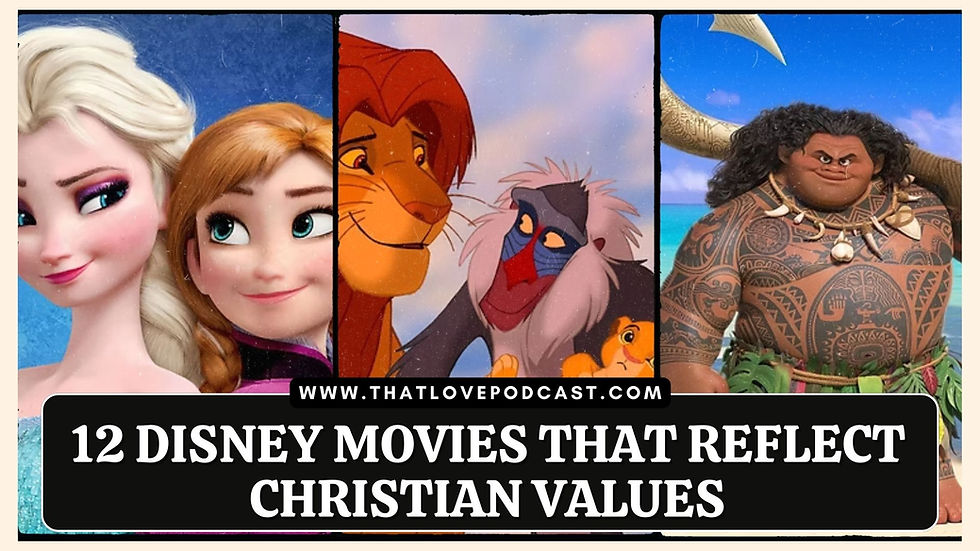
Introduction
In a world where entertainment options are endless, finding content that aligns with faith-based values can sometimes feel like searching for a needle in a haystack. For Christian families, the desire to provide entertainment that is not only high-quality but also spiritually uplifting is paramount. Surprisingly, the House of Mouse—Disney—has a long history of weaving profound moral and spiritual threads into its storytelling tapestry. While not explicitly "Christian" in the genre sense, many classic and modern Disney films resonate deeply with biblical themes of redemption, sacrifice, forgiveness, and the triumph of light over darkness.
In 2026, we are seeing a resurgence of interest on platforms like Pinterest and TikTok for "Mindful Media"—parents and individuals curating watchlists that spark deeper conversations about faith and character. These movies aren't just about magic and princesses; they are parables of truth that can serve as powerful teaching tools. Whether it's a lion laying down his life or a wooden puppet learning the value of truth, these stories mirror the greatest story ever told.
This list curates 12 Disney movies that reflect Christian values, ranked by the depth and clarity of their spiritual parallels. From overt allegories to subtle whispers of the Gospel, these films offer a perfect opportunity for family movie nights that feed the soul as well as the imagination.
If you enjoy our content and want to help us keep sharing stories that matter, please consider supporting us here: https://www.thatlovepodcast.com/donate
You Might Like This
If you enjoyed this, here are more Disney movies with inspirational and spiritual themes:
12. Robin Hood (1973)

Kicking off our list is a classic that often gets overlooked in discussions about faith: Disney's Robin Hood. While the film is a fun, anthropomorphic retelling of the English legend, it features one of the most explicitly Christian characters in the Disney canon—Friar Tuck.
Friar Tuck is not a caricature; he is the moral compass of Nottingham. He is shown ringing the church bells, caring for the poor, and standing up against the tyranny of Prince John. The church in the film is a sanctuary for the oppressed, a place where the mouse sexton and his wife find safety.
The Christian Value: Robin Hood highlights the biblical mandate of charity and caring for "the least of these" (Matthew 25:40). It contrasts the greed of the false king with the sacrificial giving of the community. Friar Tuck’s bravery in defending the church's money (meant for the poor) against the Sheriff of Nottingham is a powerful example of righteous indignation and pastoral protection.
Call to Action: Stream Robin Hood on Disney+.
Check out our latest podcast episodes here: https://www.thatlovepodcast.com/episodes
11. Moana (2016)

At number 11 is the visually stunning Moana. While rooted in Polynesian mythology, Christian viewers often find profound parallels in Moana's journey of calling and identity. The film follows a young girl chosen by the ocean to restore the heart of Te Fiti and save her people from a spreading darkness.
The standout moment for many believers is the scene where the ocean parts for Moana as a toddler, reminiscent of the Red Sea or a baptismal calling. Furthermore, the climax of the film involves Moana confronting a fiery demon not with violence, but with identity affirmation ("I know who you are"), which restores the demon to its true, peaceful nature.
The Christian Value: This film speaks to the concept of Calling and Vocation. Just as Samuel was called as a boy, Moana hears a voice calling her to a greater purpose beyond her comfort zone. It also touches on the power of restoration—seeing the "image of God" (or the true self) buried beneath anger and pain, and restoring it through love.
10. The Jungle Book (1967)

Ranking at number 10 is the swinging, jazzy classic The Jungle Book. It makes this list for a very specific, scriptural reason. In a sombre moment after Baloo the bear seemingly sacrifices his life to save the man-cub Mowgli from the tiger Shere Khan, Bagheera the panther eulogizes him.
Bagheera quotes Jesus directly from the Gospel of John: "Greater love hath no one than this, that he lay down his life for his friend" (John 15:13). It is one of the few instances where Scripture is quoted verbatim in a Disney animated feature.
The Christian Value: Beyond the direct quote, the film illustrates the concept of Sacrificial Friendship. Baloo, who initially wanted to keep Mowgli in the jungle for selfish reasons (to be his "bear cub"), eventually risks everything to ensure Mowgli's safety. It teaches children that true love is action-oriented and selfless.
9. Sleeping Beauty (1959)

Sleeping Beauty is a visual masterpiece that presents a stark, almost medieval battle between good and evil. From the moment Maleficent ("Mistress of All Evil") appears in a burst of green fire, the stakes are set. She is a clear allegorical figure for Satan, cursing the child and transforming into a dragon to prevent the "prince of peace" from awakening the kingdom.
Prince Phillip, armed with the "Sword of Truth" and the "Shield of Virtue" (Ephesians 6 armor references), must battle through a forest of thorns to save the princess.
The Christian Value: The film is a powerful allegory for Spiritual Warfare. It shows that evil is real and powerful, but that righteousness, equipped with truth and virtue, will ultimately triumph. The awakening of Aurora by "true love's kiss" can be seen as a metaphor for the awakening of the soul from the sleep of death through Christ's love.
Just as Sleeping Beauty explores the theme of awakening from a death-like sleep, this novel delves into the spiritual rebirth of a heart after tragedy.
8. Cinderella (1950/2015)

Whether you watch the animated classic or the live-action remake, the core of Cinderella is a beautiful reflection of Christian virtue. Cinderella is abused, neglected, and enslaved in her own home, yet she refuses to let bitterness take root in her heart. She maintains a spirit of kindness and hope.
The 2015 live-action version explicitly gives her the mantra: "Have courage and be kind." This reflects the biblical instruction to "bless those who curse you" (Luke 6:28).
The Christian Value: Cinderella represents Grace and Exaltation. She cannot save herself; she needs a savior (the Fairy Godmother/Prince). Her transformation from rags to riches is a picture of the believer's transformation—clothed in righteousness and invited to the wedding feast of the Lamb. It teaches that God opposes the proud but gives grace to the humble.
Call to Action: Introduce your family to this story of grace on Disney+.
7. Tangled (2010)

Tangled, the retelling of Rapunzel, lands at number 7. This film is rich with imagery of light and darkness. Rapunzel is a lost princess, stolen from her royal parents and kept in a tower by a woman who claims to be her mother but only wants to exploit her gifts. Rapunzel yearns to see the "floating lights" that appear on her birthday—lights sent by her true parents to guide her home.
The Christian Value: This is a story of The Lost Child. It mirrors humanity's separation from God (the King) and our entrapment by the lies of the enemy. The lantern scene is a beautiful metaphor for the Holy Spirit guiding us back to our true home. Furthermore, Flynn Rider's character arc is one of repentance and redemption—changing his name (identity) and sacrificing his life for another.
You Might Like This
If you enjoyed this, here are more Disney movies with inspirational and spiritual themes:
6. Frozen (2013)

Frozen became a global phenomenon for its music, but its theological undertones are surprisingly deep. The film subverts the "true love's kiss" trope. Anna, the Christ-figure in the story, sacrifices her own life to save her sister Elsa, who has cursed the land with an eternal winter (sin/death).
Elsa represents the law/fear—trying to conceal, don't feel, be perfect. Anna represents grace. When Anna steps in front of the sword to save Elsa, she freezes to death, only to be resurrected because her sacrifice constituted an "act of true love."
The Christian Value: Substitutionary Atonement. Anna dies so that Elsa (the one who caused the problem) can live. It is a clear picture of how love thaws a frozen heart. The film teaches that love isn't just romance; it's sacrifice. This aligns with John 15:13, echoing the themes found in The Jungle Book but executing them as the central plot device.
Dive deeper into the definitions of love with our podcast series, exploring how real love differs from the fairy tale version.
5. The Hunchback of Notre Dame (1996)

Perhaps the most overtly religious film in the Disney canon, The Hunchback of Notre Dame takes place almost entirely within or around a cathedral. It deals with heavy themes of lust, judgment, and hypocrisy versus true piety. The villain, Frollo, is a religious zealot who believes he is righteous while committing evil. In contrast, Esmeralda, an outcast, prays the hauntingly beautiful song "God Help the Outcasts."
The Christian Value: True Religion vs. Legalism. The film starkly contrasts the Pharisaical attitude of Frollo with the compassionate heart of Quasimodo and Esmeralda. It emphasizes that God looks at the heart, not the outward appearance (1 Samuel 16:7), and that the church is meant to be a sanctuary for the broken and persecuted.
4. Pinocchio (1940)

Pinocchio is a profound morality play. It tells the story of a wooden puppet who must prove himself "brave, truthful, and unselfish" to become a real boy. He is given a conscience—Jiminy Cricket—to guide him between right and wrong. Pinocchio faces temptation (Pleasure Island), falls into sin, and is eventually swallowed by a giant whale (Monstro).
The Christian Value: The parallels to the story of Jonah are undeniable. Pinocchio is swallowed by a whale and spat out onto dry land—a death and resurrection motif. Ultimately, Pinocchio dies saving his father, Geppetto, from the ocean. Because of this sacrificial act, he is resurrected and transformed into a real boy. It is a story of Sanctification—the process of becoming who we were truly made to be through obedience and love.
3. Snow White and the Seven Dwarfs (1937)

At number 3 is the film that started it all. Walt Disney was a man of faith, and it shows in his first feature. Snow White is depicted as a gentle servant leader. Even when forced into scullery maid duties, she remains joyful.
The most explicitly Christian moment occurs when Snow White sends the dwarfs off to work and then kneels by her bedside to pray. She asks God to "bless the seven little men who have been so kind to me."
The Christian Value: Prayer and Servant Leadership. Snow White embodies the beatitude "Blessed are the meek, for they will inherit the earth." She serves others, prays for her friends, and resists the temptation of the evil queen (until the apple, representing the Fall). Her resurrection by love's first kiss is the classic fairy tale echo of the Gospel.
2. The Lion King (1994)

The runner-up is The Lion King, a film that is practically a retelling of the Parable of the Prodigal Son mixed with Hamlet. Simba, the son of the King, runs away from his father's kingdom after being deceived by the enemy (Scar) into thinking his sin is unforgivable. He lives a life of "Hakuna Matata" (hedonism/ignoring responsibility) in the wilderness.
He is eventually convicted by the spirit of his father, who tells him, "You have forgotten who you are, and so have forgotten me."
The Christian Value: Identity and Repentance. Simba must remember his identity as the King's son to defeat the usurper and restore the kingdom from a wasteland to a paradise. It is a powerful message for Christians about not letting shame drive us into hiding, but remembering our royal identity in Christ to bring life to the world.
You Might Like This
If you enjoyed this, here are more Disney movies with inspirational and spiritual themes:
1. The Chronicles of Narnia: The Lion, the Witch and the Wardrobe (2005)

Taking the top spot is the only film on this list that is an intentional Christian allegory. Produced by Walt Disney Pictures and Walden Media, this adaptation of C.S. Lewis’s classic is the gold standard for faith-based family films.
In Narnia, it is "always winter, but never Christmas" due to the White Witch’s curse. Edmund, one of the Pevensie children, betrays his family for Turkish Delight (sin/temptation). According to the Deep Magic, his life is forfeit to the Witch. However, Aslan the Lion (the Christ figure) offers himself in Edmund's place. Aslan is humiliated, shaved, and killed on the Stone Table, only to rise again because of a "Deeper Magic from before the dawn of time."
The Christian Value: The Gospel. It is the story of Jesus. Aslan is not just a symbol; in the context of the story, he is the Narnian incarnation of Christ. The film covers the Fall (Edmund), the Atonement (Aslan's death), and the Resurrection. It is the most direct, powerful, and beautiful reflection of Christian values in the Disney library.
Call to Action: Experience the magic and the message on Disney+.
Don't forget to listen to our podcast for more family entertainment reviews: https://www.thatlovepodcast.com/episodes
Conclusion
Disney movies have shaped the childhoods of generations, but looking at them through the lens of faith reveals a deeper layer of magic. These stories remind us that good ultimately triumphs over evil, that sacrifice is the highest form of love, and that no one is beyond the reach of redemption.
Whether you are watching The Lion King with your toddlers or discussing the allegory of Narnia with your teens, these films offer a bridge to talk about the values that matter most. So pop some popcorn, gather the family, and let these stories point you toward the Truth.

If you enjoyed this list and want to support our work, please consider donating here: https://www.thatlovepodcast.com/donate
You Might Like This
If you enjoyed this, here are more Disney movies with inspirational and spiritual themes:
Frequently Asked Questions (FAQs)
1. Is The Chronicles of Narnia considered a Disney movie? Yes, the 2005 film The Lion, the Witch and the Wardrobe and its sequel Prince Caspian were co-produced and distributed by Walt Disney Pictures.
2. Does Disney explicitly make Christian movies? Generally, no. Disney makes movies for a general audience. However, many of their classic films draw heavily from Western literary traditions which are steeped in biblical morality and symbolism.
3. What is the most religious Disney movie? The Hunchback of Notre Dame is widely considered the most religious due to its setting (a cathedral), characters (archdeacon, judge), and themes of sin, damnation, and prayer.
4. Are there Bible verses in Disney movies? Yes, The Jungle Book (1967) features a direct paraphrase of John 15:13 ("Greater love hath no one...").
5. Is the "Fairy Godmother" a Christian concept? Not directly, but in Cinderella, she acts as an agent of grace—providing help that is undeserved but desperately needed, often interpreted by Christian viewers as a type of divine intervention.
6. Can I use these movies for Sunday School lessons? Absolutely. Narnia is perfect for explaining the Atonement. The Lion King illustrates the Prodigal Son. Pinocchio explains conscience and temptation.
7. Why do so many Disney movies have resurrection themes? The "sleeping death" and subsequent awakening by "true love's kiss" is a common fairy tale trope that echoes the Christian belief that love conquers death.
8. Is Soul a Christian movie? Soul deals with the afterlife and the "Great Before," but its theology is more metaphysical/jazz-inspired than biblical. It sparks good conversations but isn't a direct reflection of Christian doctrine like Narnia.
9. What values does Frozen teach? Frozen teaches that familial love is as powerful as romantic love, and that self-sacrifice is the ultimate act of love—a deeply Christian concept.
10. Where can I watch all these movies? All the movies listed in this article are available to stream on Disney+.
External Resource
Movieguide - A family guide to movies and entertainment from a Christian perspective.


.jpg)







.jpg)


Comments