




12 Best Despicable Me Characters Ranked

Updated: Sep 27
There is a reason the Despicable Me franchise is the highest-grossing animated franchise of all time — and it is not the plot twists.
It is the characters. From a bald, big-nosed former supervillain who speaks in an indeterminate Eastern European accent and accidentally becomes the world's greatest dad, to a tiny yellow henchman whose entire personality fits inside a single pair of overalls, the characters of Despicable Me have lodged themselves permanently into the cultural consciousness in a way that very few animated franchises ever achieve.
You already love these characters. You have seen the movies. You have bought the merchandise. You have quoted the lines. You have definitely gone "ba-na-na" in someone's general direction at least once. And with Despicable Me 4 bringing in nearly a billion dollars at the worldwide box office in 2024, the franchise is very clearly not going anywhere.
But which characters are actually the best? Not just the most popular, not just the cutest, but the most well-crafted, most funny, most genuinely memorable characters across all six films?
You Might Like This
If you love Gru, the Minions, Agnes, Vector, and the rest of the Despicable Me universe, these related animation rankings are perfect for continuing the franchise deep dive:
Listen After You Watch
Love funny characters, unlikely heroes, and stories with plenty of heart? Explore original comedy, romance, and drama on That Love Podcast.
This ranking covers the full franchise — from the original 2010 film through Despicable Me 4 — and includes both heroes and villains, main cast and supporting players, because some of the best characters in this universe are not the ones getting the most screen time.
We go from number twelve all the way down to the one character who the entire franchise was always built around — and who, more than any other animated character of the last fifteen years, proves that the most unexpectedly beautiful stories in cinema come from the places you least expect them.
Let's get into it 👇

💛 Love this kind of content? Help keep it going: Support That Love Podcast
If you love this, check out: 12 Best Despicable Me Moments That Made the Franchise Iconic
#12 — Vector (Victor Perkins)

Voiced by Jason Segel in the original 2010 film, Vector — real name Victor Perkins — is the antagonist of the franchise's debut entry, and he is one of the most purely entertaining first-film villains in animated movie history.
Vector's entire comedic identity is built on the contrast between his self-image and his reality. He thinks he is the next great supervillain. He has stolen the Great Pyramid of Giza. He has a compound protected by a shark, a piranha moat, and a security system so advanced that Gru — the most experienced criminal on the planet — requires the help of three small children to break through it. He dresses in a full orange tracksuit and refers to himself as someone who combines "direction and magnitude," which is technically the definition of a vector in physics, and which he delivers with the pride of someone who has just coined the greatest supervillain name in history.
The montage of Gru's repeated, catastrophic failures to penetrate Vector's security — blown up by heat-seeking missiles, attacked by the shark, outmanoeuvred at every turn — is one of the original film's best sequences, and Vector's smug commentary throughout is perfect.
His ending — stranded on the moon, presumably for the rest of his animated existence — remains one of the most quietly hilarious fates any franchise villain has ever received.
Where to watch: Stream Despicable Me on Netflix or Peacock in the US. Own the full franchise digitally on Amazon Prime Video.
🎙️ Stream something equally entertaining — That Love Podcast is live now: thatlovepodcast.com/episodes
#11 — Balthazar Bratt

Voiced by the comedy genius Trey Parker — co-creator of South Park and The Book of Mormon — Balthazar Bratt is the villain of Despicable Me 3, and the sheer joy Parker brings to the role is infectious from his very first scene.
Bratt's backstory is one of the franchise's most brilliantly absurd premises. He was, as a child, the star of a wildly popular 1980s television show in which he played a young supervillain named Evil Bratt. When the show was cancelled due to his hitting puberty and losing his child-star appeal, Bratt snapped completely — and spent the following thirty years becoming an actual supervillain, still dressed in his 80s show costume, still relying on 80s pop music as his primary battle soundtrack, and carrying a deeply personal grudge against the entire entertainment industry for ruining his career.
Everything about Bratt's villain toolkit is nostalgic, ridiculous, and somehow completely threatening: the sticky bubble gum gun, the shoulder pad rocket boosters, the cassette tape grenades, and the dance moves deployed as a genuine combat technique to the tune of Michael Jackson songs. His scheme — using a giant diamond to power a massive robot and destroy Hollywood — is so specifically personal and so elaborately petty that it wraps all the way back around to genuinely impressive.
Parker's vocal performance is a masterclass in committed absurdity. He plays Bratt as someone who is entirely serious, which is precisely what makes him so funny.
Where to watch: Stream Despicable Me 3 on Peacock or Netflix in the US.
#10 — Scarlet Overkill

Voiced by Sandra Bullock in the 2015 Minions spin-off, Scarlet Overkill holds the distinction of being the franchise's first major female villain — and she uses every moment of that status to deliver one of the most charismatic, most stylishly designed antagonists in the entire Illumination universe.
Scarlet's appeal is immediate and specific. She is brilliant, ruthless, obsessively ambitious, and completely self-made — a former nobody who climbed to the absolute top of the global supervillain community through sheer determination and impeccable fashion. Her goal in the Minions film — to steal the Crown Jewels and claim the throne of England — is both magnificent in its audacity and totally on brand for a character who simply decided that being queen would suit her.
The relationship between Scarlet and her inventor husband Herb (voiced by Jon Hamm, perfectly cast) is one of the franchise's most entertaining supporting dynamics. Herb, who designs most of Scarlet's weapons, is clearly besotted with his wife to the point of happy subservience — and their domestic partnership amid a life of international crime creates a texture that most animated villain duos never bother to develop.
Scarlet's fury when the Minions accidentally succeed in making Kevin king of England before she gets the chance is genuinely hilarious, and Sandra Bullock delivers the escalating rage with perfect comic timing.
Where to watch: Stream Minions on Peacock or Netflix in the US.
You'll also love: 20 Best Animated Movies of All Time You Need to Watch
You Might Like This
If you love Gru, the Minions, Agnes, Vector, and the rest of the Despicable Me universe, these related animation rankings are perfect for continuing the franchise deep dive:
Listen After You Watch
Love funny characters, unlikely heroes, and stories with plenty of heart? Explore original comedy, romance, and drama on That Love Podcast.
#9 — Dr. Nefario

Voiced by Russell Brand across the franchise, Dr. Nefario is Gru's ancient, partially deaf, motorised-wheelchair-riding chief scientist — and he is the source of some of the most consistently reliable comedy in the entire franchise.
Nefario's defining comedic trait is his hearing loss, which functions less as a disability and more as a filter through which reasonable requests pass and emerge as something completely different. The most famous example — and one of the franchise's most quoted moments — comes when Gru asks Nefario to build him a dart gun. What arrives is a fart gun. Nefario's calm, slightly offended defence of the fart gun's practical applications, and Gru's resigned acceptance of the situation, is exactly the kind of understated comedy the films do brilliantly.
Beyond the hearing gags, Nefario is a genuinely important character in the franchise's emotional architecture. He is Gru's longest-standing professional partner — a man who has been building weapons for a supervillain long enough to develop genuine loyalty and, eventually, a complicated form of paternal regard for the whole family. His brief defection to a jam company ("the benefits were better") and his eventual return to help save the day in Despicable Me 2 is one of the franchise's more quietly satisfying character moments.
Where to watch: Stream Despicable Me and Despicable Me 2 on Peacock or Netflix in the US.
You Might Like This
If you love Gru, the Minions, Agnes, Vector, and the rest of the Despicable Me universe, these related animation rankings are perfect for continuing the franchise deep dive:
Listen After You Watch
Love funny characters, unlikely heroes, and stories with plenty of heart? Explore original comedy, romance, and drama on That Love Podcast.
#8 — Dru Gru

Also voiced by Steve Carell in Despicable Me 3, Dru Gru is Gru's long-lost twin brother — and the decision to make him Gru's complete physical opposite is one of the franchise's most inspired choices. Where Gru is bald, Dru has a magnificent head of flowing white hair. Where Gru is pragmatic and increasingly domestic, Dru is wildly enthusiastic, recklessly optimistic, and absolutely desperate to be a proper supervillain.
The fraternal dynamic between Gru and Dru is the emotional engine of Despicable Me 3, and Carell's ability to play two completely distinct characters — sharing vocal DNA but inhabiting entirely different personalities — is an underappreciated piece of voice acting work. Dru's breathless admiration for the brother he has never met, and Gru's complex mix of exasperation and growing affection in return, creates a warmth that grounds the film's more chaotic action sequences.
Dru also represents something genuinely interesting thematically: the version of Gru that never got reformed. He still wants the villain life — the gadgets, the schemes, the dramatic capes — and watching him try to drag his increasingly reformed brother back into that world creates a productive tension that the film handles with more subtlety than it gets credit for.
The film's closing reveal — that Dru has escaped with several of Gru's Minions to pursue villainy on his own — set up a story thread that fans are still waiting to see fully resolved.
Where to watch: Stream Despicable Me 3 on Peacock or Netflix in the US.
🎙️ Halfway through the list — and things are about to get seriously good. Stream That Love Podcast while you keep reading: thatlovepodcast.com/episodes
#7 — Edith Gru

Voiced by Dana Gaier across the franchise, Edith Gru is the middle sister — and arguably the most underappreciated of the three girls in the cultural conversation around the franchise. Margo gets the responsibility arc. Agnes gets the adorability spotlight. Edith gets a pink hat, a black belt in ambition, and absolutely no filter whatsoever.
Edith is the franchise's chaos agent. In a family defined by love and unexpected warmth, Edith is the one who will crawl into a coffin to see what it is like, attempt to defeat Gru's various weapons of mass destruction out of pure curiosity, accidentally disintegrate Agnes's beloved unicorn toy, and respond to almost every situation with either a weapon or a shrug. She is, in many ways, the most realistically kid-like of the three sisters — a child who is not particularly interested in the emotional journey happening around her but is extremely interested in anything involving explosions.
Her ninja subplot in Despicable Me 3, where she discovers a genuine talent for martial arts, is one of the film's best running jokes — and the commitment with which she pursues it, entirely independent of any adult supervision, is perfectly in character.
The franchise has never quite given Edith the dedicated character development that her sisters receive, which is both a mild creative disappointment and a testament to the fact that she is funny enough in her current form to justify her screen time entirely.
Where to watch: Stream the Despicable Me franchise on Peacock or Netflix in the US.

#6 — Margo Gru

Voiced by Miranda Cosgrove, Margo Gru is the eldest of the three sisters and the character who carries the most narrative weight in the original film. Where Agnes provides the emotional centrepiece and Edith provides the comedy, Margo provides the scepticism — and it is her scepticism that makes her eventual trust in Gru so meaningful.
Margo is thirteen, sensible, quietly watchful, and very much aware that she and her sisters have been let down by adults before. Her wariness about Gru is not stubbornness or ingratitude — it is the entirely reasonable protective instinct of a child who has been an orphan long enough to know that not every adult who shows interest has their best interests at heart.
Her slow warming to Gru — the progression from guarded assessment to genuine affection — is the emotional spine of the original film. The moment when she hugs him, after Gru risks everything to save the three girls from Vector, is the scene the whole film was building toward. Margo's trust, because it was the hardest to earn, means the most.
Her subplot in Despicable Me 2 — a brief, disastrous crush on Antonio Perez, who turns out to be the son of the villain El Macho — gives her a rare moment of genuine teenage vulnerability, handled with enough humour and warmth to avoid being heavy.
Where to watch: Stream the Despicable Me franchise on Peacock or Netflix in the US.
#5 — Lucy Wilde
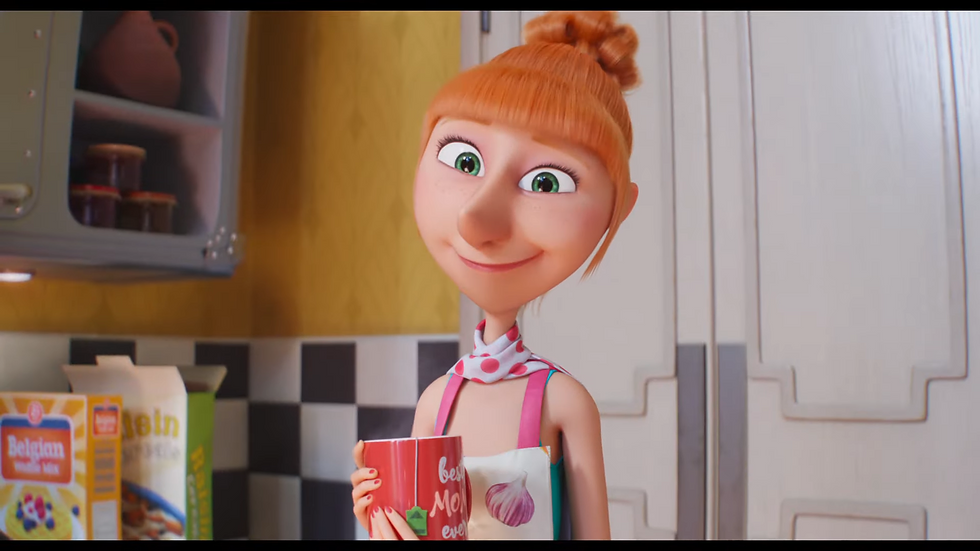
Voiced by Kristen Wiig in Despicable Me 2 and subsequent entries, Lucy Wilde is the franchise's most joyfully chaotic good character — a Anti-Villain League agent whose enthusiasm for combat, surveillance, and very unusual gadgets is matched only by her complete emotional transparency in every situation.
Lucy is introduced as a professional operative who tranquillises Gru with a lipstick taser and deposits him in a submarine, and she never really stops being that person even as she falls in love, gets married, and becomes a mother. The specific energy she brings to both parts of her identity — competent agent and warmly chaotic human being — is what makes her such a vital addition to the franchise.
What makes Lucy particularly valuable to the series is the way she changes its emotional temperature. Before Lucy, the franchise was about Gru becoming a father. With Lucy, it becomes about Gru building a family — and the distinction matters. She is not just a love interest. She is a full participant in the chaos, a stepmother who earns her place in the girls' hearts by being genuinely, uncalculatedly herself, and a partner to Gru who matches his energy completely while possessing entirely different strengths.
Kristen Wiig's voice performance is a masterclass in playing sincerity so absolute it becomes its own kind of comedy. Lucy is never in on the joke — which is precisely why she is always the funniest person in the scene.
Where to watch: Stream Despicable Me 2 on Peacock or Netflix in the US. Own digitally on Amazon Prime Video.
You'll also love: 12 Best Animated Movies to Watch With Your Family in 2025
You Might Like This
If you love Gru, the Minions, Agnes, Vector, and the rest of the Despicable Me universe, these related animation rankings are perfect for continuing the franchise deep dive:
Listen After You Watch
Love funny characters, unlikely heroes, and stories with plenty of heart? Explore original comedy, romance, and drama on That Love Podcast.
#4 — The Minions (Kevin, Stuart, Bob and the collective)

Voiced by director Pierre Coffin across all films, the Minions are the most successful supporting characters in animated movie history — and the fact that they have their own billion-dollar spin-off franchise is merely the commercial confirmation of something audiences understood from the very first film: these tiny yellow creatures are endlessly, inexhaustibly funny.
The genius of the Minions as a collective character is the tension between their apparent simplicity and their actual complexity. They look like yellow Tic Tacs with goggles. They speak an invented language — Minionese — that blends Spanish, French, English, Italian, and completely invented sounds into a vocabulary that is somehow always comprehensible in context. They are completely devoted to Gru (and before him, historically, to the most impressive villain they could find). And they are, as a group, approximately as sensible as a labrador puppy given access to a fireworks factory.
Individually, Kevin, Stuart, and Bob carry the Minions franchise's solo films on their own distinct personalities. Kevin is responsible and goal-oriented by Minion standards. Stuart is easily distracted and musically inclined. Bob is tiny, carries a teddy bear named Tim, and was briefly crowned King of England — which he handled with the appropriate gravitas of a being who does not fully understand what a king is.
The Minions as a collective comedy device works because they operate as pure id — they want what they want (bananas, fun, the approval of their chosen villain), they pursue it with absolute sincerity, and the world bends into chaos around them. They have no malice. They have no agenda. They are simply, unstoppably themselves.
Where to watch: Stream Minions and Minions: The Rise of Gru on Peacock or Netflix in the US.
🎙️ One more to go before the top three. Stream That Love Podcast right now — your ears deserve it: thatlovepodcast.com/episodes
#3 — Agnes Gru

Voiced by Elsie Fisher in the original trilogy and Madison Skyy Polan in Despicable Me 4, Agnes Gru is the youngest of the three sisters, and she is the emotional heart of the entire Despicable Me franchise.
Every major emotional breakthrough in Gru's arc passes through Agnes first. She is the first of the girls to love him unconditionally — not because she is naive, but because she has an extraordinary capacity for love that no amount of cold behaviour from Gru can diminish. She offers him the girls' piggy bank when she sees he is sad. She wants him to read her bedtime stories and means it. When Gru tries to keep her at a distance, Agnes refuses the distance entirely.
The unicorn scene — Agnes's reaction to winning a stuffed unicorn at the amusement park — is one of the most famous moments in the franchise. Her response is so intensely, purely joyful that it functions as a kind of emotional reset for the entire film. We needed to see what Gru was protecting himself from feeling. Agnes shows us.
She is also, across five films, consistently and effortlessly hilarious. The way she screams. The way she chases Kyle the "dog." Her absolute certainty that a goat is a unicorn in Despicable Me 4 and her complete refusal to be dissuaded from this belief — these moments work because they come from a character whose joy is genuine and therefore infectious.
Agnes Gru is the reason Gru became the character he became. She is the reason the whole story works.
Where to watch: Stream the Despicable Me franchise on Peacock or Netflix in the US.
#2 — The Minions' Collective King: Bob

Bob deserves his own entry entirely separate from the broader Minions collective — because Bob is not simply a Minion. Bob is a phenomenon.
The smallest of the three protagonist Minions in the 2015 film, Bob is defined by his mismatched eyes (one green, one brown), his attachment to his teddy bear Tim, and a sweetness so absolute that even the most hardened animated movie viewer tends to melt in his presence. He is the baby of the group — enthusiastic, innocent, and deeply moved by everything that happens around him — and the film's decision to make him the accidental King of England is one of the most inspired comic choices in the franchise's history.
The image of Bob in full royal regalia — tiny, overwhelmed, holding Tim with one hand and clutching a sceptre with the other — is one of the most beloved images the franchise has ever produced. His brief reign, his genuine attempt to govern with kindness and a complete lack of relevant experience, and his tearful abdication when he understands what the crown means and what needs to happen, is somehow both hilarious and surprisingly touching.
Bob's recurring trend of inspiring enormous affection in everyone he encounters — adults, villains, international dignitaries — functions as the franchise's gentle thesis: that genuine sweetness, even when completely oblivious to its own power, changes the rooms it enters. Bob does not try to be loveable. He simply is. And that, it turns out, is irresistible.
Where to watch: Stream Minions on Peacock or Netflix in the US.
#1 — Gru (Felonious Gru)

Voiced across all six films by Steve Carell with an accent that no linguist has ever been able to definitively place geographically, Felonious Gru is the greatest character the Despicable Me franchise has ever produced — and one of the greatest characters in the history of animated cinema.
The premise of Gru's character is, on paper, an impossible one. He is introduced as the world's greatest supervillain: a man whose stated life goal is to steal the moon. He is bald, joyless, surrounded by an army of yellow henchmen, and entirely contemptuous of children. He plans to adopt three orphan girls specifically to use them as tools in his scheme, fully intending to return them to the orphanage when they are no longer useful.
Everything that follows is the story of that plan failing — and of Gru failing better than he has ever failed at anything in his life.
Carell's voice performance is one of the great pieces of sustained animated acting in the genre's history. The accent — part Russian, part Hungarian, part entirely invented — gives Gru a specificity that makes him instantly recognisable. The pomposity is real, the coldness is real, and the slow, reluctant, completely convincing warmth that emerges as his daughters break through every defence he has constructed is equally real.
The moment in the original film when Gru reads the girls the bedtime story of Sleepy Kittens — doing the voices, leaning into it despite himself, then catching himself leaning into it and trying to stop — is as perfect a piece of character comedy as animated films have ever produced. He does not want to enjoy it. He does not want to care. He cares.
Across four mainline films, Gru transforms from villain to father to AVL agent to husband to father of four — and Steve Carell makes every transition feel entirely earned. The comedy never leaves him: Gru in Despicable Me 4 is still pompous, still prone to catastrophic overconfidence, still talking to his Minions like a general addressing troops for a moon heist rather than a dad dealing with school pickups. But underneath it, the love is absolute and completely unconditional.
Gru is what happens when the universe takes the hardest possible exterior and sends three small girls to knock on it every day until it opens. He is proof that the most unexpected people make the most extraordinary parents. And he is, without any serious competition, the greatest character this franchise has ever produced.
Banana.
Where to watch: Stream the complete Despicable Me franchise on Peacock or Netflix in the US. Own all six films digitally on Amazon Prime Video.
You Might Like This
If you love Gru, the Minions, Agnes, Vector, and the rest of the Despicable Me universe, these related animation rankings are perfect for continuing the franchise deep dive:
Listen After You Watch
Love funny characters, unlikely heroes, and stories with plenty of heart? Explore original comedy, romance, and drama on That Love Podcast.
Conclusion
The Despicable Me franchise has built something genuinely extraordinary across six films and fifteen years — a universe populated by characters so specifically crafted and so brilliantly performed that audiences of all ages return to them again and again.
Whether your favourite is the chaotic joy of the Minions, the heartbreaking sweetness of Agnes and her fluffy unicorn, the surprising emotional depth of Gru and his daughters, or the magnificent pettiness of Vector stuck on the moon — these characters have earned their place in animated cinema history.

The franchise is still growing. More films are coming. And wherever it goes next, the characters who started it all will be right there with it — because the best of them are not just memorable. They are genuinely loved.
💛 Enjoyed this article? Support the work behind it: Donate to That Love Podcast
🎙️ Stream That Love Podcast — stories as warm and funny as your favourite Despicable Me moment: thatlovepodcast.com/episodes
💡 You May Also Love
If you're enjoying this blog, check out these other ones:
❓ Frequently Asked Questions
1. Who is the most popular Despicable Me character of all time? Gru is consistently ranked as the greatest character in the franchise by critics and fan polls, but the Minions — particularly the iconic trio of Kevin, Stuart, and Bob — are arguably the most culturally widespread, having spawned their own billion-dollar spin-off franchise and becoming one of the most recognisable character designs in pop culture history.
2. Who voices Gru in the Despicable Me franchise? Gru is voiced by Steve Carell across all six films in the franchise — Despicable Me (2010), Despicable Me 2 (2013), Minions (2015, brief appearance), Despicable Me 3 (2017), Minions: The Rise of Gru (2022, brief appearance), and Despicable Me 4 (2024). Carell also voiced Gru's twin brother Dru in Despicable Me 3.
3. Who voices the Minions? The Minions are voiced by Pierre Coffin, the co-director of the original Despicable Me films, across the entire franchise. Coffin voices all of the Minions, including Kevin, Stuart, and Bob, speaking in the invented Minionese language that blends fragments of real languages with entirely original sounds.
4. Is the Despicable Me franchise the highest-grossing animated franchise ever? Yes. As of 2024, the Despicable Me franchise — which includes the main Despicable Me films, the Minions spin-offs, and associated short films — is the highest-grossing animated franchise of all time, having earned over four billion dollars at the global box office. Despicable Me 4, released in July 2024, earned nearly one billion dollars alone.
5. Who is the best villain in Despicable Me? Fan opinion is divided between Vector (for nostalgic affection), Balthazar Bratt (for comedic brilliance), and Scarlet Overkill (for style and cultural impact). Balthazar Bratt, voiced by Trey Parker, is frequently cited by critics as the franchise's most entertainingly written antagonist, while Scarlet Overkill earns particular praise for being the franchise's first major female villain and for Sandra Bullock's voice performance.
6. What is Agnes's famous quote about the unicorn in Despicable Me? Agnes famously screams that the toy unicorn is "so fluffy" upon winning it at the amusement park. The reaction — a child overcome by pure, total joy at the sight of a stuffed animal — became one of the most quoted and memed moments in the franchise's history and is one of the most beloved scenes in the original 2010 film.
7. Where can I stream all the Despicable Me movies? The Despicable Me franchise is available on Peacock and Netflix in the United States. Individual films are also available to own digitally on Amazon Prime Video, Apple TV, and Google Play. Availability varies by region internationally.
8. Does Gru have a real accent in Despicable Me? Gru's accent in the films is deliberately indeterminate — Steve Carell has described it as inspired by a blend of various Eastern European accents, and no specific nationality is assigned to the character. The vague, unplaceable quality of the accent is intentional and contributes to Gru's slightly alien quality as a character.
9. What happened to Vector at the end of Despicable Me? Vector is accidentally left stranded on the moon at the end of the original Despicable Me (2010), when the shrink ray wears off and the moon returns to its normal size while he is standing on it. He has not had a significant role in any subsequent film, though he makes a brief appearance as one of several villains in the Despicable Me 4 finale.
10. Who is Despicable Me 4's villain? The main villain of Despicable Me 4 (2024) is Maxime Le Mal, voiced by Will Ferrell — a supervillain with a cockroach obsession and a grudge against Gru that forces the whole family into witness protection. His partner Valentina is voiced by Sofía Vergara. The film also introduced Gru Jr., Gru and Lucy's infant son, as a new central character.
For complete character profiles, voice actor credits, and franchise history, visit the Despicable Me Wiki on Fandom. For streaming links and all six films in order, check Peacock or Netflix.

.jpg)



.jpg)


