






9 Best Black Panther Villains in Marvel History, Ranked

Introduction
The best Black Panther villains do not simply attack Wakanda with bigger weapons. They challenge the nation’s ideas about secrecy, royalty, tradition, identity, and justice. Some are outsiders who want vibranium. Some are rivals from within Wakanda. Others are powerful figures from Marvel history whose conflicts with the Black Panther have continued across comic-book eras. Together, they make T’Challa’s world richer because every enemy reveals a different vulnerability.
A memorable villain should force the hero to make a choice. Black Panther’s strongest antagonists make T’Challa question whether a peaceful tradition is actually fair, whether a king can protect his people without protecting everyone, and whether revenge can ever repair a broken family. The conflict is often political before it becomes physical. A throne, a border, a secret, or an old betrayal can matter as much as a punch.
This ranking considers villains from the MCU and Marvel Comics, while making clear when a character’s greatest impact belongs to one medium. The list weighs threat level, emotional connection, ideology, history with the Black Panther, visual identity, and lasting popularity. It also recognizes that not every antagonist is evil in the same way. Some are conquerors. Some are wounded revolutionaries. Some are criminals whose chaos exposes the weaknesses of the heroes around them.
💡 You May Also Love
Whether you are searching for the best Black Panther villains, the most powerful Wakanda enemies, Killmonger’s comic history, Namor’s Marvel rivalry, or a beginner’s guide to T’Challa’s rogues’ gallery, this article gives you a clear ranking and the reasons behind it.
Let’s start, and then👇

Please support That Love Podcast with a donation: https://www.thatlovepodcast.com/donate
If you love this, check out: From Killmonger to T’Challa: Exploring the Complex Villain-Hero Dynamic in Black Panther
A note about comic history
Marvel villains change across writers, timelines, and adaptations. The ranking reflects the most influential versions rather than one single continuity. MCU viewers can read it as a guide to the characters they know, while comic readers will recognize several antagonists whose stories are much larger on the page.
Advertise with That Love Podcast
Brands, authors, publishers, and businesses can reach readers through sponsored entertainment coverage, podcast placements, and newsletter features. Learn more at https://www.thatlovepodcast.com/advertise-with-us .
9. Achebe

Achebe is one of the strangest and most psychologically unsettling enemies in Black Panther comics. He is not memorable because he can overpower T’Challa physically. He is memorable because he attacks through manipulation, theatricality, and a deep understanding of political instability. In Christopher Priest’s influential run, Achebe becomes a symbol of the danger that enters when a ruler cannot easily tell where performance ends and genuine madness begins.
His presence adds a political-thriller quality to Black Panther. Achebe understands that a nation can be destabilized without being invaded. Rumors, fear, betrayal, and confusion can make citizens lose trust in their institutions. That makes him especially dangerous to a hero whose greatest responsibility is maintaining a kingdom.
Achebe ranks tenth because he is less familiar to mainstream MCU audiences, but comic readers remember him as a villain with a distinctive voice and unsettling energy. He makes Wakanda feel vulnerable to psychological warfare rather than only physical attack.
8. Tetu

Tetu is a revolutionary figure who challenges the authority of the Wakandan monarchy. His objections grow from a belief that the country’s political and economic systems have failed ordinary people. While his methods become increasingly violent, his criticism gives Black Panther an internal conflict that cannot be solved by defeating one foreign invader.
Tetu represents the idea that a technologically advanced nation can still contain inequality and political frustration. T’Challa cannot dismiss him as someone who knows nothing about Wakanda. Tetu is dangerous partly because he speaks to people who already feel ignored. That makes the conflict about legitimacy as much as power.
His story is useful for understanding why Black Panther comics often feel different from straightforward superhero adventures. The central question is not only whether the hero can win. It is whether the system the hero represents deserves to survive unchanged.
7. White Wolf

The White Wolf identity is associated with Hunter, T’Challa’s adopted brother, and its meaning shifts between comic continuity and the MCU. In the comics, Hunter is connected to Wakanda’s intelligence service and complicated family politics. In the MCU, the name is associated with Bucky Barnes, whose time in Wakanda adds another layer to the idea of an outsider being given a place within the nation.
White Wolf is included because the concept creates tension around belonging, loyalty, and the difference between serving Wakanda and being born into it. The character is not a conventional villain in every version, but the identity can function as a rival power center. A nation with royal succession, secret intelligence, and advanced weapons naturally creates room for competing loyalties.
The White Wolf story reminds readers that Wakanda’s greatest conflicts are sometimes family conflicts. Who counts as a son? Who can speak for the nation? Who deserves trust when old secrets are involved? Those questions make the identity more interesting than a simple hero-versus-villain label.
6. Man-Ape

Man-Ape, the former name of M’Baku in the comics, is one of the clearest examples of adaptation changing a character’s presentation. The MCU wisely emphasizes M’Baku as leader of the Jabari, preserving his opposition to T’Challa while giving him greater dignity and cultural specificity. In the comics, however, Man-Ape is a recurring challenger whose conflict with the Black Panther is tied to Jabari identity and royal authority.
The character’s importance comes from the question of whether Wakanda must have one center of power. M’Baku’s community follows its own traditions, and his challenge exposes tension between the Golden Tribe and the mountain people. He is not merely jealous of T’Challa. He believes his people have a different claim to leadership.
The modern version is one of the MCU’s most popular supporting figures because he combines pride, humor, and loyalty. His history as an opponent gives every alliance additional weight.
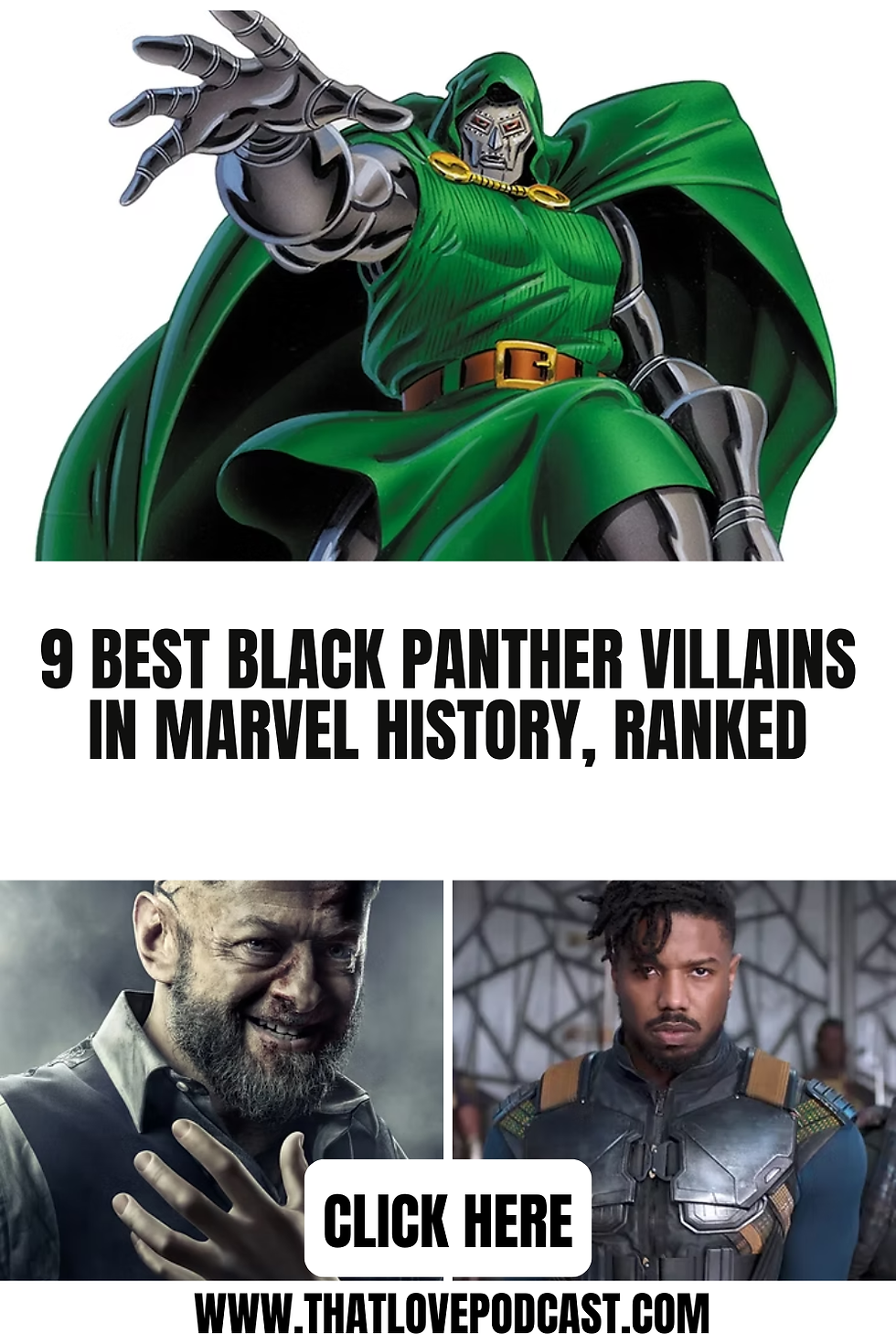
5. Klaw

Ulysses Klaue is greed and chaos wrapped in an entertaining performance. He is obsessed with vibranium, but he does not understand Wakanda as a home or culture. To him, the metal is a commodity and a way to prove that he can steal what the most powerful nation on Earth protects.
Andy Serkis plays Klaue with manic energy, making him feel unpredictable even when his goals are straightforward. He is dangerous because he enjoys disruption. He does not need to control Wakanda forever; he wants to profit from breaking its secrets open. His criminal history also connects the nation to the wider global market, showing how valuable vibranium would be to people who see every resource as something to own.
Klaue is not as emotionally deep as Killmonger, but he is a perfect catalyst. His theft, violence, and escape help bring the hidden Wakandan conflict into the open. He turns secrecy into a liability.
Where to watch: Stream Black Panther on Disney+ or buy the film through a digital retailer.
💡 You May Also Love
4. Namor

Namor is one of Marvel’s oldest and most powerful characters, and Wakanda Forever turns him into a compelling rival for Shuri. He is not simply a villain who wants to conquer Wakanda. He is a leader defending Talokan, a hidden underwater civilization whose survival depends on remaining unseen.
Namor’s conflict with Wakanda begins with overlapping fears. Both nations worry that outside powers will steal their resources. Both have histories shaped by violence. Both believe they must act before enemies act against them. The tragedy is that these similarities do not create trust. Namor chooses intimidation and war, while Shuri tries to protect Wakanda without surrendering its autonomy.
Tenoch Huerta Mejía gives Namor pride, grief, and ancient authority. His winged ankles and underwater movement make him visually distinctive, but his strongest scenes are the ones in which he explains why Talokan cannot afford weakness.
You’ll also love: Women of Wakanda: The Powerful Female Characters That Stole the Show in Black Panther
3. Doctor Doom

Doctor Doom is not exclusively a Black Panther villain, but his intelligence, imperial ambition, and repeated interest in power make him a major threat in the broader Marvel universe. In comic stories, Doom’s relationship with Wakanda can involve technology, sovereignty, and the question of whether one ruler respects another ruler’s independence.
Doom is a natural opponent for T’Challa because both are brilliant monarchs. The difference is ethical. T’Challa must balance personal ability with public responsibility, while Doom believes his genius gives him the right to rule. Their conflicts are therefore debates between two models of kingship.
Doom ranks fourth because he can challenge Wakanda intellectually, politically, and militarily. He does not need vibranium to be frightening. He can turn diplomacy into a trap and science into a weapon. Any future adaptation would have enormous material to explore.
2. Killmonger

Erik Killmonger is the most important Black Panther villain for the MCU. His story connects family tragedy, colonial history, global inequality, and royal succession. He is N’Jadaka, the son of N’Jobu, and therefore has a legitimate connection to Wakanda even though he was raised outside it.
Killmonger’s argument is direct: Wakanda possessed the power to help oppressed people but chose secrecy. His answer is to distribute weapons and use force against the world. That answer would produce new domination, but T’Challa cannot defeat the argument simply by calling it evil. The king must admit that Wakanda’s isolation protected privilege as well as culture.
Michael B. Jordan makes Killmonger charismatic, wounded, and terrifying. His scars track the life he has lived, while his relationship with T’Challa shows two men shaped by the same royal blood and completely different experiences. Killmonger ranks third because he changes the hero even in defeat.
Read more about that rivalry in From Killmonger to T’Challa: Exploring the Complex Villain-Hero Dynamic in Black Panther.
1. Erik Killmonger in the comics

The comic-book Killmonger deserves a separate place because his history is broader and more surreal than the film version. He is often associated with physical training, strategic intelligence, resentment toward T’Challa, and a desire to claim power in Wakanda. Across stories, he can be a revolutionary, rival, assassin, and symbol of the consequences of exile.
The comic character’s importance lies in his persistence. He is not a one-film obstacle. He returns because the conflict between inherited royalty and contested belonging is built into Black Panther’s mythology. Killmonger asks whether bloodline is enough to justify rule and whether a nation can deny someone a home without creating an enemy.
His comic stories also explore resurrection, ritual, and the relationship between power and identity. The details change, but the emotional engine remains familiar. Killmonger is always close enough to T’Challa to make the throne feel personal.
Podcast and sponsor CTA
Listen to That Love Podcast at https://www.thatlovepodcast.com/episodes. If your business, book, brand, or publication wants to reach an audience that enjoys thoughtful entertainment coverage, inquire about sponsorship at https://www.thatlovepodcast.com/advertise-with-us
What makes a Black Panther villain work?
A strong Black Panther villain should be connected to Wakanda’s identity. The best enemies do not arrive from nowhere. They expose a problem already present in the nation: isolation, inequality, secrecy, family privilege, or fear of outsiders. Even a villain motivated by greed becomes more meaningful when the story shows how the world’s desire for vibranium threatens Wakanda’s independence.
The strongest antagonists also have a relationship with leadership. T’Challa is not only defending himself. He is defending an institution. That means the villain can attack the throne, the royal family, the borders, the technology, or the moral legitimacy of Wakandan policy. The battle is personal because it is political.
This is why Killmonger remains so popular, why Namor feels like more than a standard enemy, and why comic villains such as Achebe and Tetu continue to matter. They turn superhero conflict into a debate about what a nation should become.
Conclusion
Black Panther villains are compelling because they make Wakanda answer difficult questions. Killmonger asks why a wealthy nation stayed silent. Klaw asks whether vibranium can remain protected in a connected world. Namor asks whether two hidden civilizations can trust each other. Achebe and Tetu ask whether the throne deserves unquestioned loyalty.
The best villains do not weaken Black Panther’s heroism. They define it. T’Challa, Shuri, and the people of Wakanda become stronger when they listen, adapt, and recognize that victory is not the same as justice.
Listen to more episodes at https://www.thatlovepodcast.com/episodes and support That Love Podcast with a donation at https://www.thatlovepodcast.com/donate

Frequently Asked Questions
1. Who is Black Panther’s greatest villain?
Killmonger is generally the greatest MCU Black Panther villain because he combines a personal connection to T’Challa with a serious political challenge to Wakanda.
2. Is Namor a villain or an antihero?
Namor is often an antihero in Marvel Comics. In Wakanda Forever, he acts as the antagonist, but his motives are rooted in protecting Talokan.
3. Why does Killmonger hate Wakanda?
He believes Wakanda abandoned him after T’Chaka killed his father, N’Jobu. He also resents Wakanda’s decision to stay isolated while Black communities elsewhere suffered.
4. Is Klaw stronger than Killmonger?
Klaw has a dangerous sonic weapon in the MCU, but Killmonger is more significant because he has a royal claim and a deeper ideological conflict with T’Challa.
5. Who is Achebe?
Achebe is a psychologically manipulative comic-book villain associated with Christopher Priest’s influential Black Panther run.
6. Is M’Baku a villain?
In the MCU, M’Baku begins as a rival but becomes an ally and important Wakandan leader. His comic identity, Man-Ape, is more openly antagonistic in some stories.
7. Does Doctor Doom fight Black Panther?
Yes. Doctor Doom and Black Panther have comic-book conflicts involving sovereignty, technology, political power, and the value of different forms of leadership.
8. Where can I watch Black Panther villains in action?
Klaw and Killmonger appear in Black Panther, while Namor appears in Black Panther: Wakanda Forever. Availability varies, but Disney+ and digital rental platforms are common options.
9. Are Black Panther villains connected to Wakanda’s politics?
Often. Many major villains challenge the monarchy, the nation’s isolation, its use of resources, or the legitimacy of its traditions.
10. Which villain is best in the comics?
Opinions vary, but Killmonger, Achebe, Tetu, Namor, and Doctor Doom are among the most important antagonists for readers exploring Black Panther comics.


.jpg)





.jpg)


