.jpg)



Let’s Kiss and Tell by Joss Richard Book Review – A Smart, Sexy Fake-Dating Romance About Trusting Love
- Joao Nsita
- 3 hours ago
- 13 min read

Why Let’s Kiss and Tell by Joss Richard is the smart, sexy fake-dating romance of the summer
I have a weakness for fake-dating romances, even when I know exactly where the story is heading. You know the rules almost immediately: two people agree to pretend, both insist that feelings are completely off the table, and somewhere along the way that very sensible arrangement becomes an emotional disaster. None of this should surprise me anymore, yet when the chemistry is good enough, I still fall for it every single time. Let’s Kiss and Tell by Joss Richard understands exactly why that familiar setup continues to work.
Published on August 11, 2026, this adult contemporary romance centres on Lucy Reid, a sex columnist whose public identity has been built around independence, and Marshall Oakley, a news writer still carrying the emotional shadow of a nine-year relationship. Lucy suddenly needs a convincing boyfriend for professional reasons, while Marshall needs an equally convincing plus-one for his ex’s wedding. A fake relationship solves both problems beautifully, at least until the two people involved start behaving like romance characters and ruining their own excellent plan.
What makes Let’s Kiss and Tell more interesting than the premise suggests is Lucy’s relationship with independence. She does not secretly believe her single life is empty, nor is the book waiting to reveal that everything she has ever said about relationships was wrong. Lucy genuinely values the life she has built, which means falling for Marshall raises a more complicated question: can she make room for another person without becoming smaller herself?
Marshall brings his own emotional baggage into the arrangement, and that gives the romance a nice balance. He is not simply the patient man waiting for Lucy to realise that relationships are wonderful; he is also trying to prove, perhaps mostly to himself, that his previous relationship no longer defines him. Their fake romance gradually becomes the one space where both of them begin telling the truth, usually by accident, and that is where Joss Richard finds the heart of the story.
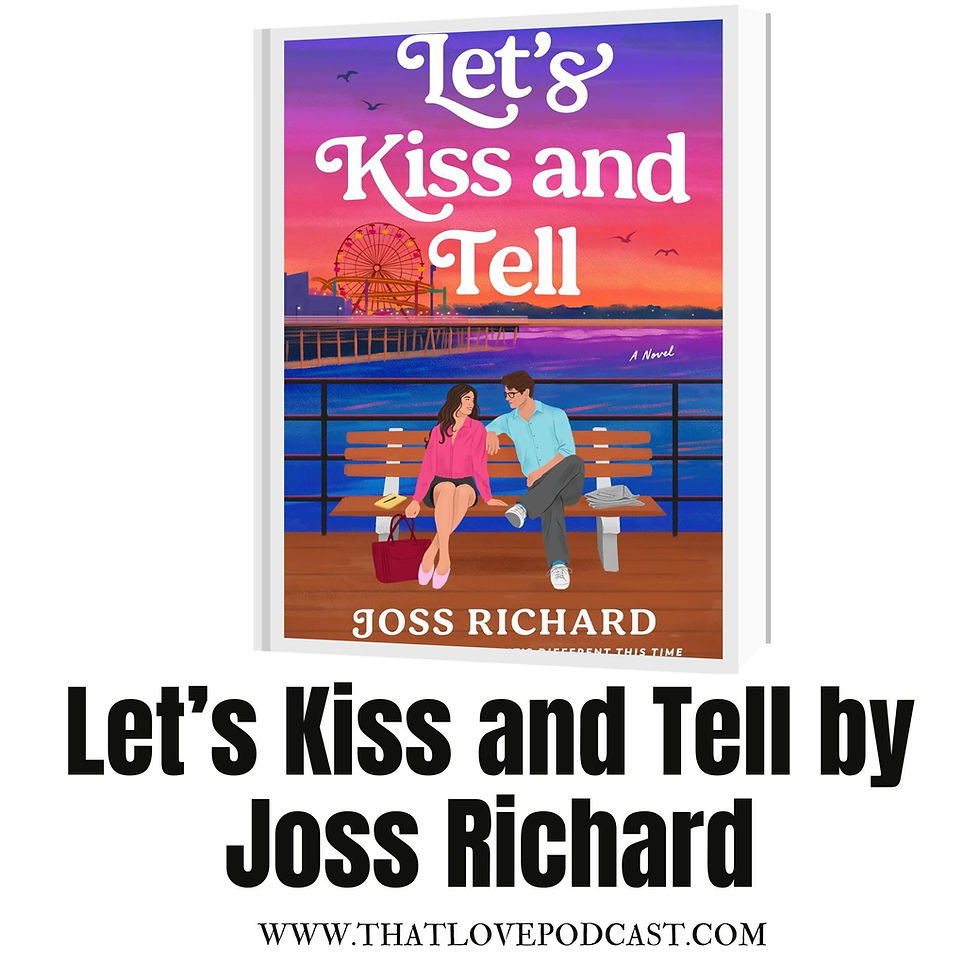
If you love romantic comedies that are warm, funny and steamy without treating emotional fear like a trivial obstacle, this one has plenty to offer. The banter gets you through the door, but the questions about freedom, vulnerability and choosing love are what make you want to stay.
Authors, publishers, brands and businesses looking to connect with readers who genuinely love romance and entertainment can advertise with That Love Podcast. Sponsorship opportunities are available across the podcast, website and newsletter.
The story at the heart of Let’s Kiss and Tell
Lucy Reid has built a successful career writing about sex, confidence and independence, and she is good at what she does. She understands desire, she understands the language people use when talking about relationships, and she has never believed that romantic partnership should be treated as the prize at the end of adulthood. The problem is that professional certainty does not always translate neatly into personal certainty, especially when Lucy’s editor starts pushing for a more personal relationship angle in her work.
Under pressure, Lucy claims she has started seeing someone and can write about the experience of finding “the one.” It is the kind of impulsive lie that probably feels manageable for approximately thirty seconds before reality arrives with a clipboard and several follow-up questions. Lucy now needs a real person who can convincingly play the role she has invented, which is where Marshall Oakley enters the story with a romantic complication of his own.
Marshall’s former partner of nine years is getting married, and he needs a date who can make him look as though he has moved forward. Lucy needs material for her column and eventually needs a believable public breakup that can support the argument she has already begun making. Their agreement is practical, mutually useful and full of the sort of carefully constructed boundaries romance readers know will survive about as long as a chocolate teapot.
The fake dates force Lucy and Marshall to learn each other rather than merely stand next to one another looking attractive. They have to understand habits, history, family dynamics, vulnerabilities and the little details that make a relationship convincing from the outside. Ironically, all that pretending creates a level of intimacy neither of them planned to experience, because performing closeness requires them to pay attention to each other in ways they normally avoid.
Lucy slowly realises that Marshall’s quieter personality is not emotional weakness, while Marshall begins recognising that Lucy’s independence is not coldness. They each carry assumptions into the arrangement, and one of the pleasures of the novel is watching those assumptions become less useful the better they know one another. Attraction complicates matters, obviously, but trust is the much more dangerous development because both characters have built their lives around avoiding exactly that kind of exposure.
The stakes grow as Lucy’s professional deception becomes harder to control and Marshall’s ex’s wedding moves closer. Neither can simply admit their feelings without also admitting that the stories they have been telling themselves may no longer fit. By the time the relationship reaches its emotional turning point, the question is not whether these two people have chemistry; that part has been obvious for a while. The question is whether they can imagine a version of love that allows both of them to remain recognisably themselves.
That gives Let’s Kiss and Tell a stronger emotional engine than simple fake-dating chaos. The story remains playful, but the romance works because the characters are not merely waiting for a kiss; they are trying to decide whether intimacy is something that threatens their independence or something that can exist alongside it.
How Joss Richard brings this romantic comedy to life
Joss Richard writes with the speed and sparkle of a good romantic-comedy screenplay, particularly when Lucy and Marshall are trading jokes or attempting to hide something behind sarcasm. The dialogue feels central to the attraction because these characters become interested in each other through conversation rather than through endless internal reminders that the other person is physically attractive. Their banter has a purpose: it becomes a safe language they can use until honesty feels possible.
The dual perspective strengthens that effect because readers can see the distance between what Lucy and Marshall say and what they actually feel. A confident joke from Lucy can sit beside the private anxiety underneath it, while Marshall’s calm exterior becomes more interesting once we understand the history he is carrying. Richard uses that contrast to create humour, but she also uses it to make the emotional progression feel earned.
The pacing is strongest in the quieter scenes where the fake relationship stops being a performance for a few minutes. Small observations, unexpected conversations and moments of vulnerability gradually become more important than the public displays that created the arrangement in the first place. The overall tone has a comforting 1990s rom-com energy, but the emotional language is modern enough to keep the story from feeling nostalgic in the wrong ways.
The themes that make Let’s Kiss and Tell much more than a fake-dating romance
Independence and intimacy sit at the centre of Lucy’s character arc. Her fear is not really being alone; it is becoming less herself inside a relationship, which is a much more interesting emotional conflict than simply claiming she does not believe in love. The book respects the independence she has fought for while gently asking whether allowing someone into your life necessarily means surrendering any part of it.
That theme reminded me of the emotional intelligence in Just for the Summer by Abby Jimenez, another contemporary romance where the central relationship does not magically erase the work the characters need to do for themselves. Both books understand that a happy ending becomes much more satisfying when the characters remain recognisable people rather than suddenly becoming perfect versions of themselves.
The stories we tell about ourselves also matter because both Lucy and Marshall have created public narratives that no longer quite match their private feelings. Lucy writes about relationships professionally, while Marshall is trying to project the image of someone who has moved beyond a long relationship. Maintaining those stories becomes increasingly exhausting as their actual connection grows, and the novel understands how frightening it can be to change your mind once other people expect you to remain consistent.
Sexual confidence and emotional courage are treated as two completely different things, which I appreciated. Lucy can talk openly about desire without automatically being comfortable with emotional dependence, vulnerability or commitment. The book never assumes that physical confidence means somebody has solved every other complicated feeling attached to intimacy.
Vulnerability as bravery becomes increasingly important as the arrangement continues. The biggest risk is not agreeing to pretend in public; it is allowing another person to see the parts of yourself that cannot be polished into a clever article or controlled performance. Readers who enjoy romance built around emotional honesty should also try The Deal by Elle Kennedy, where another supposedly practical agreement creates far more vulnerability than either person expected.
What stayed with me most was the book’s suggestion that changing your mind about love is not weakness or inconsistency. Sometimes growth simply means discovering that the life you built has enough room for something you did not originally plan to include.
What Let’s Kiss and Tell gets absolutely right
Lucy is already a complete person. She has a career, strong opinions, sexual confidence and an identity that exists independently of Marshall. That means romance expands her life rather than rescuing her from it, which makes her emotional journey far more satisfying.
The fake-dating trope actually serves the story. The arrangement creates more than convenient forced proximity because pretending requires Lucy and Marshall to learn things about each other they would otherwise avoid. The trope becomes a mechanism for trust rather than just a route to cute scenes.
The chemistry is built through attention. Their attraction works because Lucy and Marshall listen, notice small details and gradually understand how the other person thinks. That creates the feeling of two adults becoming genuinely curious about each other rather than simply responding to physical attraction.
The book separates sex from vulnerability. Lucy’s confidence does not automatically make emotional intimacy easy, and that distinction gives her much more depth. The romance becomes about trust as much as desire, which gives the steamy moments greater emotional weight.
The tone stays light without becoming shallow. Richard knows when to let a joke carry a scene and when to allow an uncomfortable feeling to remain unresolved. That balance makes the novel easy to read without making its central emotional questions feel disposable.
A few places where Let’s Kiss and Tell could have gone further
The middle occasionally stretches the arrangement. Once the emotional direction becomes clear, a few scenes feel as though they are circling the same territory rather than pushing Lucy and Marshall somewhere new. A slightly tighter middle would make the later emotional shifts land with even more force.
Lucy’s central fear is revisited several times. Her anxiety about losing herself in a relationship is believable and important, but I occasionally wanted a sharper moment where that fear clearly changed rather than being restated. The repetition never ruins the character arc, although it slightly slows it.
The workplace could have had more texture. A sex columnist and news writer working at the same company is such a strong setting that I wanted to spend a little more time inside that professional world. More newsroom detail could have made Lucy’s career stakes feel as vivid as the romance.
If you are an author, publisher or business trying to put a book, product or service in front of people who actively seek romantic stories, advertising with That Love Podcast is a natural way to join that conversation. Opportunities are available across our podcast, website and newsletter.
If you loved Let’s Kiss and Tell, read these next
The Deal by Elle Kennedy
If the part of Let’s Kiss and Tell you love most is watching a practical agreement become emotionally dangerous, The Deal by Elle Kennedy is an obvious next read. Garrett and Hannah begin from a completely different situation, but the same basic pleasure is there: two people establish rules because rules feel safer than feelings. The humour and chemistry are immediate, while the deeper emotional connection develops through the time they spend actually learning one another.
Slow Burn Summer by Josie Silver
Buy Slow Burn Summer by Josie Silver on Amazon. This is a lovely recommendation for readers who enjoy stories about performance, public identity and people discovering that the version of themselves they present to everyone else may no longer fit. Josie Silver also understands how to place emotional uncertainty inside a bright, cinematic romantic-comedy package without making the characters feel lightweight.
The Book Club Boyfriend by Kendall Ryan
Buy The Book Club Boyfriend by Kendall Ryan on Amazon. Readers who like a romance that understands its own tropes should have fun with this one because it plays with expectations while remaining completely sincere about wanting its characters to fall in love. You can also read our The Book Club Boyfriend review if you want another contemporary romance with strong chemistry and a knowingly romantic streak.
Who will love Let’s Kiss and Tell the most?
Fake-dating romance fans. The arrangement gives you all the tension you want from the trope, including rules, public performances and the inevitable moment when both people realise the pretending stopped feeling like pretending quite a while ago.
Readers who like capable heroines. Lucy’s life does not begin when Marshall arrives, and that matters. Her romantic journey is about making room for love rather than replacing everything she already values.
Workplace-romance readers. The media setting adds professional pressure to the relationship and gives Lucy genuine consequences if the arrangement falls apart publicly.
Readers who want open-door heat with emotional substance. Physical attraction is important, but the book is equally interested in trust, insecurity and the fear of allowing another person to matter.
Fans of emotionally aware romantic comedy. If you like your humour sitting beside genuine character growth, you may also enjoy browsing That Love Podcast’s August 2026 romance recommendations.
Content Warnings: Explicit sexual content, workplace tension, relationship anxiety, emotional avoidance and difficult conversations about commitment.
How Let’s Kiss and Tell stayed with me long after I finished it
What stayed with me was Lucy’s fear of becoming smaller inside a relationship because that feels more honest than the usual romantic-comedy resistance to love. She does not think love is impossible; she worries that it can become expensive in ways nobody talks about, particularly when one person slowly gives up pieces of themselves to keep a relationship comfortable. That made her hesitation easier to understand even when I occasionally wanted to shake her and point directly at Marshall.
Marshall surprised me in a quieter way because I initially expected him to function mainly as the charming man waiting for Lucy to realise she was wrong. Instead, he has his own embarrassment, history and desire to prove he has moved forward from a relationship that occupied nearly a decade of his life. Watching the fake relationship become a place where both characters accidentally tell the truth gave their connection much more warmth.
I finished the book with the slightly ridiculous happy feeling I get after a really good romantic comedy, but the central idea stayed with me. There is a meaningful difference between choosing someone because you believe you cannot live without them and choosing someone because you know you could live perfectly well alone but still want them beside you. Let’s Kiss and Tell makes a convincing argument that the second version might actually be the more romantic one.
Final Verdict: Is Let’s Kiss and Tell by Joss Richard worth reading?
Yes. Let’s Kiss and Tell is a lively, sexy and emotionally aware contemporary romance that understands why fake dating continues to work even when readers know every rule of the trope. Lucy and Marshall have the banter and chemistry required to make the setup fun, but the stronger part of their story is the way both characters gradually become less interested in controlling how they appear to other people.
Joss Richard also gives Lucy something romance heroines do not always receive: permission to remain independent after falling in love. Her happy ending does not require admitting that her single life was secretly meaningless or that she was waiting for the right man to make her whole. Instead, she has to decide whether partnership can become one part of an already complete identity, and that makes her emotional journey feel modern without becoming preachy.
Marshall gives the romance a lovely steadiness because he is not presented as a prize Lucy receives for changing her worldview. He also needs honesty, closure and the courage to stop performing the role of somebody who has completely moved on. Their relationship becomes convincing when both characters stop trying to manage the narrative and start allowing each other to see the mess underneath it.
Read this if you want fake dating, workplace chemistry, open-door romance and two adults discovering that emotional honesty is considerably more frightening than pretending to be in love. The book is warm enough to feel comforting, smart enough to give the trope something meaningful to explore, and romantic enough to remind you why we keep coming back to these beautifully doomed fake arrangements.

Before you go, authors, publishers, brands and businesses can advertise with That Love Podcast and reach readers across our podcast, website and newsletter.
About Joss Richard
Joss Richard is an international bestselling contemporary romance author based in Los Angeles whose work combines cinematic romantic-comedy energy with modern relationship questions. Before publishing fiction, she worked across television, film and digital entertainment, and her debut novel It’s Different This Time introduced readers to her warm, dialogue-driven style. Her writing is particularly strong when characters use humour to hide emotions they are not ready to admit, a quality that carries beautifully into Let’s Kiss and Tell.
Learn more about Joss Richard: Official Website | Goodreads Profile | Instagram
Subscribe to That Love Podcast's newsletter for the latest blogs, updates, and exclusive giveaways! Share the joy — pass along our blogs and website to family and friends so they can join in on the fun. Let's spread the love together!
For more inspiration on personal transformation, check out the Transform Your Life series at That Love Podcast and explore wellness tips at That Blissful Wellness Podcast.
Frequently Asked Questions About Let’s Kiss and Tell by Joss Richard
Is Let’s Kiss and Tell part of a series?
No. Let’s Kiss and Tell is presented as a standalone adult contemporary romance, so readers can begin with Lucy and Marshall without needing to know Joss Richard’s earlier novel. The story gives the central couple a complete romantic arc of their own.
What is Let’s Kiss and Tell about?
The novel follows Lucy Reid, a sex columnist, and Marshall Oakley, a news writer, as they enter a fake relationship for mutually useful reasons. Lucy needs material for her work while Marshall needs a convincing date to his ex’s wedding, but their carefully controlled arrangement becomes much more emotionally complicated.
What romance tropes appear in the book?
Fake dating and workplace romance are the biggest draws, with slow-burn tension and a wedding plus-one setup adding extra pressure. There is also plenty of the classic “we definitely do not have feelings for each other” energy that makes this trope so addictive.
Is Let’s Kiss and Tell suitable for younger readers?
This is an adult romance rather than a young adult novel. It contains explicit sexual content and mature conversations about sex, commitment, relationships and emotional intimacy.
Is there an audiobook edition?
An audiobook edition is available alongside the book’s other formats. Readers should check Amazon, Audible or their preferred audiobook retailer for current regional availability and narrator information.
If you're enjoying this blog, here are some other captivating reads that will sweep you off your feet: Just for the Summer by Abby Jimenez, The Deal by Elle Kennedy, The Book Club Boyfriend by Kendall Ryan, and 10 Most Anticipated Romance Books Coming Out in August 2026. Explore these amazing reads and let your imagination soar. Happy reading!
External Resources
For more book reviews, discussions, and recommendations, check out these fantastic resources:
Dear Author – Honest and well-thought-out reviews with sharp commentary.
All About Romance – One of the oldest romance review sites with extensive coverage.
Smart Bitches, Trashy Books – Humorous and insightful reviews with a podcast and community.
Goodreads – The world's largest book community for reviews and recommendations.
Book Riot – A lively hub for book news, lists, and recommendations across all genres. We hope these resources help you find your next favourite read!


.jpg)


.jpg)


Comments