



Father Material by Alexis Hall Book Review – A Tender, Funny, and Deeply Human Conclusion to Luc and Oliver's Love Story
- Joao Nsita
- Jul 5
- 13 min read

Why Father Material by Alexis Hall Is the Most Emotionally Honest Romance Series Finale You Will Read This Year
What happens after happily ever after — when the couple you love is finally together, finally settled, and the next question the world asks them is what kind of family they want to build?
Father Material, published June 30, 2026, is the third and final book in Alexis Hall's London Calling trilogy, following Boyfriend Material and Husband Material. Published by Sourcebooks Casablanca, it brings Luc O'Donnell and Oliver Blackwood — one of contemporary queer romance's most beloved and most argued-about couples — into the next chapter of their life together. They have civil-partnered. They have moved in together. They have survived fake dating, brief breakups, and a wedding that turned into something else entirely. Now someone is asking them: are you ready to be fathers?
Beneath the comedy — and Father Material is very funny — this is a book about the specific fear that comes with becoming the kind of parent you never had. Both Luc and Oliver carry the weight of complicated paternal relationships. Luc, the chaotic, warm-hearted son of a rock star, never had a stable father figure in the way that stability usually looks. Oliver, the composed, careful barrister, had a father whose emotional distance shaped him in ways he is still, page by page, unpacking. Father Material asks both of them — and through them, asks us — whether the love we give can exceed the love we received.
This is a book that will not suit every reader. It is long. It is honest about difficulty. It is less conventionally romantic than its predecessors. But for the readers who have followed Luc and Oliver across three books, it offers something genuinely rare: a romance that keeps going past the initial happiness and asks what love actually costs in the long run.
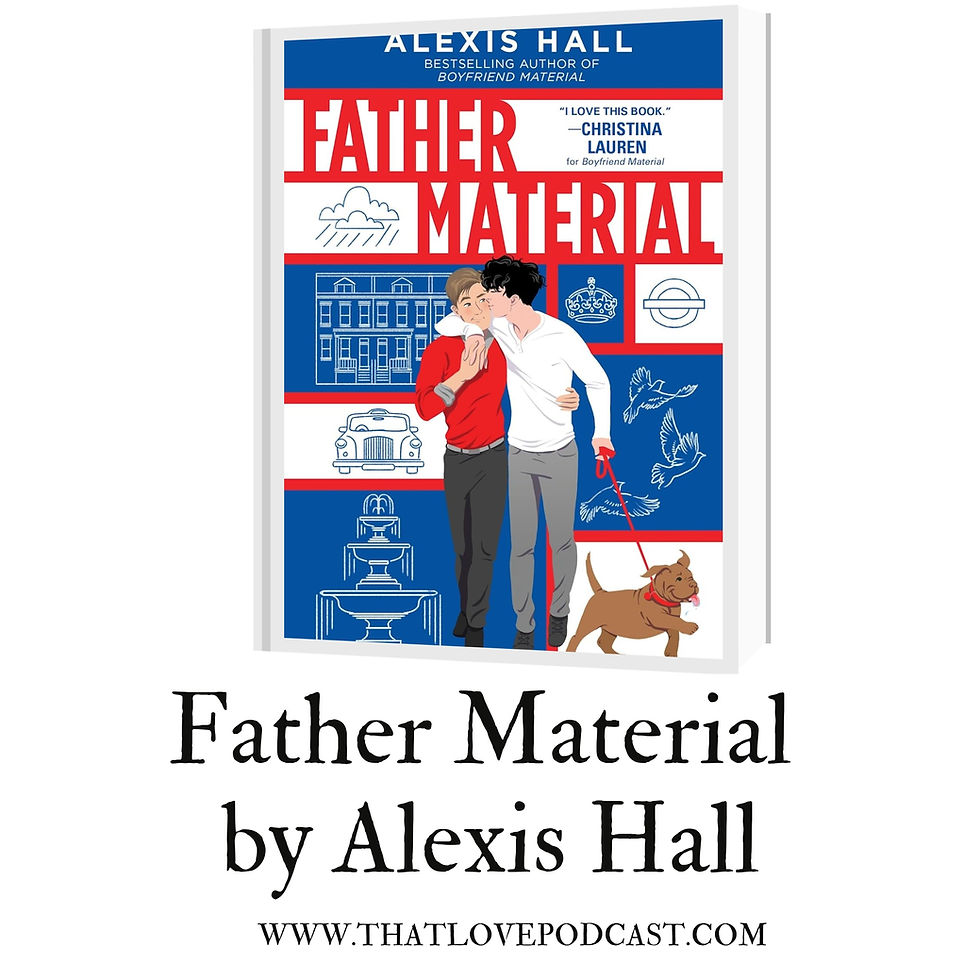
The Story at the Heart of Father Material
Luc and Oliver begin Father Material in an unusual place for a romance novel: contentment. They are happy. They are settled. Their friends are all moving into the next stage of life — some becoming parents, some actively choosing not to, one couple dealing privately with the grief of wanting children they cannot have. This collective movement in the lives of the people around them is forcing Luc and Oliver to examine their own desires. Are they the couple who wants children? Are they ready? And what does "ready" even mean when neither of them had the kind of childhood that modelled parenthood as something easy or good?
The inciting event is, brilliantly, a dog. Luc and Oliver decide to trial-foster a puppy named Spud — a logistical comedy of errors that Alexis Hall mines for every ounce of gentle hilarity — as a way of testing whether they can manage the daily demands of a dependent creature before considering something larger. Spud is wonderful. Spud is also the funniest character in a book full of funny characters. The Spud sections are pure domestic joy, and they establish, with real warmth, that Luc and Oliver might be ready for more than they think.
That "more" arrives in the form of Jasmine — Jaz — a fourteen-year-old in the foster system whose mother has been hospitalised after a suicide attempt. Luc and Oliver, already registered as foster carers, are placed with her. And the book's entire emotional register shifts. Jaz is sharp, sarcastic, guarded, and deeply likeable. Her gradual, cautious opening to Luc — who approaches parenthood with the chaotic instinctive warmth of someone who has no idea what he's doing but is all the way in — is the book's most genuinely moving thread.
The central conflict is both practical and deeply personal. Oliver, who has always been the steadier and more controlled of the two, finds that his instinct toward structure and boundaries is both appropriate and, in Jaz's specific situation, sometimes the wrong tool. Luc's instinct toward warmth and going with the flow is both endearing and, at moments, irresponsible. Neither of them is doing it right, which is exactly the point. And woven through all of this: Luc's job is in crisis, their friends are navigating enormous life changes of their own, and the question of whether they will be approved as Jaz's long-term carers hangs over every scene.
The book builds toward a conclusion that Alexis Hall handles with the careful honesty of a writer who respects their characters too much to give them an easy ending. There is a time jump. There is resolution. There is something that feels, genuinely, like a family that was built differently from the standard model — and is better, for both Luc and Oliver and Jaz, for being exactly what it is.
How Alexis Hall Brings This Story to Life
Alexis Hall writes in Luc's first-person voice — present, funny, a little chaotic, self-deprecating in ways that are always charming and occasionally infuriating — with the same precision and warmth that has made the London Calling trilogy one of contemporary queer romance's most celebrated series. Luc's narration is one of those rare voices that can make you laugh and break your heart in the same paragraph, and Hall deploys this skill with increasing confidence in Father Material.
The pacing is slower than Boyfriend Material, and deliberately so. This is a book about daily life, not grand romantic gestures. Hall understands that the most meaningful love stories eventually become about the ordinary — about who takes the dog out in the rain, who handles the difficult call with the social worker, who is still there when the other person is at their worst. The jokes land because they are embedded in genuine feeling rather than used to escape it.
The dialogue, as always with Hall, is razor-sharp and deeply funny. The exchanges between Luc and Oliver — particularly in the early Spud sections and in any scene involving Jaz — crackle with the specific energy of two people who know each other so well that they have developed a private language of affectionate frustration.
The Themes That Make Father Material So Much More Than a Romance Novel
Queerness and parenthood on your own terms. Father Material is, among other things, one of the most thoughtful explorations of queer parenthood available in contemporary romance. One of the many reasons the London Calling books are so special is how Alexis Hall interrogates the expectations put upon queer people about relationships — not decrying marriage and parenthood as archaic institutions but exploring what life looks like for a couple who choose to do things their own way. Luc and Oliver are not just queer people who happen to want children. They are queer people asking what queerness looks like when it encompasses a family built differently, and that question gives Father Material a genuine political and cultural dimension that elevates it beyond genre.
The wounds our fathers leave behind. Neither Luc nor Oliver had fathers who gave them the template they needed for good parenthood. Oliver's father was emotionally distant in ways that Oliver himself sometimes echoes. Luc's father was absent in a different way — present but not present, a rock star whose fame made him both larger than life and difficult to hold onto. Father Material asks both of them, explicitly and through action, whether they can choose to become something their fathers were not. The answer, painful and tender in equal measure, is yes — but not without cost and not without the daily practice of choosing it.
Friendship as the infrastructure of a life. The ensemble of friends around Luc and Oliver — all in different configurations of parenthood, partnership, and private grief — functions in Father Material as a genuine portrait of adult friendship under pressure. The book is honest about how major life changes create distance, how people who love each other can briefly stop being available to each other, and how those relationships require the same intentionality as romantic ones.
What love actually looks like in the long run. This is the trilogy's most sustained theme and Father Material brings it to its fullest expression. Real love, the book insists, is not the grand romantic moment. It is the daily decision to stay, to try, to do the uncomfortable thing. The foster care storyline enacts this with particular force — love for Jaz is not instant and it is not easy, and Luc's journey to a genuine, specific, protective care for her is one of the most emotionally honest things Hall has written.
If you enjoy books that explore found family and the complexities of queer love, you might also enjoy browsing our Romance Books collection at That Love Podcast or our That Love Podcast Episodes for audio stories exploring similar themes.
Father Material leaves you thinking about the kind of parent you wanted to have — and the kind of person you are still choosing to become.
What Father Material Gets Absolutely Right
Luc's parenting arc. Alexis Hall has taken the character who was most reliably frustrating in Husband Material and given him his richest, most emotionally generous portrayal yet. Watching Luc discover that parenthood might actually be the thing he is most naturally suited for — that his instinctive warmth, his willingness to be present, his refusal to pretend everything is fine when it isn't — is the book's greatest pleasure. It feels earned rather than convenient.
Jaz as a fully realised character. Too many romance novels reduce their children to props for the central couple's emotional journey. Jasmine is a person — specific, funny, occasionally infuriating, and genuinely moving. Her relationship with Luc, and her more complicated relationship with Oliver's structure and boundaries, is one of the most honestly drawn child-adult dynamics in contemporary romance.
The Spud sections. The dog is perfect. The comedy of Luc and Oliver attempting to dog-sit their way into parenthood is precisely calibrated — never farcical enough to undercut the genuine feeling underneath, always funny enough to prevent the book from becoming too heavy during its most serious middle sections.
Hall's treatment of the foster care system. Rather than simplifying the process or using it merely as a plot mechanism, Father Material engages with the genuine complexity of the foster system — the uncertainty, the social worker visits, the specific emotional labour required of foster parents — with a seriousness and an accuracy that gives the Jaz storyline real weight.
The ending. Without spoiling what the time jump reveals, the conclusion gives Luc and Oliver — and Jaz — something that feels genuinely true to who they are. It is not the conventional HEA. It is better than that: it is the specific, imperfect, chosen family that this specific imperfect couple was always building toward.
A Few Places Where Father Material Could Have Gone Further
The pacing in the middle section. A significant portion of the book is spent in the CRAPPstonbury festival subplot and in Luc's workplace crisis — both of which are funny and characteristic, but which occasionally pull the narrative energy away from the far more emotionally significant Jaz storyline. At over 500 pages, a tighter edit in these sections would have served the book's emotional core better.
Oliver's interior life. The novel is in Luc's first-person POV throughout, which is a deliberate choice and generally the right one. But Oliver's arc — confronting his own father's emotional absence — sometimes happens adjacent to the reader rather than in front of them. A slightly deeper access to Oliver's experience of becoming a father would have strengthened an already strong story.
The time jump. The book ends with a two-year skip that allows Luc and Oliver to arrive at their resolution, but several readers — and I share this view — will feel that the jump moves past precisely the moments they most wanted to witness: Jaz actually settling in, the daily reality of their family taking its shape. The resolution is earned; the journey to it deserves more page time.
If You Loved Father Material, Read These Next
Boyfriend Material by Alexis Hall is the obvious starting point for any reader encountering this series for the first time, and an essential reread after Father Material. Luc and Oliver's fake-dating origin story contains the specific energy and wit that Father Material builds on — and the knowledge of where they end up makes the beginning significantly more moving on a second visit. You can find it on Amazon here.
Everything I Know About Love by Dolly Alderton is a memoir rather than fiction, but shares Father Material's specific preoccupation with what it means to build a life that looks different from the expected template. Alderton's exploration of friendship, love, and growing up in your twenties and thirties shares the same warmth and the same honest engagement with the question of how we become who we are. It is the perfect read alongside or after the London Calling trilogy. Find it on Amazon here.
Rosaline Palmer Takes the Cake by Alexis Hall gives readers another entry point into Hall's comedy-drama approach to romance — his Winners Bakes All series shares the same dry wit, ensemble supporting cast, and willingness to let its protagonist be genuinely flawed. It is a perfect companion read for anyone who has finished Father Material and wants more of Hall's particular brand of warm, sharp fiction. Explore more recommendations on our Books section at That Love Podcast.
Who Will Love Father Material the Most
Readers who have followed the London Calling trilogy. Father Material delivers the closure that Luc and Oliver's story has been building toward, and its emotional payoffs are almost entirely dependent on investment in these characters across the previous books. This is the essential audience.
Readers who love found family romance. If the conventional romantic arc interests you less than the question of how people build families on their own terms, Father Material is precisely the book for you. It is warm, honest, and treats the found family theme with rare seriousness.
Queer readers who want their relationships represented in all their complexity. The London Calling trilogy is, across all three books, one of the most thoughtful and honest explorations of queer couplehood in contemporary romance — and Father Material is its fullest expression.
Readers who enjoy humour embedded in genuine emotional depth. This is not a light read and it is not purely a comedy. But Hall's wit is present on every page, and the laughter never comes at the expense of the feeling.
Fans of emotionally rich romance fiction might also enjoy That Love Podcast's Episodes for original audio drama that explores love in all its complexity.
Content Warnings: themes of parental absence and childhood trauma, suicide attempt (occurs off-page, involves a minor's parent), mental health themes, frank discussion of the foster care system, grief, and low-steam romance.
How Father Material Stayed With Me Long After I Finished It
I finished Father Material and sat with it for a long time before I started writing this.
What stayed with me was Luc. Not Luc the chaotic, funny disaster — though I love that Luc deeply — but the Luc who is sitting with Jaz at the end of a difficult day, not knowing what to say, choosing to stay anyway. There is a specific quality to that kind of love — the love that persists without knowing the right words — that Alexis Hall captures with a precision that surprised me, even knowing how good this author is.
I also thought about Oliver and his father. About the specific way inherited emotional patterns repeat themselves until someone chooses, consciously and daily, to interrupt them. The book asks whether love is enough to break that cycle and gives an answer that is both hopeful and honest: sometimes, yes. But only if you do the work.
Father Material left me thinking about the kind of love I choose to show the people in my life. And any book that does that deserves to be read.
Final Verdict: Is Father Material by Alexis Hall Worth Reading?
Father Material is not the most conventionally satisfying book in the London Calling trilogy. It is longer than it needs to be in places, and the middle section loses some of the tight comedic energy that made Boyfriend Material such a joy. But it is also the most emotionally ambitious and the most genuinely moving book Hall has written about these characters — a finale that treats Luc and Oliver with the seriousness their journey deserves.
What it gets most profoundly right is the thing that romance fiction most often avoids: the acknowledgement that love is not a destination but a practice. That becoming the partner, the parent, the person you want to be is a daily, imperfect, sometimes frustrating, ultimately beautiful process. Father Material sits with that truth without flinching, and without ever losing the warmth and wit that have made this trilogy special.
If you have followed Luc and Oliver from the beginning, this is the ending they — and you — deserve. If you are new to the series, start with Boyfriend Material and let Father Material be the reason you don't stop.
Luc would say something self-deprecating here. Oliver would gently correct him. And somehow, together, they would say exactly the right thing.

About Alexis Hall
Alexis Hall is a British author of contemporary and historical queer romance and fiction, best known for the bestselling London Calling trilogy — Boyfriend Material, Husband Material, and Father Material — and for the Spires series. Hall's work is celebrated for its sharp wit, emotional depth, and its commitment to queer characters whose relationships are depicted with warmth, specificity, and genuine complexity. Hall has received multiple award nominations and critical acclaim for their work. Their writing is uniquely capable of being simultaneously very funny and genuinely moving.
Learn more about Alexis Hall: Official Website | Goodreads Profile | Instagram
Subscribe to That Love Podcast's newsletter for the latest blogs, updates, and exclusive giveaways! Share the joy — pass along our blogs and website to family and friends so they can join in on the fun. Let's spread the love together!
For more inspiration on personal transformation, check out the Transform Your Life series at That Love Podcast and explore wellness tips at That Blissful Wellness Podcast.
Frequently Asked Questions About Father Material by Alexis Hall
1. Do I need to read the previous books before Father Material? Yes — Father Material is the third book in the London Calling trilogy and picks up directly from the events of Husband Material. Readers who have not read Boyfriend Material and Husband Material will lack the character context that makes Father Material's emotional payoffs land. The trilogy should be read in order: Boyfriend Material (2020), Husband Material (2022), Father Material (2026).
2. Is Father Material a standalone novel? Father Material is not a standalone. It is the concluding volume of the London Calling trilogy and requires familiarity with Luc and Oliver's relationship history, which spans two previous books. That said, the series itself is self-contained and does not connect to Hall's other series.
3. What representation does Father Material include? Father Material features a queer couple (both men in a civil partnership) as its central protagonists. The book also explores queer parenthood, the foster care system from a foster parent's perspective, and the specific experience of a teenage girl navigating the foster system. The ensemble cast includes characters with varying relationship configurations, including characters navigating infertility.
4. What age group is Father Material best suited for? Father Material is written for adult readers. The content — which includes frank discussion of mental health crises, parental trauma, and the foster care system — is most appropriate for readers 18 and over. The steam level in this book is very low (near absent), with the focus primarily on emotional rather than physical intimacy.
5. Is there an audiobook for Father Material? Yes — Father Material is available in audiobook format from Dreamscape Media, narrated with the same wit and warmth as the previous installments. An ARC audio version was available through NetGalley, and the commercial audiobook accompanies the June 2026 release. The audio format is particularly recommended for Luc's narration, which benefits greatly from performance.
If you're enjoying this blog, here are some other captivating reads that will sweep you off your feet:
Explore these amazing reads and let your imagination soar. Happy reading!
External Resources
For more book reviews, discussions, and recommendations, check out these fantastic resources:
Dear Author – Honest and well-thought-out reviews with sharp commentary.
All About Romance – One of the oldest romance review sites with extensive coverage.
Smart Bitches, Trashy Books – Humorous and insightful reviews with a podcast and community.
Goodreads – The world's largest book community for reviews and recommendations.
Book Riot – A lively hub for book news, lists, and recommendations across all genres.
We hope these resources help you find your next favourite read!


.jpg)
.jpg)


.jpg)






Comments