





10 Best Batman Movie Villains Ranked

Batman’s best movie villains do more than create action scenes. They challenge Bruce Wayne’s beliefs, force Gotham to confront its corruption, or reveal the costs of the Dark Knight’s mission. The franchise moves between gothic fantasy, crime drama and detective noir, so its antagonists take many forms: theatrical criminals, tragic outsiders, ideological leaders and organised crime figures. This ranking follows your exact supplied order, weighing performance, story importance and the distinct kind of pressure each character places on Batman. It begins with Scarecrow and ends with Heath Ledger’s Joker. Every portrayal belongs to a different film world, and the ranking is a guide for discussion rather than a claim that only one interpretation can work. For related viewing, explore 10 DC Movies and Shows for Dark Knight Trilogy Fans and 9 Batman Villains Who Deserve the DCU Spotlight. Visit our Episodes page, support the site, and check JustWatch UK for changing availability.
Support That Love Podcast
Enjoying these recommendations? Support That Love Podcast and keep independent entertainment content coming.
If you love this, explore more Batman and DC recommendations and listen to our episodes.
Want to Reach Entertainment Fans?
Brands, publishers, streaming services and creators can learn about advertising with That Love Podcast.
10. Scarecrow — Cillian Murphy, Batman Begins

Cillian Murphy’s Jonathan Crane makes fear feel clinical before it becomes monstrous. He hides cruelty behind the calm language of a psychiatrist, presenting himself as a respectable professional while using the fear toxin to make patients experience their worst anxieties. Murphy’s cool delivery and watchful eyes make Crane seem as though he is constantly studying the room for weakness. The burlap mask gives the character a stark visual identity, but the performance’s restraint is what makes it unsettling.
Scarecrow’s toxin connects directly to Bruce Wayne’s childhood trauma. Batman has decided to use fear against criminals, yet Crane makes fear feel unpredictable and intimate. The hallucinations briefly move Batman Begins from grounded crime story to nightmare, while Crane’s role in the wider League of Shadows plot gives his experiments consequences for the whole city. He is not the film’s central villain and receives less development than Ra’s al Ghul, but he remains a memorable recurring presence in the trilogy. At number ten, Scarecrow earns his place through atmosphere, concept and Murphy’s precise performance.
Need something to listen to after the movie? Discover original stories from That Love Podcast.
9. Ra’s al Ghul — Liam Neeson, Batman Begins
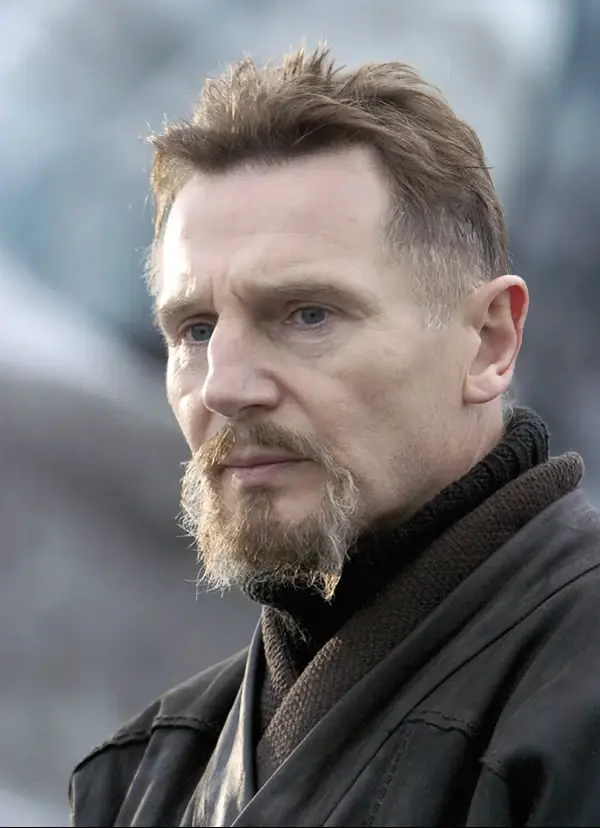
Liam Neeson’s Ra’s al Ghul first appears as the mentor Bruce Wayne needs. He offers discipline, a community and a way to turn grief into action. Neeson makes the relationship persuasive by playing Ra’s as patient and authoritative, so Bruce’s willingness to train with him feels understandable. The threat emerges when the League of Shadows’ philosophy becomes clear: Ra’s believes Gotham is so corrupt that it must be destroyed before it can be renewed.
Their conflict is personal because Bruce has learned from his opponent. Ra’s knows his strengths and understands his anger, but mistakes Bruce’s refusal to kill for weakness. Their moral disagreement gives the final battle weight. Bruce believes justice must leave space for people to change; Ra’s treats mass violence as a necessary correction to a failed society. Neeson’s measured performance makes the villain more disturbing than a simple fanatic. Ra’s is convinced he is carrying out a duty. Though his screen time is limited, his ideas shape Bruce’s training and his rejection of the League. At number nine, he is one of Batman’s strongest ideological opponents.
8. Penguin — Danny DeVito, Batman Returns

Danny DeVito’s Penguin is grotesque, funny and unexpectedly tragic. Batman Returns gives Oswald Cobblepot a gothic origin: abandoned by wealthy parents, he grows up in Gotham’s sewers and returns seeking recognition and power. DeVito embraces the physical transformation and dark comedy, but the character is more than makeup and waddling. Penguin wants the city to accept him. When he learns that respectable citizens will use him but never welcome him, his need for belonging curdles into revenge.
His mayoral campaign makes him both criminal and public performer. Penguin can charm a crowd and manipulate the press, then return to his lair to direct violence. The contrast gives the film a pointed view of Gotham’s elite: powerful people are willing to exploit an outsider when it serves them, but recoil when he asks to be treated as an equal. The story makes that rejection visible without excusing Penguin’s actions.
DeVito’s comic timing keeps the role lively, while the humour makes the villain unpredictable. His relationship with Batman is less intimate than the Joker’s, but the characters represent opposing relationships to Gotham. Bruce inherits privilege and tries to help the city; Oswald was discarded by wealth and wants to take power from those who excluded him. At number eight, DeVito’s Penguin captures the gothic side of Batman’s world and gives it genuine emotional weight.
7. Two-Face — Aaron Eckhart, The Dark Knight

Aaron Eckhart’s Harvey Dent begins as Gotham’s most visible symbol of hope. He is a charismatic district attorney who believes the law can reclaim the city. Eckhart makes him appealing without portraying him as flawless: Harvey is ambitious, confident with the press and occasionally theatrical. He is also brave enough to put himself in danger, and his relationship with Rachel Dawes gives his public mission personal stakes.
The Joker’s campaign destroys Harvey’s faith in order. His transformation into Two-Face is physical, but the deeper change is philosophical. After losing Rachel and suffering terrible injuries, Harvey lets a coin decide who deserves punishment. A token that once represented a harmless trick becomes a substitute for justice. Eckhart plays the change as an effort to control a world that has become unbearable.
Two-Face matters because his fall makes The Dark Knight’s questions about public trust personal. Joker wants Gotham to lose faith in Harvey, and Batman’s final decision to take the blame protects Dent’s public image at a cost to himself. The film’s fast pace leaves limited time for Two-Face after his transformation, but the emotional consequences remain central. At number seven, he represents lost hope and gives the story its most painful tragedy.
6. Joker — Jack Nicholson, Batman

Jack Nicholson’s Joker is a criminal showman who turns murder into public entertainment. Tim Burton’s Batman imagines Gotham as a dark, stylised city, and Nicholson’s performance is designed to dominate it. Before the transformation, Jack Napier is a mob enforcer with expensive taste and sharp jokes. After falling into a chemical vat, he becomes a celebrity criminal whose schemes mix gangster ambition with grotesque spectacle. Nicholson’s grin and theatrical voice make him instantly recognisable.
This Joker competes for control of Gotham’s underworld, stages elaborate crimes and becomes obsessed with Vicki Vale. The movie also connects him to Bruce Wayne’s origin by making Napier responsible for his parents’ murder. That change from the comics remains debated, but it creates a melodramatic link between hero and villain. Nicholson’s performance keeps the character from feeling like a plot mechanism; he seems to enjoy every opportunity to take over a room.
The role balances comic excess and menace. Joker can deliver a punchline while making the audience wonder whether violence is seconds away. His crimes are colourful, but the danger remains real. Unlike later interpretations, Nicholson’s version spends little time explaining a worldview; he is primarily a force of personality. At number six, the performance remains a landmark of comic-book cinema and made a Batman villain a major movie attraction in his own right.
Taking a break from the screen? Explore the latest episodes.
That Love Podcast also offers advertising opportunities for entertainment brands and creators. See the information above to get in touch.
5. Bane — Tom Hardy, The Dark Knight Rises

Tom Hardy’s Bane combines physical power with strategic patience. The Dark Knight Rises presents him as a commander who studies Gotham before attacking, takes advantage of Batman’s absence and understands how fear can be turned into public control. Hardy builds the performance through posture, a distinctive voice and careful stillness. Bane rarely seems hurried; he acts as though each part of his plan is settled.
His first fight with Bruce Wayne defines the threat. Batman returns injured and out of practice, assuming courage can compensate for weakness. Bane proves otherwise, defeats him and leaves him imprisoned in the Pit. That loss is more than an action sequence: it shows Bruce that determination has become recklessness. He must recover and rethink his purpose before returning to Gotham.
Bane’s strategy gives the movie a political scale. He isolates the city, turns law enforcement against itself and uses public anger as part of his takeover. The reveal of his relationship with Talia al Ghul changes the audience’s view of the plan; some fans feel it reduces his independence, while others see it as part of the League’s legacy. At number five, Bane remains Batman’s most imposing physical opponent in the trilogy and the villain who forces Bruce to rebuild himself.
4. Catwoman — Michelle Pfeiffer, Batman Returns

Michelle Pfeiffer’s Selina Kyle moves between adversary, antihero and romantic foil. In Batman Returns, Selina is an overlooked assistant pushed out of a window by her employer, Max Shreck. She returns as Catwoman with a patched costume and a desire for revenge. Pfeiffer makes the transformation physical: Selina’s movements become daring, but her awkwardness and hurt remain visible. The costume is iconic because the performance gives it an emotional purpose.
Catwoman challenges Batman differently from the other villains here. She understands the split between Bruce Wayne’s public life and Batman’s private mission, because she too lives behind a mask. Both distrust Gotham’s powerful people, but Selina does not believe the system will protect someone like her. Her revenge against Shreck grows from personal injustice, yet her methods can endanger others. Bruce recognises the person beneath the costume without approving of every choice.
Pfeiffer balances camp, anger and vulnerability. Selina can deliver a wicked joke, destroy a room and then reveal how alone she feels. Her connection to Batman creates emotional tension that cannot be resolved by defeating an enemy. At number four, she remains one of the most layered characters in a Batman movie and a vivid example of an antagonist whose loyalties resist easy labels.
3. Riddler — Paul Dano, The Batman

Paul Dano’s Riddler turns the puzzle-maker into a serial killer convinced he is exposing Gotham’s corruption. In The Batman, Edward Nashton stages crimes as messages, records videos and leaves clues that draw the Dark Knight into an investigation. Dano makes him frightening through fixation rather than flamboyance. For much of the film, the Riddler’s face remains hidden, so voice, ritual and the calm of his recordings carry the performance.
The character suits a detective story because every clue makes Batman interpret how the criminal thinks. The investigation uncovers corruption among the city’s powerful, but Nashton mistakes exposure for justice. Anger does not give him the right to punish people or turn violence into spectacle. This becomes part of Bruce’s development: Batman has to understand that a symbol can inspire people in ways he did not intend.
Dano’s Riddler is a threat and a distorted reflection of Batman’s early methods. Both wear masks, target corruption and use fear. Their moral differences grow clearer: the Riddler turns grievance into a following, while Batman learns Gotham needs hope as well as vengeance. At number three, the character gives the detective formula a modern psychological edge and makes Bruce question what his own symbol represents.
2. Penguin — Colin Farrell, The Batman

Colin Farrell’s Oswald Cobblepot is funny, vain and dangerous in the same breath. Makeup transforms his appearance, but the character comes through in Farrell’s fast rhythm, impatient swagger and instinct for reading a room. Penguin hates being underestimated and takes pleasure in proving that he has influence. His jokes never erase his criminal threat.
The Batman uses Penguin as a suspect and as a source of information about Gotham’s underworld. Batman and Lieutenant Gordon pursue him, while his position in the mob helps the story reveal the connection between organised crime and political power. He is not the central mastermind, which makes him feel like part of a larger world. His ambition is simple: he wants more power and will exploit an opening when he sees one.
Unlike Danny DeVito’s rejected outsider, this Penguin is already a criminal operator trying to climb the ladder. The contrast shows how adaptations can preserve a familiar character while reshaping his psychology to suit a new Gotham. The HBO series The Penguin continues his story; see our review for more. At number two, Farrell gives a supporting villain the detail and presence of a character ready to lead his own story.
Before the No. 1 pick, discover more stories on That Love Podcast.
1. Joker — Heath Ledger, The Dark Knight

Heath Ledger’s Joker ranks first because the performance, writing and film’s central conflict reinforce one another. This Joker claims to have no plan, but his crimes show a meticulous understanding of fear. The film gives him no definitive origin: his stories about his scars change, leaving the audience without a neat explanation. Ledger creates him through restless movement, a shifting voice and abrupt changes in mood.
Joker designs crimes as moral tests. He wants Batman to break his rule against killing and tries to make Gotham’s citizens choose self-preservation over compassion. The ferry sequence gives his worldview its clearest challenge. He assumes ordinary people will destroy one another under pressure; their refusal shows that fear does not automatically erase decency. Batman sees how close Gotham came to the outcome Joker wanted.
Ledger is funny, frightening and charismatic without reducing the character to mannerisms. Joker wants Batman to admit they are reflections of one another, while Batman insists that choices still matter. Their conflict shapes Harvey Dent’s fall and makes Bruce decide whether to protect Gotham’s belief in Dent or reveal the truth. Defeating Joker carries a moral cost, not simply a physical one.
The performance became a cultural landmark because it serves the film’s ideas so completely. Joker is not merely Gotham’s most dangerous criminal; he is the pressure that reveals what Batman and the city will sacrifice. At number one, he is the most complete cinematic Batman villain: vivid, challenging and tied to the story’s deepest questions.
What Makes a Batman Movie Villain Work?
A strong villain needs more than a memorable costume. The character should challenge Bruce in a way that makes the hero’s decisions matter. Ra’s offers a ruthless solution to Gotham; Two-Face embodies the fragility of public hope; the Riddler turns detection into an argument about vengeance; Bane defeats Batman and forces him to recover; Joker attacks the hero’s moral code. Each antagonist creates a different kind of pressure.
Performance matters as well. Nicholson’s Joker is a showman, Ledger’s is unpredictable, Hardy’s Bane is disciplined, and Murphy’s Scarecrow is controlled. These approaches suit different film styles. Burton’s gothic fantasy embraces exaggeration, Nolan’s trilogy tests an emerging hero’s beliefs, and Reeves’s film builds suspense through investigation. Adaptations do not need to copy one definitive comic version; they need a dramatic purpose.
The most lasting villains also change the world around Batman. Some alter Bruce personally; others reveal who benefits from Gotham’s broken institutions. The strongest stories connect those effects. A villain becomes more than a set piece when the conflict leaves the hero or the city changed.
How These Movie Villains Shape Their Gotham Stories
One way to compare Batman movie villains is to ask what kind of film each one helps create. Scarecrow moves Batman Begins toward horror. His toxin makes the hero’s senses unreliable, so a confrontation can be frightening even before anyone throws a punch. Ra’s al Ghul pulls the same movie toward an ideological story about what should happen to a corrupt city. Putting both opponents in one narrative gives Bruce two different problems: facing the fear inside himself and deciding which principles he will keep after training.
Batman Returns makes its antagonists part of the city’s social texture. Penguin wants recognition from a society that discarded him, while Catwoman pushes back against an employer who treated her as disposable. Their stories have very different moral shapes, yet each reveals how power in Gotham is distributed. Max Shreck can hurt people while maintaining a respectable public image; Oswald’s grotesque appearance makes society treat him as monstrous before he acts. The film’s heightened style lets those tensions become fairy-tale imagery.
The Dark Knight turns its villains into a debate over institutions and public hope. Harvey Dent represents the possibility that Gotham might not need Batman forever, and the Joker’s attack is designed to destroy that belief. Two-Face’s fall is devastating because it changes how citizens understand the law and how Bruce understands sacrifice. The film asks the audience to consider whether a symbol can remain valuable even when the person beneath it has failed.
The Batman builds its villain conflict through investigation. The Riddler wants to expose the powerful but mistakes revelation for justice, while Penguin offers Batman a view of how the criminal network works. The difference between those men helps the story move from a puzzle toward a larger picture of Gotham. Bruce’s own development follows a similar path: he begins by thinking vengeance is enough, then recognises the need to offer citizens a reason to hope.
These shifts explain why no single villain formula should define future Batman films. A new story can succeed with an old enemy if the character changes the kind of story being told. One film may need a personal rival; another may need a criminal strategist or a mystery-maker. The important point is to connect the villain’s plan to a choice Batman must face, so the final confrontation resolves more than the immediate danger.
For viewers building a movie marathon, contrast is more rewarding than watching only the most famous performance. Pair Batman Begins with The Batman to compare two detective origins, or place Batman Returns beside The Dark Knight to see how gothic fantasy and crime realism use villains differently. The actors, costumes and music change, but Gotham remains the space where every interpretation asks what justice looks like when its institutions fail.
Why These Villains Feel Different on Screen
Scarecrow and Ra’s al Ghul arrive in the same film, but they create very different kinds of suspense. Crane makes the world unreliable through the fear toxin, turning a character’s own perception into a threat. Ra’s offers an argument that Bruce has to reject, so the conflict becomes a question of principle as well as survival. Putting both figures beside one another shows how a Batman story can use horror and ideology without asking one villain to do every job.
The Gotham stories make the villains’ relationship to the city part of their characterisation. Danny DeVito’s Penguin wants acceptance from people who use and reject him, whereas Colin Farrell’s version is already a confident operator inside the criminal hierarchy. Catwoman is driven by a personal grievance against a powerful employer, and the Riddler tries to expose public corruption through his crimes. Their motives help the films feel like different stories rather than repeat versions of a single criminal plot.
The performances also use contrasting tools. Nicholson leans into stage presence; Ledger keeps Joker unpredictable; Hardy makes Bane feel formal and prepared. Murphy’s quiet Crane is unnerving because he remains composed, while Pfeiffer’s Selina uses physical transformation to show an identity coming apart and being rebuilt. These acting choices tell an audience how to read the threat even before the plot explains the whole plan.
A useful double feature is Batman Begins followed by The Batman. Both films introduce a young detective, but Crane and Ra’s represent different tests in Nolan’s origin story, while Reeves’s Riddler makes the investigation itself the main engine. To compare theatrical Gotham with a more grounded version, pair Batman Returns with The Dark Knight. The contrast makes clear how much the franchise’s villains depend on a director’s visual style as well as the character’s familiar name.
For advertising and partnership opportunities, please refer to the details above and contact the That Love Podcast team.
Conclusion
These portrayals show the range of stories Gotham can support. Scarecrow weaponises fear; Ra’s makes destruction sound like a solution; DeVito’s Penguin brings social rejection into gothic spectacle; Two-Face turns hope into tragedy. Nicholson’s Joker remains a charismatic showman, while Bane gives Bruce a defining defeat. Pfeiffer’s Catwoman blurs the line between enemy and ally; Dano’s Riddler gives Batman a disturbing modern case; Farrell’s Penguin helps create a grounded criminal world. Ledger’s Joker leads the ranking by making Batman’s moral code the centre of the conflict.
The order follows your exact list, but fans will disagree about the top position. Compare the performances, revisit a favourite film or use this guide to choose a double feature. For more superhero viewing, read Top 10 Superhero Movies That Revolutionized Cinema Forever. Check JustWatch UK for availability and subscribe on the That Love Podcast homepage.
Support That Love Podcast
Enjoyed the guide? Support That Love Podcast.
🎧 Keep the conversation going after this conclusion with That Love Podcast episodes.
Frequently Asked Questions
Who is the best Batman movie villain?
This ranking places Ledger’s Joker first because performance, writing and moral conflict work together. He challenges Batman’s code, undermines Gotham’s trust and drives Harvey Dent toward tragedy. Other fans may prefer another interpretation, but Ledger’s version combines character and theme particularly well.
Which Batman villain is most frightening?
The answer depends on the kind of fear. Scarecrow uses a toxin to make people confront their anxieties. The Riddler builds dread through murder and recorded threats. Joker is frightening because his motives remain uncertain, while Bane is physically imposing. Each film creates a different kind of menace.
Is Catwoman a Batman villain?
Catwoman can be an adversary, ally or something between the two. In Batman Returns, Selina opposes Bruce while sharing a complicated connection with him. Her motives are personal, but revenge leads her to dangerous choices. That shifting role makes her a compelling antagonist.
Why is Two-Face important in The Dark Knight?
Harvey Dent begins as Gotham’s symbol of hope. His transformation shows how grief and manipulation can damage his belief in law. His story also forces Batman to decide whether to protect the public image of a fallen hero. Two-Face gives the film its central tragedy.
Which villain physically defeats Batman?
Bane defeats Batman in The Dark Knight Rises, breaking Bruce’s back and leaving him in the Pit. The loss results from Bane’s strength and Bruce’s poor condition. Bruce must recover and rethink his mission before returning to Gotham.
What makes Paul Dano’s Riddler different?
The Batman presents Edward Nashton as a serial killer who uses puzzles and online videos to connect his crimes to corruption. The film treats him as part of a detective mystery and explores how grievance can become an excuse for violence. His hidden identity and recorded messages create suspense.
Who plays Penguin in The Batman?
Colin Farrell plays Oswald Cobblepot in Matt Reeves’s The Batman. Makeup alters his appearance, while Farrell builds the character through voice, posture and comic timing. This version is an ambitious mob lieutenant, and the HBO series continues his story.
Does Batman Begins have multiple villains?
Yes. Batman Begins features Carmine Falcone, Jonathan Crane as Scarecrow and Ra’s al Ghul, alongside the League of Shadows. They test different parts of Bruce’s mission: Gotham’s criminal system, fear and a plan to destroy the city.
Which Batman film has the best villain performance?
There is no objective answer. The Dark Knight is often praised for Ledger’s Joker; Batman has Nicholson’s flamboyant version; Batman Returns features Pfeiffer’s Catwoman and DeVito’s Penguin; and The Batman gives Paul Dano’s Riddler a detective-thriller setting.
Where can I watch these Batman films in the UK?
Streaming and rental rights change over time and vary by territory. Search each title on a current UK guide such as JustWatch, then confirm whether it is included in a subscription or offered only to rent or buy.
You May Also Love
More Places to Find Great Movies and TV Shows
JustWatch UK
For more film, television, comics and pop-culture information, these reference sites are useful starting points:
Advertising and Partnerships
That Love Podcast welcomes thoughtful partnerships connected to film, television and pop culture. For enquiries, use the contact page.
Support Our Work
If this guide helped you choose a Batman movie, support That Love Podcast and help us continue creating entertainment coverage.
Enjoyed what you read?
Subscribe to the That Love Podcast newsletter for the latest blogs, entertainment recommendations, updates and exclusive giveaways. Share the article with someone who loves movies, television, books or pop culture. Let’s spread the love together!


.jpg)



.jpg)


Comments