





All 5 The Boys Seasons, Ranked From Worst to Best

All 5 The Boys Seasons, Ranked From Worst to Best
Is The Boys the most important show on television right now? A lot of people would say yes — and after five blood-soaked, satirically brilliant seasons, it is hard to argue with them. Whether you are here for the action, the politics, the dark comedy, or simply because Homelander terrifies you in ways no fictional villain has in years, this complete ranking of every season of The Boys will tell you exactly which chapters of this epic story deserve your full attention — and which ones to approach with slightly managed expectations.
You are going to get the full picture here: what each season gets right, what it gets wrong, how it fits into the larger story, and why The Boys remains one of the most urgent, entertaining, and genuinely unmissable pieces of television in Amazon Prime Video history. From the explosive, culture-shifting debut of Season 1 all the way to the divisive but ambitious final chapter in Season 5, this is your definitive guide.
Whether you are a long-time devotee of Billy Butcher and the gang or someone who has heard the word "Herogasm" too many times to keep ignoring it and finally wants to understand what all the fuss is about — this ranking is for you.
Let's dive in. 👇

💛 Love great storytelling? Support That Love Podcast here: https://www.thatlovepodcast.com/donate
If you love this, check out: The 10 Most Binge-Worthy Episodes of The Boys, Ranked
Related Articles You Will Love
Before we get into the ranking, here are six That Love Podcast pieces that will enrich your journey through the world of The Boys and beyond:
5. Season 4 (2024) — The One That Stumbled, But Not Without Its Moments

Where to Watch: Amazon Prime Video
Let's be honest about something: Season 4 of The Boys is still better than most superhero television. The bar it is being measured against is simply every other season of The Boys — one of the most consistently brilliant shows on television — and by that standard, it falls short in ways that are worth understanding.
The core problem with Season 4 is momentum. The previous season ended with one of the most explosive moments in the show's history: Homelander's true, terrifying nature revealed to the world in the clearest possible terms. That moment demanded consequences. It demanded a season that would tear the world apart in response to it. Instead, Season 4 spends a significant portion of its eight episodes repositioning pieces on the board rather than blowing the board up entirely. For a show that has always moved fast, always committed to consequence, this restraint felt oddly out of character — and not in a thematically interesting way.
The casting additions had mixed results. Jeffrey Dean Morgan is an actor with enormous natural charisma and a track record that speaks for itself, but the character he plays in Season 4 is underwritten in ways that waste his abilities. The twist his storyline builds toward is visible from so far out that even viewers who had never read a single page of the original Garth Ennis and Darick Robertson comic book source material were predicting it well in advance. That is not a great sign for a show that has prided itself on keeping its audience genuinely off-balance.
Some of the ensemble also suffers from the season's structural problems. Frenchie (Tomer Capone) and Kimiko (Karen Fukuhara) — two of the most beloved and emotionally resonant characters in the entire show — are given storylines that feel disconnected from the main narrative for too long. Their individual arcs are not without merit, but in a season where the larger story needed to be accelerating, any diversion from the main momentum carries a real cost.
What Season 4 genuinely gets right is Antony Starr. It is a remarkable thing, the degree to which Starr has been underappreciated by the major awards circuit for his portrayal of Homelander. The character is one of the great television villains in the history of the medium — a man who is simultaneously a terrified child and a genocidal narcissist — and Starr plays both registers with extraordinary precision. Season 4 gives him some of his most complex material and he delivers, without exception.
Jack Quaid also has strong work here as Hughie. The episode dealing with his father's health crisis — featuring a beautiful performance from Simon Pegg — is one of the most quietly devastating hours in the show's entire run. It is exactly the kind of storytelling The Boys does so well when it slows down long enough to let the human stakes of its over-the-top world fully register. Hughie's emotional journey through that episode, and his words about who the boys truly are, provides one of Season 4's most genuinely moving moments.
The political satire is sharp, particularly in the storyline involving Victoria Neuman (Claudia Doumit) and the CIA assassination subplot. The Boys has always understood that political violence and institutional corruption are not abstract concepts but systems operated by specific, flawed people with personal agendas — and Season 4 explores that with real intelligence when it is at its best.
But the season's overall arc never quite finds the gear it needs to. The dark comedy that balanced the show's earlier seasons is almost entirely absent, replaced by a sustained grimness that, while thematically justifiable, makes the season feel more punishing to watch than it perhaps needs to be. This is The Boys at a lower energy level than we have come to expect — still worth watching, absolutely — but the beginning of a dip that the final season would have to correct.
🎧 Love great audio storytelling alongside great TV? Listen to That Love Podcast: https://www.thatlovepodcast.com/episodes
4. Season 5 (2026) — A Finale That Lands Where It Needs To

Where to Watch: Amazon Prime Video
Ending a show is one of the hardest things in television. The history of the medium is littered with finales that failed — that betrayed their audiences, that collapsed under the weight of expectation, or that simply ran out of ideas in the final stretch. The Boys Season 5 does not fail its audience. It also does not reach the heights of the show's best work. What it does is something more modest and in some ways more admirable: it lands. It concludes. It brings things home in a way that respects the journey.
Season 5 is a final season with the self-awareness to know what it is supposed to do. After the buildup-heavy nature of Season 4, this final run of episodes actually reaches conclusions. Characters are sent to their endings — some satisfying, some painful, some arguably a little rushed — and the world of The Boys is given a sense of finality that the show absolutely earned across five years of extraordinary television. The question was always whether Eric Kripke and his writers could stick the landing. The answer is: mostly, yes.
The season's greatest strength is its thematic clarity. The Boys has always been about the dangers of unchecked power, the seductiveness of fascism, the way celebrity and religion and nationalism can be weaponized by those willing to exploit them. Season 5 leans into all of this with real confidence. Homelander's trajectory in the final season takes the character to a new level of ideological extremism — his flirtation with far-right religious militarism and the cult of personality he represents is drawn with more precision and less subtlety than ever before, which is exactly right for a final season. This is what The Boys has always been building toward, and Season 5 refuses to look away from it.
Antony Starr, as ever, is exceptional. In Season 5, Homelander is given more complexity than in any previous season — a thread of genuine tragedy woven through the malevolence — and Starr plays it with the kind of control that makes you understand how this character could inspire devotion and terror in equal measure. Karl Urban is also given stronger material as Butcher than he had in Season 4, returning some of the gruff, wounded humanity that made the character so compelling in the early seasons.
Jack Quaid's Hughie gets more to do here than in much of the show's run, and the evolution of his character across the full five seasons is one of the most complete arcs in the series. Watching Hughie go from the traumatized, powerless young man of the pilot to the person he becomes by the finale is genuinely moving — a reminder that beneath all the gratuitous spectacle, The Boys has always been a show with real emotional intelligence about human growth.
The season's weaknesses are the direct inheritance of Season 4's problems. Some characters are still not given equal weight in the final stretch. The show's obligation to acknowledge the now-cancelled Gen V spinoff creates a few awkward moments of connective tissue that feel more like contractual necessity than organic storytelling. And the pacing, while generally stronger than Season 4, has occasional dips in momentum that suggest a writers' room that was managing an enormous amount of narrative to resolve in a limited number of episodes.
Still: The Boys ends on its feet. It does not achieve the heights of its best seasons, but it concludes with dignity and genuine emotional impact. It says something real about power, about the people who fight it, and about what those people have to sacrifice. For a show that began by blowing up every comfortable assumption about superhero storytelling, that is a respectable — and in television terms, increasingly rare — achievement.
You'll also love: The 10 Best Characters from The Boys, Ranked
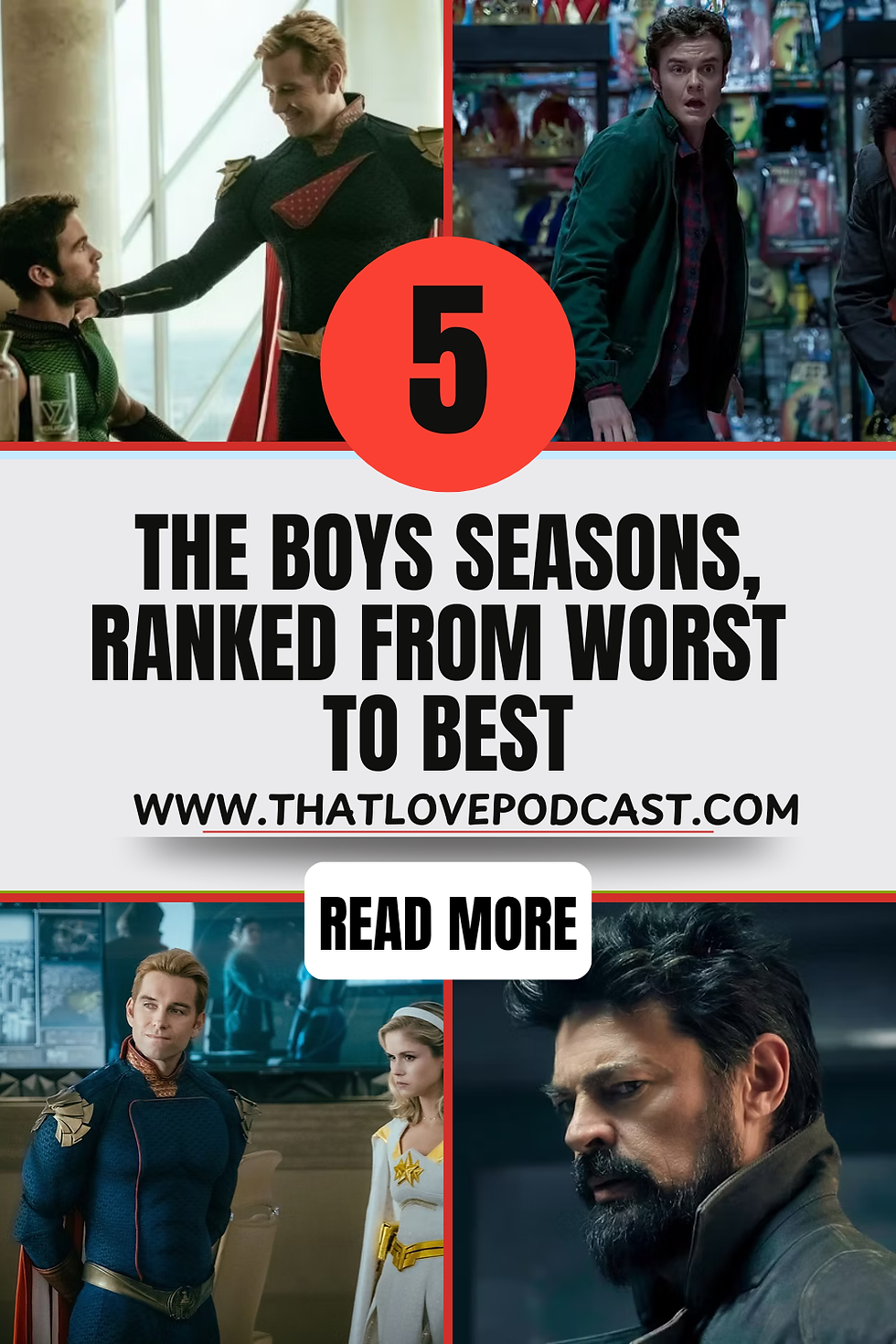
3. Season 3 (2022) — The Wildest, Most Audacious Season of Them All

Where to Watch: Amazon Prime Video
If Season 1 announced The Boys and Season 2 perfected it, Season 3 detonated it. This is the season that gave us Herogasm. It is the season that gave us Soldier Boy. It is the season that pushed the show's trademark excess to a point that left audiences slack-jawed and unable to stop talking, in a year when television was already competing for attention from every direction. In terms of pure spectacle and cultural impact, Season 3 of The Boys is in a category of its own.
What makes Season 3 work — and it absolutely works — is that the chaos has purpose. Kripke and his writers understood that the third season needed to function as an explosion after the more methodical buildup of Season 2. The decision to temporarily give Hughie and Butcher access to Compound V — giving them temporary superpowers and all the moral complications that come with it — is a risky narrative gamble that pays off beautifully. It fundamentally changes the dynamic between "the supes" and "the boys," and forces both Hughie and Butcher to confront uncomfortable questions about what they are actually willing to become in order to win.
The introduction of Soldier Boy, played by Jensen Ackles, is the season's masterstroke. Ackles brings a specific kind of terrifying to the role — a golden-age American hero who embodies every toxic masculine ideal the show has always been critiquing, unfrozen and unleashed on a world that has changed enormously since his heyday. The character is simultaneously funny, frightening, and genuinely pitiable in ways that add unexpected emotional depth to what could have been a purely satirical figure. The relationship between Soldier Boy and Homelander — when it is eventually revealed — is one of the show's most quietly devastating creative choices.
Season 3 is also where The Boys finally gives A-Train (Jessie T. Usher) and Queen Maeve (Dominique McElligott) storylines worthy of their characters. A-Train's reckoning with his own role in racial politics and his complicated relationship with his community is some of the show's most incisive social commentary. Maeve's arc reaches an emotional peak in this season that retroactively enriches everything the character has been through since the pilot.
The "Herogasm" episode deserves its reputation. It is genuinely one of the most extreme pieces of television produced by a major streaming platform, and it is also genuinely funny, genuinely horrifying, and genuinely meaningful in what it says about power, corruption, and the particular kind of dysfunction that defines The Seven. The fact that it generated so much outrage and conversation is precisely the point — The Boys has always used shock not for its own sake but as a delivery mechanism for ideas. Season 3 is where that strategy reaches its fullest, most committed expression.
The finale — Soldier Boy vs. Homelander — is among the best action sequences in any superhero property, streaming or cinematic. The fact that it is also emotionally loaded, thematically coherent, and genuinely surprising in its outcome elevates it beyond spectacle into something that genuinely resonates. This is The Boys at its most ambitious and its most excessive — and those two things, it turns out, are not incompatible.
The show's ability to balance this kind of operatic violence and satirical excess with genuine character depth is what separates it from every other superhero property. For more on how television can walk this line brilliantly, check out our ranking of The 10 Best Cringiest Comedy TV Shows of All Time — many of which share The Boys' gift for finding real truth inside extreme discomfort.
🎧 More great stories await at That Love Podcast: https://www.thatlovepodcast.com/episodes
2. Season 1 (2019) — The Arrival of the Most Important Superhero Show of Its Generation

Where to Watch: Amazon Prime Video
There are television premieres, and then there are arrivals. The Boys Season 1 was an arrival. When it dropped on Amazon Prime Video in July 2019, it hit the culture with the force of something that had been building for years but nobody had quite seen coming. In an entertainment landscape that had been dominated by the clean, optimistic world of Marvel and the grimdark posturing of DC, The Boys arrived with a completely different proposition: what if superheroes were actually the problem?
The premise of The Boys is simple and immediately radical. Superheroes exist, but they are owned by a corporation called Vought International, which manages them like celebrities, curates their public image with ruthless precision, and covers up everything they actually are — which is, in most cases, deeply dangerous. The Seven, the world's most powerful superhero team, are not saving anyone. They are being saved by PR. And when an ordinary young man named Hughie Campbell (Jack Quaid) loses the person he loves most to a catastrophic, casually indifferent act of superhero negligence, he is recruited into a vigilante group led by the furious, unstoppable Billy Butcher (Karl Urban) with one mission: take the supes down.
What makes Season 1 so special is the clarity of its vision. Kripke and his writers knew exactly what they wanted to say — about celebrity culture, about the weaponization of patriotism, about the way power corrupts in slow, normalized ways — and they said it with an economy and precision that the later seasons, for all their additional resources and ambition, sometimes struggle to match. Every episode of Season 1 feels purposeful. Every character introduction is loaded. The world is established in a way that is immediately rich and believable.
Homelander's introduction in Season 1 is one of the great villain reveals in modern television. From the very first episode, Antony Starr makes clear that this character is operating in a different register from every other superhero story you have ever consumed. The smile is wrong. The eyes are wrong. Something beneath the patriotic costume and the laser eyes and the perfect jawline is profoundly, chillingly broken — and Starr conveys it with a restraint that makes it far more frightening than any amount of explicit menace could.
Annie January, also known as Starlight (Erin Moriarty), provides the emotional counterbalance to Homelander's menace and Butcher's fury. Her arc in Season 1 — the new superhero discovering that the dream she has sacrificed everything to achieve is built on systematic corruption and abuse — is the most purely character-driven storyline in the season, and it is heartbreaking in its specificity. The Romeo-and-Juliet dynamic that emerges between Annie and Hughie is unexpectedly sweet — a reminder that The Boys, for all its darkness and cynicism, has always believed in the possibility of genuine human connection.
The show's debut season is also a masterclass in world-building economy. Vought International, the media satire, the fan culture surrounding the supes, the behind-the-scenes corporate machinery — all of it is established with remarkable efficiency, never stopping the story to explain itself but trusting the audience to keep up. The result is a first season that feels fully realized from its very first scene.
For a show that uses the comedy of extreme social discomfort as skillfully as any in television history, The Boys Season 1 is a landmark moment in television storytelling. The way it finds genuine horror inside familiar, comforting genre conventions is something it shares with the best cringe comedy and satirical television ever made. Season 1 is the reason this show exists, the reason we are still talking about it seven years later, and the reason five seasons were not enough.
1. Season 2 (2020) — The Greatest Season of Television's Greatest Superhero Show

Where to Watch: Amazon Prime Video
Season 2 of The Boys is where everything clicked into place. Where Season 1 was a brilliant announcement — loud, kinetic, deliberately provocative — Season 2 is the work of a creative team who had found their full voice and were ready to use it. This is The Boys at its most thematically precise, its most emotionally devastating, and its most complete. It is not just the best season of The Boys. It is one of the best seasons of television produced in the streaming era.
The structural genius of Season 2 is the way it complicates every relationship from the first season. With Butcher's disappearance, Hughie is forced into a leadership role he is not ready for — and watching him navigate that gap between his instincts and his capabilities is one of the most compelling character studies the show has produced. At the same time, Annie's position inside The Seven has become genuinely untenable: she is a double agent, and the cost of maintaining that position is visible in every scene Moriarty plays with the kind of raw, controlled emotion that defines her work across the entire series.
The addition of Stormfront, played by Aya Cash, is the Season 2 masterstroke. Stormfront is not just a villain — she is a diagnosis. A fascist superhero revived from the end of World War II, repackaged for the social media era, deployed with devastating effectiveness by a Vought corporate infrastructure that is more than willing to use fascist ideology as a content strategy. The character is chilling in ways that landed with extraordinary force in 2020, when the real-world parallels were — and continue to be — impossible to miss. Cash plays her with a terrifying warmth, a social fluency that makes her manipulations feel completely believable. She is among the great television villains of her era.
What Season 2 gets right about The Boys' core thematic mission — its examination of how power, media, and ideological extremism interact — is the level of precision it brings. Season 1 established the critique. Season 2 deepens it. The show's argument about the relationship between fascism and celebrity, between mass adoration and mass violence, is made here with a specificity and an intelligence that goes well beyond the genre it is ostensibly occupying. The Boys Season 2 is not just a superhero show that says something. It is a show that knows exactly what it wants to say and has the craft to say it with precision.
The dark comedy is also at its absolute peak here. Seeing The Deep (Chace Crawford) forced to rebuild his image after a series of public scandals — joining a vaguely Scientology-esque organization, attempting to rehabilitate his reputation through a series of increasingly desperate public gestures — is one of the funniest sustained storylines in the show's history. His bizarre, doomed attempt to rescue Hughie and company using a whale is both genuinely spectacular and completely absurd in equal measure. The fact that it is also thematically coherent — part of the show's argument about what celebrity rehabilitation actually looks like — elevates it from comedy to satire of the highest order.
Ryan (Cameron Crovetti), Homelander's son by Becca (Shantel VanSanten), provides Season 2 with its most quietly devastating emotional thread. The question of what Ryan is — whether he will become his father or something better — is the thematic core of not just Season 2 but the entire show. Watching Butcher and Homelander each try to claim Ryan as a son, each trying to shape him into their own image, is genuinely heartbreaking. Ryan represents the show's deepest, most hopeful argument: that the circumstances of your birth do not have to define who you choose to be.
Season 2 earned The Boys a Primetime Emmy nomination for Outstanding Drama Series — a rare recognition for a superhero property from an awards circuit that has historically overlooked the genre. It was absolutely warranted. This is prestige television that happens to feature exploding heads, a show that earns its extremism through the quality of the ideas it uses that extremism to explore.
For a show that deploys this kind of formal mastery — using genre and structure as delivery mechanisms for real ideas — The Boys Season 2 is worth comparing to the very best of what television has always done. Our ranking of Top 10 Sitcom Bottle Episodes, Ranked explores similar territory: the way television's greatest storytellers use formal constraints and creative ambition to produce something that transcends its genre.

Conclusion: Why The Boys Is Still Essential Viewing
When you sit down and look at all five seasons of The Boys together — when you trace the journey from that shocking, bloody pilot episode all the way to the finale of Season 5 — what you are looking at is one of the most ambitious, most consistent, and most genuinely important television projects of the streaming era. Not perfect. Not without its stumbles. But undeniably, compellingly essential.
The Boys dared to ask questions about power that most entertainment actively avoids. It took the genre that had come to dominate global popular culture and used it as a scalpel rather than a celebration. It gave us Homelander — one of the great screen villains of any era — and had the wisdom to make him understandable as well as terrifying. It gave us Hughie and Annie and Butcher and Frenchie and Kimiko and MM — characters with genuine emotional depth, characters who grow and change and fail and try again in ways that feel true. It made us laugh at things that were also genuinely disturbing. It made us think about things that were also genuinely entertaining.
At its peak — Seasons 1 and 2, and the riotous excess of Season 3 — The Boys is as good as television drama gets. Seasons 4 and 5 are lesser but not without real merit, and the show ends with more dignity than most finales manage. That is a remarkable thing. That is a legacy worth celebrating.
The Boys is available to stream now on Amazon Prime Video. Start from the beginning. It is absolutely worth your time.
💛 Enjoyed this article? Support That Love Podcast and help us keep producing great content: https://www.thatlovepodcast.com/donate
🎧 For original audio drama and romantic storytelling, visit: https://www.thatlovepodcast.com/episodes
💡 You May Also Love
If you're enjoying this blog, check out these other ones:
10 FAQs About The Boys — All 5 Seasons
1. How many seasons of The Boys are there? The Boys ran for five seasons on Amazon Prime Video, from 2019 to 2026. The show concluded with Season 5, which served as a planned and purposeful finale rather than a cancellation, making it one of the rare streaming shows to end on its own terms.
2. Do I need to have read the comic book to enjoy The Boys? Absolutely not. While the show is based on the comic book series by Garth Ennis and Darick Robertson, it diverges significantly from the source material in ways that creator Eric Kripke has described as intentional improvements. You can enjoy all five seasons with zero prior knowledge of the comics — and many fans argue the show is actually better than its source material.
3. Which season of The Boys is the best for new viewers to start with? Start with Season 1. There is no shortcut here. The show builds its world, its characters, and its emotional stakes from the very first episode, and jumping in anywhere else would deprive you of crucial context. Season 1 is also genuinely excellent, so there is no reason to skip it.
4. Is The Boys appropriate for younger viewers? No. The Boys is firmly adult television, rated TV-MA for a reason. It contains extreme graphic violence, explicit sexual content, strong language, and political themes of significant complexity. It is not suitable for children or younger teenagers under any circumstances.
5. Is The Boys based on a true story? The Boys is fiction, but its satire draws heavily from real-world political events, celebrity culture, and the history of far-right extremism. Many of the show's most disturbing storylines were inspired by real events and real ideological movements — which is a large part of what makes it so unsettling.
6. How does The Boys compare to other superhero shows? The Boys occupies a completely distinct category from most superhero television. Where the Marvel and DC universes are primarily interested in heroism and spectacle, The Boys is a political satire that uses the superhero genre as a vehicle for examining power, corruption, celebrity, and fascism. It is more usefully compared to prestige drama than to conventional superhero content.
7. What is Compound V in The Boys? Compound V is the synthetic substance created by Vought International that grants humans superhero abilities. The Boys. In the show's world, it is the source of all superpowers — and its existence and distribution are among the most significant plot points across all five seasons.
8. Will there be any more The Boys content after Season 5? Yes. Amazon Prime Video has confirmed the development of Vought Rising, a prequel series set in the 1950s that will explore the earlier history of Vought International and its superhero programme. The Boys universe is expanding even as the main series concludes.
9. Why is Antony Starr's performance as Homelander so highly regarded? Homelander is an extraordinarily difficult role — a character who has to be simultaneously charming, terrifying, pitiable, and genuinely menacing across five seasons and dozens of episodes. Antony Starr brings a physical precision and an emotional intelligence to the performance that has produced one of the great television villains of any era. His lack of major awards recognition has been widely criticised by television critics.
10. Is Gen V connected to The Boys? Yes. Gen V is a spinoff series set in the same universe as The Boys, focusing on a university for young superheroes. It debuted to positive reviews in 2023 but was subsequently cancelled. Season 5 of The Boys acknowledges Gen V's events in ways that make more sense if you have watched the spinoff — though it is not required viewing for understanding The Boys' finale.
External Resources for More Great TV Content:
Collider's The Boys Coverage — In-depth reviews, rankings, and analysis from one of the best entertainment sites on the internet.
Rotten Tomatoes — The Boys — Aggregated critic and audience scores for every season.
IMDb — The Boys — Full cast, crew, episode listings, and audience ratings across all five seasons.


.jpg)




.jpg)


Comments