



.jpg)
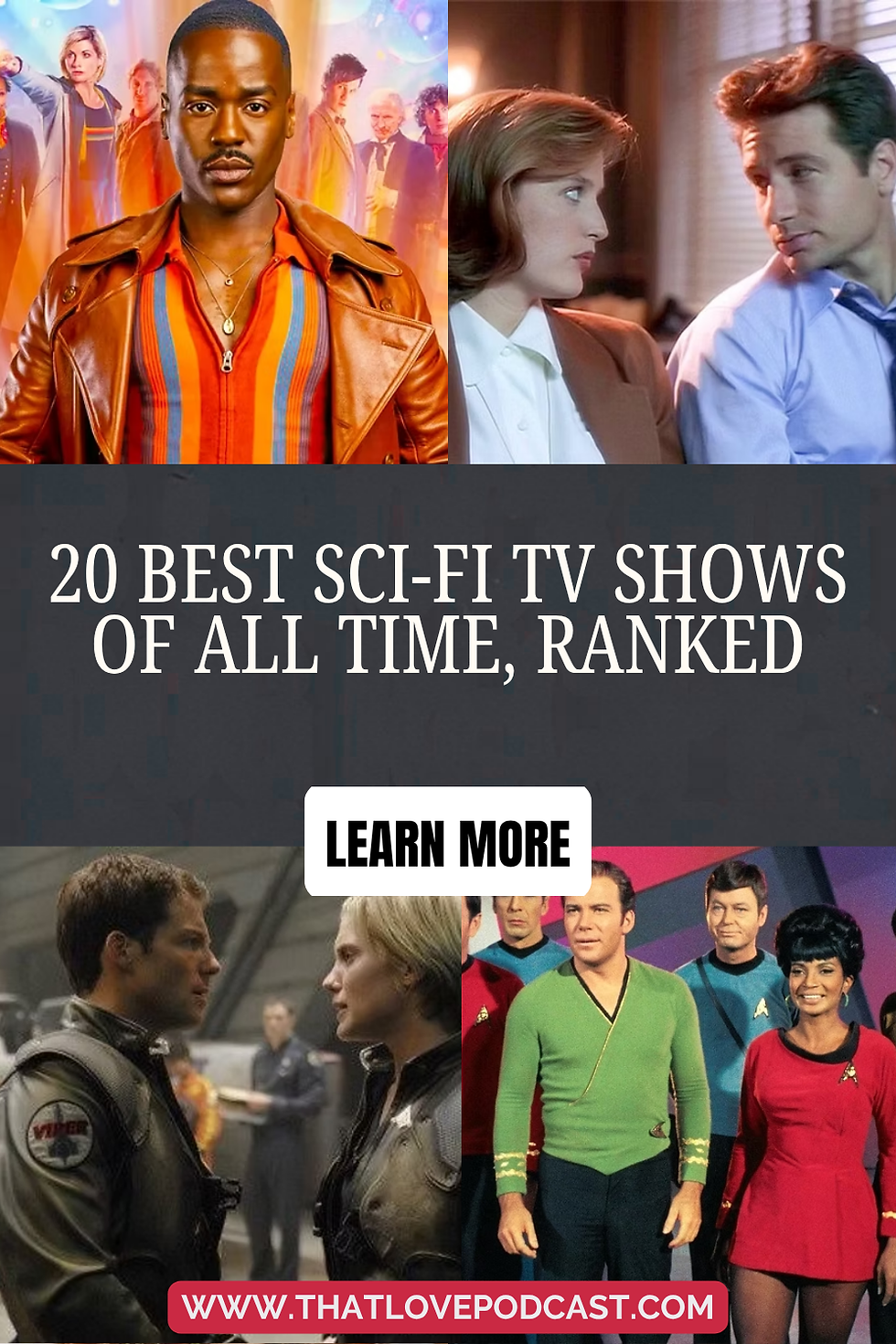
20 Best Sci-Fi TV Shows of All Time, Ranked

20 Best Sci-Fi TV Shows of All Time, Ranked
You've probably scrolled through streaming platforms for way too long trying to find a sci-fi show that actually lives up to the genre's biggest promises. This definitive ranking cuts through the noise, covering six decades of television that redefined what science fiction could do on the small screen, from black-and-white anthology classics to the biggest prestige dramas streaming today. Let's start 👇
💖 Support That Love Podcast: Donate here
If you love this, check out: The 15 Best Upcoming Sci-Fi TV Shows for 2025/2026
📣 Are you a brand, author, publisher, or business? That Love Podcast reaches a growing, engaged community of sci-fi fans, TV lovers, and entertainment obsessives every single day. If you'd love to sponsor an episode, a newsletter feature, or an article like this one, we'd love to hear from you: Advertise with That Love Podcast
Science fiction television has always had a unique job: using imagined futures, alternate realities, and speculative technology to say something true about the world we actually live in. The best shows in the genre aren't remembered for their special effects or their spaceships; they're remembered for how they used those tools to explore identity, morality, grief, and what it actually means to be human when the rules of reality have been rewritten. That's exactly the standard this list holds every entry to, and it's a standard surprisingly few shows across television history have managed to consistently meet.
This ranking spans everything from black-and-white anthology television from the 1960s to the prestige streaming era that's defined the last decade, and it deliberately favors shows that took real creative risks over shows that simply had the biggest budgets. Some entries reshaped the entire television landscape. Others remain beloved cult classics that never got the audience they deserved. All twenty earned their place through genuinely ambitious, era-defining storytelling that's continued to influence the genre long after their original air dates.

Below are the 20 best sci-fi TV shows of all time, ranked from a genuinely excellent series down to the single greatest sci-fi show ever made, spanning network television, premium cable, and the modern streaming landscape that's reshaped how these stories get told and discovered by new audiences.
20. The Man in the High Castle

Based on Philip K. Dick's acclaimed novel, this Amazon original imagines an America where the Axis powers won World War II, exploring resistance, identity, and moral compromise across a genuinely unsettling alternate history that never lets its audience feel comfortable for long.
Why It Ranks Here
The show's meticulous production design and willingness to sit with genuine moral ambiguity gave prestige sci-fi television a new benchmark for how seriously alternate-history storytelling could be taken, treating its speculative premise with the same gravity as a historical drama.
Best for: Fans of meticulously produced alternate-history storytelling that never softens its own darker implications.
You'll also love: The 20 Most Binge-Worthy TV Shows of the 2000s
19. Orphan Black

Tatiana Maslany's tour-de-force performance as multiple genetically identical clones anchors this twisty conspiracy thriller about identity, autonomy, and corporate control over human biology, unfolding across a genuinely tense, tightly plotted mystery.
Why It Ranks Here
Maslany's ability to make each clone feel like a completely distinct person, often within the same scene, remains one of the most technically impressive achievements in the genre's television history, and her eventual Emmy win felt like a long-overdue correction.
Best for: Fans who want to see a single performer carry an entire ensemble cast through sheer technical range alone.
18. 12 Monkeys

Expanding on Terry Gilliam's acclaimed film, this Syfy series builds a genuinely intricate time-travel mythology around a plague that nearly wipes out humanity, balancing emotional stakes with real narrative complexity across its full four-season run.
Why It Ranks Here
The show earned a passionate following by committing fully to its time-loop structure, rewarding attentive viewers with payoffs that took multiple seasons to fully resolve, a level of narrative patience that's genuinely rare on genre television.
Best for: Fans who love a slow-burn mystery built on a genuinely airtight, satisfyingly resolved time-travel structure.
📣 If your brand wants in front of readers actively exploring classic sci-fi content, let's talk about advertising with That Love Podcast.
17. Fringe

J.J. Abrams' genre-bending procedural blends horror, parallel universes, and genuine emotional family drama, anchored by Anna Torv and John Noble's increasingly beloved performances as the show grew more ambitious with each passing season.
Why It Ranks Here
The show's willingness to fully embrace its own escalating weirdness, while still telling a genuinely moving story about fathers and daughters, gave it a distinct identity within the genre, one that separated it from more straightforward procedural competitors airing at the same time.
Best for: Fans who want genuine emotional stakes buried inside a genre-bending, ever-escalating weekly mystery.
16. Silo

Apple TV+'s claustrophobic dystopian mystery, based on Hugh Howey's novels, follows a community living in an underground silo generations after an unspecified apocalypse, slowly uncovering the truth about their confinement one carefully doled-out revelation at a time.
Why It Ranks Here
The show's paranoid, tightly wound tension and genuinely compelling central mystery have made it one of the most talked-about new sci-fi series of the current streaming era, with each season ending on a cliffhanger substantial enough to dominate online discussion for weeks.
Best for: Fans of claustrophobic, tightly paced dystopian mystery built around one single, gripping central question.
You'll also love: 15 Shows to Watch If You Love 'Slow Horses'
15. Lost

This genre-defining mystery drama follows plane crash survivors stranded on a mysterious island, blending science fiction, philosophy, and genuinely emotional character work across six seasons that kept audiences theorizing week after week.
Why It Ranks Here
Whatever your feelings on its divisive finale, Lost fundamentally changed how television audiences engaged with serialized mystery storytelling, sparking online theorizing communities that predate much of today's fandom culture and proving a network drama could sustain this level of ongoing mystery.
Best for: Fans who want a genuinely sprawling ensemble mystery built around real, lasting character depth.
14. Dark

Netflix's German-language time-travel epic weaves together four generations of interconnected families across multiple timelines, building one of the most intricately plotted mysteries in television history across its tightly controlled three-season run.
Why It Ranks Here
Few shows have ever demanded, or rewarded, this level of attentive, repeat viewing, and Dark's genuinely satisfying conclusion remains a benchmark for how to properly resolve a sprawling, multi-timeline narrative without leaving major threads dangling.
Best for: Fans who want the single most tightly plotted, most genuinely rewarding time-travel mystery on this entire list.
📣 Loving this ranking of the genre's best shows? If your brand, publication, or business wants to reach readers who actually care about entertainment analysis, let's talk about advertising with That Love Podcast.
13. The Mandalorian

Jon Favreau's Star Wars spinoff revitalized the franchise for television, following a lone bounty hunter and his adorable, fiercely protected charge across the galaxy's outer rim in a structure heavily inspired by classic western storytelling.
Why It Ranks Here
The show's episodic, western-inspired structure and genuine emotional core gave Star Wars television a fresh identity, proving the franchise could thrive in a serialized format without losing what made it beloved in the first place, all while introducing Grogu as an instant cultural phenomenon.
Best for: Fans who want classic western storytelling filtered cleverly through a beloved, expansive sci-fi universe.
12. Westworld

HBO's ambitious reimagining of the 1973 film explores consciousness, free will, and corporate exploitation through a Wild West theme park populated by increasingly self-aware android hosts who begin questioning the nature of their own reality.
Why It Ranks Here
The show's early seasons, in particular, delivered genuinely mind-bending narrative structure alongside real philosophical weight, asking hard questions about what separates programmed behavior from genuine free will, and sparking countless online theories about its layered timelines.
Best for: Fans who want their sci-fi paired with genuine philosophical ambition and satisfying narrative puzzle-solving.
11. Severance

Apple TV+'s workplace psychological thriller imagines a procedure that surgically separates employees' work and personal memories, creating two entirely distinct versions of the same person who never interact or share knowledge of one another.
Why It Ranks Here
Few recent sci-fi concepts have felt this immediately, unsettlingly relevant, using a genuinely inventive premise to explore burnout, corporate control, and the fractured nature of modern identity, all wrapped in a distinctive, unsettling visual style that's become instantly recognizable.
Best for: Fans who want their sci-fi concept to feel genuinely, uncomfortably relevant to modern working life today.
You'll also love: 10 Best Netflix Movies and TV Shows Arriving in August 2026
10. Star Trek: The Next Generation

Picking up nearly a century after the original series, this beloved sequel gave the franchise a new crew, a more thoughtful, diplomatic tone, and some of the genre's most celebrated individual episodes across its full seven-season run.
Why It Ranks Here
Patrick Stewart's Captain Picard became one of television's most respected leading men, and the show's optimistic vision of humanity's future remains a genuine touchstone for the entire franchise, with episodes like "The Inner Light" still regularly cited among the best hours of television ever produced.
Best for: Fans who want a more thoughtful, diplomatic take on the Star Trek formula.
9. The Expanse

This meticulously grounded space opera follows the political and human fallout of humanity's expansion across the solar system, treating its science with a rigor rarely seen in mainstream television across its full six-season run.
Why It Ranks Here
The show's commitment to plausible physics, genuine political complexity, and a truly diverse ensemble cast made it one of the most respected hard sci-fi series ever produced for television, earning it a passionate fanbase that campaigned to save it after cancellation, much like Firefly before it.
Best for: Fans who want their space opera grounded in genuinely plausible science and politics.
8. Stranger Things

Netflix's nostalgic blend of 1980s horror and coming-of-age sci-fi follows a group of kids in a small Indiana town confronting supernatural forces from an alternate dimension known as the Upside Down, all while navigating the ordinary struggles of growing up.
Why It Ranks Here
The show's genuine affection for its 80s influences, combined with a genuinely talented young cast, turned it into a global cultural phenomenon and one of Netflix's most successful original series ever produced, revitalizing interest in practical effects and synth-heavy scoring along the way.
Best for: Fans who want pure 80s nostalgia paired with genuine coming-of-age heart.
7. Black Mirror

Charlie Brooker's anthology series uses standalone episodes to examine the darker implications of modern technology, delivering some of the sharpest, most unsettling social commentary the genre has ever produced across nearly every episode of its run.
Why It Ranks Here
Few shows have entered the cultural lexicon as thoroughly as Black Mirror, with "this feels like a Black Mirror episode" becoming genuine shorthand for describing unsettling real-world technological developments, a testament to just how prescient many of its individual stories have proven to be.
Best for: Fans who want the sharpest, most unsettling technology-driven anthology television has ever produced.
📣 Loving this deep dive into sci-fi television history? If your brand, publication, or business wants to reach readers who actually care about entertainment analysis, let's talk about advertising with That Love Podcast.
6. Firefly

Joss Whedon's beloved space western follows the crew of a smuggling ship navigating a morally gray galaxy, blending genre influences with genuinely sharp dialogue and richly drawn characters across its tragically brief fourteen-episode run.
Why It Ranks Here
Its cancellation after just one season remains one of the most notorious in television history, and the passionate fan campaign that followed, eventually leading to a feature film, speaks to just how deeply the show connected with its audience despite its short lifespan.
Best for: Fans who want the genre's most beloved, most tragically short-lived cult classic.
You'll also love: 10 Best Netflix Teen Series of 2026 (So Far)
5. Doctor Who

The longest-running sci-fi series in television history follows a time-traveling alien known as the Doctor, whose ability to regenerate into a new form has allowed the show to reinvent itself across more than six decades of continuous storytelling.
Why It Ranks Here
Few shows in any genre have demonstrated this kind of enduring cultural relevance, continuously introducing new generations of viewers to time travel storytelling through an ever-evolving cast and creative team, a built-in renewal mechanism no other franchise has ever quite replicated.
Best for: Fans who want the single longest-running, most continuously reinvented sci-fi show ever made.
4. The X-Files

Fox Mulder and Dana Scully's investigation into paranormal phenomena and government conspiracies defined an entire era of genre television, blending genuine horror, mythology, and one of TV's most beloved will-they-won't-they dynamics across nine original seasons.
Why It Ranks Here
The show's mix of standalone "monster of the week" episodes and an ambitious, sprawling mythology arc became a genuine template that countless later genre shows would go on to imitate, and David Duchovny and Gillian Anderson's chemistry remains one of the genre's most enduring pairings.
Best for: Fans who want a perfect mix of standalone horror and long-running government conspiracy mythology.
3. The Twilight Zone

Rod Serling's genre-defining anthology series used standalone morality tales, twist endings, and speculative scenarios to deliver some of the sharpest social commentary television has ever produced, and it remains just as relevant today as when it first aired.
Why It Ranks Here
Decades after its original run, individual episodes are still studied, referenced, and remade, a testament to just how far ahead of its time this series genuinely was, tackling racism, conformity, and Cold War paranoia through the safe distance of speculative fiction.
Best for: Fans who want the genre's sharpest, most enduring anthology series ever put on television.
You'll also love: Six Best Sci-Fi Audio Dramas to Transport You to Other Worlds
2. Battlestar Galactica (2004)

This dark, politically charged reimagining of the 1970s original follows the last remnants of humanity fleeing a devastating attack by the Cylons, a race of sentient robots the humans themselves created, forced to search for a mythical lost colony called Earth.
Why It Ranks Here
Battlestar Galactica proved sci-fi television could function as genuinely prestigious, politically resonant drama, tackling terrorism, religious extremism, and the ethics of survival with a seriousness rarely afforded the genre at the time, and its reputation as one of the greatest sci-fi shows ever made has only grown since it ended.
Best for: Fans who want the genre's most politically resonant, most prestigious dramatic achievement.
1. Star Trek: The Original Series

Topping the list is the show that essentially invented modern television science fiction, following the crew of the USS Enterprise as they explore the galaxy under Captain Kirk's command, encountering new civilizations, ethical dilemmas, and genuine philosophical questions along the way.
Why It Tops the List
Star Trek didn't just entertain audiences; it built an entire optimistic vision of humanity's future, tackled real social issues through allegory during a genuinely turbulent era in American history, including one of television's first interracial kisses, and spawned one of the largest, most enduring media franchises ever created. Every entry on this list, in some way, owes a debt to the template it established nearly sixty years ago.
Best for: Fans who want the single most foundational, most influential sci-fi show television has ever produced.
What Makes a Sci-Fi Show Truly Great
Looking across all twenty of these shows, a clear pattern emerges: the genre's best work has never been about the technology itself, but about what that technology reveals about the people using it. Whether it's Black Mirror's unsettling look at social media, Severance's meditation on corporate identity, or the original Star Trek's allegorical approach to Cold War politics, the strongest sci-fi television always uses its speculative elements in service of a genuinely human story, rather than treating spectacle as an end in itself.
It's also worth noting how many of these shows built passionate, enduring fan communities specifically because of their willingness to reward close attention and repeat viewing. Dark, Lost, and 12 Monkeys all thrive on intricate mythology that pays off across entire seasons rather than single episodes, a structural ambition that's become increasingly common as streaming has changed how audiences consume television, often in concentrated binges rather than spread out weekly viewings.
Finally, this list reflects just how much the genre has diversified in terms of tone and format. From anthology storytelling to sprawling multi-season epics, from hopeful utopian visions to bleak dystopian warnings, science fiction television has proven remarkably adaptable, finding new ways to explore the same fundamental questions about humanity across six decades of genuinely groundbreaking work. That diversity is exactly why the genre continues attracting new generations of viewers, regardless of which specific tone or storytelling structure happens to be in fashion at any given moment.
It's also worth considering how much this list owes to shows willing to take genuine financial and creative risks. Firefly and The Expanse both faced cancellation despite critical acclaim, only to be saved or extended through passionate fan campaigns, proof that genuine quality in this genre doesn't always align neatly with initial ratings success. That disconnect between critical merit and immediate commercial performance has, ironically, become one of the genre's most defining and enduring traits, and streaming platforms in particular have proven more willing than traditional networks to give ambitious, slow-building sci-fi concepts the room they need to find their audience over time.
This willingness to take creative risks extends to format experimentation as well. Anthology series like Black Mirror and The Twilight Zone prove that sci-fi doesn't need ongoing continuity to leave a lasting impact, while sprawling mythology-driven shows like Dark and Lost demonstrate the opposite approach can be equally rewarding when executed with genuine discipline and a clear endpoint in mind. That range, and the genre's consistent willingness to experiment with how its stories actually get told, is part of what makes this list feel genuinely varied rather than a collection of interchangeable space adventures.

Final Thoughts
The best sci-fi television has always done more than imagine the future; it's used that imagination to hold up a mirror to the present. Whether you gravitate toward the optimistic exploration of Star Trek, the political weight of Battlestar Galactica, or the unsettling modern relevance of Black Mirror, this list offers a genuine starting point for any fan looking to explore the genre's absolute best. What ties all twenty of these shows together is a genuine willingness to take real creative risks, rather than simply repeating familiar genre formulas, and that ambition is exactly what's kept audiences returning to these specific stories decades after some of them first aired. Revisiting these twenty shows is a reminder of just how much creative ambition television science fiction has consistently delivered, and a genuine invitation to discover, or rediscover, exactly why each one earned its place on this list.
💖 Support That Love Podcast: Donate here
💡 You May Also Love
FAQs
1. What is considered the greatest sci-fi TV show of all time? Star Trek: The Original Series is widely regarded as the genre's most influential and foundational show, having essentially established the template modern sci-fi television still follows today, decades after its original three-season run.
2. Is Black Mirror considered hard science fiction? It's more accurately described as speculative or social science fiction, using near-future technology to explore ethical and psychological questions rather than focusing on scientific accuracy or technical realism.
3. Why is Firefly still so beloved despite only lasting one season? Its sharp writing, richly drawn characters, and passionate fan campaign following its cancellation, which eventually led to a feature film, cemented its status as a genuine cult classic that continues attracting new fans decades later.
4. Is Dark difficult to follow for new viewers? It requires close attention due to its multiple timelines and interconnected family trees, but many fans consider that complexity part of what makes the show so rewarding on rewatch, with fan-made family trees and timeline charts widely shared online.
5. What made Battlestar Galactica different from typical sci-fi shows of its era? Its dark, politically charged tone and willingness to tackle terrorism, religious extremism, and morally complex survival scenarios set it apart from more traditional space opera storytelling common at the time of its release.
6. Is The Expanse considered scientifically accurate? Yes — it's frequently praised for its commitment to plausible physics and realistic depictions of space travel, setting it apart from more fantastical entries in the genre and earning praise from actual scientists and astronauts.
7. How long has Doctor Who been running? It first premiered in 1963 and remains the longest continuously running sci-fi series in television history, thanks in part to its unique regeneration concept allowing new actors to take on the lead role every few years.
8. What is Severance's central premise? It follows employees who undergo a procedure that surgically separates their work and personal memories, creating two distinct consciousnesses within the same person, neither of which retains any knowledge of the other's experiences.
9. Is Stranger Things considered a true sci-fi show or primarily horror? It blends both genres heavily, combining supernatural horror elements with genuine science fiction concepts like alternate dimensions and government experimentation, drawing heavily on both Stephen King and classic 80s sci-fi films for inspiration.
10. Where can I watch most of these sci-fi shows today? Many are available on major streaming platforms including Netflix, Apple TV+, HBO Max, and Amazon Prime Video, with some also available to rent or buy individually depending on regional licensing agreements.
External resource: For additional critical rankings and reviews, Rotten Tomatoes' guide to the best sci-fi TV shows offers further perspective worth exploring, including audience and critic scores for many of the series covered here.


.jpg)


.jpg)






Comments