.jpg)



10 Episodes Of Deadwood That Can Be Considered Masterpieces
- Joao Nsita
- Oct 3, 2025
- 12 min read


In the pantheon of prestige television, few shows command the reverence and mystique of HBO's Deadwood. David Milch's mud-and-blood-soaked epic, set in the lawless South Dakota camp in the 1870s, was more than just a Western. It was a dense, profane, and profoundly poetic exploration of how a community—a civilization, even—is violently and painstakingly birthed from chaos. Its language was a baroque fusion of Shakespearean prose and gutter profanity; its characters were historical figures reimagined as complex, wounded, and tragically human souls.
To choose a "masterpiece" episode from Deadwood is a difficult task, as the show's serialized nature means every installment builds upon the last. However, certain hours of television stand apart. They are the moments where Milch's thematic ambitions, the cast's towering performances, and the narrative's brutal momentum converge into something unforgettable. These are not just great episodes; they are perfectly constructed works of art that encapsulate the show's enduring genius.
While Deadwood may not have a massive Gen Z following generating TikTok dance trends, its legacy thrives in a different corner of the internet. You'll find its influence in the aesthetics of gritty historical mood boards on Pinterest, celebrating the show's incredible production design. On TikTok and YouTube, Al Swearengen's soliloquies have become iconic audio clips, used by creators to underscore moments of cynical wisdom or dark humor. The show's power persists not in memes, but in its raw, unfiltered depiction of humanity, which continues to resonate deeply with a dedicated audience. Here are the 10 episodes that best represent that power.
10. "Deadwood" (Season 1, Episode 1)

What It's About: The pilot episode introduces us to the titular camp, a cesspool of mud, greed, and opportunity on illegally seized Sioux land. Former Montana Marshal Seth Bullock and his partner Sol Star arrive to open a hardware store, hoping for a quieter life. Their arrival coincides with the return of the legendary Wild Bill Hickok and the machinations of the camp's unofficial ruler, the cunning and brutal saloon owner Al Swearengen.
Why It's a Masterpiece: A great pilot must accomplish two things: establish a world and introduce compelling characters. "Deadwood" does both with breathtaking efficiency and style. Milch doesn't hold the viewer's hand; we are thrown directly into the muck and expected to keep up. The episode masterfully establishes the camp's geography and power dynamics, with Swearengen's Gem Saloon physically and metaphorically looming over everything. The language is immediately striking—dense, vulgar, yet poetic. Ian McShane's debut as Swearengen is one of television's all-time great character introductions, a whirlwind of menace, intelligence, and pragmatism. It perfectly sets the stage for the show's central theme: the violent, chaotic, and often ugly process of building a society from nothing. It’s a foundational hour that is as compelling on re-watch as it is on the first viewing.
Where to Watch: Begin your journey into the muck and mire by streaming all three seasons and Deadwood: The Movie on Max.
9. "Requiem for a Gleet" (Season 1, Episode 8)

What It's About: Al Swearengen, the seemingly invincible power broker of the camp, is laid low by the excruciating pain of kidney stones. As he writhes in agony, his vulnerability sends ripples of uncertainty through the camp. Doc Cochran is summoned to treat him, forcing a confrontation between medicine and Swearengen's deep-seated mistrust. Meanwhile, Bullock and Alma Garret's burgeoning attraction intensifies.
Why It's a Masterpiece: This episode is a brilliant character study that humanizes a monster. For seven episodes, Swearengen has been a force of nature—scheming, murdering, and controlling. Here, he is reduced to a sweating, screaming man, utterly dependent on others. Ian McShane's performance is a tour de force, conveying unimaginable pain while still trying to maintain control over his empire from his sickbed.
The episode masterfully uses his physical ailment to explore his psychological depths, hinting at a traumatic past. The scenes between Swearengen and Doc Cochran (Brad Dourif) are electric, a battle of wills between two stubborn, brilliant men. It proves that Deadwood's most compelling drama often comes not from gunfights, but from quiet, character-driven moments in claustrophobic rooms. For more stories centered on complex characters, check out our guide on What to Watch: The Last of Us.
8. "The Trial of Jack McCall" (Season 1, Episode 5)

What It's About: In the aftermath of Wild Bill Hickok's murder, the camp is forced to confront the concept of law for the first time. A "miners' court" is hastily assembled in the Gem to try the killer, Jack McCall. The proceedings are a farce, orchestrated by Swearengen to avoid attracting the attention of formal American law. Bullock's simmering rage at this injustice finally boils over, setting him on a collision course with Swearengen.
Why It's a Masterpiece: This episode is the crucible where the show's central conflict is forged. It’s not just about a trial; it's about the birth of civic responsibility. The farcical nature of the court highlights the camp's lawlessness, but the very act of holding a trial, however flawed, is a step towards civilization. This is the episode where Seth Bullock's character crystallizes. His silent, righteous fury is a stark contrast to the camp's cynical pragmatism.
The final confrontation, where a bloodied Bullock throws McCall at Swearengen's feet and declares his intention to stay, is an iconic moment. It’s the official start of the Bullock-Swearengen dynamic, the two opposing poles around which the entire series will revolve. The episode's power lies in its exploration of how a community, even one built on vice, must invent its own moral code to survive. The historical basis for this trial is fascinating, as detailed by historical sites like Legends of America.
7. "A Lie Agreed Upon, Part I" (Season 2, Episode 1)

What It's About: The second season opens with the camp in a state of flux. Bullock is now the sheriff, married by proxy to his brother's widow, Martha, who is arriving with her son, William. This complicates his passionate affair with the widowed Alma Garret. Swearengen, meanwhile, faces a new threat in the form of Francis Wolcott, the advance agent for the powerful and ruthless mining magnate George Hearst.
Why It's a Masterpiece: The Season 2 premiere is a masterclass in re-establishing stakes and deepening character complexities. The title itself—"A Lie Agreed Upon"—becomes a thesis statement for the entire season, referring to the social contracts, false pretenses, and necessary deceptions people adopt to coexist.
The episode's opening scene, a brutal and silent fight between Bullock and Swearengen that ends in a bloody, exhausted stalemate, is legendary. It physically manifests their entire relationship: violent, adversarial, yet ultimately codependent. The arrival of Martha Bullock introduces a new layer of profound melancholy and duty to Bullock's life, beautifully setting up the central emotional conflict of the season. It’s a dense, literary, and emotionally charged hour that demonstrates the show's confidence at the height of its powers. For more epic, character-driven dramas, see our list of What to Watch: Binge-Worthy TV Shows.
6. "Amateur Night" (Season 3, Episode 9)

What It's About: As George Hearst's grip tightens on the camp, consolidating power and crushing dissent, Swearengen organizes an "amateur night" at the Gem. The event is a strategic move to boost morale and provide a distraction for the anxious townspeople. The performances range from disastrous to surprisingly moving, offering a brief respite from the looming threat of violence and corporate takeover.
Why It's a Masterpiece: In a season defined by darkness and dread, "Amateur Night" is a beautiful, poignant, and surprisingly funny oasis. It’s a bottle episode of sorts, focusing on the community coming together in a single location. The episode is a testament to the show's incredible ensemble cast, giving nearly every secondary character a moment to shine. From Merrick's earnest but terrible bicycle demonstration to Aunt Lou's son's powerful singing, the performances reveal hidden depths and shared humanity. The episode's brilliance lies in its juxtaposition of this fragile, hopeful community gathering with the ever-present menace of Hearst. It’s a powerful statement about the importance of art and community as acts of defiance in the face of tyranny. The episode feels like a love letter to the very community the show spent three seasons building.
The structure of the episode is so tight, it could almost be a stage play, a form David Milch excelled at, as noted in this New Yorker profile on him.
5. "Sold Under Sin" (Season 1, Episode 12)

What It's About: The U.S. Cavalry, led by General Crook, arrives in Deadwood, ostensibly to protect the illegal settlement from the Sioux but really to annex it for the United States. As the camp prepares for this momentous change, Reverend Smith's brain tumor worsens, and his public decline forces the community to confront faith, mortality, and mercy. Swearengen, in a rare act of compassion, decides to end the reverend's suffering.
Why It's a Masterpiece: The season one finale is a powerful meditation on order, both divine and man-made.
The arrival of the cavalry signals the end of Deadwood's lawless infancy and the beginning of its absorption into America—a process fraught with its own forms of corruption and violence. The episode's emotional core, however, is the tragedy of Reverend Smith (played with heartbreaking fragility by Ray McKinnon). His decline is a mirror for the camp itself: a noble spirit being ravaged by an internal affliction. Swearengen's decision to euthanize the reverend is one of the most complex and debated moments in the series. Is it murder? Is it mercy? The ambiguity is the point. It’s a brutal, pragmatic act of kindness from a man who understands suffering better than anyone. The final shot, of Swearengen gently cleaning the reverend's body, is an image of profound and unexpected grace.
4. "Boy-the-Earth-Talks-To" (Season 2, Episode 11)

What It's About: The camp is reeling from the accidental death of William Bullock, who was trampled by a horse. The episode follows the agonizing 24 hours leading up to the boy's funeral. Seth is consumed by a grief so immense it renders him catatonic, while the entire community, from Swearengen to Calamity Jane, grapples with how to respond to a tragedy that transcends their daily conflicts.
Why It's a Masterpiece: This episode is one of the most devastating and profound explorations of grief ever depicted on television. It’s an incredibly quiet and somber hour, punctuated by moments of unbearable sadness. Timothy Olyphant delivers a career-best performance, conveying Bullock's soul-crushing sorrow almost entirely without dialogue. The episode's genius lies in watching the entire, hardened community soften in the face of this innocent death. Swearengen, ever the pragmatist, struggles to find the right words. Calamity Jane, herself a mess of grief and trauma, finds a moment of purpose in comforting the distraught children.
The funeral sermon, delivered by a visiting preacher, becomes a powerful reflection on faith and suffering. It's an episode that reminds us that beneath the profanity and violence, Deadwood has always been about the fragile, desperate human need for connection and compassion. The handling of such deep emotion is something to behold, akin to the best stories found in our What to Watch: Best Romance Movies list, where love and loss are intertwined.
3. "A Constant Throb" (Season 3, Episode 4)
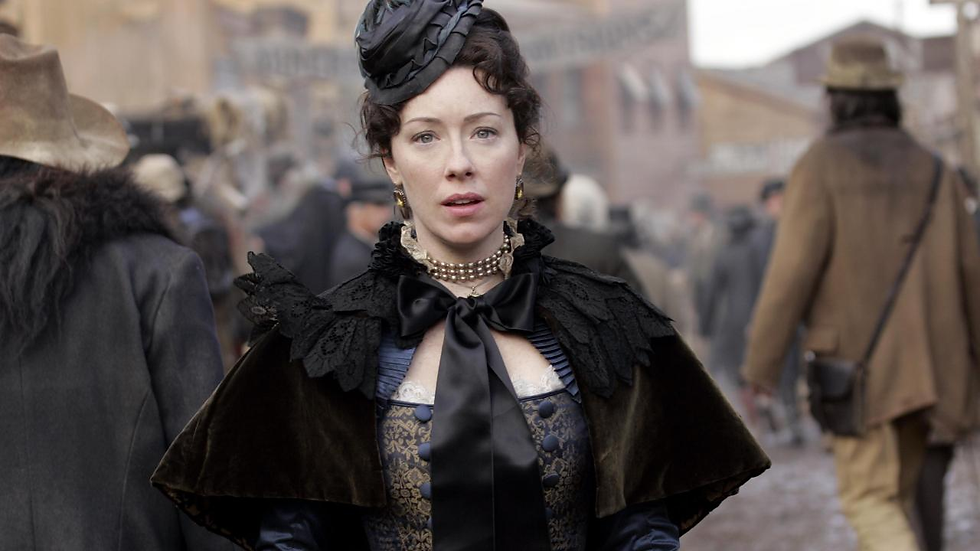
What It's About: George Hearst, enraged by an editorial in the town paper, has the new sheriff, Seth Bullock, beaten in the street. Alma, meanwhile, relapses into her laudanum addiction under the immense pressure from Hearst to sell her gold claim. Her husband, Whitney Ellsworth, discovers her relapse, leading to a raw and painful confrontation about love, addiction, and weakness.
Why It's a Masterpiece: This episode is a showcase for the show's incredible female characters and the actors who portray them. Molly Parker's portrayal of Alma's relapse is utterly convincing and heartbreaking. The confrontation between her and Ellsworth (Jim Beaver) is one of the series' most powerful domestic scenes, a raw and honest depiction of how addiction destroys trust. The episode also highlights the unwavering courage of Martha Bullock (Anna Gunn) and Trixie (Paula Malcomson), who stand up to Hearst in their own ways.
It’s a brutal episode that demonstrates the different forms of violence—physical, psychological, and emotional—that Hearst has unleashed upon the camp. It showcases the strength of the community's women, who refuse to be passive victims in a world dominated by violent men. It's a powerful narrative that fans of strong female leads, like those in What to Watch: House of the Dragon, would appreciate.
2. "Tell Your God to Ready for Blood" (Season 3, Episode 12)

What It's About: The season three finale (and, for 13 years, the series finale) brings the conflict with George Hearst to a head. After Hearst murders the prostitute Jen, Trixie, in a fit of rage, attempts to assassinate him. She wounds him but fails to kill him. To save Trixie from Hearst's certain retribution, Swearengen must make an impossible choice: he murders another prostitute who resembles Trixie and presents her body to Hearst as a sacrifice.
Why It's a Masterpiece: This episode is Deadwood at its most nihilistic, brutal, and heartbreaking. It’s a devastating conclusion that offers no easy answers. The central act—Swearengen murdering an innocent woman to save another—is a moral horror, yet it's framed as a grim necessity, a strategic sacrifice for the good of the camp. The final scene, where a defeated Swearengen scrubs the bloodstain from his floor while muttering "Wants me to tell him something pretty," is one of the most haunting endings in television history.
As a series finale, it was deeply unsatisfying for fans, leaving countless threads dangling. But as a thematic statement, it is brutally perfect. It argues that civilization is built on unspeakable acts and that even the most powerful and cunning individuals can be crushed by the impersonal forces of capital and power, a theme explored in depth by publications like The Atlantic.
1. "Here Was a Man" (Season 1, Episode 4)

What It's About: The legendary gunslinger Wild Bill Hickok, weary of his own fame and haunted by his past, spends his days drinking and gambling. He forms a tender, paternal bond with young Sofia and a respectful friendship with Seth Bullock. Then, in the middle of a poker game at the Nuttall & Mann's No. 10 Saloon, a pathetic young man named Jack McCall walks up behind him and shoots him in the back of the head, killing him instantly.
Why It's a Masterpiece: No other episode so perfectly encapsulates the ethos of Deadwood. In 2004, killing off your biggest name actor (the magnificent Keith Carradine) and the show's most famous historical character in the fourth episode was a revolutionary act. It was a shocking declaration that this was not a show about heroes and legends, but about the messy, random, and often pathetic reality of life and death. The death itself is unceremonious and sudden, stripping away all mythic grandeur. The episode’s power comes from its aftermath—the camp’s stunned reaction and, most profoundly, Calamity Jane’s raw, animalistic grief.
Her simple, repeated eulogy, "Here was a man," is the heart of the entire series. It’s a show about flawed, complex people, not symbols. Hickok's death is the catalyst for everything that follows: it solidifies Bullock's role as the camp's conscience, it deepens the mystery around Alma Garret, and it forces the camp to take its first tentative steps toward law. It is a perfect, self-contained tragedy that defines the series and stands as its most powerful and iconic hour.
Conclusion
For thirteen long years, the brutal, ambiguous ending of "Tell Your God to Ready for Blood" was the final word on Deadwood. The show's abrupt cancellation left a wound in the hearts of its devoted fans. Thankfully, Deadwood: The Movie (2019) provided a powerful and emotionally resonant coda, a grace note that brought closure to these beloved characters. But the series itself remains a singular achievement.
These ten episodes are not just highlights; they are the pillars that support one of the most ambitious and literate structures ever built for television. They demonstrate a commitment to character over plot, to language over exposition, and to thematic depth over easy resolution. Deadwood was never an easy show, but its rewards were immense. It held a mirror up to the bloody birth of America and, in the process, reflected something eternal about the human condition: our capacity for both shocking brutality and breathtaking grace, often within the same profane, poetic breath.
Frequently Asked Questions (FAQs)
1. Why was Deadwood canceled after Season 3? The cancellation was the result of a complicated breakdown in negotiations between HBO and Paramount Television, which co-produced the show. It was not due to low ratings but rather financial disagreements and the complex logistics of David Milch's production deal, as detailed by sources like Entertainment Weekly.
2. Is the language in Deadwood historically accurate? No. While profanity was common in the Old West, the specific style and frequency in Deadwood are an artistic choice by David Milch. He used modern profanity as a substitute for the period's blasphemous curses, believing it would have a similar shocking and expressive effect on a contemporary audience.
3. Are the characters based on real people? Yes, many of the main characters—including Seth Bullock, Al Swearengen, Wild Bill Hickok, Calamity Jane, Sol Star, and George Hearst—were real historical figures who lived in Deadwood. However, their personalities, relationships, and specific actions are heavily dramatized for the series.
4. What does "hooplehead" mean? "Hooplehead" is a piece of David Milch's invented slang, used in the show as a general-purpose insult meaning a fool, an idiot, or a simpleton. It has become one of the show's most iconic and beloved bits of profanity.
5. Do I need to watch the series to understand Deadwood: The Movie? Absolutely. The movie is a direct continuation and conclusion of the series. It relies heavily on the viewer's knowledge of the characters' histories and relationships. It is a deeply rewarding experience for fans but would be almost incomprehensible to a newcomer.
6. Is Al Swearengen a villain or an anti-hero? He is one of television's most complex characters, defying easy categorization. He is a ruthless murderer, pimp, and manipulator. He is also a brilliant strategist, a community builder, and capable of surprising acts of compassion. The show argues that in a place like Deadwood, the lines between hero and villain are almost meaningless.
7. What is the significance of the opening credits sequence? The sequence, showing a horse galloping through a creek, is symbolic of progress and untamed nature. As the horse moves, the water becomes muddier, and the music becomes more industrial, representing the encroachment of civilization and industry on the wild frontier.
8. Where was the show filmed? Deadwood was filmed at Melody Ranch in Santa Clarita, California, a famous movie ranch that has been used for numerous Westerns, including Gunsmoke. The incredibly detailed and authentic-looking sets were a hallmark of the show's production.
9. Is Timothy Olyphant's character in Justified similar to Seth Bullock? While both Raylan Givens and Seth Bullock are lawmen with a quick temper played by Timothy Olyphant, they are very different. Bullock is a man of deep, repressed rage and moral certainty, while Raylan is more laid-back, witty, and operates in a grayer moral area. The comparison is a favorite among fans of both shows.
10. What is the best way to appreciate the show's dense language? Many fans recommend watching with subtitles on, at least for the first viewing. This helps catch the nuances of Milch's rapid-fire, complex dialogue and ensures you don't miss any of the brilliant insults or philosophical musings.


.jpg)


.jpg)


Comments