





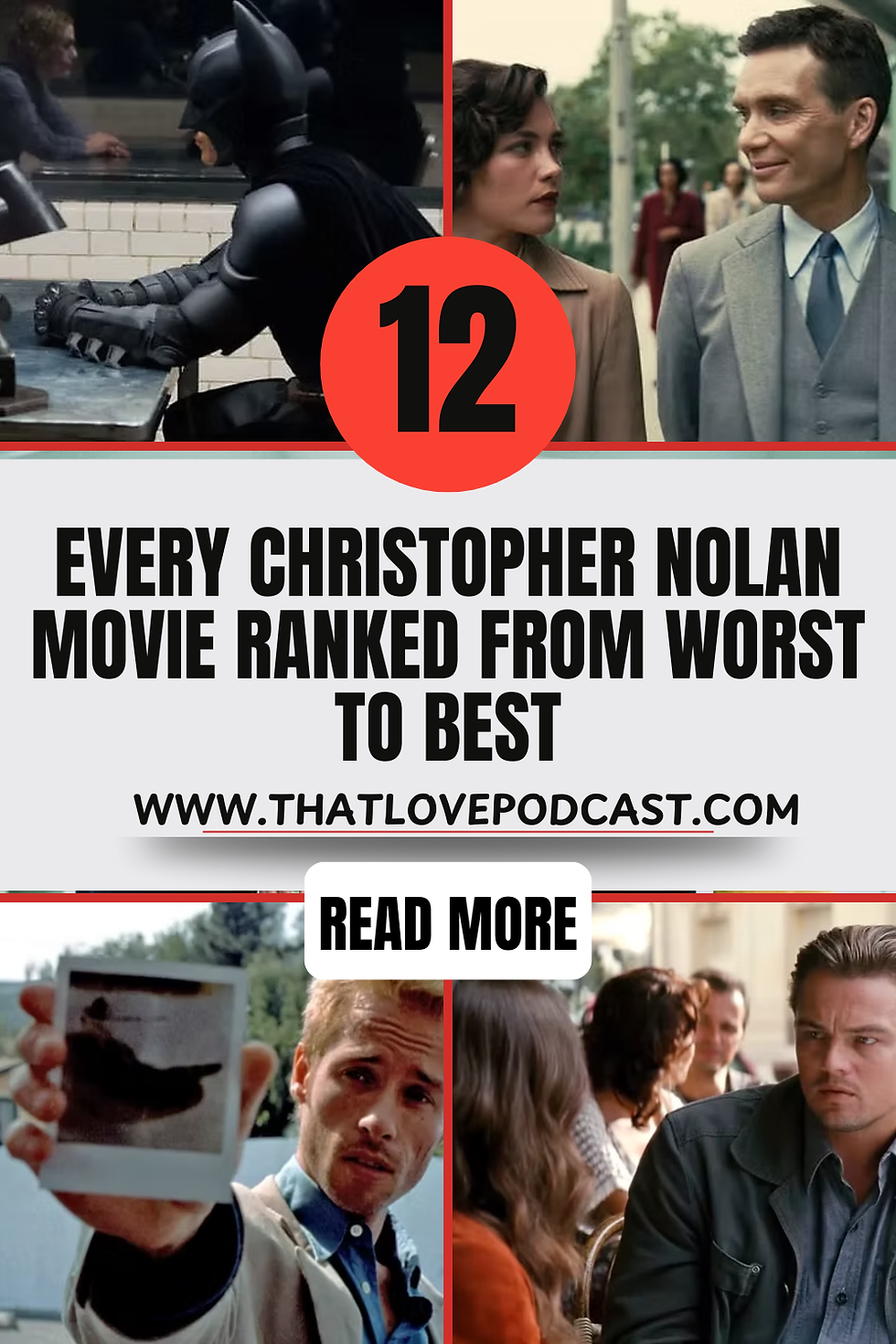
Every Christopher Nolan Movie Ranked from Worst to Best

You have watched every Christopher Nolan film at least once, but you have never actually settled the debate over which one truly deserves the top spot.
This complete ranking breaks down all twelve of Nolan's released films, from his most divisive misstep to his undisputed masterpiece, using critical reception, technical craft, and genuine cultural impact as the measuring stick.
Let's start 👇

💛 Love this kind of content? Help keep it going: Support That Love Podcast
If you love this, check out: The 20 Best Quotes from 'The Dark Knight', Ranked
📢 Are you a brand, author, publisher, or business looking to reach an audience that loves stories like this one? That Love Podcast partners with sponsors who want to connect with genuine, engaged readers and listeners. If you're interested in advertising with us, we would love to hear from you: Advertise With That Love Podcast
💡 You May Also Love
#12 — Tenet (2020)

Nolan's most divisive film arrives at the bottom of this ranking not because it lacks ambition, but because that ambition frequently outpaces its own emotional payoff. Following an unnamed Protagonist, played by John David Washington, as he navigates a mission to prevent a temporal war using technology that allows objects and people to move backward through time, Tenet is a genuinely dazzling technical achievement wrapped around a story that struggles to make audiences feel anything beyond intellectual admiration.
The film's central heist sequences, particularly the airport hallway fight between the Protagonist and his own inverted self, showcase meticulous choreography and a level of practical filmmaking few directors would even attempt, including a decommissioned 747 that Nolan genuinely crashed into a hangar rather than faking the sequence digitally. Yet for all its technical bravado, the film's dense, backward-and-forward plotting and largely opaque character motivations leave many viewers admiring the mechanics of the puzzle rather than feeling invested in its human stakes. Even Nolan's defenders tend to agree that Tenet represents the moment his ambition slightly outran his ability to land the emotional core that anchors his best work.
Where to watch: Stream on Peacock.

🎙️ Stream a great love story while you scroll through this ranking — That Love Podcast is live now: thatlovepodcast.com/episodes
#11 — The Dark Knight Rises (2012)

The concluding chapter of Nolan's Batman trilogy carries the unenviable burden of following The Dark Knight, one of the most acclaimed and commercially dominant films of its era, and it never quite escapes that shadow. Set eight years after Harvey Dent's fall, the film brings Bruce Wayne out of retirement to face Bane, a hulking, ideologically driven terrorist intent on completing the work Ra's al Ghul began in Batman Begins.
Tom Hardy's Bane remains one of the film's most memorable elements, delivering a genuinely intimidating physical and vocal performance despite working almost entirely behind a mask, and Anne Hathaway's Selina Kyle brought a welcome, morally ambiguous energy to a trilogy that had largely been defined by its male characters. However, the film's plotting feels noticeably more strained than its predecessors, cramming in dense political allegory, a rushed timeline, and a finale that many critics and fans found less satisfying than the trilogy deserved. There is a persistent sense, reinforced by Nolan's own comments over the years, that this was a film he felt obligated to make rather than one born from the same creative hunger that fueled Batman Begins and The Dark Knight.
Where to watch: Stream on Max.
#10 — Insomnia (2002)

Nolan's first studio assignment following the success of Memento, Insomnia is a remake of a acclaimed Norwegian thriller of the same name, following an LA detective, played by Al Pacino, sent to a remote Alaskan town to investigate a murder while sleep deprivation from the region's perpetual daylight slowly unravels his grip on reality. It is, by Nolan's own admission and by most critical consensus, the entry in his filmography that feels most like a director-for-hire project rather than a fully personal vision.
That said, Insomnia remains a genuinely accomplished psychological thriller in its own right. Robin Williams delivers a chilling, against-type performance as the murderer at the center of Pacino's investigation, and Wally Pfister's cinematography captures the disorienting, sunlit dread of the Alaskan setting with real skill. Pacino's slow psychological unraveling, driven by guilt, exhaustion, and moral compromise, previews themes of obsession and self-deception that Nolan would return to throughout his career, even if the film itself lacks the structural inventiveness that defines his most celebrated work.
Where to watch: Stream on Max.
You'll also love: The 10 Best DC Movies of the Last 10 Years, Ranked
#9 — Following (1998)

Nolan's microbudget directorial debut, shot on weekends over four months with a cast of largely unknown actors and financed almost entirely out of his own pocket, remains a remarkable curio nearly three decades later. The film follows a young, unemployed writer who begins following strangers around London for creative inspiration, eventually falling under the influence of a charismatic burglar whose schemes pull him into increasingly dangerous territory.
Told in a fractured, non-chronological structure that Nolan would refine considerably in Memento just two years later, Following already displays the director's fascination with unreliable narration, moral ambiguity, and puzzle-box plotting that would come to define his entire career. The performances are occasionally rough around the edges, and the black-and-white, shoestring-budget aesthetic clearly reflects its limited resources, but the film's clever structural conceit and eerie, understated menace make it an essential watch for anyone interested in tracing the earliest seeds of Nolan's directorial voice.
Where to watch: Available on Criterion Collection Blu-ray and select digital platforms.
📢 Loved reading this so far? If you're a brand, author, or business interested in reaching readers who love content just like this, we'd love to connect. Explore sponsorship and partnership opportunities with That Love Podcast: Advertise With That Love Podcast
💡 You May Also Love
#8 — Dunkirk (2017)
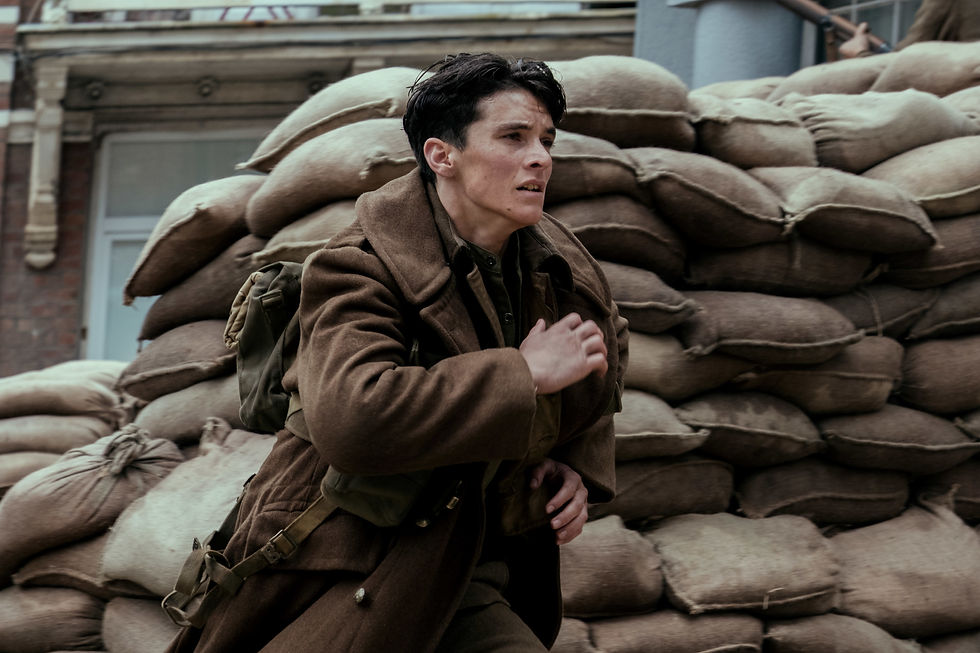
Nolan's World War II epic takes a considerable structural risk, telling the story of the evacuation of Allied soldiers from the beaches of Dunkirk through three intercutting timelines — land, sea, and air — each unfolding across a different duration and eventually converging in the film's climax. The result is a visceral, almost wordless immersion into the chaos and terror of war, prioritizing sensory experience over traditional character development or dialogue-driven exposition.
Some critics have argued the film's fragmented structure lacks the same thematic justification found in Nolan's other time-bending work, functioning more as a technical exercise in tension than a story with deep emotional throughlines for its ensemble cast. Others consider it one of the most genuinely immersive war films ever made, praising Hans Zimmer's relentless, ticking-clock score and the sheer scale of Nolan's practical filmmaking, including real Spitfire aircraft and a fleet of small boats recreating the historic civilian rescue effort. Whichever camp you fall into, Dunkirk remains a bold, technically extraordinary experiment that few other directors working at this scale would have attempted.
Where to watch: Stream on Peacock.
#7 — Interstellar (2014)

Christopher Nolan's most ambitious and most polarizing film follows a former NASA pilot, played by Matthew McConaughey, who leaves his family behind to pilot a mission through a wormhole in search of a habitable planet as Earth becomes increasingly uninhabitable. Equal parts hard science fiction and unabashed emotional epic, Interstellar swings for the fences in ways that some viewers find genuinely moving and others find frustratingly uneven.
At its best, the film is a jaw-dropping rebuttal to any accusation that Nolan's work is emotionally cold, delivering one of the most devastating single scenes of his career as Cooper watches decades of missed messages from his now-grown daughter arrive in a matter of minutes due to relativistic time dilation. McConaughey's raw, tearful performance in this sequence remains one of the most purely emotional moments Nolan has ever committed to film. However, the movie's frequent detours into dense scientific exposition, along with a third-act twist involving a tesseract inside a black hole, have led many critics to call it Nolan's most overrated work — a film whose reach for 2001: A Space Odyssey-level transcendence occasionally exceeds its grasp, even as its ambition remains genuinely admirable.
Where to watch: Stream on Paramount+.
🎙️ Halfway through the ranking — stream That Love Podcast while you keep reading: thatlovepodcast.com/episodes
💡 You May Also Love
#6 — Batman Begins (2005)

Nolan's first foray into the superhero genre reinvigorated a franchise that had been creatively dormant since the campier excesses of the 1990s Batman films, offering a grounded, psychologically complex origin story for Bruce Wayne that treated its comic book source material with genuine dramatic seriousness. Christian Bale's portrayal of a man haunted by his parents' murder and driven to channel his fear and rage into a symbol of hope, rather than simple vengeance, laid the foundation for one of the most acclaimed trilogies in modern cinema.
The film's exploration of fear as both Bruce Wayne's personal demon and the League of Shadows' preferred weapon gives Batman Begins a thematic depth that elevated the entire superhero genre's ambitions going forward. Michael Caine's warm, paternal Alfred and Liam Neeson's morally complex Ra's al Ghul provide the film with a strong supporting cast, while cinematographer Wally Pfister's stylistic choices established the grounded visual language that would define the entire trilogy. Batman Begins may lack the singular cultural impact of its immediate sequel, but its role in redefining what a superhero film could achieve cannot be overstated.
Where to watch: Stream on Max.
#5 — Oppenheimer (2023)

Nolan's Best Picture-winning biopic of physicist J. Robert Oppenheimer, adapted from the Pulitzer Prize-winning book "American Prometheus," catches the director at his most existentially terrified, chronicling the theoretical scientist whose deadly obsession with splitting the atom instills a myopic perspective in which the tangible horrors of his creation remain perpetually just out of view until it is far too late to look away.
Cillian Murphy's central performance, which finally earned him a long-overdue Academy Award, captures Oppenheimer's brilliance, arrogance, and eventual crushing guilt with a haunted intensity that anchors the film's three-hour runtime. Nolan's kinetic, almost anxiety-inducing directorial style transforms courtroom hearings and committee meetings into sequences as tense as any action set piece in his filmography, and the Trinity test detonation sequence remains one of the most terrifying and meticulously crafted moments of his entire career. Some critics note that Nolan's characters occasionally over-explain their emotions rather than letting silence do the work, a minor recurring weakness in his screenwriting. But as a complete distillation of his recurring obsessions with guilt, genius, and the catastrophic consequences of unchecked ambition, Oppenheimer stands as one of the most complete artistic statements of his career.
Where to watch: Stream on Peacock.
💡 You May Also Love
#4 — The Prestige (2006)

Released as something of a palette cleanser following the massive success of Batman Begins, The Prestige pits Christian Bale and Hugh Jackman against each other as rival Victorian-era magicians whose escalating feud, born from a tragic accident, gradually destroys them both. The film gives Nolan a rich canvas to draw explicit parallels between the art of stage magic and the art of filmmaking itself, both built on carefully engineered deception and the audience's willing suspension of disbelief.
What makes The Prestige so rewarding on repeat viewings is how thoroughly Nolan hides his own directorial sleight of hand within the story's structure, mirroring the "pledge, turn, and prestige" of a magic trick in the film's own fractured, dual-narrator storytelling. Both Bale and Jackman deliver genuinely committed performances as men whose professional rivalry curdles into consuming obsession, and the film's devastating final twist recontextualizes everything the audience thought they understood about both characters' methods and motivations, cementing it as one of Nolan's most purely satisfying screenplays.
Where to watch: Stream on Max.
💡 You May Also Love
#3 — Memento (2000)

Nolan's breakthrough sophomore feature remains one of the most audacious structural experiments in modern American cinema, following Leonard Shelby, played by Guy Pearce, a man with anterograde amnesia hunting his wife's killer using an elaborate system of Polaroid photographs, handwritten notes, and body tattoos to compensate for his inability to form new memories. Told partially in reverse chronological order, the film forces audiences to experience Leonard's own confusion and unreliable grip on reality firsthand.
The genius of Memento lies in how completely its structure serves its themes rather than existing as a mere gimmick. Every scene reveal recontextualizes what came before it, mirroring Leonard's own fragmented understanding of his situation, and the film's ambiguous, deeply unsettling final revelations about Leonard's own complicity in his ongoing quest for vengeance remain some of the most quietly devastating in Nolan's entire career. It is remarkable how much genuine dread and moral complexity Nolan mines from the absence of traditional narrative flow, and Memento remains the clearest, most influential demonstration of the structural inventiveness that would define his subsequent work.
Where to watch: Stream on Tubi.
🎙️ Before we reveal the top spot — stream That Love Podcast for a story just as heartfelt: thatlovepodcast.com/episodes
#2 — Inception (2010)

Inception may be the film that feels most quintessentially "Nolan" of his entire filmography, synthesizing every idea he had experimented with in his earlier work — fractured chronology, morally ambiguous protagonists, emotional stakes tied to grief and memory — into one clean, spectacular, and commercially dominant execution. Following Dom Cobb, a thief who infiltrates people's dreams to steal secrets, as he attempts one final, impossible job — planting an idea rather than stealing one — the film builds an entire internally consistent architecture of nested dream levels that somehow never loses the audience despite its considerable complexity.
The film's iconic Paris-folding sequence, in which Cobb demonstrates the rules of shared dreaming by bending an entire city back on itself, remains one of the most breathtaking single images of Nolan's career, announcing the film's ambitions without a hint of apology. Leonardo DiCaprio's performance as a man whose guilt over his wife's death threatens to unravel the entire mission gives the film's dazzling visual spectacle genuine emotional stakes, proving conclusively that an original science fiction concept could dominate globally at blockbuster scale without ever needing to simplify itself for mainstream audiences.
Where to watch: Stream on Netflix.
#1 — The Dark Knight (2008)

There is little debate left to be had: The Dark Knight is Christopher Nolan's masterpiece and, for many critics and fans, one of the greatest films ever made in any genre. Far more than a comic book sequel, the film operates as a sprawling crime epic and a profound philosophical meditation on chaos, order, and the thin, fragile line separating heroism from villainy, anchored by Heath Ledger's posthumously Oscar-winning performance as the Joker.
Ledger's Joker remains one of the most towering achievements in modern screen acting, a genuinely unpredictable and terrifying agent of chaos whose nihilistic worldview challenges every one of Batman's carefully constructed rules. Aaron Eckhart's tragic transformation from idealistic District Attorney Harvey Dent into the coin-flipping Two-Face gives the film its emotional gut-punch, while Christian Bale's Batman and Gary Oldman's Commissioner Gordon anchor the story's moral core amid the escalating devastation. Nearly two decades later, The Dark Knight remains the tentpole every subsequent blockbuster still measures itself against, a film whose thematic richness, technical mastery, and cultural impact have never been matched, even by Nolan's own considerable later achievements.
Where to watch: Stream on Max.
Bonus: The Odyssey (2026)
Christopher Nolan taking on Homer’s The Odyssey sounded almost ridiculously ambitious on paper, but the finished film somehow justifies the scale of the idea. Matt Damon stars as Odysseus, the king of Ithaca attempting to return home after the Trojan War, only for his voyage across the Mediterranean to become an epic battle against hostile seas, mythical creatures, gods and his own increasingly desperate need to reach his family. Tom Holland plays his son Telemachus, Anne Hathaway is Penelope, Robert Pattinson plays Antinous and Lupita Nyong’o appears as Helen, while Zendaya and Charlize Theron are also part of Nolan’s enormous ensemble. Rotten Tomatoes
The premise is ancient, but Nolan treats it like a modern blockbuster without stripping away the mythology that made Homer’s story endure for thousands of years. Odysseus encounters figures and dangers including the Cyclops Polyphemus, the Sirens and Circe as his journey home becomes increasingly punishing, but the movie works because the spectacle is ultimately attached to a very simple emotional idea: a man desperately trying to return to his wife and son. At 2 hours and 52 minutes, this is huge, muscular filmmaking, yet the intimate stakes prevent the battles, monsters and vast landscapes from becoming empty visual effects. Metacritic
And visually, this thing is absolutely enormous. The Odyssey became the first feature film shot entirely using IMAX film cameras, with Nolan filming across multiple international locations and using the format for both gigantic action sequences and quieter character moments. That technical achievement matters because the movie was clearly designed as a theatrical experience rather than something intended to become background viewing on your television while you check your phone. NBCUNIVERSAL MEDIA
The critical response has justified the hype. The Odyssey currently holds a 94% Tomatometer score from 499 reviews and a remarkable 97% verified audience score on Rotten Tomatoes, whose critical consensus praises the movie's combination of enormous scale and human emotion. Metacritic is similarly enthusiastic, giving it an 88 Metascore from 63 critics, placing it firmly in the site's "Universal Acclaim" category. Rotten Tomatoes
But its popularity may be even more impressive than the reviews. As of August 21, The Odyssey had reached approximately $1.35 billion worldwide, overtaking Deadpool & Wolverine to become the highest-grossing R-rated movie in global box-office history. It has earned more than $516 million in North America alone and has also become Christopher Nolan's highest-grossing film ever, an extraordinary achievement for a nearly three-hour adaptation of an ancient Greek epic. The Guardian
The cultural impact has extended beyond cinemas too. The film reportedly caused a surge in demand for Homer's poem at the San Francisco Public Library, while demand for IMAX 70mm screenings remained strong enough for the premium-format run to be extended. That is perhaps the clearest sign of what Nolan has achieved here: he has turned one of the oldest stories in Western literature into one of 2026's biggest pop-culture events. San Francisco Chronicle
There will inevitably be arguments over where The Odyssey belongs among Nolan's best movies, but it has already earned a place in the conversation alongside The Dark Knight, Inception and Oppenheimer. It combines the cerebral ambition people expect from Nolan with something much more primal—monsters, war, survival, temptation, family and one exhausted man's determination to get home. For anyone who misses the feeling of walking into a cinema because a movie genuinely demands the biggest screen available, The Odyssey is one of the defining theatrical experiences of 2026.
Where to watch: The Odyssey opened in theaters and IMAX on July 17, 2026 and is still playing theatrically.
Conclusion
From the microbudget ingenuity of Following to the towering cultural dominance of The Dark Knight, Christopher Nolan's filmography represents one of the most consistently ambitious bodies of work in modern cinema. Even his most divisive entries, like Tenet or The Dark Knight Rises, reflect a director unwilling to repeat himself or play it safe, and with The Odyssey poised to become another genuine cinematic event, Nolan's legacy as one of the defining filmmakers of his generation only continues to grow.

💛 Enjoyed this? Support the content that celebrates the films you love: Donate to That Love Podcast
🎙️ Stream That Love Podcast — stories with just as much heart: thatlovepodcast.com/episodes
💡 You May Also Love
If you're enjoying this blog, check out these other ones:
❓ Frequently Asked Questions
1. What is Christopher Nolan's best movie? The Dark Knight is widely considered Nolan's best film, praised as one of the greatest films ever made in any genre, anchored by Heath Ledger's posthumously Oscar-winning performance as the Joker.
2. What is Christopher Nolan's worst movie? Tenet is generally considered Nolan's most divisive and weakest film, criticized for prioritizing dense, backward-and-forward plotting over emotional stakes, though even critics agree it remains a technically impressive achievement.
3. How many movies has Christopher Nolan directed? As of mid-2026, Nolan has directed twelve released feature films, with a thirteenth, The Odyssey, releasing on July 17, 2026.
4. Is The Odyssey Christopher Nolan's most anticipated film? Yes. With a massive ensemble cast including Matt Damon, Tom Holland, and Zendaya, and being the first film in history shot entirely on IMAX 70mm cameras, The Odyssey has generated the highest advance anticipation of any Nolan release to date.
5. Did Christopher Nolan win an Oscar for Oppenheimer? Yes. Oppenheimer won Best Picture at the Academy Awards, and Nolan won his first Best Director Oscar for the film, with Cillian Murphy also winning Best Actor.
6. What is Christopher Nolan's most underrated movie? The Prestige is frequently cited by fans and critics as Nolan's most underrated film, praised for its elegant structure and devastating final twist, despite being somewhat overshadowed by Batman Begins and The Dark Knight around its release.
7. Why is Interstellar considered divisive among Nolan fans? While beloved for its ambition and emotional scope, particularly Matthew McConaughey's performance, some viewers find Interstellar's heavy scientific exposition and complex third act less accessible compared to Nolan's tighter, more grounded films.
8. What was Christopher Nolan's first movie? Following, released in 1998, was Nolan's directorial debut, a microbudget black-and-white thriller shot on weekends and self-financed by the director.
9. Does Christopher Nolan always write his own films? Nolan has written or co-written nearly all of his films, often collaborating with his brother Jonathan Nolan. Insomnia is a notable exception, as it is a remake of a Norwegian film and was not developed from an original Nolan screenplay.
10. What themes recur throughout Christopher Nolan's filmography? Nolan's films consistently explore themes of memory, non-linear time, grief, and characters haunted by the loss of a loved one, alongside his signature use of large ensemble casts, practical effects, and structurally ambitious storytelling.
Meta Description
Every Christopher Nolan movie ranked from worst to best, including a look ahead at his highly anticipated new film, The Odyssey. This complete guide breaks down all thirteen films in his filmography with in-depth critical analysis and streaming information.
Suggested URL Slug: /post/every-christopher-nolan-movie-ranked-worst-to-best


.jpg)





.jpg)


Comments